Executive Summary
Fractional CFO specialization looks, at first glance, like a strange move in an industry built on versatility. Founders hire fractional chief financial officers precisely because they can move between industries, adapt to different stages of growth, and solve problems that a full-time hire has never had to face. Yet the CFOs who build the most durable practices are rarely the ones who say yes to everything. They are the ones who have narrowed their focus enough that a founder can describe them in a single sentence, and in doing so they have turned a generalist skill set into a recognizable brand.
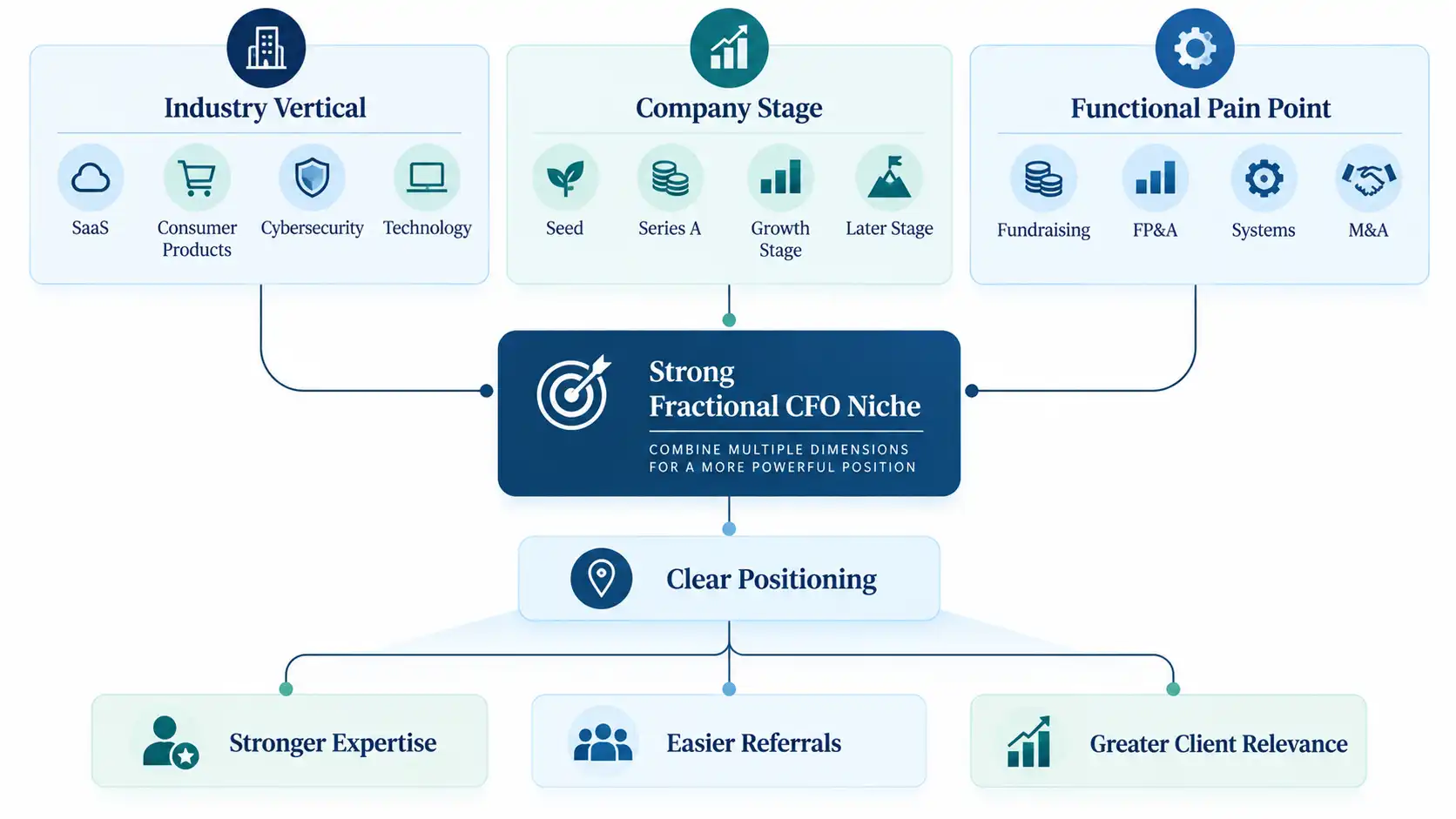
This article examines why specialization accelerates trust, credibility, and pricing power for fractional CFOs, and it lays out three practical ways to define a niche: by industry vertical, by company stage, and by functional pain point. It closes with guidance on avoiding over-narrowing, marketing a niche without losing broader opportunities, and understanding why focus compounds into intellectual property over time.
Why Specialization Matters for Fractional Chief Financial Officers
Buyers of financial leadership trust demonstrated pattern recognition more than they trust a polished pitch. When a founder learns that a fractional CFO has already built the forecasting engine, capacity model, and reporting cadence for a handful of businesses in their own sector, the sales conversation changes shape entirely. There is no need to explain unit economics from scratch, because the assumption of fluency is already in place. That assumption shortens the sales cycle and removes a layer of due diligence that a generalist candidate would otherwise have to earn through conversation alone.
Consider a high-growth cybersecurity and identity access management company operating across the United States, Canada, Mexico, India, and Nepal, scaling toward $30M in annual recurring revenue. A finance leader who has already built a driver-based forecasting engine for a company of that shape, one that held actuals within five percent of forecast for eight consecutive quarters, does not need to prove competence with churn analysis or delivery cost management. The track record does the proving. This is the mechanism behind specialization: it converts lived experience into a credibility shortcut that a founder can recognize instantly.
Specialization also drives referral behavior in ways that generalist positioning cannot. Investors, attorneys, and startup advisors tend to refer professionals who solve a specific problem within a specific domain, in the same way legal counsel becomes known for a particular type of financing round. A fractional CFO known for guiding climate tech founders through cap table modeling and grant compliance becomes the natural referral whenever that exact problem surfaces, and the referral arrives already qualified.
Three Ways to Define a Fractional CFO Niche
Niche construction for fractional CFOs tends to fall into three overlapping categories, and most successful practitioners combine at least two of them rather than relying on a single axis.
By Industry Vertical
Each industry carries its own financial vocabulary and its own regulatory pressure points. SaaS businesses live and die by MRR, churn, and customer acquisition cost, while consumer products companies live by inventory turns and channel margin. A CFO who has owned the full profit and loss statement for a $127M global consumer products company selling through DTC, Amazon, and wholesale channels, and who more than doubled inventory turns from three times to seven through demand planning and SKU rationalization, brings a fluency in working capital dynamics that a SaaS-only specialist would need years to develop independently.
By Company Stage
Seed-stage engagements and Series B engagements demand almost entirely different skill sets, even within the same industry. Early-stage work tends to be foundational: building a chart of accounts from a blank page, standing up GAAP-compliant controls where none existed, and giving a founder financial visibility for the first time. Later-stage work becomes strategic: board reporting, multi-year long-range planning, and audit committee engagement. A CFO who has raised $37M in equity and venture debt for a mission-driven institution while simultaneously running finance, HR, IT, legal, and facilities understands that stage-based specialization is as much about organizational maturity as it is about revenue size.
By Functional Pain Point
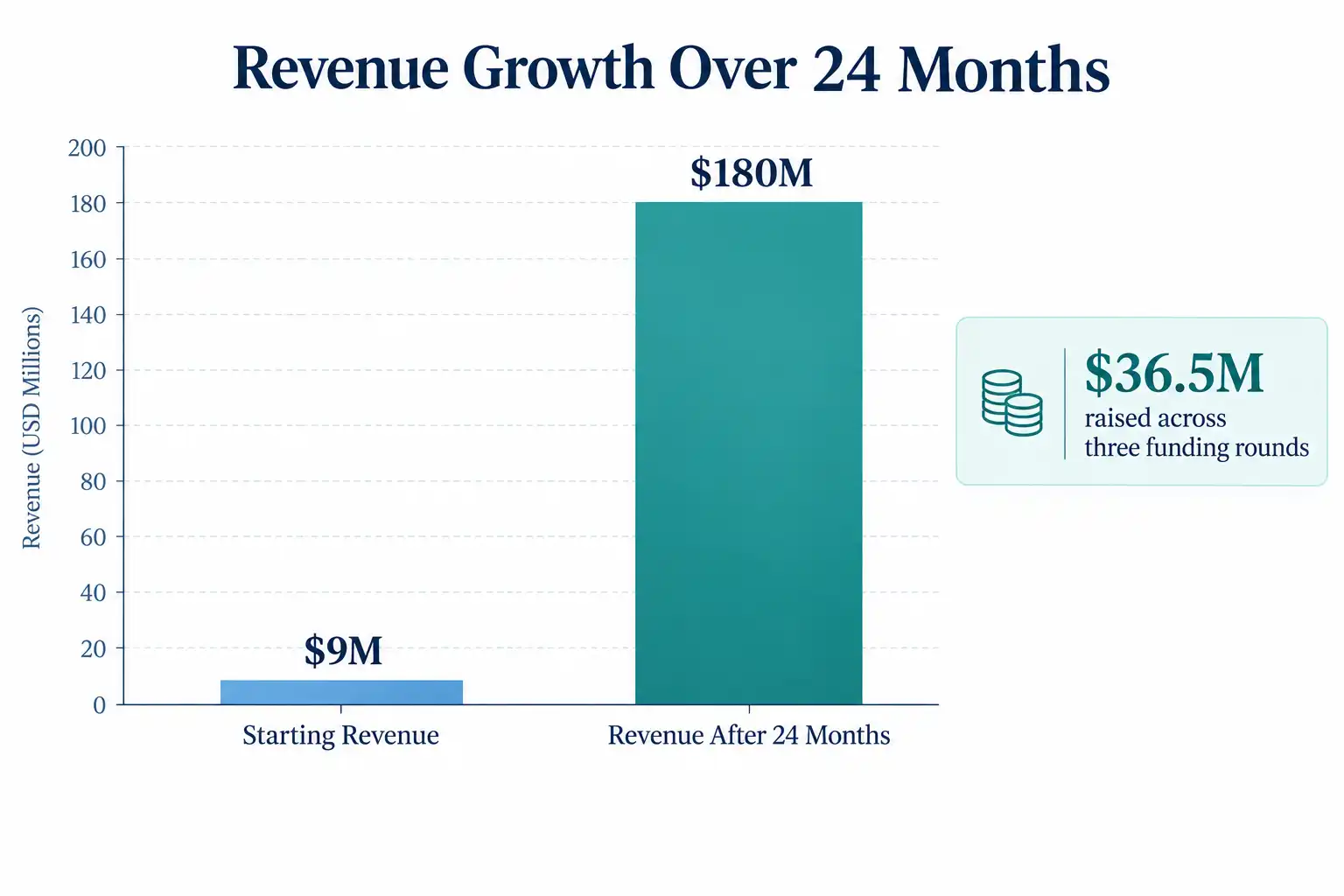
Some fractional CFOs become known less for an industry and more for a function: fundraising, systems implementation, financial planning and analysis, or mergers and acquisitions. A CFO who executed over $100M in cross-border M&A for a Euronext Paris-listed gaming and digital entertainment company, including due diligence and post-merger integration across five countries, has built a functional specialization in deal execution that travels across industries. The same is true of a CFO who scaled a venture-backed digital marketing organization from $9M to $180M in revenue over twenty-four months while raising $36.5M across three rounds. That kind of fundraising and scaling fluency becomes the niche itself, independent of sector.
Choosing the Right Fractional CFO Niche
A durable niche sits at the intersection of three factors, and the strongest positioning statements tend to satisfy all three simultaneously:
- Passion: the type of work that sustains energy across long engagements rather than depleting it.
- Results: the engagements where measurable outcomes, not just activity, were delivered.
- Demand: the segments of the market where founders are actively searching and underserved by existing options.
Reflecting honestly on past roles tends to surface the answer faster than market research alone. The industries and stages that produced the clearest wins are usually the ones worth building a practice around.
Real-World Positioning Examples
Clear positioning statements do the work of a sales pitch before a conversation even begins. A few examples illustrate the pattern:
- “Works with post-seed SaaS startups to implement finance infrastructure and prepare for a Series A raise.”
- “Helps growth-stage consumer products brands manage unit economics and channel strategy across DTC, Amazon, and wholesale.”
- “Advises founders on cap table modeling and multi-country reporting frameworks during venture financing rounds.”
Each of these signals a specific value proposition, which allows founders to self-select before the first call, saving both sides time that would otherwise be spent qualifying fit.
Avoiding the Trap of Being Too Narrow
Specialization does not require rigidity, and most top-performing fractional CFOs operate across two or three adjacent niches rather than a single one. Adjacency provides a hedge against sector-specific slowdowns while preserving the depth that makes the practice credible in the first place. Common adjacent pairings include:
- SaaS and marketplace platforms
- Consumer products and direct-to-consumer brands
- Cybersecurity and broader technology services
The goal of a niche is not exclusion. It is clarity, distributed across a portfolio wide enough to withstand a downturn in any single vertical.
Marketing a Fractional CFO Niche
Positioning only converts into pipeline when it is visible in the places founders actually look. A practical checklist for marketing a niche includes:
- Updating LinkedIn headlines and About sections to state the niche explicitly, rather than defaulting to generic titles.
- Publishing content using industry-specific vocabulary rather than generalized financial commentary.
- Speaking on panels or podcasts within the chosen vertical to reinforce recognition among referral sources.
- Publishing case studies that highlight niche-specific outcomes, using industry and stage descriptors rather than generic accomplishments.
The Compounding Effect of Focus
Niche depth compounds in ways that are easy to underestimate at the outset. Working with five companies in a similar space produces pattern recognition that a generalist practice simply cannot replicate: templates get reused, diagnostic questions sharpen, and the time between a founder’s question and a confident answer shrinks with each engagement. A CFO who spent years managing operations controllership and standard costing across a $170M global medical device manufacturer with plants in Copenhagen, Cork, and Taiwan develops an instinct for regulated cost accounting that no amount of general finance experience can substitute for. That instinct becomes the intellectual property of the practice, and it is precisely what commands premium pricing over time.
Three Key Takeaways
- Specialization functions as a trust shortcut rather than a limitation, allowing fractional CFOs to skip the credibility-building phase of a sales conversation because their track record within a specific industry, stage, or function has already done that work.
- The strongest niches sit at the intersection of demonstrated passion, measurable past results, and genuine market demand, and most durable practices combine two or three adjacent niches rather than a single narrow lane, which protects against sector-specific downturns.
- Niche depth compounds over successive engagements, producing reusable frameworks, sharper diagnostic instincts, and faster time to value, all of which justify premium pricing and generate the kind of referral flow that generalist positioning rarely achieves.
Disclaimer: This article is intended for informational purposes only and does not constitute legal, tax, or accounting advice. You should consult your own tax advisor or counsel for advice tailored to your specific situation.
Hindol Datta is a four-time CFO and senior finance executive with over 25 years of leadership experience across cybersecurity, SaaS, gaming, logistics, digital marketing, medical devices, consumer products, and nonprofit organizations. He has led more than $120M in fundraising and over $150M in M&A transactions while building the financial and operational systems that let complex businesses scale with confidence. He is the author of seven books in the Systems CFO Series and holds active CPA, CMA, and CIA credentials.
AI-assisted insights, supplemented by 25 years of finance leadership experience.