Executive Summary
Startup finance leadership is being rewritten. Capital efficiency mandates, remote-first work, and tightening markets since 2022 have turned the fractional CFO from an interim backfill into a genuine strategic advantage. A fractional CFO engages with a company part time or on contract, owning financial modeling, capital strategy, board reporting, and scenario planning rather than routine bookkeeping. The model fits startups because their needs are episodic, intense during a raise and lighter during execution, making a full-time hire an expensive mismatch. Investors increasingly view fractional CFOs as smart allocation rather than a resource gap, and experienced finance leaders are building portfolio careers around multiple clients. The shift favors versatility over hierarchy and rewards clarity over tenure, reshaping both how startups access finance leadership and how CFOs build their own careers.
Defining the Fractional CFO Role
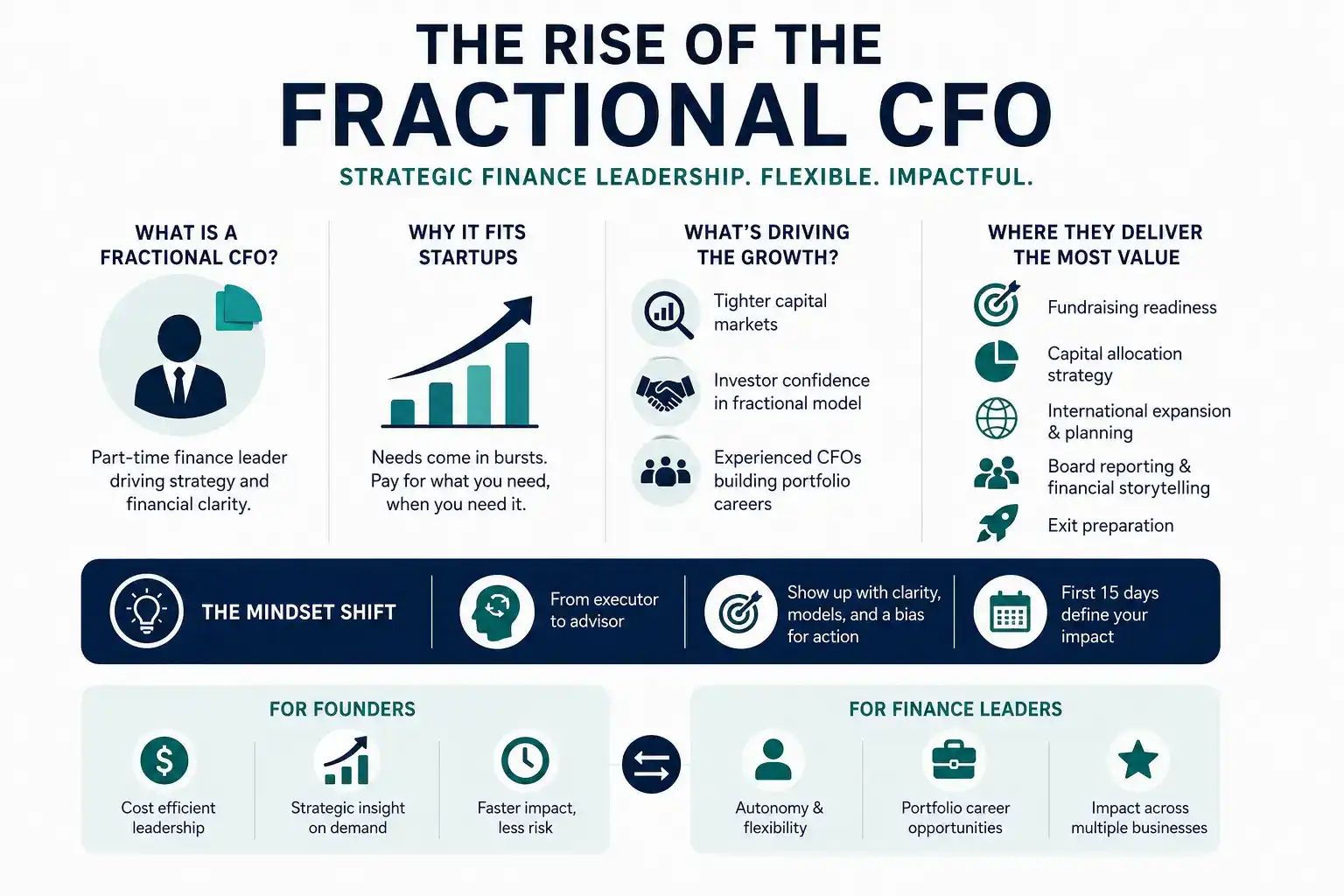
A fractional CFO sits closer to the CEO than a bookkeeper or accountant ever would, owning financial modeling, capital strategy, board reporting, and business scenario planning on a part-time or contract basis. What defines a strong fractional CFO is not hours logged but leverage delivered. Engaging only eight to twenty hours a month with a client, a fractional CFO is still expected to produce real strategic output, including:
- Forward-looking cash flow visibility
- Board-ready financials and key performance indicators
- Capital raise support and investor alignment
- Scenario modeling tied to product and go-to-market strategy
- Systems recommendations and implementation support
Why the Model Fits Startups
Early-stage companies experience need in bursts rather than a steady stream. Founders may need intensive support preparing for a Series A raise, then relatively little as they shift into execution. Hiring a full-time CFO at a substantial salary plus equity for that kind of variability rarely makes sense. Fractional CFOs solve this mismatch through tiered service that scales with the company. Seed and Series A companies often pay a few thousand dollars a month for high-leverage output like cash runway modeling and cap table strategy, then increase hours and depth only as the business genuinely requires it.
What Is Driving Fractional CFO Services Now
Tightening capital markets since 2022 have forced companies to do more with less, putting burn multiples under scrutiny and pushing boards to demand clearer return on executive hiring. In that climate, fractional roles have gained real credibility. Investors increasingly see fractional CFOs as smart allocation rather than a sign of resource scarcity, and even late-stage companies with complex international structures now bring in fractional specialists for carve-outs, due diligence, and system implementations.
A parallel shift is happening in the workforce itself. Experienced CFOs are leaving corporate roles to build portfolio careers, often blending fractional work with board seats, advisory roles, or coaching. Many operate with three to five clients at once, drawing on cross-company insight while protecting confidentiality, supported by technology platforms built for forecasting and reporting at scale.
Where Fractional CFOs Deliver the Most Value
A few use cases show up repeatedly across engagements:
- Fundraising readiness, including data rooms, forecasts, and investor decks
- Capital allocation strategy for headcount, go-to-market, and research tradeoffs
- Exit preparation, including financial modeling ahead of a sale or partnership
- International expansion, covering entity setup and multi-currency planning
- Board management, crafting financial narratives that support strategic alignment
The Mindset Shift for CFOs Considering the Leap
Moving from a full-time executive role into fractional work requires a genuine reframe. The work is no longer only execution. It becomes selling, packaging, and positioning as much as modeling. Conversations with founders, investors, and fellow finance leaders point to a consistent theme, everyone is searching for signal over noise. The strongest fractional CFOs show up with a clear scope, a clean model, and a bias toward action rather than waiting to be managed. The first fifteen days with a new client tend to be decisive, since that is when a fractional CFO proves whether they are functioning as an advisor or simply a contractor.
Conclusion
The fractional CFO model is not a temporary reaction to a tight funding environment. It reflects a lasting shift in how startups access finance leadership and how experienced CFOs choose to build careers. For founders, it offers flexibility, cost efficiency, and speed to impact without the fixed cost of a full-time hire. For finance leaders, it offers autonomy, variety, and a path that rewards clarity and repeatable playbooks over tenure inside a single company. As capital efficiency continues to matter and talent flexibility becomes normal, this model looks set to keep growing rather than fade once markets loosen again.
Disclaimer: This blog is for informational purposes only and does not constitute legal, financial, or professional consulting advice. Always consult with qualified advisors before making decisions regarding executive hiring or career transitions.
Hindol Datta is a seasoned finance executive with over 25 years of leadership experience across SaaS, cybersecurity, logistics, and digital marketing industries. He has served as CFO and VP of Finance in both public and private companies, leading $120M+ in fundraising and $150M+ in M&A transactions while driving predictive analytics and ERP transformations. Known for blending strategic foresight with operational discipline, he builds high-performing global finance organizations that enable scalable growth and data-driven decision-making.
AI-assisted insights, supplemented by 25 years of finance leadership experience.