Executive Summary
Pricing is rarely just arithmetic for a fractional CFO. It is positioning, psychology, and long-term strategy rolled into a single number on a proposal. A fractional chief financial officer who prices too low invites scope creep and signals inexperience, while one who prices too high without proof points risks losing the deal before the conversation even starts. As fractional work continues to normalize across the finance profession, the fractional CFOs who treat pricing as a deliberate strategic lever, rather than an afterthought, tend to build the most durable practices.
This article examines the three dominant pricing models used by fractional CFOs today, retainer, hourly, and outcome-based, and explains how experienced practitioners blend and evolve these models as their practice matures. It also covers price tier construction, scope protection, and the signaling effect that pricing has on market perception.
Why Pricing Is a Strategic Decision for Fractional CFOs
A fractional CFO does not simply sell hours. The role sells judgment, pattern recognition built across many companies, and the ability to walk into ambiguity and produce clarity. Because the value delivered is intangible until it shows up in a board deck or a closed funding round, pricing becomes the mechanism through which a client first understands what they are actually buying.
Consider a cybersecurity and identity access management company scaling toward $30M in annual recurring revenue across five countries. The forecasting discipline, the audit readiness, and the board-grade reporting that a fractional finance leader build there are not measured in hours spent, they are measured in whether actuals land within a tight band of forecast, quarter after quarter. Pricing that rewards this kind of outcome, rather than time logged, aligns the fractional CFO with what the client actually needs.
The Retainer Model Offers Stability and Scope Control
The retainer model remains the most common structure among fractional CFOs. A client pays a fixed monthly fee in exchange for defined services and a guaranteed level of availability.
- Predictable revenue for the fractional chief financial officer and predictable cost for the client
- Easier capacity planning across multiple engagements
- Stronger, more collaborative client relationships over time
- Requires disciplined upfront scoping, without it the arrangement drifts
- Difficult to scale without systems and clear weekly limits
The retainer model tends to work best when the scope is ongoing and strategic, covering board preparation, fundraising support, or cash planning, and when a practice has multiple clients that require predictable bandwidth. A mission-driven education institution running on variable philanthropic and earned revenue is a good example of where a steady retainer, paired with tight quarterly scope reviews, keeps both sides aligned rather than drifting into an always-on expectation.
The Hourly Model Provides Flexibility with Tradeoffs
Hourly billing still has a place, particularly for short, discrete engagements or early-stage relationship testing.
- Simple for clients to understand
- Flexible for one-time or ad hoc projects
- Rewards time spent over outcomes delivered
- Makes it harder to command premium pricing
- Invites invoice scrutiny that damages trust
Hourly pricing suits fractional cfos who are starting out and still testing client fit, or projects with a clear beginning and end. Many experienced practitioners eventually shift even small engagements toward fixed project fees tied to a defined deliverable and timeline, since this reduces friction and improves conversion compared with an open-ended hourly quote.
Outcome-Based Pricing Aligns Incentives but Raises Risk
Outcome-based pricing ties compensation directly to results, such as a successful capital raise or exit readiness.
- Aligns the fractional CFO’s incentives with the client’s goals
- Offers high upside when structured with care
- Requires deep, established trust between both parties
- Harder to scope cleanly than time-based or fee-based work
- Carries legal exposure if the success definition is vague
This model works best when the relationship is mature and the fractional CFO has strong conviction in their ability to influence the outcome. A cautionary pattern worth noting involves back-end success fees tied to a capital raise that stalls when market conditions shift. Months of committed support can go uncompensated if the raise never closes, which is why outcome-based agreements need clear milestones, partial payouts along the way, and a precise definition of what counts as success before either side signs.
Blended Pricing Models Balance Predictability and Upside
Many established fractional CFOs combine elements of all three models rather than choosing one in isolation.
- A flat onboarding fee for the first thirty days, tied to a milestone such as a cash model or reporting cleanup
- A monthly retainer scoped to a fixed number of weekly hours thereafter
- A success fee attached to a defined event, such as a funding close or a major system launch
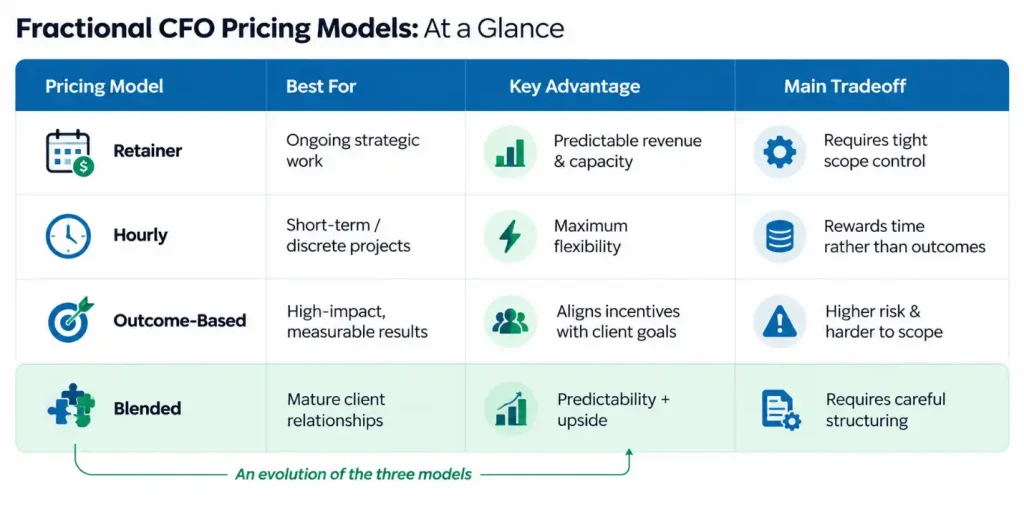
This structure lets a client test fit at low commitment, observe the value delivered, and scale the relationship as trust builds. It also lets the fractional chief financial officer’s revenue track impact rather than effort alone, which is a more durable foundation for a growing practice.
How Fractional CFOs Should Set Their Price Tiers
Pricing benchmarks should draw from three sources, prior salary converted to an hourly equivalent, current market rates gathered from peers, and the actual value delivered, particularly in fundraising or M&A contexts where the dollar impact is large and demonstrable.
A simple tiering framework, adapted for the fractional CFO market, looks like this.
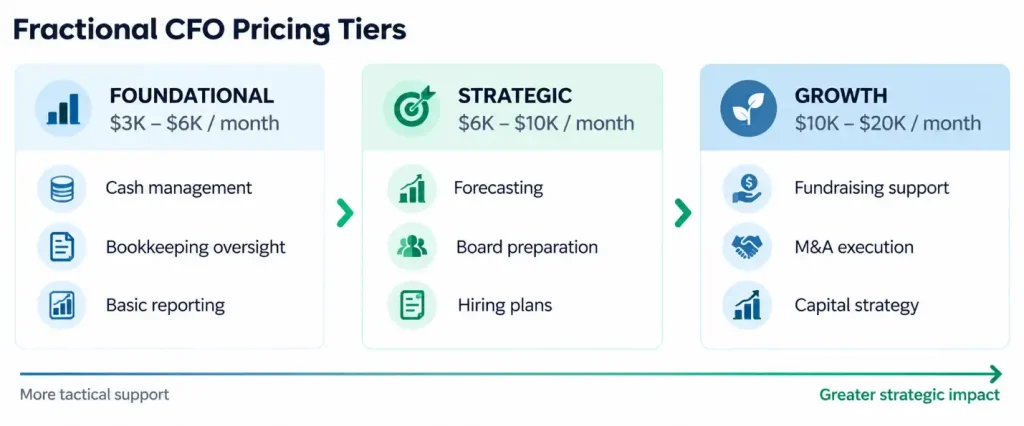
Foundational tier
- $3,000 to $6,000 per month
- Covers cash management, bookkeeping oversight, and basic reporting
Strategic tier
- $6,000 to $10,000 per month
- Covers forecasting, board preparation, and hiring plans
Growth tier
- $10,000 to $20,000 per month
- Covers fundraising support, M&A execution, and capital strategy
The path between tiers often mirrors the arc from a lean, pre-revenue build to a company running a capital raise or an acquisition process, each stage demanding a different depth of financial infrastructure and a correspondingly different price point.
Protecting Against Scope Creep
Pricing is only as strong as the scope that backs it. Clear statements of work, defined weekly hour limits, and explicit change order language keep an engagement from quietly expanding beyond what was priced. Tracking time, even on fixed retainers, remains valuable, since a fractional CFO spending far more hours than the fee implies is underpriced, while one spending far fewer hours is either overdelivering or well positioned to take on more.
A useful discipline is asking, before setting a fee, what level of pain the engagement solves for the client, what a full-time CFO would cost to do the same work, and how the value can be anchored before price ever enters the conversation. Opening with an hourly rate frames the discussion around cost, while opening with the outcome delivered, such as reducing burn or preparing for a Series A, frames the discussion around value instead.
Price Signaling and Market Positioning
What a fractional CFO charges shapes how a prospective client interprets their experience before a single deliverable is produced. Underpricing invites questions about competence, while overpricing without supporting proof points, case studies, or clear documentation of prior impact causes hesitant clients to walk away. A rate structured around $3,000 per month tends to attract early-stage founders, while rates above $12,000 per month typically require the kind of collateral that only comes from a track record involving multi-entity finance builds, audit readiness, or M&A execution.
The underlying lesson is straightforward even if the execution is not, pricing must reflect both the cost structure of running a fractional practice and the market position that practice occupies.
Three Key Takeaways
- Fractional CFOs who tie pricing to outcomes and value, rather than hours logged, build practices that scale revenue with impact instead of effort, and this shift in framing changes how clients perceive the engagement from day one.
- Blended pricing models, combining a flat onboarding fee, a scoped monthly retainer, and a targeted success fee, give clients a low-risk way to test fit while giving fractional chief financial officers a path to revenue that grows alongside demonstrated value.
- Scope discipline determines whether any pricing model actually works in practice, since clear statements of work, weekly hour limits, and ongoing time tracking are what prevent a well-priced retainer from quietly becoming an underpriced one.
Disclaimer: This article is intended for informational purposes only and does not constitute legal, tax, or accounting advice. You should consult your own tax advisor or counsel for advice tailored to your specific situation.
Hindol Datta is a four-time CFO and senior finance executive with over 25 years of leadership experience across cybersecurity, SaaS, gaming, logistics, digital marketing, medical devices, consumer products, and nonprofit organizations. He has led more than $120M in fundraising and over $150M in M&A transactions while building the financial and operational systems that let complex businesses scale with confidence. He is the author of seven books in the Systems CFO Series and holds active CPA, CMA, and CIA credentials.
AI-assisted insights, supplemented by 25 years of finance leadership experience.