Executive Summary
The first 30 days of a fractional CFO engagement tend to decide whether the relationship lasts a quarter or several years. Founders are watching for signal, and investors are asking pointed questions of their own. Meanwhile, the internal team is quietly forming a verdict about this new fractional chief financial officer. A fractional CFO who overpromises in that window damages trust before any real work has begun. One who underdelivers gives everyone a reason to wonder why the role exists at all.
This article lays out a practitioner framework for creating real value in the first month. It moves week by week: mapping cash, cleaning the books, building the forecast, and framing the roadmap.
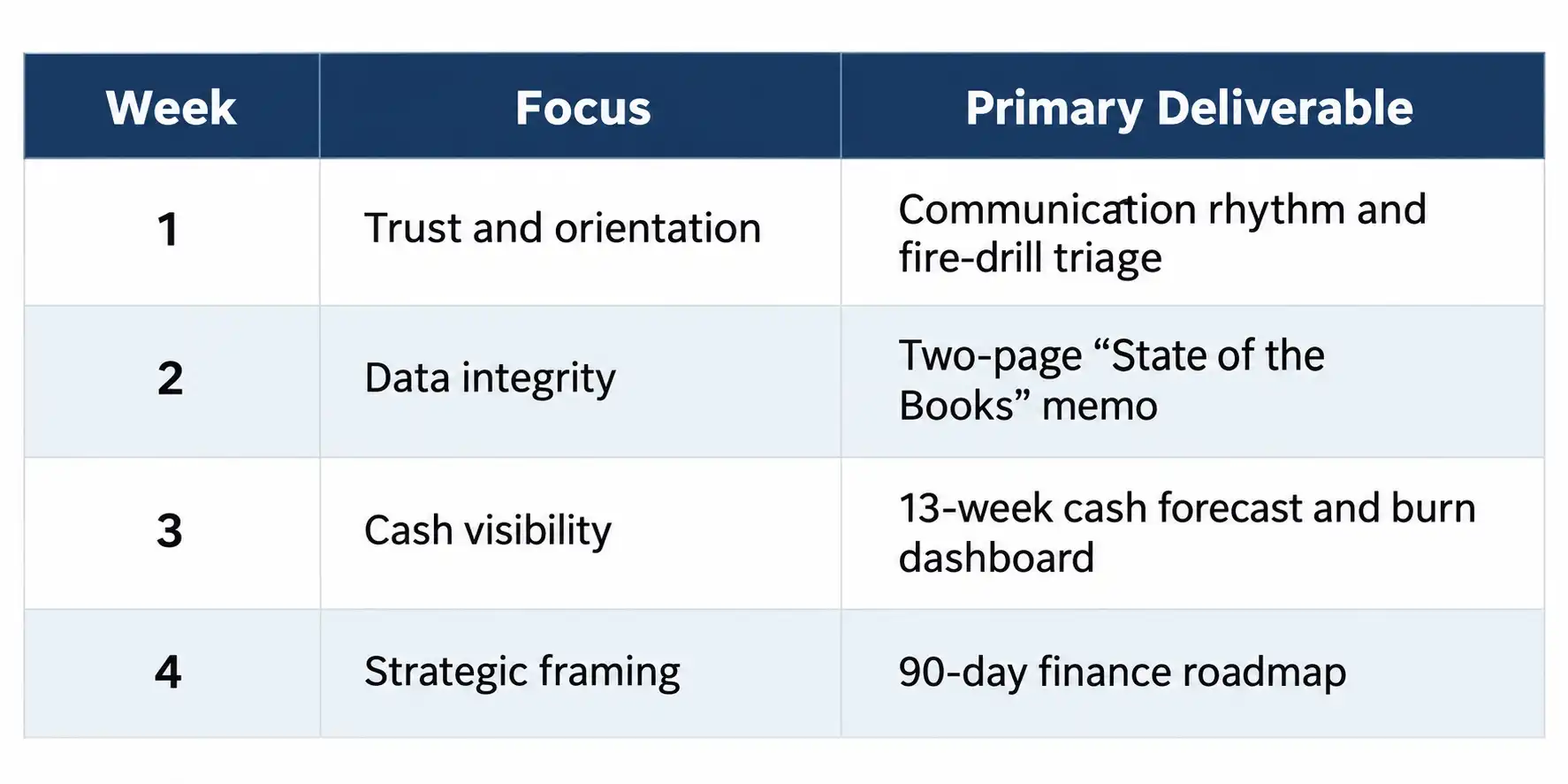
The 30-Day Framework at a Glance
Week One: Establish Trust and Set the Terms of Engagement
A fractional CFO who walks in diagnosing before listening has already made the first mistake of the engagement. The opening days belong to orientation, not conclusions. The priority is understanding the founder’s vision, the investors’ expectations, and how the team already works together.
The useful moves in week one tend to be simple and almost entirely about listening:
- Structured stakeholder interviews with the founder, the operations lead, and the head of sales
- A full walkthrough of the financial systems in place, whether that is QuickBooks, Carta, or a patchwork of Excel models
- Immediate triage of any active fire drills, including payroll, cash burn, and pending investor updates
- A defined communication rhythm across Slack, email, and weekly check-ins
Fractional CFOs sometimes advise a high-growth cybersecurity and identity access management company. One example generates roughly $30M in annual recurring revenue across five country entities. CFOs in that position know the early listening phase is not a formality. It is the diagnostic method itself. What looks like a reporting problem is often a governance problem. And what looks like a governance problem is often a byproduct of something simpler. Nobody has asked the operations lead a direct question in months.
Some fractional CFOs call this stretch “listening diligence.” The goal in these early conversations is not to arrive with solutions. It is to collect context. The financial systems walkthrough serves the same purpose. It exists to observe how transactions are recorded. It also shows where the bottlenecks are actually hiding, not where the org chart implies they should be.
Week Two: Clean the Data and Find the Red Flags
Insight cannot be built on unreliable inputs, and week two is where a fractional CFO earns the credibility to say anything meaningful in week three. The work here is unglamorous and essential:
- A basic review of the profit and loss statement and balance sheet
- A variance review against budget, where a budget exists at all
- Chart of accounts cleanup
- A sanity check of the cap table and equity ledger
- An aging review of accounts receivable and accounts payable
The deliverable at the end of the week is a two-page “State of the Books” memo that highlights gaps, risks, and a short list of triage suggestions, written so a founder can absorb it in five minutes rather than fifty.
In one engagement with that same cybersecurity and identity access management company, the accounts receivable and revenue figures looked healthy on the surface, yet the business was routinely late on payables. The reporting cadence and approval flows had quietly broken down to the point where vendors were being paid on memory and Slack reminders rather than on any defined schedule. Cleaning up the accounts payable ledger and installing a weekly cash operations cadence produced a measurable difference within 14 days, and that small, visible win opened the door to the larger moves that followed. Clients rarely need an elaborate dashboard in the first two weeks. They need confidence that someone is watching the cash, naming the risks, and cleaning up the sins of the prior regime.
Week Three: Build the Cash Map and the 13-Week Forecast
Cash remains the single asset that early-stage companies cannot fake, and by week three a fractional CFO has usually identified where the real issues sit. The construction work now shifts toward:
- A rolling 13-week cash forecast
- Burn rate calculation and runway analysis
- Expense categorization for genuine visibility, not just categorization for its own sake
- Revenue recognition timing, where the business model requires it
The deliverable is a simplified dashboard a founder can actually use, one that shows cash position, burn trends, and what happens to runway if revenue slows or hiring accelerates faster than planned. A fractional chief financial officer who has scaled a venture-backed digital marketing organization from $9M to $180M in revenue across 24 months understands why this artifact matters so much to a founder who has been running the company on bank balance and instinct. A visual runway that incorporates hiring, collections, and variable spend changes the level of the conversation almost immediately.
A 30-minute scenario planning session tends to follow naturally from the forecast. What happens if sales slip by 20%? A faster-than-planned acceleration in engineering hiring changes the picture too, and so does a Series A that closes 60 days later than expected. These questions move a founder from survival thinking into option-space thinking, and that shift is one of the more valuable things a fractional CFO can trigger in a single conversation.
Week Four: Frame the Finance Roadmap and Strategic Priorities
Once the foundation has stopped moving, the fourth week turns toward the road ahead. The work now includes:
- A maturity model assessment across books, reporting, planning, and systems
- A clear separation of quick wins from the longer-term roadmap
- Role clarity across finance, operations, and accounting
- Investor preparation, including the reporting pack and board metrics
A three-tier maturity model tends to organize this conversation cleanly:
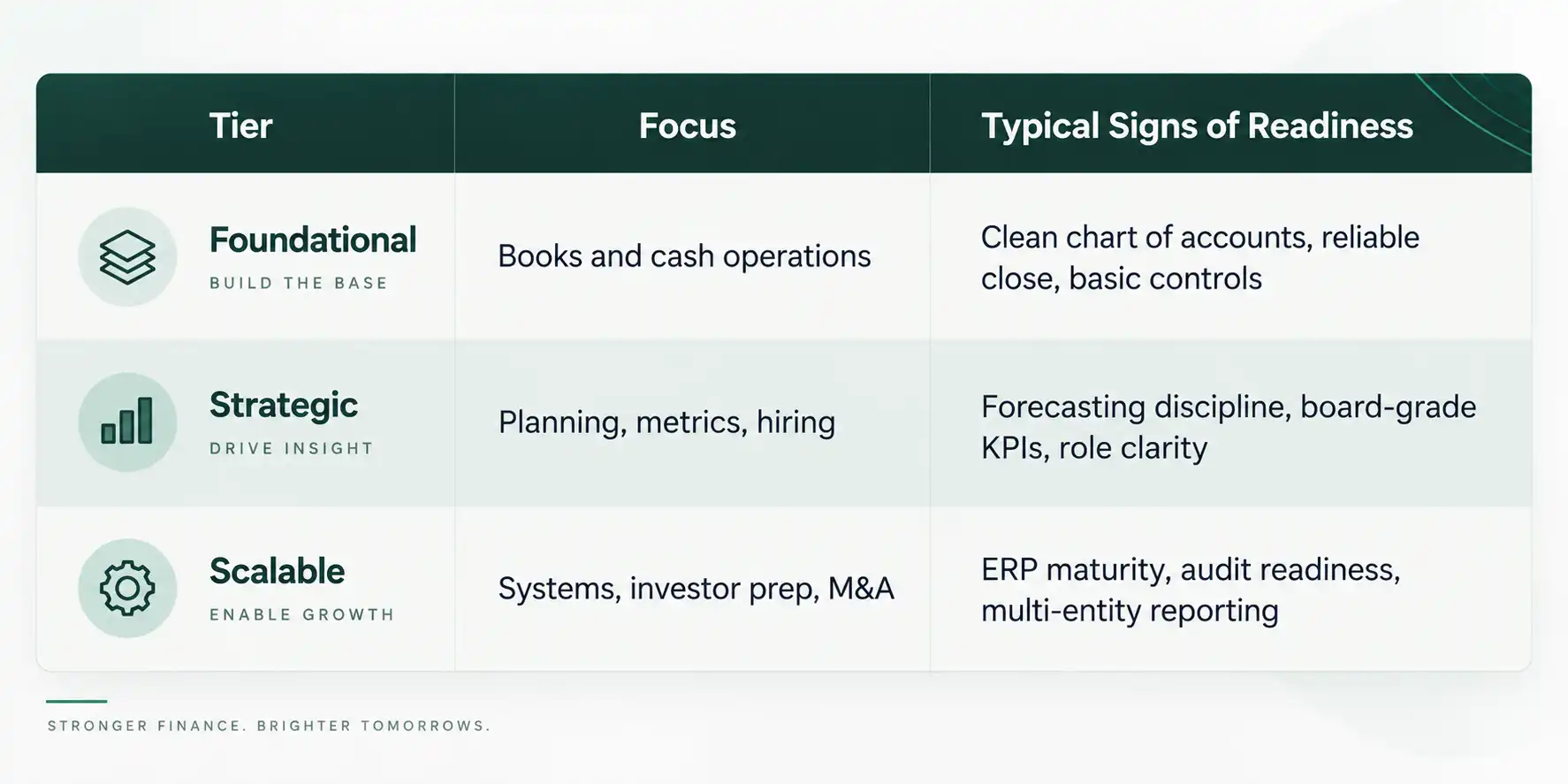
A fractional CFO who has served as chief financial officer of a mission-driven education and research institution, where the mandate stretched across finance, HR, IT, legal, and facilities while raising $37M in equity and venture debt, has seen firsthand how quickly a company outgrows an informal maturity level once a serious board or investor enters the picture. The 90-day finance roadmap that closes out week four becomes both the plan for the next quarter and the natural anchor for the renewal conversation.
Avoiding the Trap of False Precision
Nothing damages an early engagement faster than a fractional CFO who tries to impress with an elaborate model before the basics are stable. The instinct to dazzle is common and almost always counterproductive, because founders and investors alike tend to value a crisp summary over an elaborate spreadsheet the more senior, they become. The task in the first month is not to fix everything. It is to stabilize what is broken and signal, with precision rather than noise, where the next unit of value creation will come from.
Setting the Communication Cadence
The first 30 days also set the tone for how a fractional CFO shows up going forward, and deciding how to be present without becoming a bottleneck matters more than it might initially appear. A three-tier communication strategy tends to hold up well: weekly calls for priorities, asynchronous updates for tactical shifts, and structured documents for board-level analysis. A Friday recap email that lists wins, risks, open items, and any asks of the founder reinforces that the engagement is being managed thoughtfully on both sides.
Founders will occasionally pull a fractional CFO into legal, HR, or go-to-market questions that sit outside the defined scope. Handling those moments as a calm advisor rather than a reactive executor, and saying plainly when something falls outside scope while still offering to help navigate it, tends to build the kind of long-term loyalty that outlasts a single engagement.
Three Key Takeaways
- Trust, not brilliance, is the currency of the first 30 days, and a fractional CFO who listens before diagnosing earns more credibility in week one than any early model or deck could produce.
- Clean data and a visible cash forecast do more to stabilize a founder’s confidence than sophisticated analysis, because the two-page memo and the 13-week forecast translate directly into decisions a founder can act on immediately.
- The 90-day roadmap built in week four is not a document that gets filed away. It becomes the shared language for the rest of the engagement and the natural starting point for the conversation about renewal.
Disclaimer: This article is intended for informational purposes only and does not constitute legal, tax, or accounting advice. You should consult your own tax advisor or counsel for advice tailored to your specific situation.
Hindol Datta is a four-time CFO and senior finance executive with over 25 years of leadership experience across cybersecurity, SaaS, gaming, logistics, digital marketing, medical devices, consumer products, and nonprofit organizations. He has led more than $120M in fundraising and over $150M in M&A transactions while building the financial and operational systems that let complex businesses scale with confidence. He is the author of seven books in the Systems CFO Series and holds active CPA, CMA, and CIA credentials.
AI-assisted insights, supplemented by 25 years of finance leadership experience.