
Executive Summary
Data integrity in reporting is the quiet foundation beneath every forecast, board packet, and capital decision a finance team produces. A report can reconcile perfectly and still describe a business that no longer exists. When that gap widens, capital drifts toward the wrong bets and investor trust begins to erode.
This article traces how reporting systems lose fidelity and how scale and scrutiny expose the cracks. It closes with a design framework for financial reporting that stays traceable, verifiable, and honest as the company grows.
Why Data Integrity in Reporting Matters More Than Precision
Every financial leader eventually meets a report that is pristine and wrong. A revenue figure survives audit while an accrual error hides beneath it. A reconciled EBITDA line can still conceal the margin cliff ahead.
Data does not gain integrity simply by living inside a system, since systems encode their builders’ blind spots. Every report is also a form of compression, reducing thousands of transactions into a few digestible lines. Good compression discards noise and keeps the signal intact, while poor compression throws away the signal itself.
How Small Reporting Errors Compound into Strategy
Complexity theory holds that small inputs can produce outsized outcomes. Finance offers a vivid version of this butterfly effect:
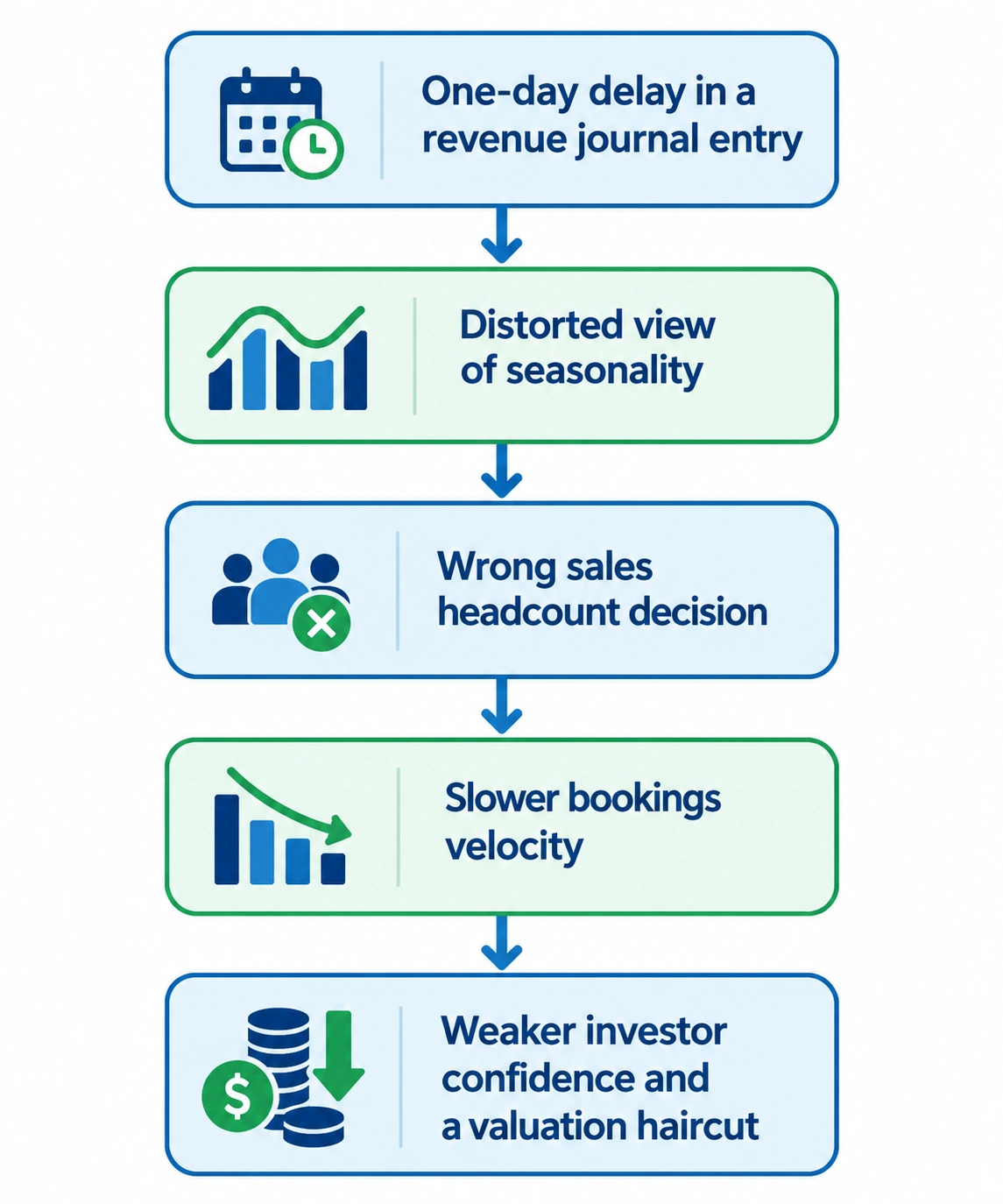
Each flawed decision becomes the next baseline, until the organization executes the wrong strategy with full conviction. The true cost lies in that chain reaction, not in the original number.
Data Integrity as a Leadership Stance, Not Hygiene
Many organizations treat data integrity in reporting as overhead with no external payoff. In game theory terms, clean data is an under-incentivized public good that everyone uses and nobody is paid to protect.
The CFO must therefore act as a system designer, not a data cop. That role calls for feedback loops where operators flag anomalies and finance traces root causes before errors harden into strategy. Reporting systems must also evolve with the business, much as living organisms adapt to new environments.
Measurement also changes behavior, echoing the observer effect in physics. Tracking churn by cohort reshapes how teams build products and negotiate pricing, so flawed data provokes flawed change. Deferring a known error can feel reasonable, yet treating reporting as narrative management corrodes truth-seeking. A report exists to help leaders act wisely, not to make anyone look good.
Where Financial Data Integrity Breaks Down
Fragility in financial reporting rarely comes from absence; it grows from accumulation. Tools, workflows, and unexamined assumptions pile up quietly until the floor beneath the house begins to shift.
Integrity failures start in the daily terrain of transactions. A sale lacks a product code, or refunds land in opex instead of contra-revenue. Each act seems rational alone, yet together they produce emergent distortion that nobody intended.
Signal Loss Across the Reporting Chain
Information theory describes how a signal degrades through repeated transmission, and financial data follows the same path:
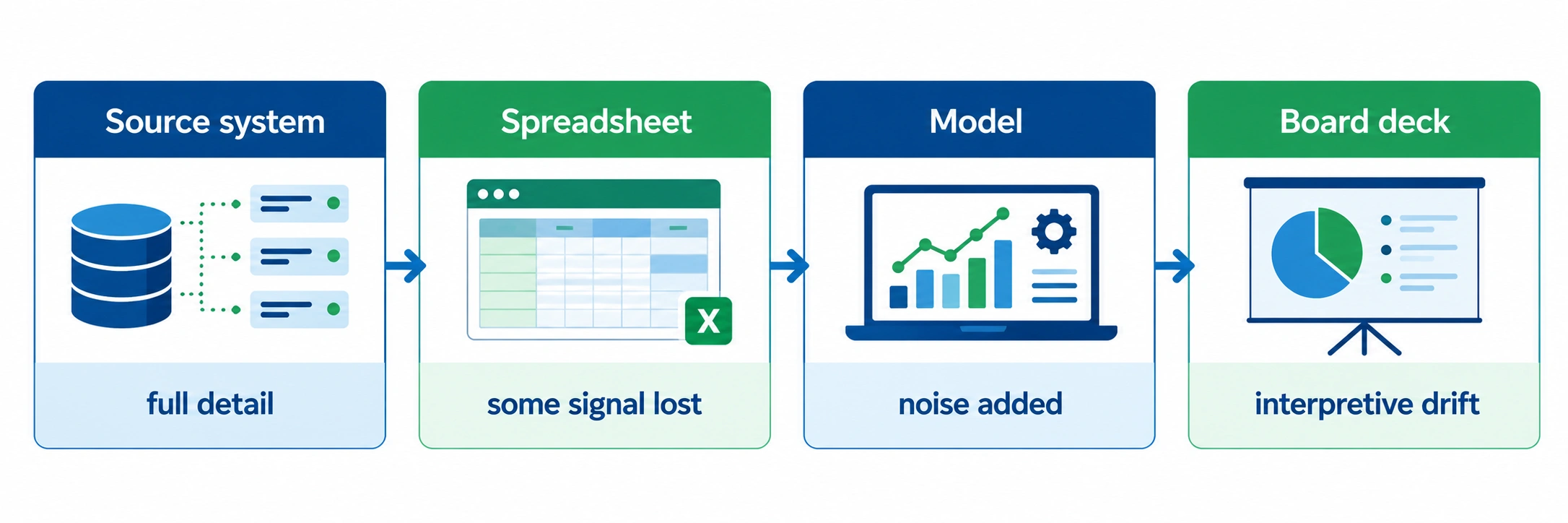
A 3% gross margin deviation may look immaterial, but misattributed COGS behind it could conceal a structural error. Periodic preventive reviews should revalidate assumptions and test account mappings.
Incentives That Reward Speed Over Fidelity
Operators earn rewards for output, finance teams win praise for speed, and executives gain credit for forecasts that match investor expectations. Each actor behaves rationally, and the system meets surface expectations while eroding at its core. Real-time dashboards make this worse, since errors spread faster than anyone can catch them.
Designing Reporting Controls for Verifiability
The remedy is to design for verifiability as well as visibility. Strong financial reporting controls should cover five areas:
- Mapping every metric back to its source system
- Documenting each transformation between source and report
- Enforcing audit trails that support root cause analysis, not just compliance
- Building modular processes that teams can test and replace independently
- Creating parallel verification paths instead of single points of failure
COGS, for example, should never rest on one master file kept by one analyst. A cybersecurity and identity access management company with about $30M in ARR illustrates the point. Its single ERP across 5 country entities compressed the monthly close from 18 days to 10. Its ASC 606 framework held up through acquisition diligence, and actuals stayed within five percent of forecast for 8 quarters.
Boards should learn how data cleanliness is assured, and audit committees should ask whether controls target the right classes of failure. Bayesian thinking also helps separate signal from noise in new data. A 3% churn gain in an untested cohort deserves less weight than a 1% decline in a stable segment.
Some threats to data integrity in reporting show up in culture, not in cells, as teams avoid reports and restatements become routine. When the internal story a company tells itself drifts from reality, it becomes myth, and capital deployed on myth rarely ends well.
Protecting Data Integrity in Reporting Under Scale and Scrutiny
The true test of data integrity in reporting arrives when velocity rises and ambiguity thickens. As investor updates move from quarterly to monthly, data becomes the bloodstream of the company, and small contamination can trigger systemic misjudgment.
When Dashboards Refresh but Truth Degrades
Growth adds currencies, tax regimes, and product lines, multiplying the hands that touch each number. The dashboards still refresh and the metrics still reconcile, but the causal map underneath begins to fade.
A publicly listed gaming and digital entertainment company operating across five countries faced this problem directly. Each subsidiary defined revenue differently, and one unified definition shortened statutory reporting cycles under IFRS and US GAAP.
Instrumentation, not more dashboards, provides the lasting answer for data integrity in reporting. Diagnostics built inside the data pipeline should include the following:
- Variance alerts that flag unexpected movements
- Trend anomaly detection across periods and segments
- Tracking of reconciliation points that fail repeatedly
These warnings matter because systems tend to drift through localized optimization, a concept from the theory of constraints. A business unit books journal entries outside master data flows to close faster. A product team launches a SKU without integrating pricing into billing. The goal is to embed discipline inside improvisation, so that fidelity enables speed.
Building a Truth-Telling Reporting Culture
Since bounded rationality limits every actor, reporting can only reduce distortion, which requires an ethic as well as architecture. CFOs should reward people who surface anomalies and create forums where teams discuss data instead of merely displaying it. Leaders should model the discipline of admitting what remains unknown while explaining how the answer will be found.
The moment of scrutiny always arrives, whether in diligence, audit, refinancing, or exit. Quality-of-earnings work on an IT services acquisition surfaced material EBITDA adjustments where reported earnings diverged from economic reality. Once published, a faulty figure can only be repaired through restatement or the slow work of re-earning trust.
Designing Reporting Systems That Tell the Truth
Accuracy is a function of arithmetic, while truth is a function of context. The CFO’s highest obligation is to build reporting that expresses the company’s real causal logic:
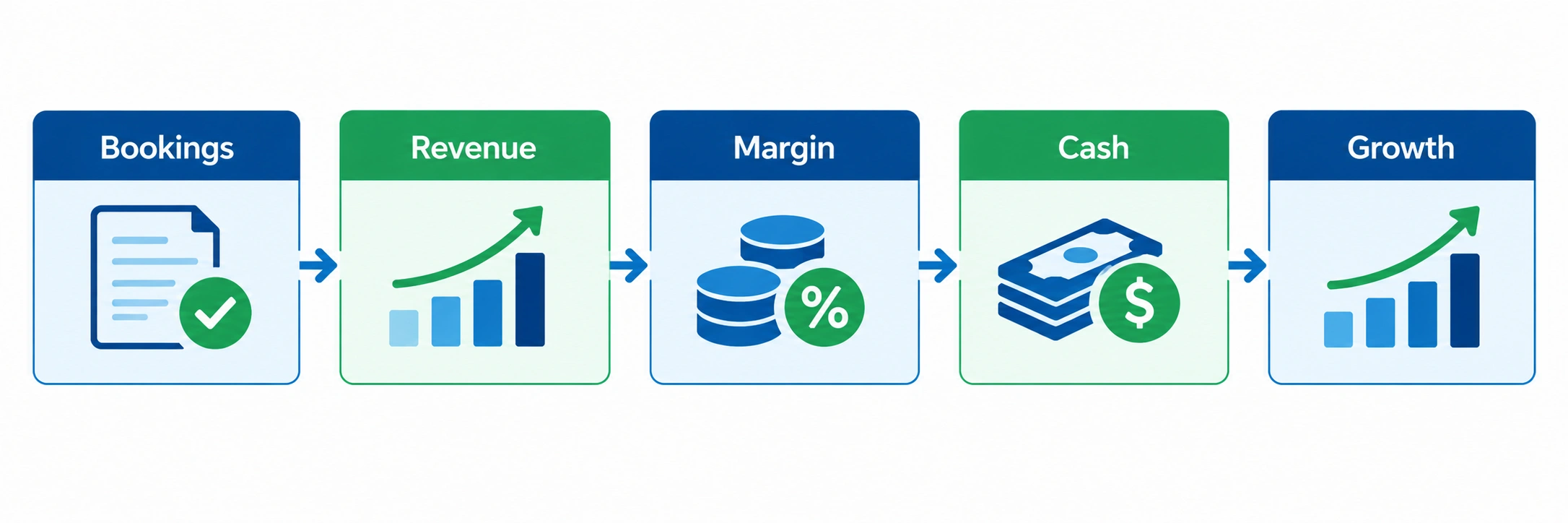
Any system that obscures this chain misleads, even when each node is accurate. Four design principles help keep data integrity in reporting intact over time.
Four Principles for Data Integrity in Financial Reporting
| Principle | What It Requires | In Practice |
| Measurement mirrors action | Metrics shaped like the levers they represent | Churn tracked by cohort; CAC segmented by channel and period |
| Explanations carry the proof | Every variance explained by mechanism | Freight, discounting, staffing, or mix behind a cost shift |
| Room for contradiction | Space for friction and disconfirmation | Forecast assumptions and model structure open to challenge |
| Stewardship across time | Periodic refactoring of reporting logic | Retiring legacy definitions and outdated mappings |
Explaining variances by mechanism builds a shared causal grammar across operators, finance, and the board. Room for contradiction guards against systems where forecast and narrative agree only because nobody introduces friction. Reporting logic also accumulates sediment, so periodic refactoring keeps the system fit for its future.
A marketplace SaaS platform raising a $20M Series B illustrates the payoff. Its cohort models rested on consolidated US and Polish reporting and withstood investor diligence because the logic was traceable.
Three Key Takeaways
- Data integrity in reporting is a leadership discipline, not a reconciliation exercise. A report that ties out can still mislead, so CFOs must ask whether the system behind each number reflects how the business creates value.
- Fragility grows from accumulated design choices and misaligned incentives. Map every metric to its source, document transformations, and build modular controls with parallel verification paths before scale exposes the gaps.
- Scrutiny always arrives in diligence, audit, or exit. Instrument the reporting pipeline, reward people who surface anomalies, and keep the story told to investors consistent with the internal one.
Disclaimer: This article is intended for informational purposes only and does not constitute legal, tax, or accounting advice. You should consult your own tax advisor or counsel for advice tailored to your specific situation.
Hindol Datta is a four-time CFO and senior finance executive with over 25 years of leadership experience across cybersecurity, SaaS, gaming, logistics, digital marketing, medical devices, consumer products, and nonprofit organizations. He has led more than $120M in fundraising and over $150M in M&A transactions while building the financial and operational systems that let complex businesses scale with confidence. He is the author of seven books in the Systems CFO Series and holds active CPA, CMA, and CIA credentials.
AI-assisted insights, supplemented by 25 years of finance leadership experience.