
Executive Summary
The venture capital success rate tells a sobering story that rarely appears in startup folklore. Research by Harvard Business School lecturer Shikhar Ghosh found that roughly 75% of venture-backed startups never return their investors’ capital. VC remains a powerful tool, yet it suits a narrow band of companies built for exponential outcomes.
This article examines both sides of the funding decision. Part I sets out 10 conditions under which founders should decline or walk away from venture funding. Part II explains the criteria investors apply, so founders can see where their company fits and where it does not.
Why the Venture Capital Success Rate Should Shape the Funding Decision
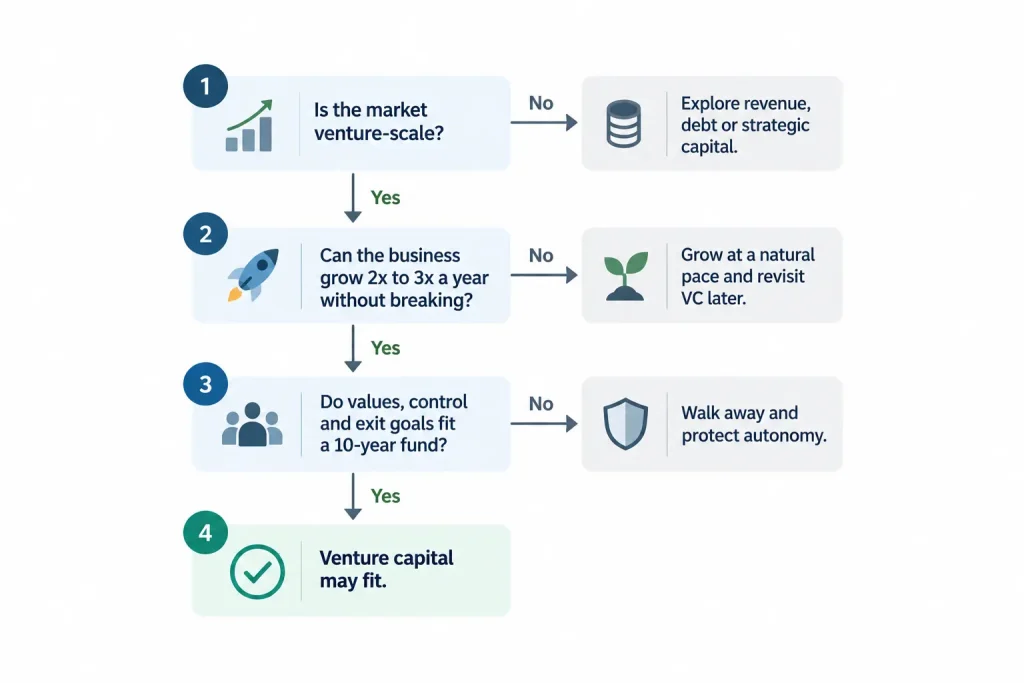
Modern startup culture treats venture capital as the natural next step and a badge of legitimacy. That script assumes every great company must be venture-backed, that capital always adds value, and that dilution barely matters. A low venture capital success rate exposes the flaw, because the model depends on a few outliers covering many losses. For some founders, declining VC is the most strategic decision available, and the flow below offers a quick first screen.
10 Reasons Founders Should Turn Away From Venture Capital
Misaligned Time Horizons
Venture funds typically run on 10-year cycles, with return expectations front-loaded into the first seven years. Founders in regulated or frontier sectors, or with long gestation periods, may find that cycle out of step with reality. The signal to walk away appears when an investor’s exit timeline compresses the operating strategy and plants a structural conflict in the boardroom.
Marginal Capital With Exponential Costs
Growth that is not capital-efficient can turn into a treadmill. VC often demands a growth rate that outpaces natural market absorption, creating artificial burn and premature scaling. An early-stage email marketing SaaS company once needed an operational turnaround to cut monthly burn from $800K to $200K. Founders should step back when capital would accelerate an unproven go-to-market plan or mask fragile unit economics.
Loss of Strategic Autonomy
Board seats, control rights, and protective provisions are not neutral clauses. They place decision-making power where capital pools, which may not be where insight lives. Mission-driven and craft-centric ventures often cannot afford to lose narrative control. When fund return dynamics look set to override customer-centric logic, VC stops being a partnership and starts to resemble a leveraged acquisition of the founder’s future.
A Market That Is Not Venture-Scalable
Venture portfolios need companies capable of billion-dollar outcomes, and that requirement drives the industry’s lopsided success rate. Many businesses are profitable, defensible, and durable without hyper-scaling. If the total addressable market is finite, fragmented, or stable, VC may distort strategy and eventually force a pivot that cannibalizes what made the business viable.
Capital Priced Above the Actual Risk
Venture capital is priced for exponential risk. A business that has de-risked key elements through IP, pre-sales, or channel partnerships may qualify for cheaper, less intrusive funding. One $127M global consumer products company secured $12M in growth financing through its banking and lender relationships. When credible alternatives such as revenue, debt, or strategic partners exist, founders should pursue those first.
Values Misalignment
Some ventures sit at the intersection of ethics, sustainability, and community, and their trade-offs rarely fit an IRR calculation. A mission-driven education and research institution in Silicon Valley raised $37M across equity and venture debt while modeling funding under variable philanthropic and earned-revenue conditions. If a founder’s values are non-negotiable and the investor’s incentives are extractive or short-term, the partnership can become a cultural infection.
Overfunding and Signal Risk
Too much capital too early becomes its own liability. It raises expectations, erodes frugality, and attracts scrutiny before product-market fit. When funding creates more narrative pressure than execution leverage, the company ends up building optics instead of outcomes.
Team and Culture Fragility
VC changes a company’s growth curve and cultural velocity, and some teams fracture under that pressure. Teams that thrive on craftsmanship over blitzscaling may find their culture is the real moat. If the post-funding team would look unrecognizable from the trusted core, the cultural cost may exceed the capital gain.
Customer Validation Over Investor Validation
Customers who pay early provide stronger signal than investors who speculate. VC offers validation for some founders, yet it remains a poor proxy for sustainable demand. When the best lead is a paying customer rather than a term sheet, founders should follow the money that pays, not the money that expects.
Fundraising Becomes the Product
Founders who enjoy raising money can drift into optimizing for the next round instead of the next product iteration. Once raising replaces building as the core activity, capital stops enabling progress and becomes a distraction.
What VCs Look For and How Founders Can Test Alignment
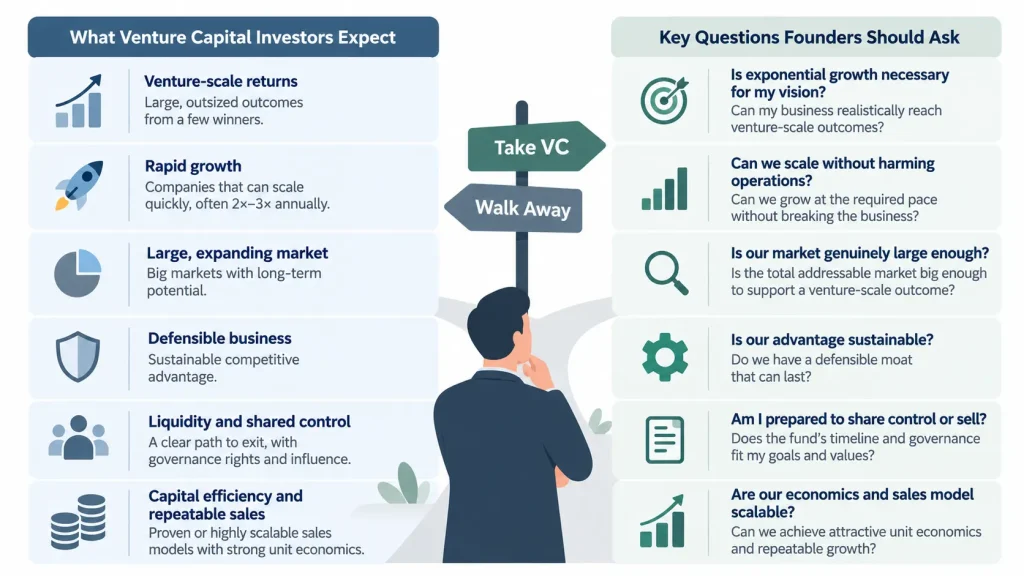
Understanding investor criteria helps founders recognize when they do not, and should not, match. A mismatch reflects selection, not rejection, and it explains much of the venture capital success rate. The table below pairs each investor criterion with the alignment test a founder should run.
Investor Criteria and Founder Alignment Tests
| Investor Criterion | What VCs Expect | Founder Alignment Test |
| Venture-scale potential | 10x or greater returns. A $300M fund needs exits of $3B+ | Is $100M ARR both likely and necessary for the vision? |
| Fast growth trajectory | Revenue doubling or tripling each year in early stages | Would acceleration push the business beyond operational stability? |
| Large, expanding TAM | A total addressable market that is large and still growing | Is the market definition being stretched to fit the VC mold? |
| Category creation | Companies that redefine industries or create new categories | Is innovation driven by market need or by pressure to look disruptive? |
| Defensibility and moats | Technology, network effects, or models that scale defensibly | Is the moat real, or does the edge rest on execution and culture? |
| Clear path to liquidity | IPO, acquisition, or secondary sale at venture multiples | Is the goal to own the business or to sell it? |
| Coachable founding team | Founders who can scale and accept guidance | Is the founder willing to be replaced as CEO if needed? |
| Capital efficiency | Healthy burn rate, unit economics, and LTV:CAC ratios | Do strong economics reflect frugality or true leverage? |
| Governance readiness | Formal boards, legal obligations, and shared control | Is the founder ready to govern alongside others? |
| Repeatable go-to-market | A scalable, repeatable sales motion | Is the sales motion artisanal or institutional? |
Reading the Alignment Tests Honestly
Each test exposes a gap between investor math and founder intent. A business whose advantage lies in customer empathy may not translate into VC underwriting logic. Frugal economics may not justify venture input, while true leverage might. If every deal is bespoke, venture growth math will not pencil.
When the criteria do align, venture capital can compound growth with striking speed. A venture-backed digital marketing company scaled from $9M to $180M in 24 months while raising $36.5M across three rounds. Disciplined tracking of CAC, LTV, and contribution margin kept that growth grounded in economics rather than narrative.
Beyond the Venture Capital Success Rate: The Strength in Saying No
Turning away from VC does not mean turning away from ambition. It means defining ambition on the founder’s own terms. The venture path is powerful but narrow, designed for exponential outcomes at high variance. Founders must weigh what capital demands as well as what it enables. Ownership, vision, time, and mission can be too precious to sell, however gilded the offer.
Saying no is a strategic choice that separates chasing valuation from creating value. In the final calculus, not every unicorn wears a horn, and some companies are simply focused, profitable, and free.
Three Key Takeaways
- The venture capital success rate is low by design, because funds rely on a few outliers to offset many losses. Founders should treat VC as a specialized instrument instead of a default milestone.
- Misaligned time horizons, values, or market size are strong signals to walk away from a term sheet. Revenue, debt, and strategic partners often provide cheaper capital with less loss of control.
- Running investor criteria as honest alignment tests reveals whether a company fits the venture model. A clear no protects ownership, culture, and mission for the long run.
Disclaimer: This article is intended for informational purposes only and does not constitute legal, tax, or accounting advice. You should consult your own tax advisor or counsel for advice tailored to your specific situation.
Hindol Datta is a four-time CFO and senior finance executive with over 25 years of leadership experience across cybersecurity, SaaS, gaming, logistics, digital marketing, medical devices, consumer products, and nonprofit organizations. He has led more than $120M in fundraising and over $150M in M&A transactions while building the financial and operational systems that let complex businesses scale with confidence. He is the author of seven books in the Systems CFO Series and holds active CPA, CMA, and CIA credentials.
AI-assisted insights, supplemented by 25 years of finance leadership experience.