
Executive Summary
The signs that a business is failing rarely arrive as a single dramatic event. They gather quietly at every stage, in a sagging retention curve or a founder-dependent sales process. Success travels the same hidden road, compounding through traction and discipline long before anyone celebrates.
This article maps those indicators from pre-seed through Series E, setting the signals of strength beside those of decay. Founders, investors, and corporate venture leaders can use it to catch drift while correction remains affordable.
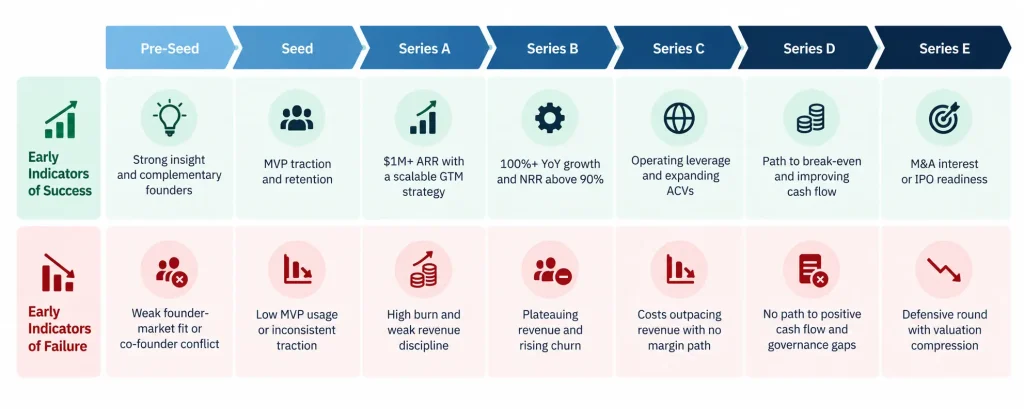
Reading Startup Signals Across Every Funding Stage
Each funding stage has its own vocabulary, and a pattern that looks harmless at seed can prove fatal by Series C. The matrix below sets success indicators beside the signs that a business is failing.
| Stage | Early Indicators of Success | Early Indicators of Failure |
| Pre-Seed | Deep domain expertise and complementary skills; a sharply articulated problem and insight; early believers and customers | Weak founder-market fit or co-founder conflict; a vague, trend-driven problem; no initial users or weak engagement |
| Seed | Strong MVP engagement and retention; fast learning loops and pivot agility; validation from angels or early VCs | Little MVP usage or inconsistent traction; iteration without insight; rejection by multiple quality investors |
| Series A | $1M+ ARR on a predictable trajectory; a scalable GTM strategy; LTV above 3x CAC and a burn multiple under 2x | High burn without revenue discipline; founder-only sales; unknown or excessive CAC and a burn multiple above 4x |
| Series B | Sustained 100%+ YoY growth and NRR above 90%; clear functional leaders; institutional VC participation | Plateauing revenue and rising logo churn; key roles unfilled; a flat or down round that signals strategic doubt |
| Series C | Operating leverage with the Rule of 40 approached or met; expanding ACVs and international traction | Costs outpacing revenue with no margin path; stalled deal sizes and regional overdependence |
| Series D | EBITDA approaching break-even and improving FCF; a clean cap table ready for IPO diligence | No path to positive cash flow; persistent negative margins; governance gaps; financing dependency |
| Series E | Strategic M&A interest or IPO readiness; controlled burn and a disciplined roadmap | A defensive bridge round with valuation compression; overhiring and weak financial control |
Early Indicators of Success: How Traction Takes Shape
Success seldom announces itself with grandeur, arriving first as a data point that holds or an investor who leans forward. Founders attuned to these signals learn to navigate by them.
Pre-Seed: The Power of Insight and Alignment
The earliest signal of potential lives in the founder’s frame of mind, not in the product. Strong pre-seed companies tend to come from founders with asymmetric insight, earned through years inside a problem others dismissed. Investors lean in when a nuanced view of customer pain fits the founder’s history. Complementary co-founders provide scaffolding for speed, and a handful of users who behave like evangelists offers the strongest proof of forward motion.
Seed: Momentum, Learning Velocity, and Signal Integrity
At seed, a rough product exists, and momentum divides promise from stagnation. The strongest teams ship quickly, measure with intent, and let retention guide them more than raw usage. Founders with deep user empathy know which behaviors to measure, which channels to fund, and which segments matter most. An oversubscribed round with respected angels validates that judgment and is no vanity metric.
Series A: Revenue Quality and Go-to-Market Repeatability
By Series A, investors look beyond product-market fit toward product-channel fit and a coherent business model. Revenue becomes the north star, though not all revenue is equal, and strong companies usually pass a three-part screen:
- $1M+ ARR with low churn and healthy expansion.
- CAC and LTV defined with confidence, with LTV at least 3x CAC.
- A burn multiple under 2x, signaling capital efficiency.
The GTM engine need not be mature, but early salespeople should close deals without the founder. The best companies also hold a hiring roadmap for heads of sales, marketing, engineering, and product. One performance marketing company that grew revenue from $9M to $180M in 24 months paired that roadmap with CAC, LTV, and contribution margin discipline.
Series B: Organizational Scaling and Market Positioning
Series B marks the passage from promise to proof, with investors expecting 100%+ annual growth, net revenue retention above 100%, and a sales process with CRM discipline. Organizational signals carry equal weight, since a team must scale without sliding into entropy. Early executives should stay, and functional silos should begin to collaborate. Independent directors with GTM experience join the board, and top-tier funds signal institutional readiness.
Series C: Efficiency and Moat Signals
The Rule of 40 enters the conversation at Series C, as investors look for growth that coexists with margin discipline. CAC efficiency, contribution margin, and improving EBITDA trends move to the center of board discussions. Rising contract values and geographic expansion signal scale, while customer success teams reduce churn and expand wallet share. Moats such as proprietary data, platform lock-in, or ecosystem stickiness begin to separate category leaders from fast followers.
Series D and E: Liquidity Maturity
Investors measure late-stage success by proximity to liquidity, expecting positive or forecast EBITDA, improving free cash flow, and an exit route through IPO or M&A. Strategic acquirer interest, investment bank engagement, and public-company-grade governance strengthen the case. A $127M global consumer products company with 4 consecutive clean audits shows how that maturity reads to a buyer.
Signs That a Business Is Failing, from Pre-Seed to Late Stage
Failure seldom looks like failure in its opening chapters, because decline compounds through opacity, drift, and denial. The signs that a business is failing are visible early to anyone willing to look, and the flow below traces how they harden.
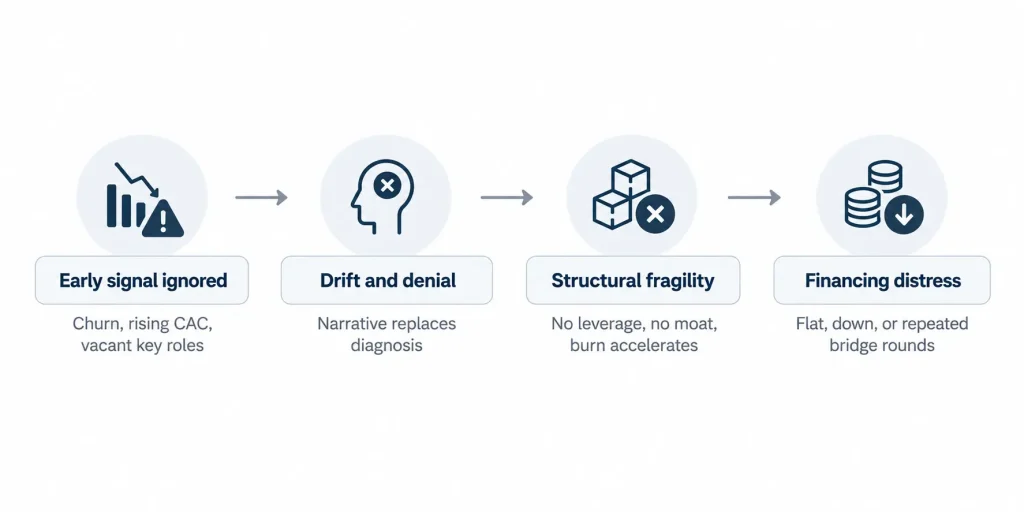
Pre-Seed: Misaligned Founders and Misdiagnosed Problems
At the earliest stage, the warning signs tend to be interpersonal or intellectual. Co-founders may carry divergent risk tolerance or unclear role boundaries. Problem statements may borrow from trends instead of observed pain, often inside jargon-heavy decks without original insight. Founder absolutism, which treats feedback as a distraction, is among the most dangerous signs that a business is failing.
Seed: Stalled Learning, Vanity Metrics, and Incoherence
Investors expect weak traction at seed, so the signs that a business is failing lie in how the team responds:
- Repeating the same experiments without drawing new lessons.
- Chasing new features instead of diagnosing core usage problems.
- Leaning on top-line growth that hides poor retention.
A team always fundraising yet unable to define CAC or LTV has broken fundamentals. Rejections that cite the same concern, whether team, market size, or GTM plan, deserve introspection instead of dismissal.
Series A: Growth Without Foundation
When founders raise Series A on narrative alone, the following 18 months become precarious. Signs that a business is failing here include a burn multiple above 4x and a shifting ideal customer profile. A founder still running sales, product, and finance is another warning, and hiring under pressure adds talent churn. An early-stage email marketing technology company reversed that pattern when a turnaround cut monthly burn from $800K to $200K.
Series B: Scaling Chaos Instead of Systems
Among the signs that a business is failing at Series B, premature scaling leads, as companies copy late-stage organizations without their coordination. Key roles sit vacant or revolve, marketing spend outpaces pipeline, and engineering sprints stretch while shipping slows. International expansion before domestic repeatability adds risk, accelerating burn with little return.
Series C: No Leverage, No Moat
By Series C, the failure mode turns structural, with costs rising alongside revenue. Flat gross margins, CAC creeping up as win rates fall, and customers who never expand all point to absent operating leverage. A $30M ARR cybersecurity company found the remedy, lifting gross margin by 12% through pricing discipline and workforce mix. Investor confidence fades when a company lacks a moat or well-funded competitors gain share. A flat or down round without new strategy or leadership then raises the risk of a death spiral.
Series D and E: Valuation Traps and Liquidity Desperation
Late-stage failure is the most painful, and inflated valuations from earlier rounds often sit at its root. The late-stage signs that a business is failing include resistance to repricing, burn with no clear return, and down rounds with onerous terms. Governance gaps surface through board dysfunction, delayed audits, and an unclear exit narrative. Repeated bridge rounds without structural correction make the endgame predictable.
Recognizing the Signs That a Business Is Failing Before It Is Too Late
Success whispers and failure whispers louder, but only disciplined leaders hear either in time. These indicators shape trajectories in startups and corporate ventures alike, though none guarantees an outcome. Founders who practice diagnostic honesty, and investors who resist narrative intoxication, build companies that endure.
Three Key Takeaways
- The signs that a business is failing appear in small, stage-specific signals long before a crisis. Leaders who track them can correct course while correction is still affordable.
- Success indicators shift from founder insight at pre-seed to revenue quality, leverage, and liquidity readiness later. Each stage asks for proof that earlier strengths now scale.
- Late-stage failure usually traces back to signals that leaders ignored or explained away. Diagnostic honesty, in startups and corporate ventures alike, remains the best defense against slow decline.
Disclaimer: This article is intended for informational purposes only and does not constitute legal, tax, or accounting advice. You should consult your own tax advisor or counsel for advice tailored to your specific situation.
Hindol Datta is a four-time CFO and senior finance executive with over 25 years of leadership experience across cybersecurity, SaaS, gaming, logistics, digital marketing, medical devices, consumer products, and nonprofit organizations. He has led more than $120M in fundraising and over $150M in M&A transactions while building the financial and operational systems that let complex businesses scale with confidence. He is the author of seven books in the Systems CFO Series and holds active CPA, CMA, and CIA credentials.
AI-assisted insights, supplemented by 25 years of finance leadership experience.