
Executive Summary
Secondary buyouts have moved from the margins of private equity to its center, and secondary buyouts value creation now sits in front of every sponsor, lender, and limited partner. When one fund sells a company to another, the deal can extend a genuine growth story or simply reprice the same asset with fresh leverage and a new clock.
The analysis below covers the structural forces behind sponsor-to-sponsor deals, operational change after the handoff, the role of valuation and debt in returns, and the obligations of stewardship. Together, these offer a practical test for separating compounding from circulation before capital is committed.
Why Secondary Buyouts Became a Fixture of Private Equity
A deal type once read as a failed exit has become routine. In the 1980s and 1990s, private equity was a contrarian craft built on a few relationships and singular deals. A sale to another sponsor often signaled that no strategic buyer or public market wanted the asset.
Today the industry is institutional, crowded with megafunds and professional deal teams. IPO windows open and close with little warning, and strategic acquirers face tougher regulatory review. As the entry spigot widened, the exit funnel narrowed, and continuity became the pragmatic path.
Fund Lifecycles and the Search for Yield
The closed-end fund model exerts steady pressure on exit timing. The typical 10-year fund must realize gains, distribute carry, and raise its successor on schedule. A company may still have headroom, yet the seller’s clock forces a sale regardless.
Buyers with fresh funds and new investment periods fill that gap. Meanwhile, a decade of cheap money pushed pensions, endowments, and sovereign funds deeper into private markets. Proprietary deals are scarce, so secondary buyouts offer what crowded capital craves: scale, familiarity, and speed.
Diligence is also lighter, because the asset arrives with audited financials, installed processes, and a seasoned management team. Limited partners often welcome this predictability, since a sponsor-to-sponsor deal can be modeled and benchmarked with more confidence than a turnaround.
How the Sponsor-to-Sponsor Handoff Unfolds
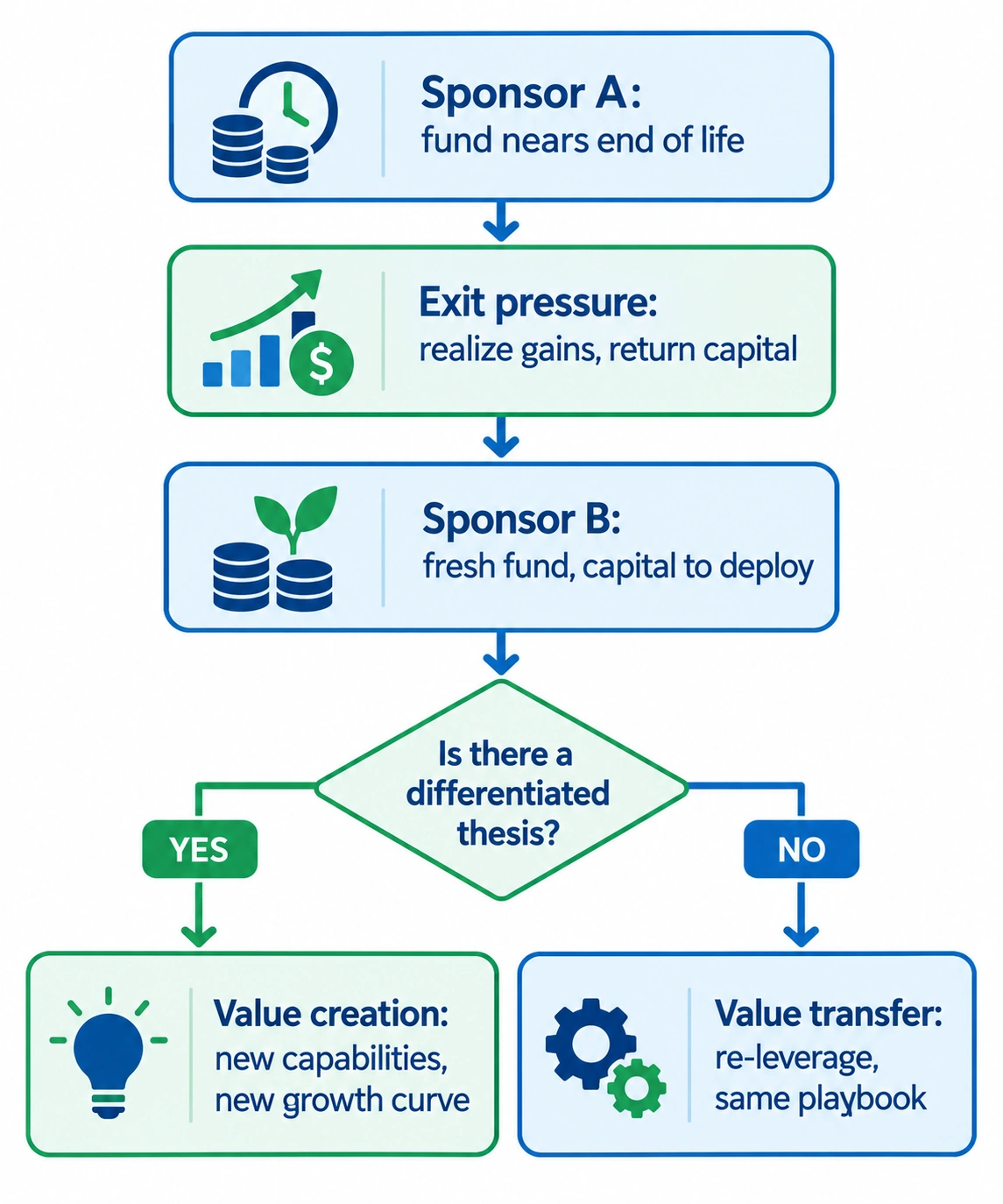
This efficiency carries a cost, because the incoming buyer inherits structure rather than chaos. That raises a hard question about whether the second owner can still find latent value or will only rerun the previous plan. In consolidating industries, sequential owners can play distinct roles, one rationalizing operations and the next layering on M&A. Without that conviction, the deal becomes a ritual driven by capital that must be deployed.
Inside the Company After the Secondary Buyout
Deal announcements typically promise a strong partnership and a continued path of growth. Inside the company, the transition carries more weight than those announcements suggest. Management has just delivered against one owner’s mandate and now faces a new scoreboard and a new voice in the boardroom.
The central operational question is whether the new sponsor brings fresh insight or merely a new calendar. A stabilized carve-out or a regional player with national ambition can support a genuine second thesis. Mature assets with their easy gains already harvested invite a weaker playbook of more leverage and harder cost targets.
Incentives, Culture, and Talent Renewal
Incentive design reveals the true state of the transition. New owners often ask executives to roll equity at re-struck terms and recommit to a familiar growth story. Loyalty on the surface can mask quiet disengagement underneath, and culture does not reset with a new cap table.
Inherited infrastructure offers a real advantage to the incoming sponsor. A cybersecurity and identity access management company with board-grade reporting, ASC 606 controls, and a 10-day close moved through acquisition diligence with little friction. Yet the same processes that enforce discipline can harden into bureaucracy when the purpose of the next phase goes undefined.
Teams build muscle memory around whatever the last owner rewarded. Revising metrics without reframing the purpose behind them changes the dashboard but not the direction. Retaining the same leadership team protects continuity while limiting renewal, so new board advisors or M&A-savvy operators often make the difference.
What Good Sequencing Looks Like
The strongest secondary buyouts pair the capabilities of two complementary owners. A turnaround specialist exits and a platform builder enters, or a regional sponsor hands over to one with global reach. The second owner builds on the first owner’s scaffolding rather than repeating it.
Investors can watch for these non-financial signals of real progress:
- New initiatives proposed rather than strategy held in maintenance mode
- Succession plans emerging from talent reviews instead of recycled incumbents
- Capital deployed for capacity rather than conserved for exit optics
- Leverage treated as a temporary bridge, with throughput driving value
Valuation, Leverage, and Secondary Buyouts Value Creation
The financial engine room is where value is either earned or constructed. On the surface the logic is clean: one sponsor sells at a performance-backed multiple and another buys on future potential. Underneath, valuation depends on discount rates, earnings adjustments, comparable selection, and synergies assumed but not yet delivered.
When EBITDA Becomes Negotiable
In secondary buyouts, EBITDA is often a negotiated figure rather than a settled fact. A seller chasing a premium may front-load cost cuts, defer capital spending, or count forward synergies as trailing performance. The final twelve months then absorb several years of optimization.
A buy-side quality-of-earnings review on an IT services acquisition illustrates the risk. The work surfaced material EBITDA adjustments where reported earnings diverged from economic reality, and those findings reshaped the buyer’s decision. Without that scrutiny, the buyer would have paid for performance pulled forward from future years, leaving fewer footholds for growth.
Leverage, Fund Timing, and Sponsor Reciprocity
By the second sale, the outgoing sponsor has often optimized the capital stack. To re-lever, buyers turn to mezzanine debt, PIK notes, seller financing, or covenant-lite loans. That is return engineering, designed to sustain the appearance of momentum.
Fund vintages add non-market motives to the price. A seller near the end of its fund needs liquidity, and a buyer early in its fund needs deployment. Academic research on these deals has found weaker performance when buyers acquire late in their investment period under pressure to invest. Reciprocity compounds the problem, since firms that sell to each other today may swap roles tomorrow, which discourages any challenge to a markup.
Multiple expansion also deserves skepticism in a sponsor-to-sponsor deal. An exit at 14x EBITDA may reflect abundant liquidity rather than operating excellence. Real operating gains look different and show up on the balance sheet. In a $127M global consumer products company, inventory turns rose from 3x to 7x through demand planning and SKU rationalization, releasing working capital no refinancing could produce.
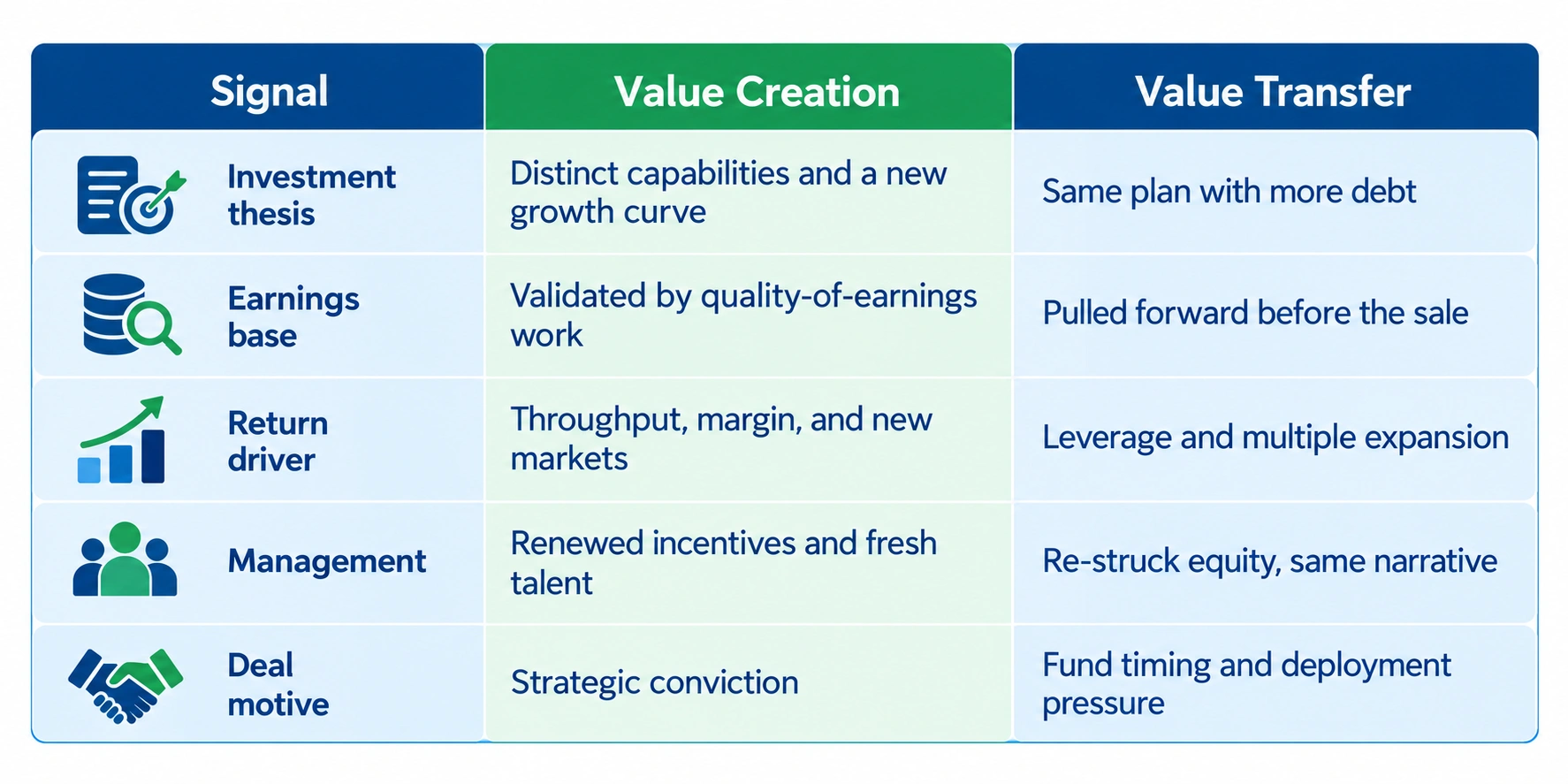
Value Creation Versus Value Transfer at a Glance
Stewardship and the Ethics of Repeat Ownership
Every transaction expresses a judgment about time, value, and legacy. A secondary buyout can be legal, economically logical, and still strategically hollow. Ethics here is less about compliance and more about what the owner believes is worth doing.
Intent is the first test of stewardship in any repeat ownership deal. A sponsor with a clear ambition, such as new geographies or a digital transformation, signals stewardship. Fund matching or yield smoothing as the motive signals substitution. Narrative truth follows, since margins expanded through temporary cuts differ from margins earned through better fundamentals.
Employees feel these choices first, and strained trust is hard to refinance. Re-engaged managers facing tougher hurdles and shorter timeframes may comply without conviction. Customers and communities bear the consequences when a new owner raises prices or cuts service to monetize inertia. The sponsor can exit handsomely and still leave behind a fragile shell.
A Practical Stewardship Framework
Ethical practice in secondary buyouts rests on four disciplines:
- Intentional design: the new owner brings new tools and a differentiated theory of change
- Transparent alignment: candid conversations with management about risks and shared burdens
- Diligent continuity: preserving what works without being trapped by legacy assumptions
- Consequential reflection: asking who benefits from the value and at what cost
The true measure of a sponsor’s contribution is the company’s condition at exit, not the exit multiple. Greater resilience, broader optionality, and a stronger competitive position mark real secondary buyouts value creation. The test is not what was bought or sold, but what was changed.
Three Key Takeaways
- Secondary buyouts create value only when the second sponsor brings capabilities the first lacked, such as platform M&A, global reach, or digital depth. Without a differentiated thesis, the deal reschedules returns rather than building them.
- Buyers should treat seller EBITDA as a hypothesis until quality-of-earnings work confirms it. Pulled-forward margins, deferred capital spending, and assumed synergies inflate the entry price and shrink the room for error.
- Durable returns come from throughput, working capital discipline, and renewed talent rather than leverage and multiple expansion. Fund timing should never be the main reason a deal happens.
Disclaimer: This article is intended for informational purposes only and does not constitute legal, tax, or accounting advice. You should consult your own tax advisor or counsel for advice tailored to your specific situation.
Hindol Datta is a four-time CFO and senior finance executive with over 25 years of leadership experience across cybersecurity, SaaS, gaming, logistics, digital marketing, medical devices, consumer products, and nonprofit organizations. He has led more than $120M in fundraising and over $150M in M&A transactions while building the financial and operational systems that let complex businesses scale with confidence. He is the author of seven books in the Systems CFO Series and holds active CPA, CMA, and CIA credentials.
AI-assisted insights, supplemented by 25 years of finance leadership experience.