
Executive Summary
Anyone asking what does VC stand for in business will hear a quick answer, which is venture capital. The term describes equity funding placed into young, high-growth companies in exchange for ownership, and behind it sits a demanding craft of allocating capital amid uncertainty.
This article covers both halves of a first founder meeting. Part I explains the preparation investors complete before a founder walks in. Part II sets out the 20 core questions asked in the room and what each one is meant to reveal.
What Does VC Stand for in Business When the Meeting Begins?
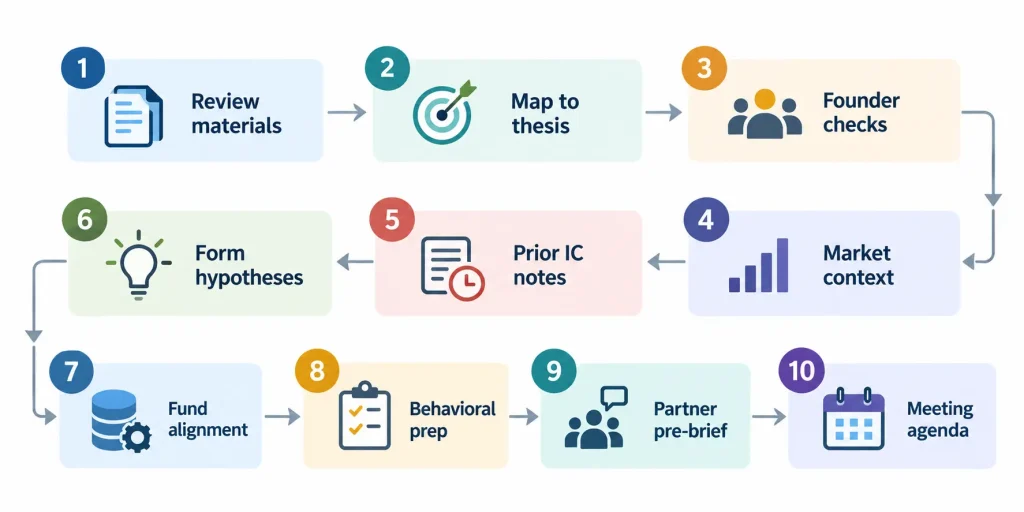
Venture capital is a bet on people, markets, and timing before most of the evidence exists. Investors weigh what founders present, imply, and withhold, and preparation turns a casual pitch into a diagnostic session. The flow below traces the sequence from document review to meeting agenda.
Part I: How a Venture Capitalist Prepares for a Founder Meeting
1. Reviewing the Pitch Deck and Executive Summary
The first pass covers the deck, one-pager, and executive summary, which should tell a coherent story across product, team, and business model. Investors look for the following signals:
- A clear articulation of the problem
- An insightful framing of the solution
- Market sizing that triangulates bottom-up and top-down methods
- Team bios that connect to domain execution capacity
- A business model with visible logic and leverage
- Early traction that suggests product-market fit or velocity
This review produces the first set of hypotheses. It also classifies the company by stage, vertical, thesis fit, and risk profile.
2. Mapping the Company to the Investment Thesis
Every venture firm holds a set of theses, written or implicit, about what it will fund. The partner tests sector alignment and checks whether the stage suits the fund mandate. Overlap with existing portfolio companies can help or compete, so this filter serves both strategic fit and portfolio construction.
3. Running Quiet Background Checks on Founders
Seasoned investors conduct quiet diligence well before the first handshake, since founders with strong signal tend to surface across several layers of the ecosystem. Typical sources include the following:
- LinkedIn, for career progression, time in role, and patterns of achievement
- AngelList and Crunchbase, for prior startups, exits, and funding history
- Social media, blogs, and podcasts, for thought leadership and public presence
- Shared contacts, for candid, off-the-record reputation checks
4. Building a View on Market Context
Investors study direct competitors, saturation, public comparables, and valuation multiples before they engage. Regulatory shifts, macro headwinds and tailwinds, and recent funding activity round out the picture. This work tells the partner whether the founder’s market narrative is differentiated or derivative.
5. Pulling Prior Investment Committee Notes
If the company has pitched before, the partner retrieves the old notes to see whether the team has evolved and addressed earlier concerns. Partners also check whether anyone in the firm already knows the space well.
6. Framing Hypotheses and Thematic Questions
With initial data in hand, the investor drafts working hypotheses. One might suggest the team understands the buyer while monetization seems aspirational. Another might flag defensible technology with a nascent go-to-market motion, or key-person risk around the CEO. Such hypotheses shape tailored questions and reveal how self-aware the founders are.
7. Checking Fund Dynamics and Ownership Targets
The partner confirms that the fund has dry powder and sector bandwidth, then screens for conflicts with other portfolio companies. Stage must also fit the target ownership model. A $250M Series A fund, for example, typically seeks 15% to 20% ownership and will ask whether the company can absorb $5M to $10M and justify it.
8. Preparing for Behavioral Signals
Skilled investors prepare emotionally as well as intellectually, watching for a communication style that is concise, crisp, and coachable. Attention also goes to how a founder handles pushback, whether confidence tips into arrogance, and how well the founder listens. These soft signals help predict board dynamics, resilience under pressure, and leadership style.
9. Holding Partner Pre-Briefs
When other partners plan to attend, the lead partner shares the core hypothesis, key concerns, and preferred next steps. Alignment inside the firm drives decision speed after the meeting.
10. Setting the Agenda and Expectations
Finally, the investor sketches an informal agenda that the founder rarely sees but that steers the discussion:
- Understand the origin story behind the company
- Walk through a product demo or customer flow
- Explore monetization and the go-to-market plan
- Gauge founder ambition and clarity of thought
- Identify the deal timeline and competitive dynamics
Part II: The 20 VC Due Diligence Questions Investors Ask Founders
Once the meeting starts, it becomes an exercise in pattern recognition and trust calibration. The questions below work as tools of discovery, grouped into six common themes.
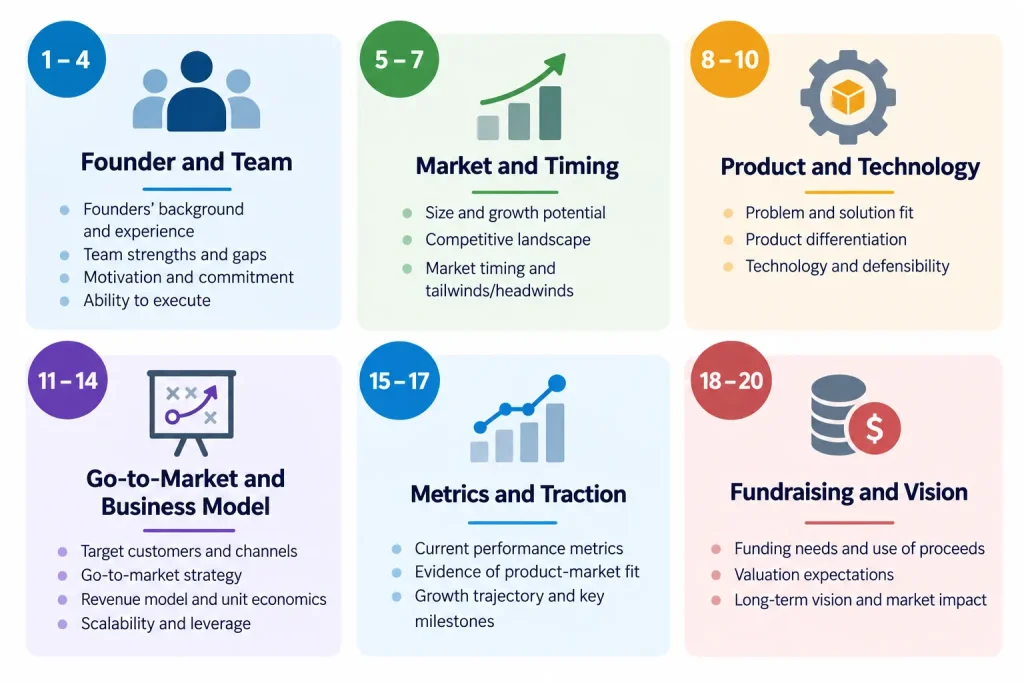
Founder and Team Questions
- Why did you start this company, and why now? The answer reveals mission alignment, timing sensitivity, and founder-market fit.
- What in your background makes you uniquely qualified to solve this problem? Investors use it to weigh experience, insight, and authenticity.
- How do you make decisions as a team, and what happens when you disagree? It gauges decision-making maturity and the health of team dynamics.
- Who is on the core team today, and who are the next three key hires? A good reply exposes the hiring plan and the depth of the bench.
Market and Timing Questions
- How big is the market today, and how will it evolve over five years? It tests top-down and bottom-up thinking along with vision.
- Why has nobody solved this problem already, and what changed to make now the right time? Investors look here for insight and structural tailwinds.
- Who are your competitors, and how are you different? The response filters for clarity, honesty, and real differentiation.
Product and Technology Questions
- Walk us through the product, including the pain it solves and for whom. It examines product-market clarity and depth of customer empathy.
- What is technically or operationally hard about what you are doing? Investors use it to search for defensibility and barriers to entry.
- How do you onboard customers and get them to an “aha” moment? The answer evaluates user experience and the onboarding funnel.
Go-to-Market and Business Model Questions
- How do you acquire customers today, and which channels work? It illuminates marketing efficiency and the scalability of growth.
- What does your revenue model look like today and in the future? Investors separate recurring, high-margin revenue from commoditized revenue.
- What are your CAC and LTV, and how do they evolve at scale? The question seeks traction data and growth economics.
- How long is your sales cycle, and who makes the buying decision? It distinguishes enterprise complexity from transactional velocity.
These questions separate prepared founders from hopeful ones. A venture-backed digital marketing company that scaled from $9M to $180M in 24 months relied on CAC, LTV, and contribution margin discipline across three funding rounds. In a marketplace SaaS business, cohort and unit economics models withstood investor scrutiny during a $20M Series B.
Metrics and Traction Questions
- What are your core KPIs, and how have they moved over the past 6 months? It assesses momentum, prioritization, and the strength of data culture.
- How do you define product-market fit, and what evidence supports it? Investors judge the maturity of go-to-market and retention.
- What does churn look like, and how are you addressing it? The answer shows honesty and a founder’s operational focus.
Credible metrics rest on a reliable forecasting engine, and one cybersecurity and identity SaaS company with roughly $30M in ARR held actuals within plus or minus 5% of forecast for 8 consecutive quarters. That record, backed by board-grade reporting, later carried the business through acquisition diligence.
Fundraising and Vision Questions
- How much are you raising, at what valuation, and what milestone will it reach? It checks realism, planning horizon, and capital efficiency.
- Who else are you speaking with, and how far along are those talks? The reply signals competitiveness, timeline, and market heat.
- If this works, what does the company look like in 5 to 10 years? Investors gauge the scale of ambition and clarity of vision.
A mission-driven education institution in Silicon Valley raised $37M across equity and venture debt with a capital stack and investor narrative that answered question 18 before anyone asked it.
Beyond What VC Stands for in Business: Preparation as Strategy
For venture capitalists, preparation means building a mental model of who is building what, for whom, why now, and how value gets captured. The first meeting does not close a deal; it opens a relationship grounded in rigor and shared ambition. When the process works, a founder leaves feeling understood, perhaps seen for the first time as the enterprise builder they aspire to become.
Three Key Takeaways
- VC stands for venture capital, yet the business practice behind it is a disciplined process that begins well before the founder meeting. Thesis mapping and market research shape every question in the room.
- The 20 core questions span team, market, product, go-to-market, metrics, and fundraising, and each one tests a specific hypothesis. Founders who understand the purpose behind each question can answer with evidence instead of enthusiasm.
- Unit economics, forecast accuracy, and a coherent capital narrative carry more weight than polish in venture capital due diligence. Founders who build them early turn a first meeting into a lasting partnership.
Disclaimer: This article is intended for informational purposes only and does not constitute legal, tax, or accounting advice. You should consult your own tax advisor or counsel for advice tailored to your specific situation.
Hindol Datta is a four-time CFO and senior finance executive with over 25 years of leadership experience across cybersecurity, SaaS, gaming, logistics, digital marketing, medical devices, consumer products, and nonprofit organizations. He has led more than $120M in fundraising and over $150M in M&A transactions while building the financial and operational systems that let complex businesses scale with confidence. He is the author of seven books in the Systems CFO Series and holds active CPA, CMA, and CIA credentials.
AI-assisted insights, supplemented by 25 years of finance leadership experience.