
Executive Summary
A down round occurs when a company raises capital at a lower valuation than its previous round, and it reaches far beyond the price per share. Down round financing triggers anti-dilution clauses, compresses founder and employee ownership, reshapes governance, and tests morale across the organization.
This article explains how a down round works, how it disrupts the cap table, and when it can be a rational choice. It then covers the governance, talent, and legal implications, along with a practical recovery plan, so founders, CFOs, and boards can treat the reset as a strategic recalibration rather than a terminal setback.
What Is a Down Round?
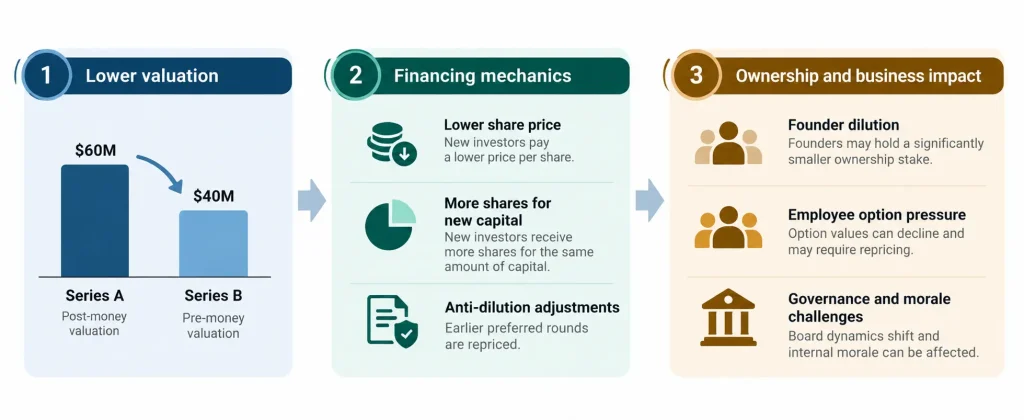
In venture capital, valuation works as narrative currency, signaling momentum and investor confidence. A down round happens when a private company raises new funding at a lower per-share price than in its prior round. The arithmetic is simple, but the consequences ripple through the cap table and the culture of the company.
A Simple Down Round Example
| Round | Capital Raised | Pre-Money Valuation | Post-Money Valuation |
| Series A | $10M | $50M | $60M |
| Series B | $15M | $40M | $55M |
Because the Series B pre-money valuation of $40M sits below the Series A post-money valuation of $60M, Series B investors pay a lower price per share, even though the company raises more money. The market has implicitly marked the business down.
The Core Mechanics
Two levers drive the underlying mechanics: price per share equals pre-money valuation divided by fully diluted shares, and a lower price means new investors receive more shares for the same capital. Existing shareholders end up owning a smaller slice of a company valued at less, a dual compression of both value and control.
How Down Round Financing Reshapes the Cap Table
A lower price is rarely the end of the story for the cap table. It sets off a chain of contractual adjustments that shift economic pain toward common shareholders.
Anti-Dilution Provisions Activate
Most venture investors hold anti-dilution protection, which preserves their economic position when prices fall. A full ratchet reprices all earlier shares to the new price, while a weighted average adjustment considers both the new price and the number of new shares issued. If an investor holds 1M shares bought at $1 and the new round prices at $0.50, a full ratchet effectively doubles the investor’s share count on conversion, whereas weighted average produces a more moderate adjustment. Either way, the burden falls mainly on founders, employees, and unprotected early investors.
Cap Table Disruption and Option Repricing
The cap table absorbs the reset in three main ways:
- New investors receive more shares for each dollar invested
- Anti-dilution clauses reprice earlier preferred rounds
- An option pool expansion is often required to retain talent
A founder holding 20% before the round may hold 10% or less afterward, and employee options can sink deep underwater. The 409A valuation used to price options must also be reassessed. A lower valuation allows cheaper grants for new hires but leaves existing grants nearly worthless unless repriced, and repricing can create accounting charges and shareholder disputes.
Convertible Instruments and Cram Downs
SAFEs and convertible notes typically convert at the valuation cap, which may sit well below the round price, or at a discount such as 20%. Uncapped SAFEs and misalignment between noteholders and equity holders can magnify dilution, so every conversion needs careful modeling. In extreme cases, the financing becomes a cram down, where existing investors keep their terms only if they participate, non-participants convert to common or face heavy dilution, and founders may receive a fresh 5% to 10% stake as an incentive. Cram downs reset the cap table entirely and are painful, though sometimes necessary.
Signaling, Morale, and When a Down Round Makes Sense
Optics matter in venture markets, where a lower valuation can signal missed milestones, weak investor confidence, poor strategic fit, or inefficient use of capital, and competitors and the press may amplify that message. Inside the company, morale often drops, attrition rises, and leadership attention narrows to survival. Strong leaders reframe the event as a recalibration and a new baseline rather than an indictment.
Not every down round is a failure, and several situations make one a rational choice:
- Extending runway in turbulent markets
- Bringing in strategic investors
- Correcting an overly aggressive past valuation
A company that raised at $1B on thin traction may sensibly raise at $500M to reset expectations and realign for sustainable growth. Structuring a $37M raise across equity and venture debt at a mission-driven education institution showed how much the framing and mix of instruments shape how stakeholders read any financing event.
Governance and Strategic Implications of a Down Round
How leadership responds to a down round often determines whether the company stabilizes or slides into decline. The table below summarizes the main implications and practical responses.
| Area | Risk | Recommended Response |
| Governance | Investors seek more board seats, protective provisions, and CEO replacement rights | Negotiate balanced representation, independent directors, and clear performance metrics |
| Future investor perception | The round may signal fragility or desperation and raise burn rate questions | Build a coherent narrative on why it happened and what it enables |
| Talent retention | Equity that felt aspirational becomes worthless on paper | Reprice carefully, issue new grants, and add retention bonuses or performance acceleration |
| Founder incentives | Heavy dilution removes the founder’s economic motivation | Use carve-outs, milestone-based equity, and dual vesting re-up packages |
| Convertible debt maturity | Conversion disputes, cap table distortion, and insolvency risk | Renegotiate early, extend maturities for participation, and model conversions openly |
| Fiduciary duties | Favoring preferred holders invites litigation from common | Obtain fairness opinions, disclose robustly, and avoid unjustified insider advantages |
Bridge Rounds Versus Priced Down Rounds
A bridge round, often uncapped or carrying a low cap, can sometimes beat a full priced down round. It carries less signaling risk, executes faster, and delays revaluation until KPIs improve. Bridges still create overhang and need full disclosure, however, because noteholders may demand too much and an implicit down round can still loom.
A Chance to Clean the Cap Table
The reset can also simplify a messy cap table. Converting old SAFEs, eliminating dormant option grants, and realigning shareholder classes all improve future fundability and exit potential, so founders should treat the reset as a restructuring opportunity.
Recovering After Down Round Financing
After down round financing closes, the strategic focus must shift to re-earning valuation credibility, with a flat or up round as the next goal. The recovery cycle below shows how that focus translates into operating rhythm.
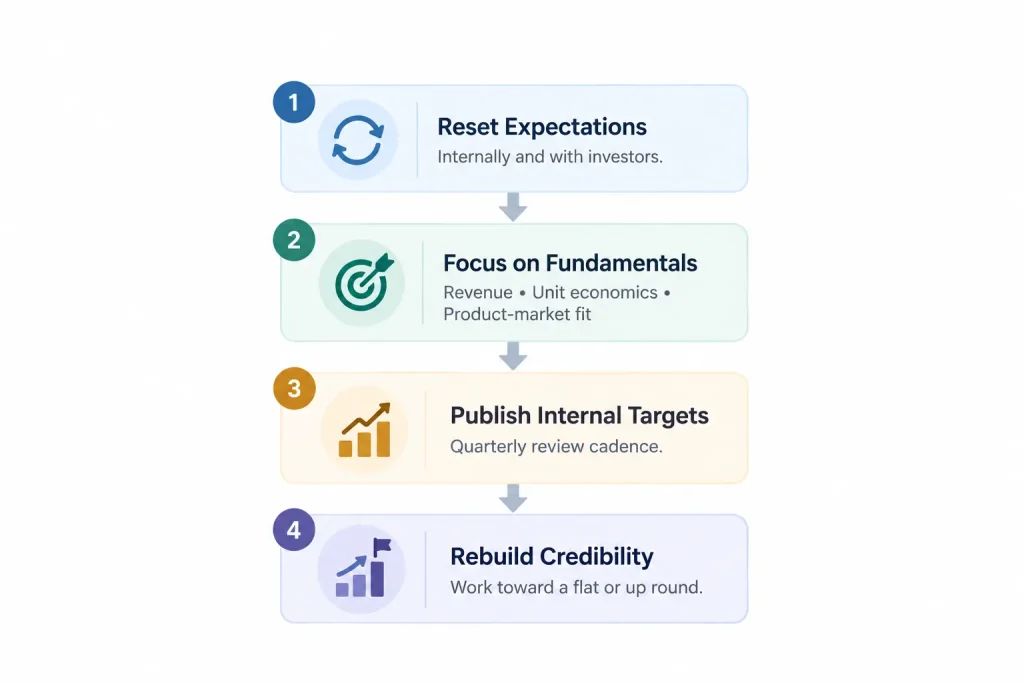
Capital efficiency sits at the heart of recovery. An early-stage digital marketing SaaS company that cut monthly burn from $800K to $200K shows how decisive cost action can stabilize a business and restore investor confidence. Forecast reliability matters just as much, and a cybersecurity company that held actuals within plus or minus 5% of forecast for 8 consecutive quarters illustrates the kind of predictability that rebuilds trust with a board.
Down rounds do not destroy companies on their own; denial, miscommunication, and poor leadership do. Square, for example, went public at a lower valuation than its last private round and still built a durable public company. Founders who treat the reset as a strategic realignment, execute with discipline on the new capital, and protect investor trust as a fragile but renewable resource can turn a down round into a re-founding moment.
Three Key Takeaways
- A down round compresses both value and control, so founders should model anti-dilution adjustments, option pool expansion, and convertible conversions before agreeing to terms.
- Governance demands, talent retention, and fiduciary duties all intensify during down round financing, and balanced boards, thoughtful repricing, and transparent disclosure limit lasting damage.
- Recovery depends on capital efficiency, credible forecasting, and a clear narrative, which together rebuild investor trust and position the company for a flat or up round.
Disclaimer: This article is intended for informational purposes only and does not constitute legal, tax, or accounting advice. You should consult your own tax advisor or counsel for advice tailored to your specific situation.
Hindol Datta is a four-time CFO and senior finance executive with over 25 years of leadership experience across cybersecurity, SaaS, gaming, logistics, digital marketing, medical devices, consumer products, and nonprofit organizations. He has led more than $120M in fundraising and over $150M in M&A transactions while building the financial and operational systems that let complex businesses scale with confidence. He is the author of seven books in the Systems CFO Series and holds active CPA, CMA, and CIA credentials.
AI-assisted insights, supplemented by 25 years of finance leadership experience.