
Executive Summary
Board representation for minority investors is the mechanism that turns a minority stake from a passive financial claim into a working voice in how a company reads risk, frames strategy and reports results. Without a seat, an investor infers direction from periodic updates, while a seat structured with care and exercised with restraint supplies the signal needed to judge performance and decide on follow-on capital.
The sections below explain why the seat carries such weight, how to design board rights, how boardroom behavior shapes influence, and which ethical duties come with the role, drawing on experience across venture-backed, public and mission-driven organizations.
Why a Board Seat Is the Real Price of Minority Capital
The Asymmetry Behind Every Minority Stake
Minority investing rests on an asymmetry that no spreadsheet resolves, because investors commit capital without control and carry risk without authority over execution. Negotiations concentrate on valuation, liquidation preferences and anti-dilution protection, yet the term that shapes how the others play out is the right to sit at the table. Preferred shares entitle an investor to outcomes but not to process, and process is where companies create or lose value.
For that reason, influence in a minority position flows from placement more than from percentage, since a seat is the channel through which information arrives and investors exercise oversight.
The Cost of Governing Without Visibility
Minority investors without board representation face an epistemic handicap, since they cannot tell whether a missed quarter reflects market forces or managerial drift, nor whether a strategic pivot is real or narrative spin. Forecasts turn into guesses, follow-on decisions become acts of faith, and escalation becomes the only available lever.
In a venture-backed digital marketing company that raised $36.5M across three rounds while revenue grew from $9M to $180M, the investor conversations that carried the most weight rested on the customer acquisition cost, lifetime value and contribution margin data behind the growth.
Earning a Seat Instead of Claiming It
A 5% minority stake may not justify a seat on entitlement alone, though strategic expertise, reputational capital or the capacity to lead future rounds can change that judgment. A board seat is therefore a resource allocation decision and a cooperative move in a repeated game, granted because the investor sharpens governance and not as tribute for a check. The negotiation should reach beyond thresholds to the questions below.
- Does the seat carry committee rights, an observership or veto thresholds?
- Can the investor contribute without dominating or disrupting the culture?
- What does the company gain from this person beyond capital?
Without answers, both sides drift into a relationship defined by inertia, with a crowded board and a diluted agenda. Not every investor deserves a seat, and every investor who receives one should earn it through clarity of contribution.
Structuring Board Representation Rights in Minority Investments
Governance rights often begin as loose agreements, with an observer right and an informal expectation of elevation, yet the cost of ambiguity compounds as the company scales and decisions begin to outpace representation.
Triggers, Scope and Duration
Three design questions deserve explicit answers before anyone signs a term sheet.
- Triggering asks whether representation arrives with the investment or upon a threshold, and capital conditioned on future rounds or industry insight may outweigh the percentage held.
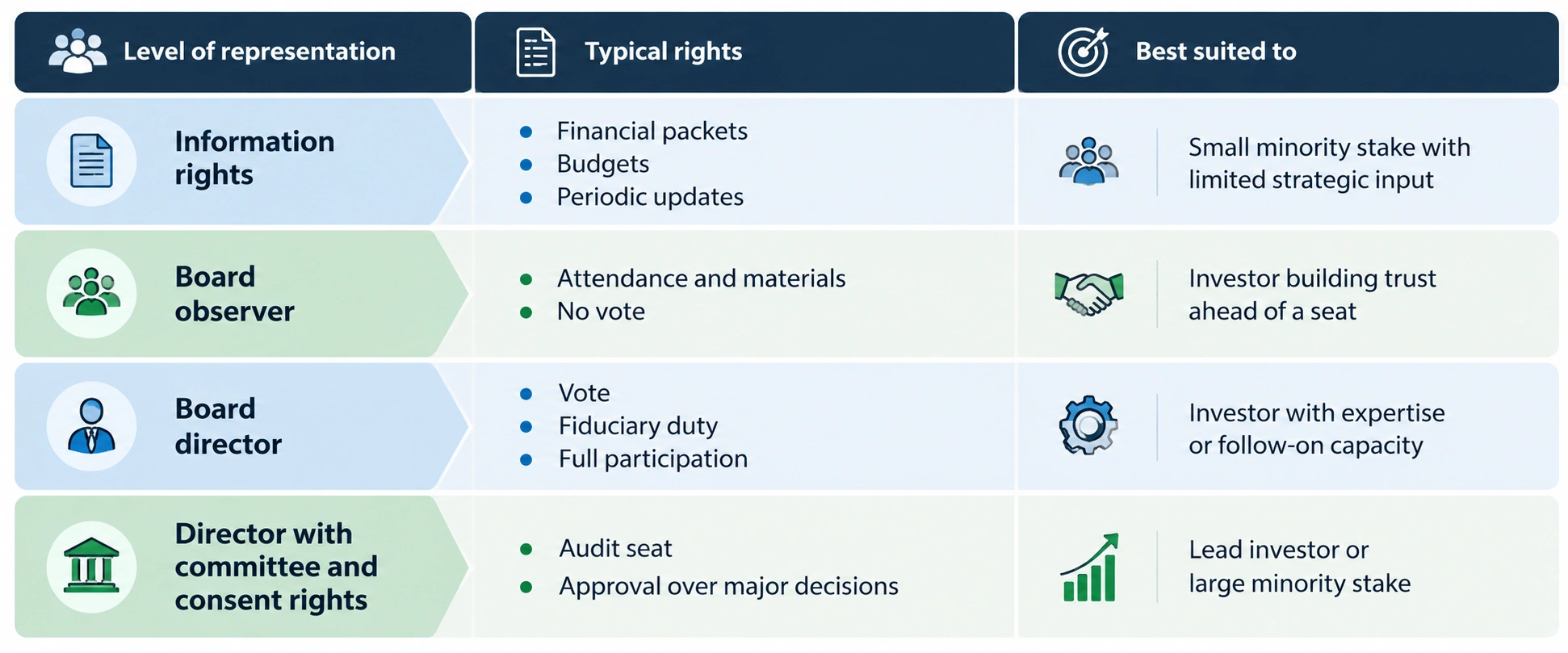
- Scope recognizes that governance runs along a spectrum, and a seated director can be sidelined in executive sessions while an observer with strong information rights shapes outcomes.
- Duration addresses whether rights lapse when equity falls below a threshold, a provision that can discourage secondary sales and leave governance vacuums at critical transitions.
Tying rights to strategic role instead of raw equity offers stability, though it raises the question of whether influence should persist after financial exposure diminishes. The table below summarizes the common rungs on the ladder of representation.
Pluralism and the Dual Fiduciary Line
When several minority investors compete for limited seats, rotation or expansion solves the politics while eroding effectiveness, because a bloated board turns performative. Consolidation works better, with one seat standing for a class of investors and shared information flows preserving the collective voice.
A seated investor still walks a dual line, as a fiduciary to the company and a loyal representative of a fund. In a public gaming company where $100M+ in cross-border M&A demanded constant board engagement and audit oversight, that duality sharpened during diligence and integration. Directors should state whether they speak as fiduciary or as fund representative and recuse themselves when they cannot separate the two.
How Minority Investors Build Influence in the Boardroom
Epistemic Humility and the Questions That Frame Decisions
A term sheet grants a seat, yet behavior shapes its usefulness. A director with full voting rights can carry little weight while an observer shapes outcomes through insight, tone and timing, so early meetings reward questions over instruction.
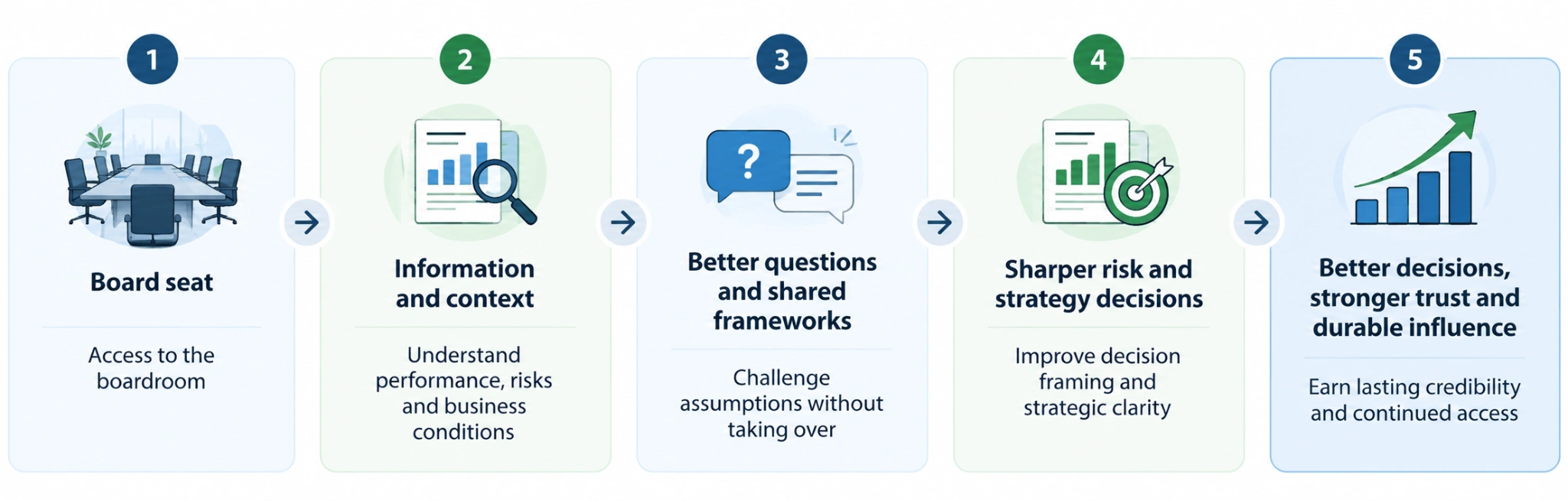
Constructive inquiry builds credibility because a question such as “What would have to be true for this plan to work?” introduces counterfactual reasoning, and another such as “What bet sits behind this initiative?” moves the conversation from narrative to risk calibration. The vocabulary a director introduces outlasts any single vote, which makes this soft power more durable than contractual control. The sequence below shows how a seat compounds into influence.
Pressure, Timing and the Signal a Board Sends
During missed quarters, customer losses and macro shocks, the board becomes a signal amplifier because management reads its reaction as a verdict on reality, so a director who separates controllable from uncontrollable variance preserves coherence.
Influence is rarely exerted in the vote itself and more often in the private conversation or the memo of questions sent ahead of the meeting. Raising $37M in equity and venture debt for a mission-driven education institution, while owning the investor narrative and audit committee engagement, showed how much of a board outcome is settled before the agenda is printed. The power of representation is therefore inversely related to how visibly it is used.
Ethical Duties of an Investor Holding a Minority Stake
Seeking the Truth and Speaking It
Directors owe the company a search for the truth of the business and not merely the version curated for investors. A buy-side analysis of an IT services acquisition, where quality-of-earnings work exposed material EBITDA adjustments and showed where reported earnings diverged from economic reality, illustrates the discipline. The task is to compress data without distortion and to name dissonance, for example by saying that a metric no longer describes what it once did. Silence in the boardroom is abdication and not neutrality.
Aligning Fund Horizons with Company Arcs
Funds have fixed lives while companies do not, and that mismatch creates pressure to accelerate revenue, defer costs or frame an exit before foundations are built. Whether to support a sale that benefits the fund but stunts long-term potential, or back a bridge round that avoids a down mark but burdens the cap table, are stewardship questions that no charter answers. A company must deserve the next round and not merely survive this one.
Clarity and Principled Dissent
A chief executive cannot operate amid concealed dissent, so directors should say plainly when they support a plan, voice doubts early and declare when they abstain, which reflects integrity and not weakness. Cohesion is not consensus, and a minority investor must preserve the right to dissent when assumptions no longer hold. Board representation is not a right to monitor but a chance to steward, and the power in the seat is the trust that flows through it.
Three Key Takeaways
- Board representation for minority investors should be justified as a resource allocation decision, with triggers, scope and duration agreed in advance, because a minority stake without clear governance rights leaves capital exposed to signals the investor cannot read.
- Influence comes from the quality of questions, the timing of conversations and composure under pressure, so minority investors who ask before they instruct build authority that outlasts any single decision.
- A seat carries fiduciary and ethical weight, which means directors must speak with clarity about their role, align fund horizons with the long-term arc of the company and dissent in a principled way when a strategy stops holding together.
Disclaimer: This article is intended for informational purposes only and does not constitute legal, tax, or accounting advice. You should consult your own tax advisor or counsel for advice tailored to your specific situation.
Hindol Datta is a four-time CFO and senior finance executive with over 25 years of leadership experience across cybersecurity, SaaS, gaming, logistics, digital marketing, medical devices, consumer products, and nonprofit organizations. He has led more than $120M in fundraising and over $150M in M&A transactions while building the financial and operational systems that let complex businesses scale with confidence. He is the author of seven books in the Systems CFO Series and holds active CPA, CMA, and CIA credentials.
AI-assisted insights, supplemented by 25 years of finance leadership experience.