
Executive Summary
Most operational improvement initiatives fail to move the needle because leaders design them for optics rather than leverage. Dashboards multiply and programs launch, yet throughput rarely changes in any lasting way.
This article sets out a four-part playbook for operational improvements that compound over time. It covers diagnosing the true constraint, designing asymmetric interventions, building learning loops, and respecting the ethics of change. Finance and operations leaders will find a practical lens for choosing fewer initiatives and executing them with precision.
Why Most Operational Improvement Initiatives Fail
Investor decks promise synergies and value unlocked through transformation, yet those phrases ring hollow without intelligent action. Factories have come back to life through better work-order design instead of fresh capital. Sales teams have tripled conversion rates by removing two clicks from a CRM workflow.
Such cases point to a hard truth about operational improvement: initiatives rarely fail from bad intent, and far more often from epistemic laziness. They confuse visibility with control and process with progress. What separates needle-movers from busywork is strategic precision, the ability to identify which levers shift the center of gravity.
Three Principles Behind Needle-Moving Change
Three principles shape where improvement effort should go before leaders reach for any template. Each one corrects a common bias in how organizations approach change.
- Context over convention: a procurement fix that works in a centralized wholesaler may collapse in a distributed service network.
- Simplicity over sophistication: a plant manager may cut scrap by 20% through better shift rotation, with no software involved.
- Intelligence over activity: the best operational improvements make the organization smarter about its own friction, so learning compounds into advantage.
A Four-Part Framework for Lasting Change
The playbook unfolds across four connected stages, and each stage feeds the next. Learning from the final stage loops back to sharpen the next diagnosis.
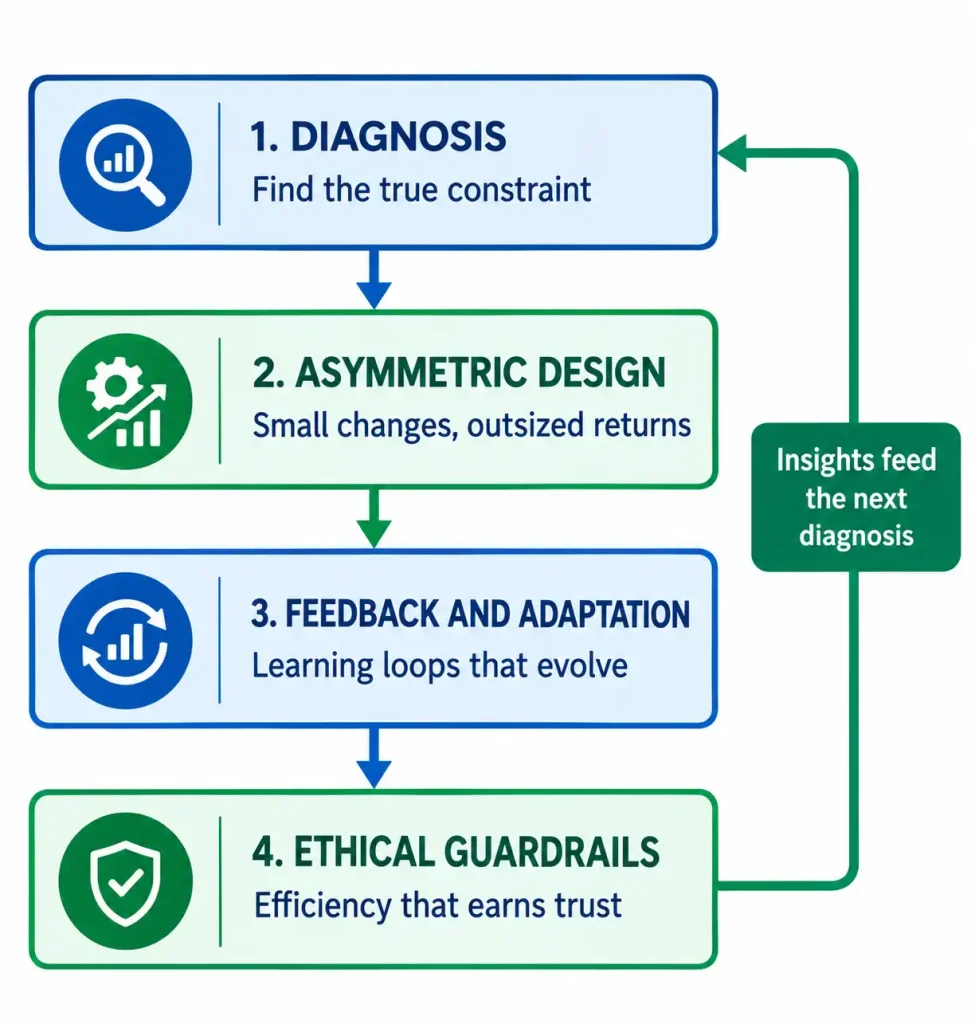
Diagnosis: Finding the True Constraint Behind Operational Improvement
Diagnosis is the fulcrum of operational improvement, not a preliminary formality. Get it wrong, and no amount of executional brilliance will save the initiative. When diagnosis is right, even modest interventions resonate through the organization like a tuning fork.
Many enterprises still treat diagnosis as a quick scan of dashboards followed by a declaration that costs are too high. Metrics lie by omission, showing only what someone chose to track. Teams may blame rising churn on pricing when onboarding friction is the real cause.
Systems Thinking and Operational Ethnography
Every organization is a network of parts linked by process, information, and incentives. A billing delay may originate in Sales Ops failing to mark a deal as closed, not in Accounts Receivable. Constraints live in silent queues and organizational ambiguity, so slow product development may trace to a deadlocked product council rather than a shortage of engineers.
Surfacing such issues requires operational ethnography: shadowing schedulers, walking the floor, and watching escalations in real time. Near-misses and routine workarounds reveal more than quarterly KPIs ever will. A professional services firm that scaled from $12M to $63M in revenue across five business units offers a useful example. Engagement-level profitability analytics showed where margin was created and where it was quietly leaking.
Classifying the Constraint Before Acting
A true constraint governs throughput, and fixing anything else delivers marginal impact. The Theory of Constraints treats improvement without constraint focus as waste. Timing matters too, since today’s bottleneck may not persist into next quarter.
| Constraint Type | Typical Example | Appropriate Response |
| Transient | Seasonal service backlog or a temporary ERP disruption | Monitor closely and avoid structural intervention |
| Chronic | Recurring handoff delays between sales and billing | Targeted process fixes and clear ownership |
| Structural | Governance design that stalls key decisions | Redesign decision rights or workflow architecture |
A CFO must also read power flows alongside process flows, because a threatened function will steer the diagnosis toward someone else’s shop. Naming the real constraint is a moral act that demands honesty and a culture where inconvenient truths are safe to speak.
Designing Operational Improvements for Asymmetric Returns
Every system resists change through memory, hierarchy, and sunk emotional capital. The goal is asymmetry, meaning an intervention that yields disproportionate return relative to its implementation friction. Sweeping transformations impress leadership, yet well-placed marginal interventions tend to outperform them.
Consider a B2B services firm with inconsistent contract margins. Instead of a pricing overhaul, the firm could redesign its proposal template to flag low-margin line items in real time. A required pricing manager override then creates friction at the point of error, without new systems or retraining.
Principles of Asymmetric Intervention Design
Several design principles separate interventions that stick from those that stall. Each one respects the real load that frontline teams already carry.
- Constraint-aware sequencing: size each change to the absorption capacity of the front line, not to leadership ambition.
- Modularity: interventions that deploy independently allow learning, rollback, and parallel experiments.
- Social levers and legibility: autonomy over shift swaps signals trust, and every change must make sense to the people executing it.
- Path dependency leverage: change flows best through existing channels, such as an upcoming SKU rationalization.
- Graceful degradation and co-ownership: simple designs fail safely, and teams protect what they help shape.
A $127M global consumer products company shows path dependency at work. Demand planning, SKU rationalization, and logistics changes lifted inventory turns from 3x to 7x by riding existing planning cycles. In a cybersecurity and identity SaaS company spanning five country entities, a phased NetSuite rollout compressed the monthly close from 18 days to 10. Designing operational improvements this way means doing the right less, with small bets placed where throughput is blocked.
Building Feedback Loops That Sustain Operational Excellence
Change is a direction, not a destination, and believing otherwise is the fallacy of finality. People rotate, incentives shift, and edge cases accumulate until even great designs drift toward entropy. Operational excellence therefore depends on evolution, and evolution depends on learning loops.
A dashboard is not a feedback loop, since it shows variance without closing it. Picture a logistics firm whose new routing algorithm cuts delivery times by 8%, until drivers start overriding it. Only ride-alongs and exception analysis will reveal whether the system is blind to real conditions.
What Makes a Learning Loop Effective
Effective learning loops follow a repeatable cycle that turns raw signals into changed behavior. The flow below shows how each step hands off to the next.
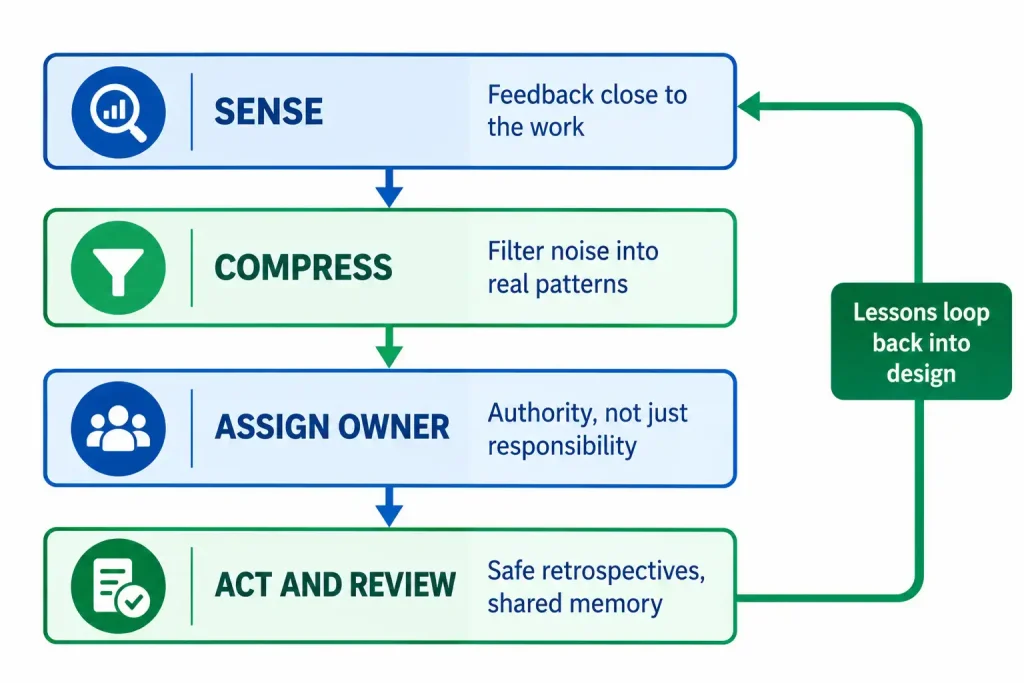
Feedback must sit close to the work and be compressed into the patterns that matter. Every signal needs an owner with the authority to act. Loops must also feel safe, because fear distorts data at the source and teaches teams to game metrics.
Leaders need both leading and lagging indicators, since an onboarding redesign may reduce attrition only months later. A $30M ARR cybersecurity company held actuals within plus or minus 5% of forecast for 8 consecutive quarters through this kind of rhythm. Feedback must ultimately loop back into design, because every system contains its own obsolescence.
The Ethics of Operational Improvement
Every operational improvement promises a system that works better, faster, or cheaper. Yet improvement is never neutral, because it alters human experience and reorders effort. Each gain forms a triangle of cost, benefit, and burden, and the burden often falls unexamined on people.
A call center may cut average handle time with rigid scripts and auto-termination thresholds. The charts improve, but agents feel mechanized, customers feel dismissed, and turnover spikes. A warehouse that installs cameras and pressure sensors may see workers dodge algorithms instead of improving throughput.
Questions That Keep Efficiency Humane
The issue in both cases is intentionality, not technology. Leaders can test every proposed change against four practical questions:
- Does this change increase human agency, or reduce it?
- Will it reward learning, or punish deviation?
- Does it create transparency, or surveillance?
- Would it treat the organization as a machine, or as a community of intent?
Toyota’s Andon cord shows the alternative in practice. Any worker can pull it to stop the production line on spotting a defect. It introduces delay, yet it tells each worker that their judgment matters as a steward of quality.
Why Operational Improvement Belongs on the Board Agenda
Moral legitimacy is an operational asset, and wise leadership sometimes means declining a gain that is possible but not worth its human cost. For the CFO and COO, operational improvement is a board-level concern because of its cultural signal, not only its cost impact. When leaders name a true constraint and respect values, the needle does more than move. It learns where to go next.
Three Key Takeaways
- Lasting operational improvement starts with naming the true constraint that governs throughput, which requires systems thinking, time on the floor, and the courage to read power flows.
- Small, well-placed interventions outperform sweeping transformations when they are modular, legible, and co-owned by the people who carry them out.
- Sustained operational improvements depend on safe, proximate feedback loops and ethical design, because systems that earn trust keep learning long after the project ends.
Disclaimer: This article is intended for informational purposes only and does not constitute legal, tax, or accounting advice. You should consult your own tax advisor or counsel for advice tailored to your specific situation.
Hindol Datta is a four-time CFO and senior finance executive with over 25 years of leadership experience across cybersecurity, SaaS, gaming, logistics, digital marketing, medical devices, consumer products, and nonprofit organizations. He has led more than $120M in fundraising and over $150M in M&A transactions while building the financial and operational systems that let complex businesses scale with confidence. He is the author of seven books in the Systems CFO Series and holds active CPA, CMA, and CIA credentials.
AI-assisted insights, supplemented by 25 years of finance leadership experience.