
Executive Summary
The equity bridge connects the negotiated enterprise value of a business to the equity check a buyer funds at close, and few deal mechanics shape the final price as quietly or as powerfully. Behind its simple arithmetic sit competing assumptions about cash, debt, working capital, and the future behavior of the business.
This article explains how an equity bridge works, why each line item becomes a point of negotiation, how bridge decisions echo long after closing, and what disciplined financial judgment looks like in its construction. CFOs, deal teams, and investors will find a practical framework for building bridges that hold up under post-close scrutiny.
What an Equity Bridge Does in Transaction Structuring
Enterprise value answers what a business is worth, while equity value answers what a buyer must pay today. The equity bridge reconciles the two, translating a forward-looking valuation into a present-day commitment conditioned on balance sheet facts.
The term deserves a quick clarification, because equity bridge financing refers to something different. In equity bridge financing, a lender provides a short-term facility that funds a sponsor’s equity commitment until investor capital arrives. The valuation bridge discussed here is the reconciliation schedule inside a purchase agreement, although both share a common purpose of turning commitments into funded cash at close.
Why the Equity Bridge Is a Dynamic System
Treating the bridge as a plug-and-play template copied from a banker’s deck is a common mistake. Its components carry different kinds of information, since some look backward, some lean forward, and some depend on judgment more than accounting. A small change in the working capital definition can cascade through purchase price, covenants, escrows, and IRR, which makes the bridge path-dependent and sensitive to its initial assumptions.
As a deal approaches close, information also degrades. Diligence findings pass through too many hands, and crisp definitions decay into loose terms such as “normalized,” “recurring,” and “debt-like,” which carry little rigor but enormous capital impact. The equity bridge often becomes the last line of defense against that drift.
How the Equity Bridge Translates Enterprise Value into Equity Value
The canonical equity bridge starts with enterprise value, subtracts net debt, adjusts for working capital against an agreed target, and may also capture tax liabilities, customer prepayments, and other debt-like items, following the standard sequence shown below.
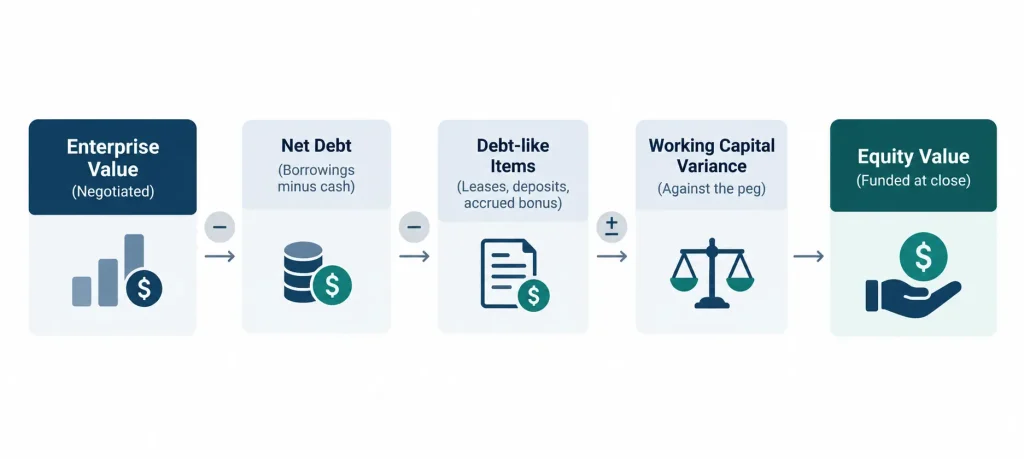
None of these line items is a passive input. Each reflects an interpretation of the past and, more dangerously, a forecast of post-close behavior. Does the business routinely carry excess inventory, stretch vendors to cover cash shortfalls, or show balances distorted by seasonality? Every answer updates the buyer’s view of what is being acquired.
The Equity Bridge as a Behavioral Driver
Bridges do not simply map one value to another; they change behavior. Sellers who know a working capital shortfall will cut proceeds may delay payables, accelerate receivables, and trim inventory in the final months of ownership. A stable business can look volatile just before close, not from real change but from predictable responses to the incentives the bridge creates.
Small Classifications, Outsized Consequences
When a leveraged buyout rests on a modest equity check, or rollover equity is sized carefully for tax reasons, a $1M misclassification can trigger IRR distortion, escrow tension, and litigation. Quality-of-earnings work on an IT services acquisition illustrates the point, since adjustments that separated reported earnings from economic reality directly changed the buyer’s view of value and integration risk.
Despite this leverage, the bridge often gets negotiated last, after headline value is agreed. That sequencing is backward, because the bridge frequently reveals more about a deal’s real assumptions than any multiple or discounted cash flow. There is no single true net debt number, only a defensible range, so the CFO’s task shifts from false accuracy to deliberate judgment.
Negotiating the Equity Bridge: Signals and Incentives
Each component of the equity bridge becomes a negotiation over worldview rather than arithmetic. The table below summarizes how buyers and sellers typically frame the main items.
Equity Bridge Components and Competing Positions
| Bridge Component | Typical Seller Position | Typical Buyer Position | What Is Really Being Negotiated |
| Cash | Excess cash reflects efficient operations and belongs to the seller | Cash is needed for post-close stability or reflects deferred spending | Confidence in normalized operations |
| Debt | Only formal loans and credit lines count | Anything that behaves like debt under stress counts | Downside protection |
| Debt-like items | Accrued vacation and employee earnouts are operating costs | Leases, deposits, bonuses, and contingencies reduce equity | Hidden future cash drains |
| Net working capital | Trailing balances show a lean, efficient business | A normalized peg must reflect seasonality and pre-close gaming | Which version of “normal” prevails |
A seller calling $8M of cash “excess” signals confidence in efficiency and seasonality, while a buyer contesting it discounts the story the balance sheet tells. Deferred revenue raises similar questions, since it may be a liability or a sign of customer loyalty depending on perspective.
Net Working Capital and the Peg
Net working capital reveals the bridge’s most intricate dynamics. Buyers respond to pre-close optimization by demanding a working capital peg drawn from trailing twelve-month averages or seasonal trends. Sellers hold an information advantage about operating rhythm, while buyers rely on diligence conducted under time pressure, so the outcome is an acceptable approximation rather than a single truth.
Practical experience with working capital sharpens this negotiation. At a $127M global consumer products company, lifting inventory turns from 3x to 7x showed how much cash can hide in operating balances, and how differently two parties might define a normal level.
Lenders, Governance, and Complexity
A tightly negotiated bridge gives lenders comfort about leverage and downside risk, while a loose one raises perceived volatility and the cost of capital. The CFO must therefore orchestrate trust across all stakeholders, not only the counterparty. Complexity carries its own risk, however, because a bridge crowded with exceptions turns from a map into a maze. Knowing when a $500K working capital dispute could damage a $200M relationship is part of that judgment.
Post-Close Consequences of the Equity Bridge
The equity bridge does not end when the wire hits. Its assumptions resurface in post-close life in several predictable ways:
- Working capital true-ups that trigger claims, escrow releases, or earnout effects
- Disputes over definitions such as “debt-like items” or “cash equivalents”
- Undisclosed obligations, such as accrued customer rebates, that surface as cash drains
- Audit committee questions about whether a risk was priced or inherited
- Covenant calculations affected by bridge classifications
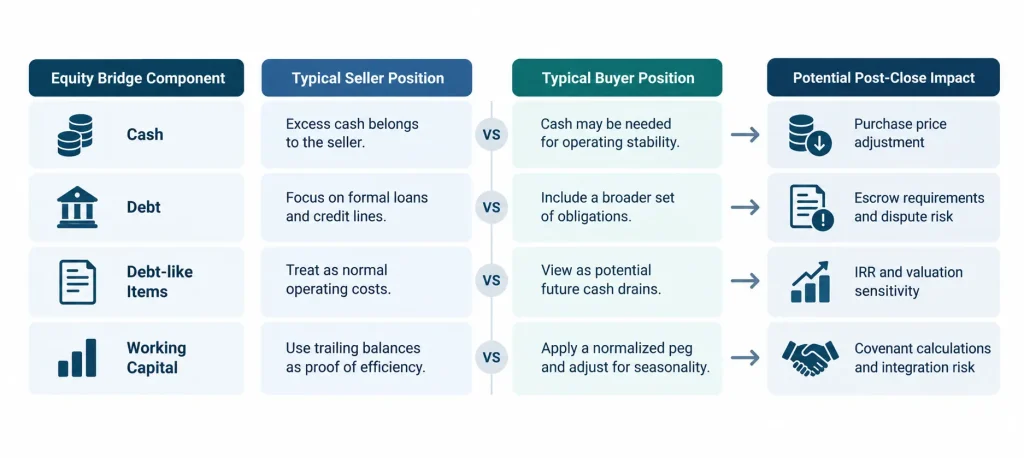
A peg agreed under uncertainty becomes a benchmark of accountability, and because no peg captures variance perfectly, it can breed resentment on both sides. The language of the bridge migrates from the data room into the ERP system, where its meaning either survives or erodes. Leading post-merger integration across more than $100M in cross-border acquisitions for a publicly listed gaming company showed how much smoother integration runs when finance teams can trace every bridge adjustment back to a documented definition.
Culture, Investors, and Trust
Unexpected liabilities or aggressive claims can turn a cooperative deal adversarial and push integration teams into defensive postures. Narrow tolerances can breed a culture of suspicion, while loose, principle-based terms may leave the buyer without remedies for genuine surprises. Equity investors judge the first year against expectations, and a misestimated net debt item, a working capital dispute, or tied-up escrow quickly becomes a verdict on management’s stewardship.
Judgment, Uncertainty, and Equity Bridge Discipline
Every equity bridge compresses a complex, moving business into a model of exchange, and that compression always discards information. The bridge is a model rather than the business itself, and it remains vulnerable to false precision and unacknowledged uncertainty. Questions such as how to value net debt with irregular cash sweeps, or how reliable a peg drawn from a period of supplier distress might be, are questions of belief as much as accounting.
The strongest bridges come from calibrated teams rather than confident ones. Calibrated teams update their views with each diligence finding and seek defensible convergence instead of perfection. Disciplined equity bridge construction rests on a few principles:
- Negotiate bridge definitions early, alongside headline value
- Anchor working capital pegs in documented seasonal analysis
- Use standard, coherent definitions rather than convenient ones
- Declare uncertainty openly, even when it weakens a negotiating position
- Document every adjustment so post-close teams can trace it
- Walk away when a bridge works more as camouflage than conduit
Decisions buried in bridge footnotes, such as whether a customer deposit counts as working capital or a tax refund counts as cash, often matter more than the headline valuation. Built with integrity, the equity bridge lets two parties carrying different uncertainties meet on terms both can call value.
Three Key Takeaways
- An equity bridge is a behavioral system as much as a calculation, so every definition of cash, debt, debt-like items, and working capital should be tested for the incentives it creates before close.
- Negotiating the equity bridge early, with documented pegs and coherent definitions, prevents the post-close disputes, escrow delays, and trust erosion that weaken integration and investor confidence.
- Sound bridge construction depends on calibrated judgment, transparency about uncertainty, and the willingness to walk away from structures designed to obscure rather than clarify.
Disclaimer: This article is intended for informational purposes only and does not constitute legal, tax, or accounting advice. You should consult your own tax advisor or counsel for advice tailored to your specific situation.
Hindol Datta is a four-time CFO and senior finance executive with over 25 years of leadership experience across cybersecurity, SaaS, gaming, logistics, digital marketing, medical devices, consumer products, and nonprofit organizations. He has led more than $120M in fundraising and over $150M in M&A transactions while building the financial and operational systems that let complex businesses scale with confidence. He is the author of seven books in the Systems CFO Series and holds active CPA, CMA, and CIA credentials.
AI-assisted insights, supplemented by 25 years of finance leadership experience.