
Executive Summary
Fund managers decide portfolio construction in private equity during the investment period. In this finite window, conviction turns into allocation across the portfolio. Every commitment becomes a permanent expression of belief about sector, management, and timing. Unlike public positions, private holdings offer no easy way to rebalance. Investment portfolio construction therefore depends on pacing, diversification, reserves, and the quality of judgment applied under uncertainty.
This article examines deployment pacing, portfolio shape, incentive distortion, and adaptive decision making. The article closes with three takeaways for CFOs, CIOs, and managing partners. Each one helps build portfolios that endure scrutiny, not ones that only deploy capital.
Why the Investment Period Shapes Portfolio Construction
Many fund managers treat the investment period as an administrative window. In practice, it works more like an arena where strategy meets real markets, real management teams, and a running clock. A fund typically has about five years to assemble a coherent, resilient portfolio, and the work is never a simple optimization problem. It is a set of interdependent constraints that move together.
- Capital that is limited and committed in irreversible increments
- Team bandwidth for sourcing, board service, and operating support
- Sector cycles and valuation environments that shift between year one and year four
- The psychological inertia created by early wins or early doubts
Pacing Capital Deployment Across the Cycle
In portfolio construction, pacing is a strategic rhythm and not a metric. Deploying too quickly risks filling a vintage with deals priced at peak exuberance, while deploying too slowly leaves dry powder idle, compresses hold periods, and erodes DPI just as the next fundraise begins. Deployment pace also shapes IRR and TVPI, and the right curve shifts with the macro regime and fund size.
In a venture-backed digital marketing company that scaled revenue from $9M to $180M in 24 months, the discipline that sustained growth was a contribution margin and customer acquisition cost framework that decided where each marginal dollar went. The same logic applies to a fund, since tempo should follow evidence of advantage.
The Heat Curve and the Sunset Distortion
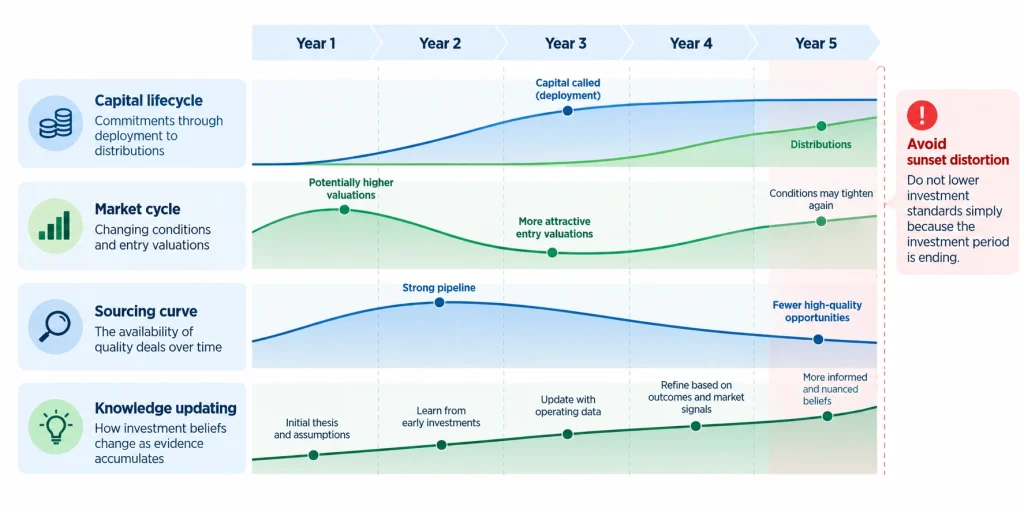
Early in the period, time feels abundant and caution is high. As the clock advances, LP questions about deployment rates, anxious teams, and a thinning pipeline raise the heat, and the challenge is to stay isothermal by holding conviction constant while pressure rises. By the final year many firms rationalize weaker opportunities as too close to let go, which is the sunset distortion. The antidote is deliberate slack, meaning a willingness to finish with dry powder when no opportunity clears the bar.
Four Dimensions to Manage Together
Portfolio construction during the investment period tracks four curves at once.
Portfolio Construction Architecture and Diversification
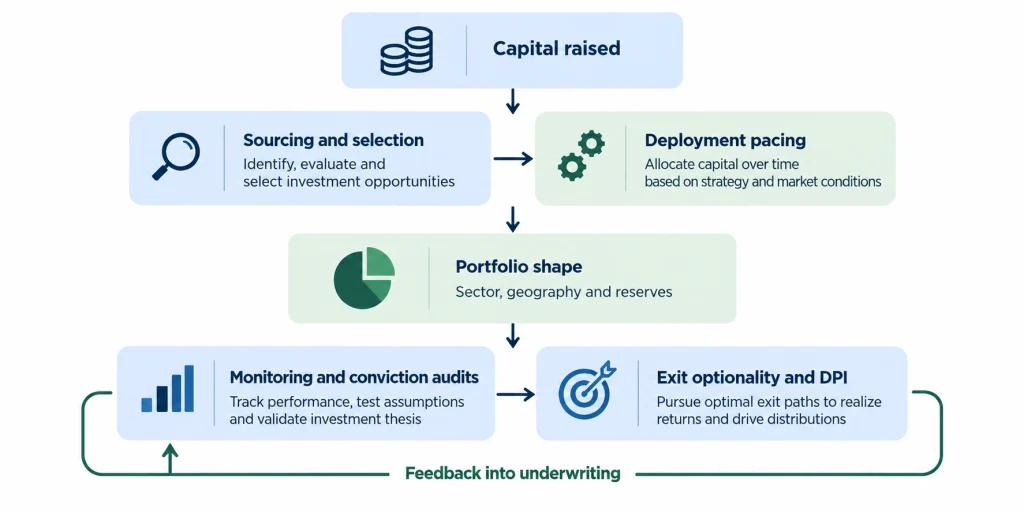
A portfolio is a geometry with shape, weight, and balance, and every new investment shifts its center of gravity. Many firms claim balanced exposure when what they have assembled is a failure to say no. Sound portfolio construction balances correlated failure modes while preserving the ability to generate uncorrelated returns.
How Many Positions Is Enough
In investment portfolio construction, the right number of holdings is the number that matches operational bandwidth and not only the capital base. Ten is not inherently better than eight, because each added deal stretches governance presence and raises cognitive load. Concentration is a philosophy that accepts variance in exchange for insight, yet pure concentration invites single-node failure, so calibrated conviction with enough slack to survive is the target.
During a buy-side review of an IT services acquisition target, quality-of-earnings analysis showed where reported earnings diverged from economic reality. That experience reinforces why selection discipline matters, since a marginal deal does more than dilute returns and can distort the topology of the whole portfolio.
Sector, Geography, and Covariance
Labels such as healthcare, technology, and consumer hide more than they reveal. The better exposure map follows cash flow profiles, regulatory risk, input sensitivity, and exit path variability, because a tech-enabled healthcare provider and a fintech lender can share the same dependence on interest rates and labor costs. Geography adds a similar trap, since new jurisdictions bring tax codes, labor laws, and currency mismatches. The goal is tractability, meaning the ability to make high-fidelity decisions at every node.
Reserves and Exit Optionality
In private equity portfolio construction, reserves are often set mechanically at 20% to 25% of the fund, yet a blunt rule ignores deal performance and sector capital velocity. Scenario-based reserve curves preserve option value, and capital held for follow-ons, pivots, and opportunistic bolt-ons is priced optionality rather than idle cash.
- Stagger expected maturities so that exits do not cluster
- Vary liquidity profiles across the assets held in the fund
- Diversify the buyer universe beyond IPO windows or one strategic cohort
A portfolio should also tell a coherent story. LPs fund theses, so a portfolio that cannot be explained in a single worldview becomes difficult to defend and almost impossible to scale.
Incentives That Distort Portfolio Construction
Incentives rarely shout and instead whisper, reshaping portfolio construction from within over time. A fund that opens with a plan for eight to twelve deals meets a clock that asks about deployment by year two and prepares materials for the next vintage by year three, which turns patient selection into performance optics.
The Tyranny of Mid-Period Velocity
Conviction gives way to cadence when deals passed in year one become acceptable in year three because the institutional need to show progress overruns the standard for quality. The principal-agent problem then sits inside the GP itself, as junior partners chase sourcing credit, mid-level professionals want board seats, and senior partners balance legacy with liquidity.
- Pipeline bias favors deals that are almost there over deals that challenge the thesis
- Carry economics reward early exits, which tilts selection toward short-duration assets
- Narrative anchoring keeps a firm loyal to a theme after the data has weakened
- Career horizon mismatch splits time preferences across the partnership
Designing Against Distortion
Incentives should be modeled as structural inputs to portfolio shape. Compensation can reward investment quality at maturity, pacing can follow strategic readiness instead of calendar targets, and dashboards can track coherence metrics such as correlation risk and attention per asset. A deal graveyard that logs rejected investments and the reasons for rejection reveals drift over time, while a rotating outside voice on the investment committee guards against groupthink.
Adaptive Judgment Within a Fixed Fund Structure
The investment period works best as a Bayesian corridor, a zone of structured experimentation in which each datapoint informs the next decision.
Conviction Audits and Belief Revision
Early deals teach, but only if assumptions are formally revisited. Mid-period conviction audits ask what was believed, what occurred, what was learned, and what changes. They also expose the sunk cost fallacy, where follow-on capital flows to an asset because it is owned and not because the opportunity improved. In an early-stage digital marketing company where monthly burn fell from $800K to $200K, the turnaround began only when assumptions were reopened and tied to explicit thresholds.
Stress Testing, Slack, and Thresholds
Stress testing strengthens portfolio construction by simulating macro, regulatory, and liquidity shocks across the portfolio to reveal cash flow synchronization, key-person risk, and hidden sector coupling. Holding about 30% in reserve for mid-period pivots, secondaries, or emerging theses is dynamic rather than defensive, since many strong deals arrive after year three. Adaptive management is disciplined flexibility, and thresholds make it concrete.
- If three of five early deals underperform internal benchmarks, reopen the sector playbook
- If exit timelines lengthen across several assets, adjust the reserve logic
- Read live dashboards continuously instead of waiting for each quarter
Adaptivity without thresholds becomes improvisation, and thresholds without adaptivity become bureaucracy.
Building Investment Portfolios That Withstand Scrutiny
Strong investment portfolio construction is a temporal choreography of choices bound by constraint, confidence, and course correction. LPs outsource a decision problem too complex to solve internally, and the investment period is where a firm proves through placements that its process can carry that trust. The portfolios that outperform adapt most faithfully to changing truth rather than adhere to the original plan.
Three Key Takeaways
- Treat portfolio construction as a pacing discipline and match deployment pace to evidence of advantage and sourcing bandwidth, and accept ending the investment period with dry powder when no opportunity clears the bar.
- Diversify by cash flow, covariance, and exit path instead of labels, and size the number of positions and reserves to operational capacity.
- Model incentives as structural inputs, run mid-period conviction audits, and set explicit thresholds so that adaptation is disciplined rather than reactive.
Disclaimer: This article is intended for informational purposes only and does not constitute legal, tax, or accounting advice. You should consult your own tax advisor or counsel for advice tailored to your specific situation.
Hindol Datta is a four-time CFO and senior finance executive with over 25 years of leadership experience across cybersecurity, SaaS, gaming, logistics, digital marketing, medical devices, consumer products, and nonprofit organizations. He has led more than $120M in fundraising and over $150M in M&A transactions while building the financial and operational systems that let complex businesses scale with confidence. He is the author of seven books in the Systems CFO Series and holds active CPA, CMA, and CIA credentials.
AI-assisted insights, supplemented by 25 years of finance leadership experience.