
Executive Summary
Many leaders reduce the meaning of finance transformation to a systems upgrade or an accounting team reorganization. The more durable definition concerns how an enterprise decides what it values and measures progress toward it. Financial metrics sit at the center of this shift. They direct attention, shape incentives, and determine where capital flows when strategy changes.
This article explains why inherited metrics undermine strategic capital planning. It also shows how CFOs design, embed, and govern transformation-aligned metrics. Measurement can then become a working instrument of strategy rather than a record of the past.
What Finance Transformation Means in Practice
A finance transformation begins with perception rather than with a reorganization or a strategy offsite. What a firm notices, rewards, and willingly forgoes all follows from the numbers that reach leadership. Over time, the judgment leaders form on those numbers defines the character of the firm. When the metrics are misaligned, no transformation, however eloquent its intent, can take root.
Financial metrics carry unusual force because they sit where credibility meets consequence. Unlike culture statements, they lend themselves to measurement. Unlike operational KPIs, they connect to bonuses, investor expectations, and capital allocation. A vague metric becomes a trap in which activity masquerades as impact. A well-designed one invites reflection on what matters most to the business.
The Anatomy of a Financial Metric
A metric is more than a numerator and a denominator. It states a belief about causality, time, and value. It also brings into view what earlier reporting kept hidden. A good metric compresses complexity without distorting the underlying picture. The best versions create feedback loops that compound across planning cycles. They provoke useful questions about what drives a trend and what the number leaves out.
Why Legacy Metrics Undermine Strategic Capital Planning
Measurement appears neutral, yet every metric is a wager on what matters. Most are inherited from a prior CFO, a consultant, or an investor, and their formulas are copied forward until the assumptions beneath them are forgotten. In moments of change this inheritance becomes costly, because transformation demands a new theory of value while legacy metrics keep reinforcing the old one.
Transitional Distortions in Subscription and Digital Models
A company moving from product sales to subscriptions will see unit sales fall, customer acquisition cost rise, and gross margin compress. These are transitional artifacts of an economic model not yet stabilized, but if the metrics remain unadjusted they trigger panic, with hiring frozen and investment cut. A retailer digitizing its customer experience faces the same trap, since platform costs arrive ahead of revenue and sales per square foot signal weakness while the unit of economic performance is being redefined.
In a venture-backed digital marketing company that scaled from $9M to $180M in 24 months, growth stayed healthy because customer acquisition cost, lifetime value, and contribution margin were tracked together rather than revenue alone. That combination showed operators where the next dollar of capital would earn the most.
Metrics as Beliefs About Value
EBITDA implies a preference for cash-generative scale, ROIC privileges disciplined capital allocation, and customer lifetime value signals faith in long-term relationships. Because these commitments are repeated in compensation plans and investor decks, changing them feels like heresy. The resulting dissonance is a signal that the measurement system no longer matches the business the firm is becoming, and the CFO is best placed to surface it.
Designing Metrics That Drive Behavior
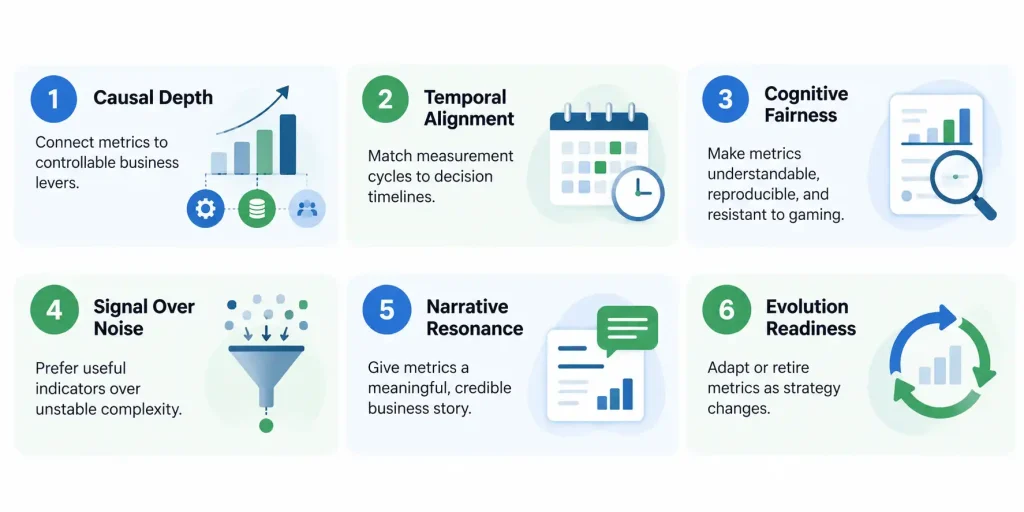
Effective strategic capital planning depends on metrics built as lenses rather than mirrors. Six design principles separate a metric that steers from one that merely reports.
- Causal depth, so the metric ties to levers management can influence, such as the pricing power, cost structure, and product mix behind gross margin
- Temporal alignment, so the rhythm of measurement matches the rhythm of the decision, with quarterly feedback, annual trends, and multi-year investment payoff
- Cognitive fairness, so frontline managers can reproduce the metric, explain it, and trust that it resists gaming
- Signal over noise, favoring simpler proxies such as ARPU paired with retention when composite measures like lifetime value swing on unstable inputs
- Narrative resonance, so the name and logic tell a story the organization believes, as with strategic capital velocity or value yield per relationship
- Evolution readiness, so the metric either stays valid under new conditions or is retired gracefully
Ownership matters as much as design. A metric built in finance and imposed on product earns suspicion, whereas one co-authored with operations and validated by the front line earns acceptance. Definitions must also be unambiguous, since terms such as adjusted EBITDA or NPS become incantations without them. In a public gaming company operating across five countries, a single definition of revenue rolled out to every subsidiary shortened statutory reporting cycles under both IFRS and US GAAP and ended debates over whose number was correct.
Embedding Metrics into Planning and Capital Allocation
A metric stays inert until it enters daily practice. The diagram below shows how embedding moves from a written definition to genuine conviction.
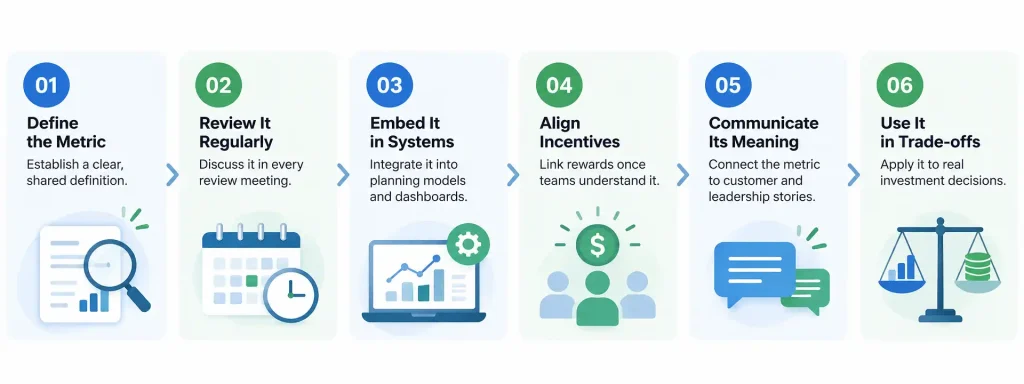
Meetings come first. A metric that is visible but never discussed fades, whereas one raised through the question of how an initiative affects strategic capital velocity begins to anchor judgment, and habit precedes belief. Systems come next, because a metric living only in slides is a slogan, while one embedded in planning models becomes infrastructure with a single canonical definition maintained by finance.
Compensation, Narrative, and Leadership Behavior
Compensation should follow comprehension. Introducing a metric first as an evaluative lens, then linking a portion of incentives once teams understand which actions move it, avoids both gaming and cynicism. Metrics tied to pay must be controllable and lag-aware. Narrative then carries the logic into all-hands meetings and board letters, anchored in specific customer stories rather than averages.
Leadership behavior settles credibility. A team that praises ROIC while approving negative-return initiatives turns the metric into theater, whereas pausing a project because capital velocity dropped gives it authority. In a $127M global consumer products company, inventory turns rose from 3x to 7x once demand planning and SKU rationalization were governed by working capital metrics rather than sales volume alone, which released trapped cash that funded further growth.
Governing Finance Transformation Metrics as Strategy Evolves
Every metric is born under assumptions about customers, capital costs, and risk. When the world shifts, a metric can remain accurate in arithmetic while becoming obsolete in meaning. A firm that moves from hardware to SaaS, for instance, may keep rewarding bookings per rep after the business has entered land-and-expand dynamics, which pushes teams to over-optimize initial sales and neglect long-term relationship depth.
Governance rests on four practices.
- Periodic metric reviews built into the planning cycle, including operators and go-to-market leaders, asking whether each metric is accurate and also whether it is lived
- Metric lineage, a record of definition changes that preserves institutional memory as leaders turn over
- Boundary integrity, so a learning tool is not quietly converted into a budget-cutting weapon
- Transparent communication of changes, since investors and employees attach meaning to continuity
Reviews produce three outcomes, which are recalibrating a metric, translating it into a new lens, or retiring it. In a cybersecurity and identity SaaS company with about $30M in ARR, a driver-based forecasting engine held actuals within plus or minus 5% of forecast for 8 consecutive quarters, and a board-grade reporting framework carried the business through acquisition diligence. No metric is eternal, and a culture that treats metrics as strategic hypotheses remains transformable.
Three Key Takeaways
- Finance transformation meaning begins with redesigning what the firm measures, because attention follows metrics and strategy follows attention.
- Strategic capital planning improves when metrics are causal, fairly defined, co-authored with operators, and embedded in meetings, systems, incentives, and leadership decisions.
- Metrics need governance through periodic review, lineage, and boundary integrity so they evolve with strategy without losing coherence.
Disclaimer: This article is intended for informational purposes only and does not constitute legal, tax, or accounting advice. You should consult your own tax advisor or counsel for advice tailored to your specific situation.
Hindol Datta is a four-time CFO and senior finance executive with over 25 years of leadership experience across cybersecurity, SaaS, gaming, logistics, digital marketing, medical devices, consumer products, and nonprofit organizations. He has led more than $120M in fundraising and over $150M in M&A transactions while building the financial and operational systems that let complex businesses scale with confidence. He is the author of seven books in the Systems CFO Series and holds active CPA, CMA, and CIA credentials.
AI-assisted insights, supplemented by 25 years of finance leadership experience.