
Executive Summary
For most US startups, a cross-border tax strategy becomes urgent only after Canada or Mexico is already generating revenue. That’s precisely the wrong order of operations. Proximity, continuity under USMCA, and strong local demand pull founders north and south long before a formal international tax plan exists. Beneath that opportunity, the architecture is layered in ways few founders anticipate.
Corporate tax obligations, withholding requirements, transfer pricing rules, and indirect tax regimes diverge sharply from the US system, and missteps in structuring rarely stay confined to the tax function. They surface later as cash flow strain, audit exposure, and friction during diligence.
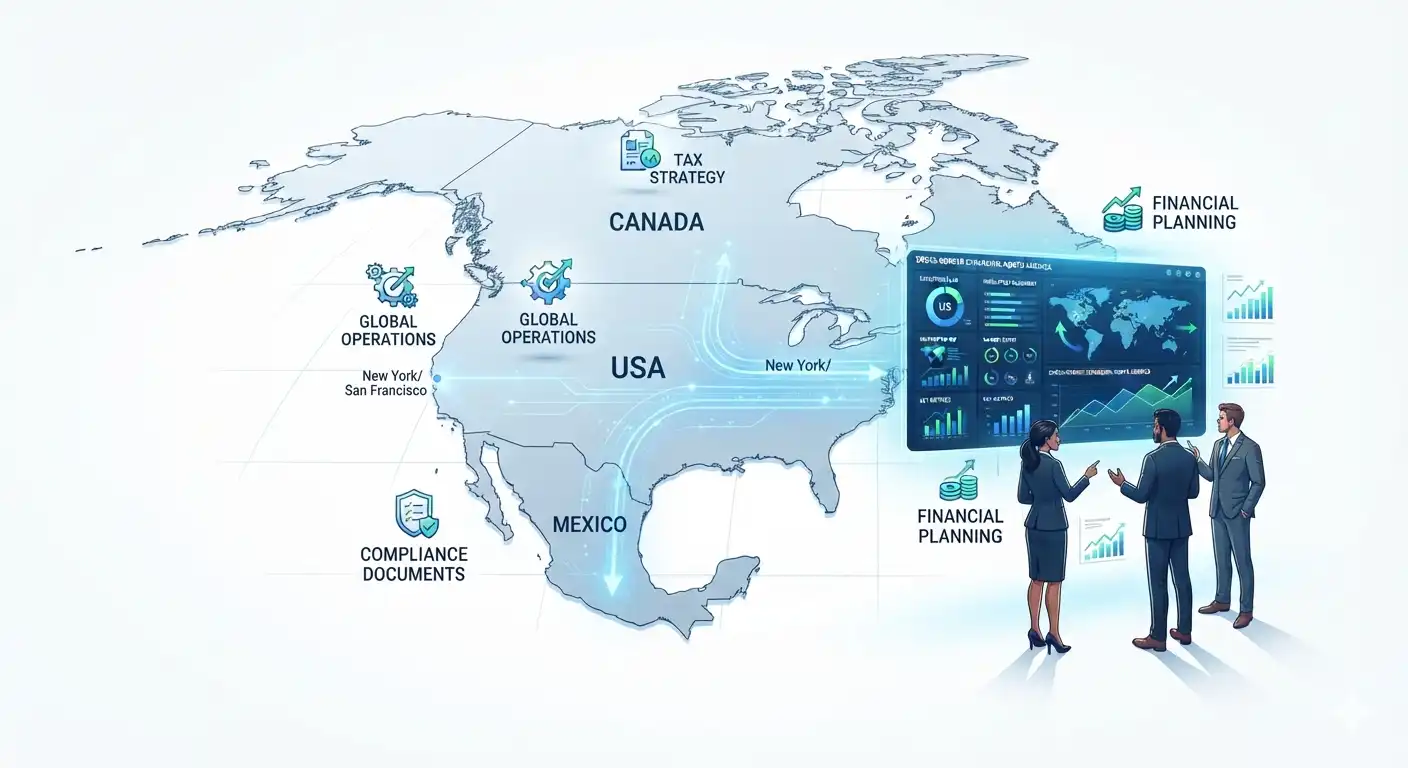
Why Cross-Border Tax Planning Belongs on the Executive Agenda
Startups rarely expand for tax reasons. They follow product traction, engineering talent, or operational efficiency. Canada has long attracted US companies seeking product localization, while Mexico has become a preferred base for nearshoring. Both markets reward founders who move quickly, and neither forgives those who assume proximity means simplicity.
The moment a US company begins transacting locally, through payroll, invoicing, warehousing, or service delivery, local tax obligations activate. Unlike the US system, where federal rules largely set the tone, Canada and Mexico apply tax at multiple levels simultaneously. Entity structure, intercompany arrangements, and invoicing discipline shape exposure well before revenue becomes material. A sound cross-border tax strategy is not a downstream compliance task. It is an early architectural decision that supports or undermines the capital raises and exits that follow.
Finance leaders who have built multi-entity structures spanning the United States, India, Nepal, Canada, and Mexico recognize this pattern well. In one high-growth cybersecurity and identity access management company operating across five country entities, the finance architecture was designed from the outset for consolidated reporting. The month-end close cycle compressed from 18 days to 10 as a result, discipline that prevents costly late-stage remediation.
Corporate Tax in Canada: Entity Structure, Withholding, and Treaty Elections
Canada imposes corporate income tax at both the federal and provincial levels. Combined rates typically range between 23% and 31%, depending on jurisdiction. An Ontario corporation pays an effective rate near 26.5%, while Alberta sits closer to 23%. Foreign-controlled entities, including most US subsidiaries, are generally taxed at the full general rate. They don’t qualify for the reduced small business rate available to qualifying local companies.
Choosing Between a Subsidiary and a Branch
Choosing the right entity structure is among the earliest and most consequential decisions a US startup will make in Canada. The choice carries direct withholding consequences.
- Local subsidiary: contains liability, simplifies reporting, and is generally the cleaner path for most startups
- Branch operations: introduce complexity around permanent establishment, withholding exposure, and treaty eligibility
- Federal withholding: 15% applies on interest, dividends, royalties, and management fees paid to non-residents
- Treaty relief: available under the US-Canada tax treaty, but only when documentation and elections are filed correctly and on time
This is procedural detail that experienced finance leadership tends to catch early, while less seasoned teams often discover it during an audit.
GST, HST, and Payroll Discipline
Startups selling software or services into Canada must account for the Goods and Services Tax and the Harmonized Sales Tax, value-added tax equivalents applied to most goods and services. Canada requires foreign digital service providers, including SaaS companies, to register once they exceed a CAD $30K threshold in taxable supplies annually, and the burden requires accurate input credit tracking alongside disciplined invoicing. Canadian tax authorities conduct thorough, data-driven reviews, and inconsistent filings attract attention quickly.
Canadian payroll adds employment insurance, Canada Pension Plan contributions, and provincial premiums, all requiring regular withholding and remittance. Misclassifying employees as contractors to reduce administrative load is a common shortcut that frequently triggers audits, particularly in Quebec and British Columbia where labor enforcement runs strict. Intercompany transactions between US parents and Canadian subsidiaries, whether for research and development, management fees, or intellectual property licensing, must comply with transfer pricing rules aligned to OECD guidance, requiring arm’s length pricing and annual documentation once volume crosses prescribed thresholds. The Canada Revenue Agency actively reviews these arrangements, and early-stage companies are not exempt simply because the dollar amounts appear modest.
Corporate Tax in Mexico: Permanent Establishment and the CFDI Invoicing System
Mexico’s tax regime runs centralized, with a corporate income tax rate of 30% applied nationwide. Unlike Canada, Mexico does not levy state-level income tax, though state payroll taxes and local levies vary and require careful tracking across jurisdictions.
A central question for any US startup operating in Mexico is whether its activity has created a permanent establishment, triggered by local employees, agents with contract-signing authority, fixed office space, or repeated executive visits. Once triggered, the company must register with Mexico’s tax authority, file monthly returns, and withhold tax on cross-border payments.
Mexico also operates a digital invoicing system known as CFDI, under which invoices must be electronically issued, timestamped, and filed through authorized providers. Any company transacting in Mexico must adhere to this system or risk penalties and non-deductibility of related expenses. Companies with logistics or nearshoring operations, where invoice volume scales quickly, benefit from building CFDI-compliant systems before that volume arrives.
Withholding Tax, Transfer Pricing, and VAT
Mexico imposes withholding tax on payments to foreign entities at rates that vary by category, though documentation under the US-Mexico tax treaty can reduce these rates.
- Interest payments: 10% withholding tax
- Services payments: 25% withholding tax
- Certain royalties: withholding tax up to 40%
- Value-added tax: 16% standard rate on most goods and services, with monthly filing required for digital service providers
Transfer pricing rules mirror OECD standards, but Mexican authorities enforce them with particular rigor, and companies must maintain contemporaneous documentation and submit annual informative returns. Even small subsidiaries must typically maintain a local file. Exemptions and zero-rated VAT treatments exist but are narrowly defined, and the common assumption that business-to-business sales are automatically exempt has led many companies into repeated audit exposure.
Common Mistakes in Cross-Border Tax Compliance
Certain patterns of cross-border tax exposure repeat across cybersecurity, SaaS, gaming, logistics, digital marketing, and medical device sectors.
- Failing to identify a triggered permanent establishment
- Operating through informal or contract-based structures instead of proper entity formation
- Misunderstanding VAT or GST obligations tied to cross-border digital services
- Under-documenting transfer pricing arrangements for shared services
- Relying on US-centric invoicing, payroll, and compliance systems abroad
- Assuming US GAAP or IRS treatment will mirror foreign jurisdiction rules
Each of these mistakes carries a cost beyond the tax line. In one $127M global consumer products company with a supply chain spanning China and Vietnam, freight, trucking, and warehouse operations were restructured alongside the finance function, and inventory turns more than doubled from three times to seven, precision that becomes possible only once the underlying tax structure sits on solid ground. Private equity firms and strategic buyers routinely treat weak cross-border tax structures as deal risk during diligence, even when the dollar exposure appears modest.
A Practical Framework for Cross-Border Tax Compliance
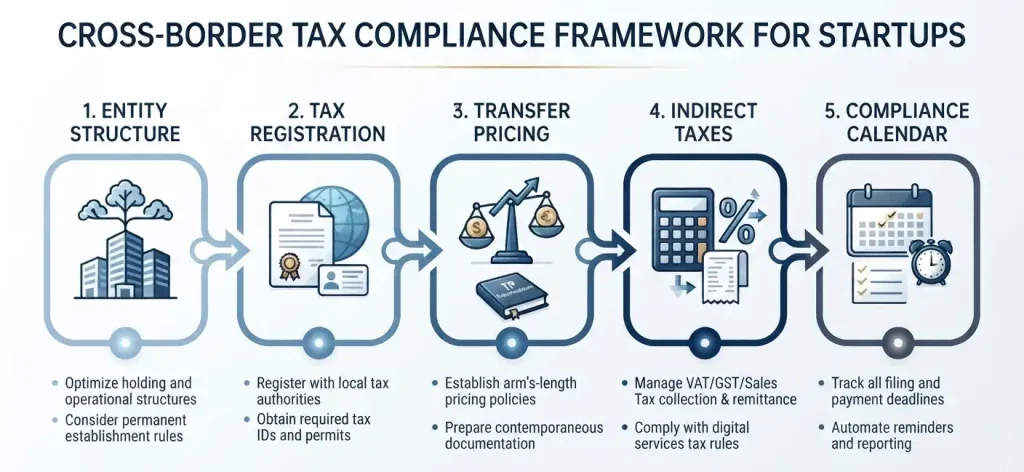
Sound cross-border tax strategy begins with legal structuring rather than tax filing. Local subsidiaries, properly registered with tax authorities, are almost always preferable to informal or grey-zone arrangements, and engaging advisors who understand both US and local regimes allows issues to be anticipated rather than discovered after the fact. A lightweight compliance calendar covering filing deadlines, registration, payroll cycles, and intercompany documentation keeps the finance function ahead of its obligations instead of reacting to them one notice at a time.
A general sequence for evaluating exposure in a new jurisdiction includes the following steps.
In one mission-driven education and research institution, the finance function sat alongside HR, IT, legal, and facilities. Audit committee reporting followed the same discipline applied to multi-year financial modeling. In a Euronext Paris-listed gaming and digital entertainment company operating across five countries, a single unified definition of revenue rolled out across every subsidiary. This shortened statutory reporting cycles under both IFRS and US GAAP evidence that enterprise systems built for multi-jurisdictional accounting make this framework sustainable at scale.
Indirect taxes, including GST, HST, and Mexican VAT, deserve a place in working capital forecasts even for pre-revenue operations, and these structures should be communicated clearly to boards, since discipline in cross-border tax strategy is increasingly read as a marker of executive readiness.
Three Key Takeaways
- Entity structure and permanent establishment analysis belong at the start of expansion, not after the first invoice is issued, since retroactive fixes cost far more than upfront structuring.
- Withholding tax, transfer pricing documentation, and indirect tax registration are not optional formalities. They are how tax authorities in both countries test whether a cross-border tax position will withstand scrutiny.
- A compliance calendar tracking filing deadlines, VAT and GST thresholds, and intercompany documentation converts cross-border taxation from a recurring surprise into a predictable rhythm that boards and acquirers read as maturity.
Disclaimer: This article is intended for informational purposes only and does not constitute legal, tax, or accounting advice. You should consult your own tax advisor or counsel for advice tailored to your specific situation.
Hindol Datta is a four-time CFO and senior finance executive with over 25 years of leadership experience across cybersecurity, SaaS, gaming, logistics, digital marketing, medical devices, consumer products, and nonprofit organizations. He has led more than $120M in fundraising and over $150M in M&A transactions while building the financial and operational systems that let complex businesses scale with confidence. He is the author of seven books in the Systems CFO Series and holds active CPA, CMA, and CIA credentials.
AI-assisted insights, supplemented by 25 years of finance leadership experience.