Executive Summary
There is a quiet seduction in financial engineering. Early-stage rounds feel like a sandbox of flexibility. Founders draft SAFEs, convertible notes, preferred shares with liquidation waterfalls, and performance-based warrants for speed. They close them without much ceremony. Accounting for warrants, SAFEs, and preferred shares works differently. It arrives with delay, often just as a company prepares for audit, institutional capital, or an exit. Instruments that appear harmless on a cap table can mutate into liabilities on the balance sheet.
This article walks through the classification logic behind accounting for warrants. It also covers accounting for stock warrants tied to revenue or funding milestones. It covers SAFE remeasurement and preferred share redemption features too. The discussion draws on years spent building the finance function underneath instruments like these. The goal is not to summarize GAAP. It is to show where the accounting breaks in practice, and how to keep it from breaking on your watch.
Warrant Accounting: Where Fair Value Quietly Disrupts Earnings
Warrants look deceptively simple. They give an investor or a strategic partner the right to buy equity at a set price in the future. They carry no obligation to do so. For a plain-vanilla warrant with a fixed strike and share count, the accounting genuinely is simple. The trouble begins when the terms depend on future events, and in venture and growth-stage financing, they frequently do. Warrants may adjust their strike price based on a future funding round. They may also carry net or cash settlement provisions, or vest contingently based on operational milestones.
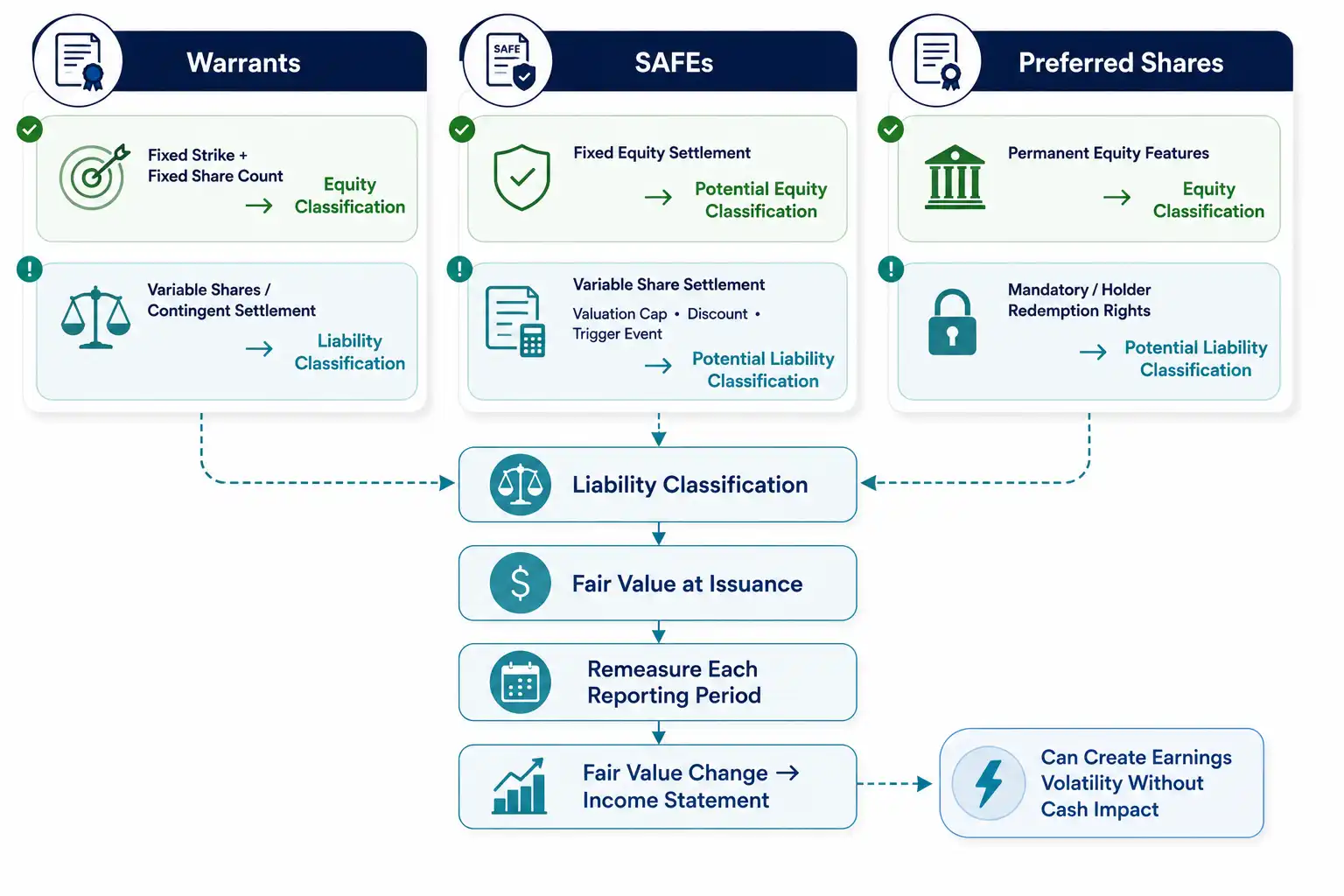
When those features are present, warrant accounting under U.S. GAAP may require the instrument to be classified as a liability rather than equity. Under ASC 815, the warrant fails the equity classification test if the company cannot control the settlement outcome. It also fails if the number of shares it must deliver is variable. The company must then measure it at fair value on issuance. It must remeasure that value every reporting period after, running the change through the income statement.
I have sat across the table from a board while this exact issue unfolded. In a high-growth cybersecurity and identity access management company, I served as de facto head of finance. We issued strategic warrants with exercisability tied to revenue growth thresholds. The company’s control over the timing of that revenue was not absolute. The number of underlying shares could also adjust with performance. Because of that, the warrants were classified as liabilities rather than equity. A swing in fair value turned a projected gain into a reported loss with no cash impact whatsoever. It reduced GAAP net income and confused board members who had modeled the deal differently. It also complicated conversations with a potential acquirer months later.
A Practical Example of Warrant Accounting Journal Entries
Accounting for warrants journal entries becomes far more consequential once liability classification applies. Every reporting period brings a new fair value and a new entry. A simplified illustration follows. It covers a warrant issued at a fair value of $400K. That value is later remeasured to $650K at the next reporting date:
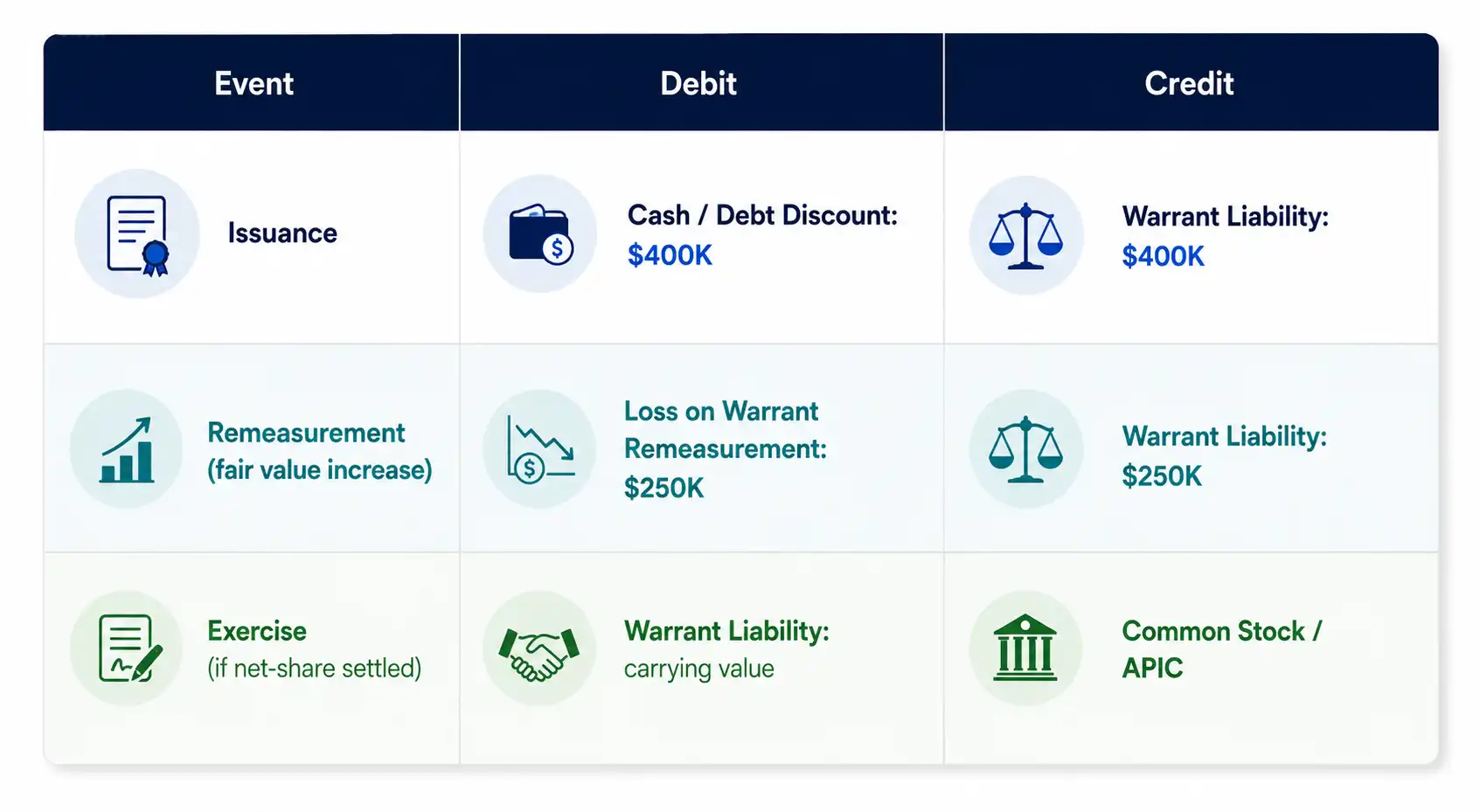
The mechanics do not complicate the process. The valuation work behind the numbers in that table trips up most finance teams. So does the governance a team needs to defend the assumptions to an auditor.
SAFEs: Simple in Name, Rarely in Treatment
The SAFE, or Simple Agreement for Future Equity, has become the default instrument of early-stage financing. It is fast, founder-friendly, and it lets a round close without a hard valuation conversation. Many SAFEs, however, fail the equity classification tests under ASC 480 and ASC 815, because they require settlement in a variable number of shares upon a triggering event, usually the next priced round, and the company typically lacks control over when that trigger occurs. When that variability is present, the instrument is generally classified as a liability and measured at fair value, which means it must be remeasured every period, with the mark-to-market changes running through the income statement.
While advising the capital strategy and investor narrative for an AI governance and assurance platform in its pre-Series A phase, I rebuilt the finance workflow around exactly this kind of instrument-level scrutiny, because a founder-friendly SAFE is not the same thing as an accounting-friendly one. Valuation caps, discounts, and most-favored-nation clauses all push the classification analysis toward liability treatment, and founders who treat the SAFE as equity in substance are often surprised by what shows up on the balance sheet once the next round prices.
I have also seen this play out downstream, in a biotech company where a set of seed-stage SAFEs with standard discount and cap features converted at the Series A. The finance team had never booked them as liabilities, unaware of the remeasurement requirement, and when the Series A closed at a materially higher valuation, the fair value of the SAFEs increased sharply. A late audit adjustment erased three quarters of previously reported net income. The SAFEs were structurally sound and strategically necessary; the accounting, deferred too long, created a credibility problem that had nothing to do with the business itself.
Preferred Shares: Where Classification Hinges on Redemption
Preferred shares are an older, more familiar instrument, but in venture-backed companies they are rarely plain vanilla. Embedded puts, redemption rights, participation features, and layered liquidation preferences are now standard, and each of these terms introduces its own classification risk under ASC 480. If the instrument is mandatorily redeemable at a fixed or determinable date, or redeemable at the holder’s option, it is often treated as a liability rather than equity, and even a contingent redemption right can shift classification depending on how likely the triggering event is judged to be. A conversion feature tied to an IPO with variable pricing, if it is not clearly and closely related to the host contract, may also require bifurcation and separate derivative accounting.
During the capital raise for a mission-driven education and research institution, where I structured $37M across equity and venture debt and owned the investor narrative and audit committee relationship, redemption language was one of the first things counsel and I stress-tested before signing anything. A poorly worded protective provision can quietly convert what looks like equity into debt on the balance sheet. I have seen a Series D term sheet where a redemption clause allowed the investor to force a buyout after six years if no IPO or sale had occurred, inserted purely as investor protection, that triggered liability treatment under GAAP once the ink was dry. It affected leverage ratios, changed EBITDA adjustments under an existing credit agreement, and raised capital-permanency questions with rating analysts.
Later, leading the S-1 and IPO-readiness process for a Euronext Paris-listed gaming and digital entertainment company, I watched the same principle play out at scale: every preferred and quasi-equity instrument on the balance sheet had to be defensible to underwriters and Big Four auditors simultaneously.
Valuation and Remeasurement: The Silent Force Behind Volatility
Once liability classification applies, the real work begins. Fair value must be determined using an appropriate model, often a Monte Carlo simulation for complex, path-dependent instruments, or a Black-Scholes framework for simpler ones, and each model carries assumptions about volatility, expected term, discount rates, and event probability. These are governance choices as much as mathematical ones, and they need to hold together with what the same company is telling its board, its investors, and its lenders in every other room.
As a buy-side analyst supporting due diligence on an IT services acquisition, I spent considerable time on quality-of-earnings analysis and valuation modeling, and the pattern that surfaced repeatedly was the one that also shows up in warrant and SAFE remeasurement: reported earnings that diverged from economic reality because the underlying assumptions had never been stress-tested. A strong fundraising environment, a shift in exit expectations, or a change in volatility can each trigger a swing in liability value that flows straight through the income statement, creating earnings volatility with no cash impact and every bit of investor-perception impact. Too many companies outsource the valuation model without building the internal capability to own the assumptions inside it, and “the valuation firm gave it to us” is not an answer that survives scrutiny from an auditor or a board member.
Cap Table Clarity and Financial Integrity
Complex instruments rarely stay hidden for long. As a company matures, prepares for an IPO, or enters acquisition discussions, the structure of its capitalization moves to the center of the conversation, and if warrants, SAFEs, or preferred shares have not been accounted for cleanly along the way, due diligence will surface the problem at the worst possible moment. Adjustments to prior financials, unexpected dilution, or restated disclosures all erode trust that took years to build.
The finance function’s job is to ensure every financing instrument is understood in economic and accounting substance, not only in legal terms, so the cap table functions as a strategic asset rather than a document that needs decoding under deadline pressure. That requires legal, accounting, investor relations, and strategy to speak the same language about capital structure from the moment an instrument is issued, tracking settlement mechanics, dilution, and remeasurement triggers as they arise.
Three Key Takeaways
- Any warrant, SAFE, or preferred share with variable share counts, contingent triggers, or redemption features deserves a liability-classification review under ASC 480 and ASC 815 before the term sheet is signed, not after the audit begins.
- Liability classification is not the end of the analysis; it is the beginning of a recurring valuation and remeasurement obligation that management must be able to explain in its own words to auditors, boards, and investors.
- A cap table built on instruments the finance team fully understands, and can defend under diligence, becomes a source of credibility during a raise, an acquisition, or an IPO, while one built on unexamined terms becomes a liability in every sense of the word.
Disclaimer: This article is intended for informational purposes only and does not constitute legal, tax, or accounting advice. You should consult your own tax advisor or counsel for advice tailored to your specific situation.
Hindol Datta is a four-time CFO and senior finance executive with over 25 years of leadership experience across cybersecurity, SaaS, gaming, logistics, digital marketing, medical devices, consumer products, and nonprofit organizations. He has led more than $120M in fundraising and over $150M in M&A transactions while building the financial and operational systems that let complex businesses scale with confidence. He is the author of seven books in the Systems CFO Series and holds active CPA, CMA, and CIA credentials.
AI-assisted insights, supplemented by 25 years of finance leadership experience.