
Executive Summary
A cap table, short for capitalization table, records who owns a company, under what terms, and with what rights. Far from a simple spreadsheet of names and percentages, it encodes the economic, legal, and strategic structure of a business and shapes every financing, hiring, and exit decision.
This article explains the building blocks of a startup cap table, how it evolves across funding rounds, and how dilution, option pools, governance rights, liquidation preferences, and convertible instruments play out in practice. Founders, CFOs, and investors will find a practical guide to treating the cap table as a strategic asset rather than an administrative record.
Why the Cap Table Matters to Every Stakeholder
A cap table maps the power structure of a business. It determines the allocation of control, the economics of outcomes, and the hierarchy of payouts in a liquidity event. At its core, it is a snapshot of the equity structure that shows:
- Who owns equity, including founders, investors, employees, and others
- What types of equity they hold, such as common, preferred, options, or warrants
- How many shares or units each party holds
- The percentage of total ownership each holder commands
- The price and date of issuance for each security
Each audience reads the document through its own lens: founders see control and economic upside, investors see protections and their share of future gains, and employees see their path to participation. For CFOs and corporate counsel, the cap table serves as the canonical source of truth for governance, reporting, and compliance.
Key Components of a Startup Cap Table
A basic startup cap table lists shareholders in rows and details their positions in columns. More mature versions add columns for board representation rights, liquidation preferences, participation rights, and anti-dilution protections, so that each row tells the story of how and when a party joined.
Core Cap Table Columns
| Column | What It Captures |
| Shareholder name | The individual or entity holding equity |
| Security type | Common stock, Series A preferred, stock options, and similar |
| Shares or units held | The number of securities owned |
| Price per share | The issue price, where applicable |
| Investment or grant value | Total capital invested or value granted |
| Ownership percentage | Both fully diluted and non-diluted |
| Date of issuance | When the security was issued |
| Vesting schedule | Terms for options or restricted stock |
Equity Instruments on a Cap Table
| Instrument | Typical Holder | Key Features |
| Common stock | Founders and employees | Voting rights, junior in liquidation |
| Preferred stock | Investors | Liquidation preference, dividends, anti-dilution, possible voting advantages |
| Options | Employees and advisors | Right to buy stock at a set strike price |
| Warrants | Lenders and financing partners | Similar to options, often tied to financing instruments |
| Convertible notes and SAFEs | Early investors | Convert into equity at a priced round and must be modeled in fully diluted scenarios |
Fully Diluted Versus Issued Shares
Fully diluted shares outstanding give the truest picture of dilution, because they count every share that could convert into common stock, including each of the following categories:
- Outstanding common stock
- All classes of preferred stock
- All issued and unissued options in the option pool
- Warrants
- Convertible securities such as SAFEs and convertible notes
This figure drives ownership percentages and potential exit distributions, which is why investors focus on it in every negotiation.
How a Cap Table Evolves from Founding to Series A and Beyond
A cap table changes with every financing round, employee grant, option exercise, or exit event. The earliest version is often two or three founders holding equal shares, yet by a Series C or D round it becomes a multi-layered legal architecture.
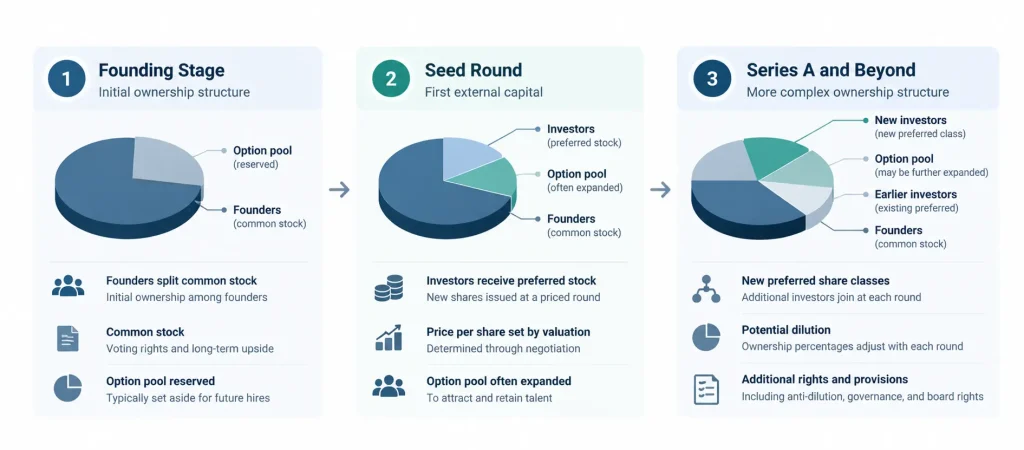
At each step, the cap table must balance growth capital, founder control, employee incentives, and strategic flexibility. Structuring a $37M raise across equity and venture debt for a mission-driven education and research institution showed how much the choice of instrument shapes the ownership picture that follows.
Common Pitfalls in Cap Table Management
Poorly managed cap tables can create serious and costly problems for a growing company:
- Over-dilution of founders
- Misalignment with employees when options are too few or underwater
- Investor confusion or mistrust
- Delays in financing or exits caused by unclear ownership
- Legal disputes over unrecorded agreements
Most early-stage companies begin in Excel, but fast-growing ventures soon move to dedicated equity management software for version control, audit readiness, and real-time modeling.
Managing Dilution on a Startup Cap Table
Dilution, the reduction in ownership percentage as new shares are issued, is inevitable in most growth scenarios. The real question is whether it creates value. A founder who moves from 60% to 20% ownership over three rounds while building a $500M company walks away with far more than one holding 60% of a $5M business.
Types of Dilution
- Pre-money dilution comes from option pool expansions or convertible securities factored into the pre-money valuation.
- Post-money dilution reflects new capital raised relative to total capitalization.
- Anti-dilution adjustments apply in a down round, protecting earlier investors through weighted average or full ratchet mechanisms.
Modeling Dilution Scenarios
A sophisticated cap table supports scenario modeling, answering questions such as what happens to ownership in a $10M raise at a $50M post-money valuation, what a 5% option pool expansion before the round would do, and how outstanding notes will convert. Cohort and unit economics models built for a $20M Series B at a marketplace SaaS company proved most persuasive when paired with clear dilution scenarios that investors could test themselves.
Option Pools, Governance, and Control
Option pools exist to recruit and retain talent, and a typical pre-Series A pool ranges from 10% to 20% of fully diluted shares. Their size and structure affect both founder dilution and investor expectations:
- A pool refresh is often required before a new round, and a pre-money refresh dilutes only existing holders.
- Most options vest over 4 years with a 1-year cliff.
- A 409A valuation is required to set the fair market value of options.
Investors watch the pool closely because it signals alignment, and a team holding underwater options represents a hidden risk to execution.
Governance and Voting Rights
Governance rights also live on the cap table, since preferred shareholders often hold board seats, protective provisions that let them veto key decisions such as a sale, new share issuance, or new debt, and conversion rights into common stock. Founders may control early stages, but later rounds often shift power, and some founders adopt dual-class structures with super-voting common stock to preserve influence despite dilution.
Liquidation Preferences and Exit Waterfalls
A liquidation preference ensures that preferred shareholders recover their investment, often with a multiple or interest, before common stockholders receive proceeds. Under a 2x preference, an investor who put in $10M receives $20M first, so in a $30M exit only $10M remains for everyone else.
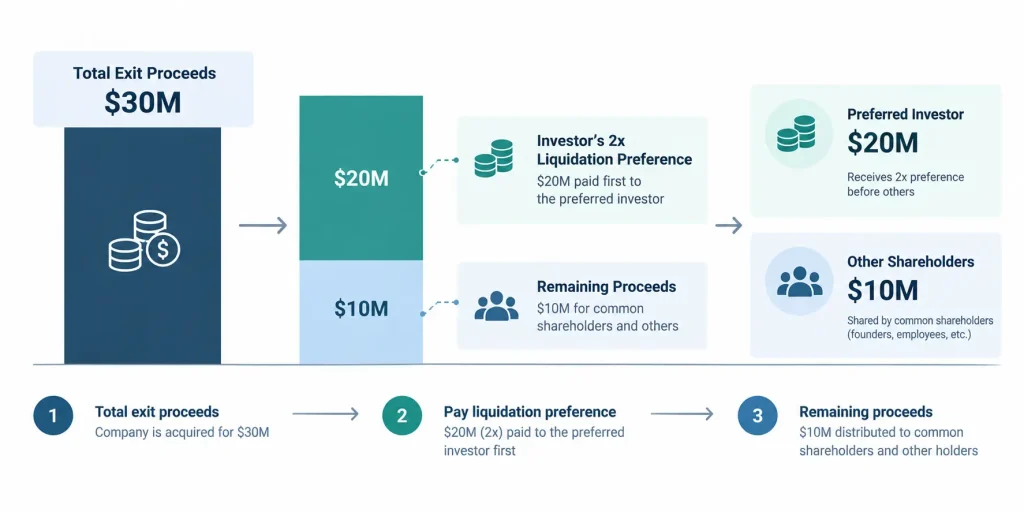
Participation rights shape the waterfall further, because participating preferred receives its preference and then shares pro-rata in the remaining proceeds, while non-participating preferred must choose between the preference and conversion to common. Good modeling tools simulate these ranked distributions before terms are signed.
Convertible Instruments and Pro-Rata Rights
Convertible notes and SAFEs convert into equity at a discount or valuation cap during a priced round, so the cap table must reflect both their dilution impact and implied valuation. Discounts typically run 10% to 20% off the next round price, the valuation cap sets a maximum conversion price, and accrued interest on notes also converts into equity.
Many investors also negotiate pro-rata rights to maintain ownership in future rounds, and heavy insider participation increases founder dilution. Investors weigh these rights based on confidence in the company, ownership consolidation strategy, and the signaling risk if insiders decline to follow on. Raising $36.5M across Series A through C at a venture-backed digital marketing company showed how insider follow-on decisions can shape both round dynamics and outside investor perception.
Clean Versus Messy Cap Tables
A clean cap table is transparent, consistent, and well structured. Messy versions slow deals, complicates diligence, and deters investors, usually because of a few recurring problems:
- Numerous SAFEs with varying terms
- Option grants with inconsistent vesting
- Unsigned or undocumented equity agreements
- Complex convertible debt arrangements
A coherent startup cap table preserves fundraising flexibility, protects founder alignment, builds investor confidence, and supports employee morale. Founders and CFOs should curate ownership as well as track it, since early angels, strategic partners, and lead investors shape influence as much as capital. As companies scale, cap tables grow more layered, and teams that treat them as strategic instruments build businesses that endure.
Three Key Takeaways
- A cap table is the economic constitution of a company, so every security, vesting term, and right should be recorded accurately and modeled on a fully diluted basis.
- Dilution is acceptable when it creates value, and scenario modeling of option pools, convertible conversions, and liquidation preferences lets founders negotiate with clear consequences in view.
- A clean startup cap table speeds financing and diligence, while undocumented agreements and inconsistent terms quietly erode investor trust and strategic flexibility.
Disclaimer: This article is intended for informational purposes only and does not constitute legal, tax, or accounting advice. You should consult your own tax advisor or counsel for advice tailored to your specific situation.
Hindol Datta is a four-time CFO and senior finance executive with over 25 years of leadership experience across cybersecurity, SaaS, gaming, logistics, digital marketing, medical devices, consumer products, and nonprofit organizations. He has led more than $120M in fundraising and over $150M in M&A transactions while building the financial and operational systems that let complex businesses scale with confidence. He is the author of seven books in the Systems CFO Series and holds active CPA, CMA, and CIA credentials.
AI-assisted insights, supplemented by 25 years of finance leadership experience.