
Executive Summary
Vertical SaaS market penetration rewards depth over breadth, turning a narrow industry focus into pricing power, low churn, and durable defensibility. Where horizontal software chased ubiquity across industries, vertical platforms aim to become indispensable to one. Success is measured in wallet share, retention depth, and how critical the product becomes to daily operations.
This article examines how vertical SaaS companies find friction, embed value, and win dense clusters of customers. It then covers scaling within a vertical, choosing adjacencies, defending against horizontal rivals, and the mistakes that trap growing platforms in mediocrity.
From Horizontal Scale to Vertical SaaS Market Penetration
In the classical age of software, the dominant mantra was scale. Microsoft, Oracle, and SAP built generalized platforms that spanned industries, roles, and geographies. The modern startup landscape has inverted that logic, and market penetration now depends on relevance and precision instead of mass reach.
Vertical SaaS platforms embed themselves in the workflows, language, compliance rules, and rhythms of a single industry. A CRM for real estate brokers, an ERP for dental practices, or a scheduling system for veterinary clinics all seek intimacy, not ubiquity. The funnel narrows by design, sales cycles turn consultative, and onboarding becomes immersive.
The Economics of Depth
The economics of vertical SaaS invert familiar patterns. Total addressable markets look smaller at first glance, yet ARPU often runs higher thanks to lower churn, pricing power, and high switching costs. Lifetime value expands as the product reaches core operations, and word of mouth inside tight networks makes CAC more efficient.
Pricing power deserves close attention from finance leaders. At a cybersecurity and identity SaaS company with $30M in recurring revenue, pricing discipline and delivery cost management lifted gross margin by twelve percent. Vertical platforms hold a similar advantage, since customers who depend on specialized workflows resist switching over modest price changes.
| Dimension | Horizontal SaaS | Vertical SaaS |
| Target market | Many industries, broad reach | One industry, deep relevance |
| Sales motion | Transactional, volume-driven | Consultative, reference-driven |
| Key growth metric | Lead velocity | Logo density within the niche |
| Unit economics | Larger TAM, higher churn | Higher ARPU, LTV, and retention |
| Defensibility | Scale and brand | Domain data, compliance, and workflow fit |
Finding Friction: Where Vertical SaaS Market Penetration Begins
Vertical SaaS market penetration starts by locating an industry’s epicenter of friction, and the most promising segments share three traits:
- Fragmentation: Many small players with no dominant system of record.
- Outdated systems: Manual processes, paper records, or spreadsheets still run the business.
- Underserved workflows: High-frequency tasks that generic software handles poorly.
Real estate, logistics, elder care, and specialized legal niches such as immigration law all show these traits. The strongest vertical SaaS startups insert themselves into these gaps as infrastructure, not just as tools.
Domain Fluency and Founder-Market Fit
Insertion demands domain fluency, since the product must speak the industry’s language and handle its regulations. A dental scheduling platform cannot succeed with features built for fitness coaches, because time units, cancellation rules, and compliance needs do not transfer, so contextual fit matters more than surface usability.
In a regulated medical device environment, standard costing and inventory controls had to survive line-by-line audit scrutiny. Software serving such industries must meet the same standard, which is why many leading vertical founders come from inside the industry. A former clinician builds an EMR system, and a logistics operator builds a fleet dispatch app.
Landing with Density: The Vertical SaaS Go-to-Market Model
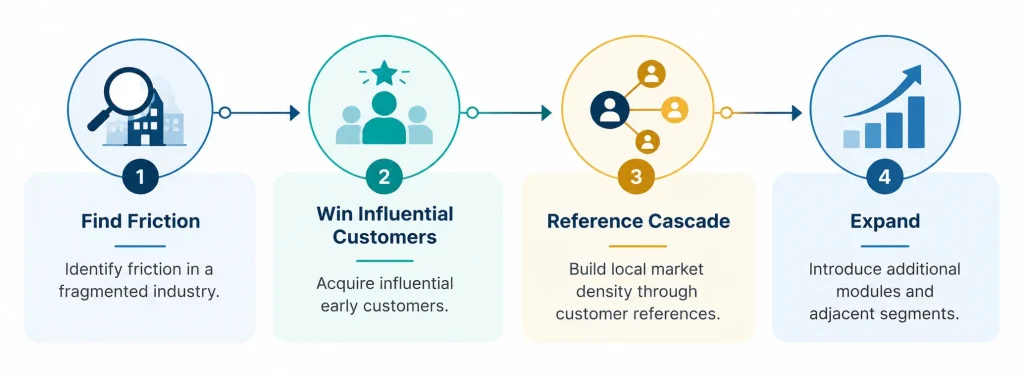
Vertical SaaS market penetration relies on density over volume. The goal is often to dominate a geographic cluster or subsector before expanding further. Winning 30% of dental offices in one metro area is worth more than scattered wins nationwide, because density fuels network effects among suppliers, partners, and customers.
The Reference Cascade
In tightly knit industries, trust is often hyper-local. One veterinarian’s endorsement in a town of ten clinics can lead to majority adoption, so early sales should prioritize influence over volume. Field sales, community marketing, and industry events matter more than SEO or paid search. Customer success becomes a frontline function, with support teams trained in the customer’s business logic as well as the software.
Metrics That Reflect Depth
Top-of-funnel volume matters less in vertical SaaS than measures of entrenchment:
- Logo concentration in key clusters
- Net revenue retention (NRR)
- Product usage penetration, such as logins per employee per week
- Workflow displacement, meaning tasks moved from manual or Excel processes into the platform
The aim is transformation, not just subscription, and the best platforms deepen within one market until they become infrastructural.
Scaling Within the Vertical: Saturation and Network Entrenchment
True vertical SaaS market penetration depends on how embedded the product becomes within customer operations. The first vector is workflow saturation, which turns a point solution into a daily command center. A veterinary platform might begin with scheduling, then add billing, EMR, inventory, and client communication in one interface. Each module raises switching costs, engagement, and revenue per customer.
The second vector is network entrenchment, since many verticals contain vendors, consultants, insurers, and regulators who interact with the core customer. Procore built modules for contractors, architects, and permit authorities, becoming the connective tissue of construction management.
Why Horizontal Rivals Struggle to Stick
Defensibility in vertical SaaS comes from specificity, not size. Horizontal players often repackage generic features to invade vertical markets, yet they struggle with use-case depth and compliance nuance. Vertical leaders reinforce their moats with domain-specific data models, tailored UX, and industry-aligned support. Generalists can enter these markets, but they rarely stay.
Sequencing Strategic Adjacencies
Adjacency in vertical SaaS means complementary functions within or near the current market, not new industries. A product serving dental practices might expand into orthodontics or oral surgery before tackling broader healthcare. That path preserves brand equity, reduces R&D risk, and reuses existing channels. Founders can test each candidate against three axes:
| Axis | Test Question |
| Workflow contiguity | Does the same persona or team use the new module? |
| Data reusability | Can existing customer data power the new feature? |
| Sales channel alignment | Can the same reps sell the new offering? |
If at least two answers are yes, the adjacency is likely low friction and high return.
Capital Discipline and Common Mistakes
Strong gross margins and low churn make vertical SaaS attractive to private equity and growth investors. That attention creates pressure to scale go-to-market efforts too early. Founders should instead double down where ideal customer profile penetration is highest.
Toast began as a restaurant POS system, then layered payments, loyalty, inventory, and payroll for one industry. Veeva Systems focused on life sciences for over a decade, building regulatory depth no horizontal CRM could match. Other companies chase ARR through opportunistic sales to adjacent verticals, which dilutes the roadmap and damages NRR. Some reuse workflow modules across industries and end up with generic features, caught in a mediocrity trap.
Aligning Leadership, Finance, and Product-Led Growth
As the company matures, go-to-market teams must evolve from vertical specialists into vertical strategists. Product should partner with customer success to mine feedback loops, and finance must segment the P&L by vertical. At a professional services firm that grew from $12M to $63M in eight months, engagement-level profitability across five business units revealed where margin was created and where it leaked.
Product-led growth also needs adaptation in vertical markets. Most vertical platforms begin with sales-led motions because of complexity. Self-serve onboarding for smaller accounts, usage-based pricing, or freemium modules can then layer in PLG. This hybrid model improves CAC efficiency while preserving consultative depth.
A Vertical SaaS Market Penetration Playbook
The strategy distills into a five-part playbook for founders and investors:
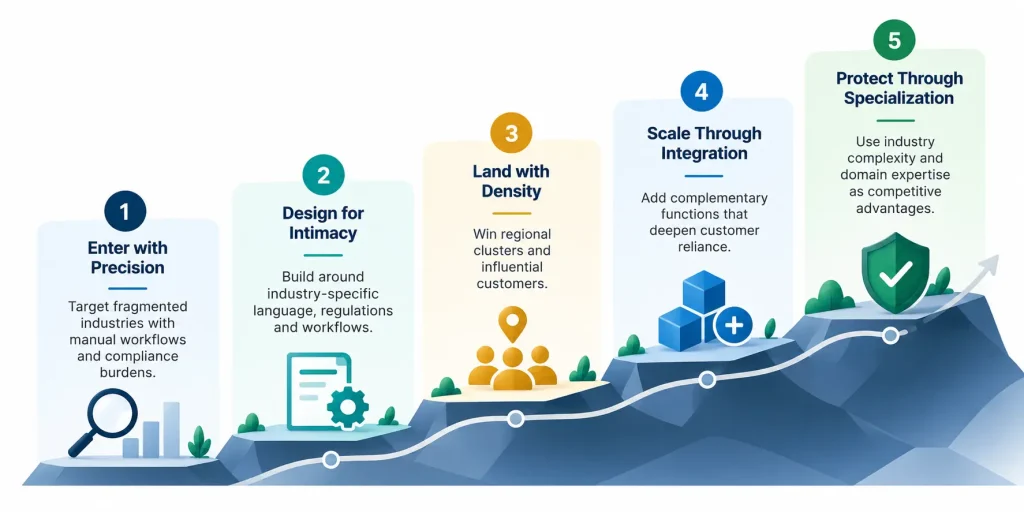
- Enter with precision: Choose verticals with fragmentation, analog workflows, and heavy compliance burdens.
- Design for intimacy: Build around the industry’s language, regulation, and workflows.
- Land with density: Target regional or community clusters where reference cascades accelerate adoption.
- Scale through integration: Layer adjacent functions that deepen reliance without fracturing the product.
- Protect through specialization: Treat complexity as a moat, since horizontal “edge cases” are vertical customers.
Risks remain for those who misread their market. A shallow grasp of the customer’s world produces beautifully designed irrelevance, and vertical dominance rarely guarantees horizontal opportunity. For disciplined operators, though, vertical SaaS market penetration builds a gravity that competitors cannot easily break. When removing a product feels as unthinkable as turning off the lights, true penetration has arrived.
Three Key Takeaways
- Vertical SaaS market penetration is measured by logo density, NRR, and workflow displacement, not by top-of-funnel volume or the size of the addressable market.
- Dense regional clusters and reference cascades lower CAC in tight industries, so early sales should favor influential customers over scattered wins.
- Expand through adjacencies that share personas, data, and sales channels, and resist opportunistic deals that dilute the roadmap and retention.
Disclaimer: This article is intended for informational purposes only and does not constitute legal, tax, or accounting advice. You should consult your own tax advisor or counsel for advice tailored to your specific situation.
Hindol Datta is a four-time CFO and senior finance executive with over 25 years of leadership experience across cybersecurity, SaaS, gaming, logistics, digital marketing, medical devices, consumer products, and nonprofit organizations. He has led more than $120M in fundraising and over $150M in M&A transactions while building the financial and operational systems that let complex businesses scale with confidence. He is the author of seven books in the Systems CFO Series and holds active CPA, CMA, and CIA credentials.
AI-assisted insights, supplemented by 25 years of finance leadership experience.