
November 11, 2026
In Part 1, I argued that governance hedges against volatility. In Part 2, I argued that legitimacy, not capital, is now the scarce input in American AI. Part 3 asks what follows for policy, and my answer will not please free-trade purists, including the ones I read with admiration. The United States should treat AI assurance, meaning the standards, testing, certification, and audit institutions that make powerful systems safe to rely on, as a strategic industry. It should build that industry deliberately, protect it at the border where the logic holds, and attach conditions to what it sells abroad. Governments that wrote the standards for earlier technologies collected the margin on every unit that followed. A CFO recognizes the pattern: whoever sets the specification owns the pricing power.
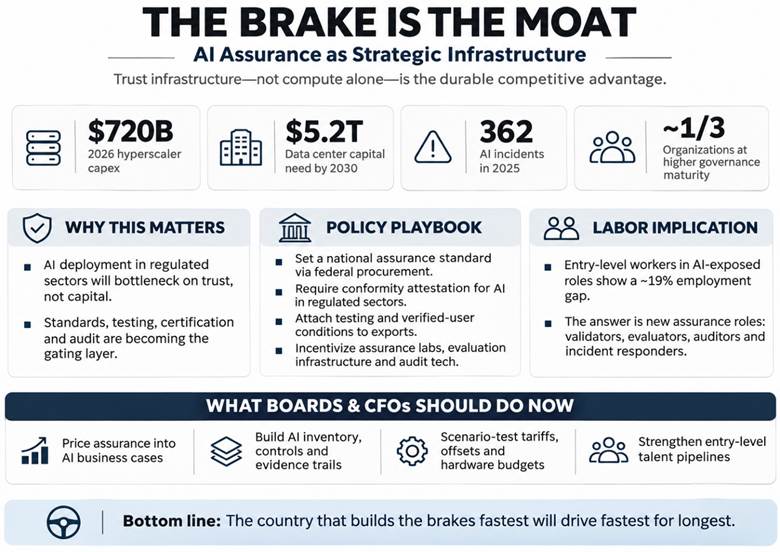
Speed without brakes is a balance sheet problem
Consider how a bank grows. Its lending capacity is set less by its capital than by the credibility of its controls. A lender with weak risk systems is capped by its regulator, its auditors, and its counterparties, no matter how much money it raises. The same logic now applies to the American AI build-out. Hyperscalers are guiding to more than $720 billion of 2026 capital spending, according to The New York Times, and McKinsey sizes data center capital needs at roughly $5.2 trillion by 2030. That capital earns a return only if the systems it funds are trusted enough to be deployed in banks, hospitals, utilities, and government.
The brakes are not being built as fast as the engine. Stanford’s 2026 AI Index counted a record 362 AI incidents in 2025. McKinsey’s 2026 trust survey found only about a third of organizations at the third maturity level in governance and agentic controls. Narayandas, in the Harvard Business Review, describes firms that approve AI formally and then never grant it authority, because accountability stays with humans who have no reason to defer. The result is a widening gap between what the technology can do and what institutions will let it do. My central claim is that closing that gap faster than anyone else is the competitive advantage. Any well-funded rival can buy compute. A trusted system of standards, testers, and attestations takes decades to build and cannot be bought.
What Japan and India actually did
Industrial policy has a mixed record, and an honest argument has to begin there. Japan’s Ministry of International Trade and Industry sponsored the VLSI project in the 1970s. A Hitotsubashi University working paper by Sigurdson attributes much of Japan’s later semiconductor success to that project and notes that, for a short period in the mid-1980s, Japanese companies produced some 50 percent of the world’s semiconductor devices. Scott Callon, in his study reviewed by MIT Technology Review, reached a harsher verdict on the wider record: the VLSI consortium was arguably the only partial success among MITI’s high-technology consortia, largely because MITI provided large-scale funding. Success was real, but narrow.
India offers a contemporary variant. Its Semiconductor Mission began in 2021 with an outlay of 76,000 crore rupees. On July 15, 2026, the Union Cabinet approved Semicon 2.0 at 1,27,500 crore rupees, about $13.2 billion. NITI Aayog reported in May that India still imports 90 to 95 percent of its semiconductor requirements, and industry assessments cited by Upstox note that India’s strength is design talent while fabrication and yield management demand a different skill set. Both cases support a conditional reading. State direction works when it is tied to a specific capability, is funded at scale, and is willing to be measured.
Three design lessons follow for anyone tempted to copy these programs. The target capability must be narrow enough to measure, so that failure is visible early. The funding must be large enough to change behavior, which is why small, scattered grants rarely matter. And the protected industry must remain exposed to eventual competition, because insulation without a test is how subsidies become permanent. A CFO would call these the standard conditions for any capital project: a defined scope, a sufficient budget, and a hurdle rate.
| Case | Instrument | Observed outcome | Source |
| Japan VLSI project, 1970s | MITI-sponsored research consortium | Japanese firms made about half of the world’s semiconductor devices in the mid-1980s; other consortia were judged weaker | Sigurdson (Hitotsubashi); MIT Technology Review |
| India Semiconductor Mission | 76,000 crore rupees (2021); Semicon 2.0 at 1,27,500 crore rupees (2026) | 90 to 95 percent import dependence in May 2026; design strength, fabrication gap | PIB; NITI Aayog via Times of Oman; Upstox |
| US Section 232 chip tariff | 25 percent on a narrow set of advanced chips from January 15, 2026 | Broad US-use exclusions; framed as a negotiating lever | Morgan Lewis; GHY |
| US BIS export rule | Case-by-case licensing of H200-class chips to China | China volume capped at 50 percent of US shipments; independent US lab testing; KYC | BIS; Morgan Lewis |
The United States already conditions access, in one direction
The bottom two rows of that table matter more than they appear. Washington has begun to use tariffs and export licensing as industrial instruments. The Section 232 action of January 14, 2026 imposed a 25 percent tariff on a narrow set of advanced semiconductors, including the Nvidia H200 and AMD MI325X, with broad exclusions for chips used in the United States. Morgan Lewis reads the action as a negotiation lever and a way to secure direct investment in domestic production, and the fact sheet itself contemplated an offset program for companies that build capacity here. On exports, the Bureau of Industry and Security now reviews licenses for such chips to China case by case, but only if the chips are commercially available in the United States, if shipments to China do not exceed half of US shipments, if a US laboratory tests each shipment, and if the buyer maintains customer-screening procedures.
Notice what that rule does. When America sells advanced computing abroad, it demands testing, certification, and verified end users. When America buys or deploys AI systems at home, it demands almost nothing comparable. That asymmetry is the policy gap. The tools of conditional access already exist; they simply point outward. My proposal is to point them inward as well, in a disciplined way.
What the policy should contain
First, a national assurance standard with enforcement behind it. The NIST AI Risk Management Framework is voluntary, and voluntary frameworks do not create an industry. Federal procurement is the fastest lever available: require attestation against a recognized standard from every AI system sold to federal agencies, and let that demand seed a private market of accredited testers and auditors.
Second, conditional import access rather than blanket tariffs. AI systems and models offered into regulated sectors such as finance, health, and critical infrastructure would carry a conformity attestation, whatever their country of origin. Hardware tariffs, where used, should follow the offset logic already contemplated in the Section 232 fact sheet, with credits for domestic manufacturing and assurance investment. A tariff designed to raise revenue from the inputs of a $720 billion capex program would tax the very build-out it is meant to protect. For example, if covered imported hardware were 30 percent of a data center budget, a 25 percent duty with no offset would add 7.5 percent to total cost. The Section 232 exclusions for US use exist because Washington understands this arithmetic.
Third, export conditions that sell the standard along with the product. The BIS rule already requires testing and know-your-customer controls. An allied assured-AI export program would extend those conditions to model weights, remote access and cloud delivery, and offer allied buyers a trusted path in return. The House passed the Remote Access Security Act by 369 to 22, as reported by Introl, which signals bipartisan appetite for closing the cloud loophole.
Fourth, capital for the assurance industry itself. The CHIPS investment tax credit now stands at 35 percent for qualifying manufacturing. A comparable credit for accredited testing laboratories, evaluation infrastructure, and audit technology would treat assurance as the capital-intensive sector it is becoming. This is my proposal, not an enacted measure, and it should carry a sunset date and published performance gates.
The politics are more favorable than the rhetoric suggests. Part 2 noted that the House passed a data center ratepayer bill by 417 to 3, and the Remote Access Security Act passed by 369 to 22. Divided government after the midterms makes sweeping new mandates unlikely, but it makes disclosure, testing, and procurement standards, which both parties can defend as consumer protection and national security, the most plausible path. An assurance strategy built on those instruments fits the votes that exist.
Fifth, and most important, labor.
Recapitalizing the workforce
Capital policy has moved faster than human capital policy, and the labor data show why that matters. The Stanford Digital Economy Lab’s August 2026 update, reported by GCN, found that employment among workers aged 22 to 25 in the most AI-exposed occupations stands about 19 percent below the level implied by similar workers in less exposed occupations. The adjustment works through hiring, not firing: companies are declining to bring in young workers rather than dismissing them. The same researchers find no comparable shortfall among experienced workers and no sign of economy-wide displacement.
| Measure | Finding | Source |
| Ages 22 to 25, most exposed occupations versus similar less exposed peers | About 19 percent below counterfactual | Stanford Digital Economy Lab, via GCN |
| Same age group, most exposed 40 percent of occupations, since 2022 | Down about 11 percent; least exposed 60 percent up about 10 percent | Stanford, via Computing |
| Mechanism | Reduced hiring, not increased separations | Stanford, via Silicon Canals |
| Overall employment in the ADP client sample, November 2022 to June 2026 | Up about 6 percent | Stanford, via Silicon Canals |
Two cautions apply. The Dallas Fed itself states that the pattern may not be causal, and the Stanford authors stress association. Still, the finding that codified, entry-level tasks are exposed while tacit, experience-based roles are not points at a concrete problem: the first rung of the career ladder is thinning. A company that stops hiring juniors today will lack seasoned managers in a decade.
This is where assurance becomes a labor policy, and the optimistic case emerges. Every control described in this series requires people: model validators, evaluators, internal auditors, decision-rights designers, incident responders, and the accountable executives Narayandas says AI adoption lacks. McKinsey found that organizations with a named accountable function score 2.6 on responsible AI maturity, compared with 1.8 for those without one. These are new rungs, and they reward judgment rather than codified tasks. A serious program would fund apprenticeships and community college pathways into assurance work, give schools and institutions a credential to teach toward, and finance the effort partly from the revenue and fees the standards regime generates. I would rather the country train ten thousand model validators than debate whether AI is a threat to jobs in the abstract.
The pessimistic view of the technology is also incomplete on the evidence. Employment in the ADP client sample grew by about 6 percent across the same period in which the young-worker gap opened, and the researchers see no mass displacement. The data describe a transition problem concentrated at the entry point, which is exactly the kind of problem institutions, schools, and well-designed incentives can address. Optimism here is a policy position, not a mood: it holds only if the country invests in the people on the receiving end of the change.
What the free-trade tradition gets right
The strongest objection comes from Jagdish Bhagwati and the Chicago tradition. Bhagwati’s argument, as summarized by reviewers of his book Free Trade Today, is that even in an imperfect world with market failures, free trade remains almost always the best policy, and that domestic problems are usually better addressed by domestic instruments than by trade barriers. The Cato Institute adds an empirical claim: that free trade, rather than selective protection, deserves credit for East Asia’s growth. I take both seriously, and my proposal deliberately leans on domestic instruments, namely procurement, standards, and tax credits, ahead of tariffs.
Four risks remain. Standards bodies can be captured by the incumbents who can best afford compliance, and the remedy is open participation and mandatory review. Retaliation is real: China reportedly blocked H200 imports at customs even after the United States opened the licensing door, according to Introl, which shows how limited export leverage can be. Callon’s record on MITI warns that consortia can fail when cooperation is forced. And a tariff mistake would land on the hyperscalers whose spending sustains the capital markets described in Part 2. For these reasons, I would insist on sunset clauses, published metrics such as the number of accredited testers, attested procurement volumes, and entry-level assurance hires, and a standing review that can retire any measure that is not working.
Bhagwati also observed that a free trade regime needs institutions to curb distortive practices to survive. That is the point of an assurance regime. It is the institutional layer that lets open markets in AI function without a race to the lowest-trust bottom.
What CFOs should do now?
Boards should assume that attestation will become a condition of selling to governments and regulated customers, in the United States as under the EU AI Act, whose fines reach 7 percent of worldwide turnover for the gravest violations. Management should price that obligation into AI business cases today, build the inventory and decision-rights documentation that evidence requires, and treat assurance spend as a hedge rather than a tax. Finance leaders should also scenario-test tariff and offset outcomes on their hardware budgets and hiring plans, and support entry-level pipelines before the senior bench thins.
Closing thought
The usual framing sets innovation against regulation, as if one pedal fought the other. A driver knows that the quality of the brakes sets the safe speed. The country that builds its brakes fastest, and teaches the world to trust them, will drive fastest for longest. Optimism about the technology and seriousness about its governance are two sides of the same coin.
Five questions to ponder
I would value your answers in the comments.
- Would you support conditional market access tied to assurance standards even if it raised your costs, and where would you draw the line? Industrial policy rewards early movers and penalizes laggards, and a CFO should know which side the company sits on.
- If export and import rules begin to require evidence of controls, could your supply chain produce it? Case-by-case export licensing already asks for testing and customer verification.
- Which supplier or customer is most exposed to a tariff or export-condition change, and have you scenario-planned it? Concentration risk becomes a finance problem the day a rule changes.
- MITI and India’s semiconductor program show industrial policy can build an industry or waste a budget. What would tell you an American assurance policy is working? Agree the test before the policy arrives, not after.
- How are you investing in the workforce, especially at entry level? The evidence points to slower hiring rather than layoffs, which means the cost lands on the next cohort.
Sources: The Economist, September 19 and November 7, 2026; Harvard Business Review, November to December 2026; Das Narayandas; Parts 1 and 2 of this series for the figures cited there. Sigurdson, VLSI Revisited: Revival in Japan, Hitotsubashi University. MIT Technology Review, Questioning Japan’s Miracle, January 1997. Press Information Bureau of India, Semiconductor Mission. Times of Oman citing NITI Aayog, May 2026. Upstox, Semicon 2.0, July 2026. Morgan Lewis, Section 232 Investigations Prompt Trade Negotiation, February 18, 2026. GHY International, January 15, 2026. Bureau of Industry and Security press release and final rule, January 15, 2026. Morgan Lewis, BIS Revises Export Review Policy, January 2026. Introl, BIS export policy analysis, 2026. GCN, Stanford Digital Economy Lab update, August 17, 2026. Computing, Stanford study coverage, 2026. Silicon Canals, AI entry-level employment gap. Stanford HAI, 2026 AI Index. McKinsey, State of AI trust in 2026. Congressional Research Service, R49031. Griswold review of Bhagwati, Free Trade Today. Cato Institute, Economic Development Bulletin 31.
AI-assisted insights, supplemented by 25 years of finance leadership experience.