
Executive Summary
Convertible notes with valuation caps let a startup raise capital before it has earned a price. The note defers valuation, yet the cap quietly sets one. That hidden price determines how much equity early investors receive when the note converts.
This article explains how convertibles and SAFEs work and why the valuation cap matters most. It models dilution, examines fairness for founders, and sets out when a convertible offering makes sense. It closes with the GAAP entries every finance team needs from issuance to conversion.
Understanding Convertible Notes With Valuation Caps
A convertible note is short-term debt that converts into preferred stock at the next priced round. The investor expects shares instead of cash repayment, usually at a discount to the new round price. Unlike investing in convertible bonds issued by public companies, early-stage notes rarely end in repayment.
A SAFE, or Simple Agreement for Future Equity, replaces debt with a contract. It carries no maturity date and no interest, but keeps the same deferred pricing. Both instruments often include a discount, commonly 10% to 25%, and a valuation cap.
The valuation cap sets a ceiling on the valuation at which the note converts. If the company’s value jumps before the next round, early investors still convert at the cap. A note with a $5M cap and a 20% discount converts at whichever price favors the investor.
Why the Cap Exists
A discount alone fails early investors when the next round prices high. An investor who funded a $5M company might otherwise convert at a 20% discount to a $50M round. A $10M cap instead lets that investor convert as if the company were worth $10M. The cap rewards the risk borne, not just the time waited.
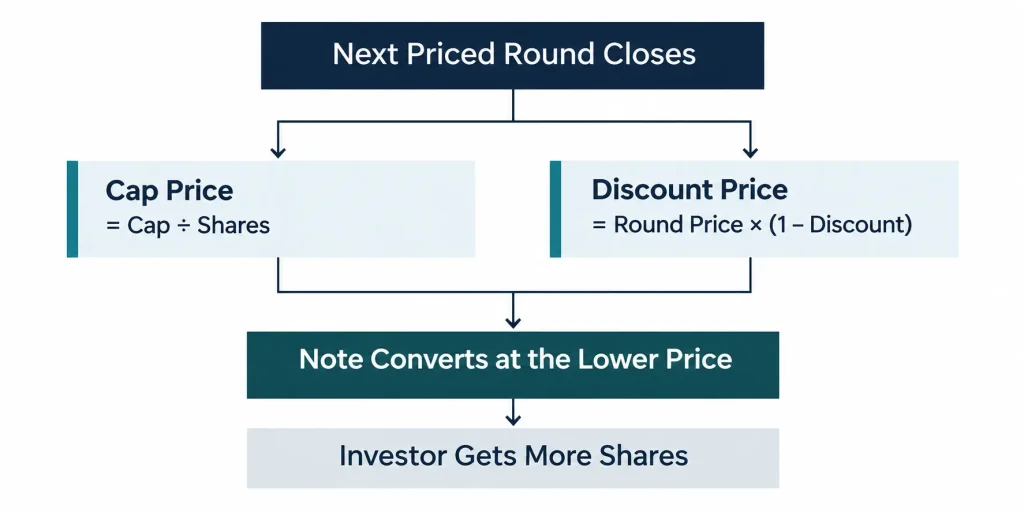
How a Note Chooses Its Conversion Price
The Origins and Logic of Convertible Instruments
Convertibles solve a hard problem in company formation. A young company cannot be priced fairly, yet investors need a claim on its upside. The note bridges that gap by deferring valuation, negotiation and dilution mechanics to a later round.
Convertibles grew popular after the dot-com era for raises of $250K to $1M. Documents are shorter and negotiations faster, with no board seats or liquidation preferences. The same simplicity, though, hides dilution that surfaces only when a priced round arrives.
A cap is a price in disguise, as a simple example shows. A $500K note with a $5M post-money cap converts into 10% of the company. Under a pre-money cap, the figure is about 9.1%. Either way, the next investors cannot change it.
Convertible notes with valuation caps work best under three conditions:
- Speed matters, such as closing a key hire or a market opportunity.
- Pricing is speculative, as in deep tech, life sciences or frontier markets.
- Trust between founder and investor runs high, since the instrument depends on deferred judgment.
How Valuation Caps Shape Convertible Notes
Consider a $1M note with a $5M cap and no discount, against 10M existing shares. The next round prices the company at $10M pre-money, or $1.00 per share. The cap price is $0.50 per share, so the note converts into 2M shares. Without a cap, the investor would receive 1M shares, half as many.
The conversion rule is simple: conversion price = the lower of the round price and the cap price. Caps that sit far below the next round shift real ownership. Suppose a company issues $2M of notes at a $5M cap and later prices at $15M. Those notes then convert into $6M of equity at round prices.
Setting the Cap and Combining It With a Discount
Some CFOs anchor the cap to an expected Series A valuation. One working formula is cap = implied pre-money × (1 − founder risk premium). With a $10M expected pre-money and a 25% premium, the cap lands at $7.5M.
Investors often ask for both a cap and a discount. With an $8M cap, a 20% discount and a $10M round, both methods give an $8M effective valuation. At a $9M round, the discount yields $7.2M, so the note converts at that lower price. Building the capital strategy for a pre-Series A AI assurance platform meant modeling these interactions in advance.
A cap set too low creates friction with later investors, who may demand renegotiation. A cap set too high defeats its own purpose. Burned founders grow wary of convertibles, while emboldened investors push for lower caps, higher discounts and MFN clauses.
Dilution, Fairness and the Founder’s Dilemma
Take $2M of notes with an $8M cap, no discount and no interest. Founders hold 8M shares, and a Series A invests $2M at $16M pre-money. The round price is $2.00 per share, while the notes convert at $1.00.
| Holder | Shares | Ownership After Series A |
| Founders | 8,000,000 | 72.7% |
| Note holders ($2M at $8M cap) | 2,000,000 | 18.2% |
| Series A ($2M at $16M pre) | 1,000,000 | 9.1% |
| Total | 11,000,000 | 100% |
Note holders receive twice the equity per dollar of the Series A investors. Some see the cap as fair reward for early risk. Others call it unearned dilution, based on past uncertainty instead of present contribution.
The Modeling Imperative
Multiple notes with different caps compound the problem. Assume 10M founder shares and a Series A at $20M pre-money, or $2.00 per share.
| Note | Cap | Conversion Price | Shares Issued | Shares per Dollar | Ownership Before New Money |
| $500K | $5M | $0.50 | 1,000,000 | 2.00 | 7.7% |
| $750K | $8M | $0.80 | 937,500 | 1.25 | 7.2% |
| $1M | $10M | $1.00 | 1,000,000 | 1.00 | 7.7% |
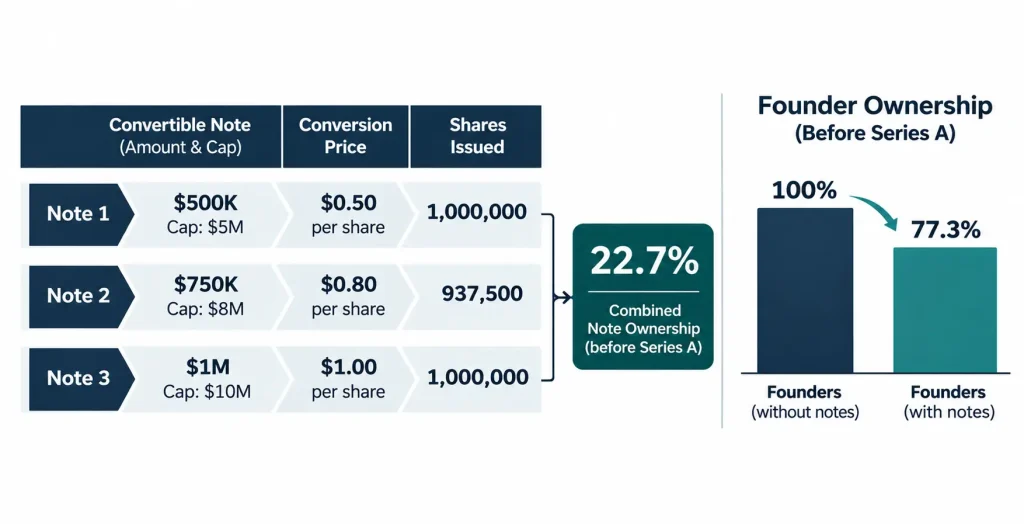
Together, the notes claim 22.7% before the new round invests. Every note deserves modeling at issuance, against questions like these:
- What ownership does this cap yield across plausible round valuations?
- How does that compare with the dilution of a priced round today?
- Is the investor’s protection proportionate to the risk taken?
- How will several capped notes interact on one cap table?
Many founders still accept capped notes because the alternative is running out of cash. The cap works as a tax on success, not on survival. The danger arises when founders treat that tax as theoretical and stop planning for it.
When a Convertible Offering Makes Sense
A convertible offering fits a few defined moments:
- A near-term funding need arrives before the company is ready for full pricing.
- Information gaps make any priced round arbitrary at pre-seed.
- A bridge precedes a Series A already in motion.
- A hot market lets founders secure high caps and small discounts.
- Stakeholders disagree on valuation and need time for performance to settle it.
An early-stage email marketing company cut monthly burn from $800K to $200K during a turnaround. Episodes like that show why bridge capital must lead somewhere, not merely buy time. Convertibles turn into brambles when maturity nears with no priced round in sight.
Founders should reject convertibles used to hide dilution, dodge governance conversations or flatter the balance sheet. A sound structure keeps three virtues: transparency, modelability and finality. Counterparty character matters as much as structure. A poor deal with a good partner often survives, while a perfect structure with the wrong investor rarely does.
Accounting for Convertible Notes and SAFEs Under GAAP
Convertibles begin as handshakes but end on the balance sheet. A venture-backed digital marketing company raised $36.5M across Series A through C and delivered its first external audit. Every instrument in a stack like that eventually reaches the auditors.
Key Journal Entries
| Event | Debit | Credit |
| Issue $500K note | Cash $500K | Convertible note payable $500K |
| Monthly interest at 6% | Interest expense $2,500 | Interest payable $2,500 |
| Note with $50K detachable warrant | Cash $500K; debt discount $50K | Note payable $500K; APIC, warrants $50K |
| Monthly discount amortization (12 months) | Interest expense $4,167 | Debt discount $4,167 |
| Embedded derivative bifurcated at issuance | Cash $500K | Note payable $400K; derivative liability $100K |
| Derivative fair value rises $20K | Loss on revaluation $20K | Derivative liability $20K |
| Conversion ($500K note, $30K interest, $10K unamortized discount) | Note payable $500K; interest payable $30K | Debt discount $10K; preferred stock $1K; APIC $519K |
The warrant entry uses straight-line amortization for simplicity, although GAAP prefers the effective interest method. At conversion under original terms, the net carrying amount moves to equity without a gain or loss.
SAFEs and Disclosure
SAFEs carry no interest or maturity, so they are not debt. Most SAFEs, however, fall under ASC 480 as liabilities because a liquidity event can require cash settlement. Companies remeasure liability-classified SAFEs at fair value each reporting period until conversion.
Footnotes should disclose conversion terms, caps, discounts, maturity, interest, amounts outstanding and fair value methods. Auditors will review board approvals, derivative valuations and evidence of arm’s-length terms.
Three Key Takeaways
- Treat every valuation cap as a real price and model its dilution at issuance. Waiting until conversion turns a manageable term into an unwelcome surprise.
- Several notes with different caps can claim over 20% of a company before the Series A invests. A single fully diluted model keeps that exposure visible to founders and boards.
- Book convertibles correctly from day one, including discounts, derivatives and SAFE classification. Clean entries build the trust that later investors and auditors expect.
Disclaimer: This article is intended for informational purposes only and does not constitute legal, tax, or accounting advice. You should consult your own tax advisor or counsel for advice tailored to your specific situation.
Hindol Datta is a four-time CFO and senior finance executive with over 25 years of leadership experience across cybersecurity, SaaS, gaming, logistics, digital marketing, medical devices, consumer products, and nonprofit organizations. He has led more than $120M in fundraising and over $150M in M&A transactions while building the financial and operational systems that let complex businesses scale with confidence. He is the author of seven books in the Systems CFO Series and holds active CPA, CMA, and CIA credentials.
AI-assisted insights, supplemented by 25 years of finance leadership experience.