
Executive Summary
Preference shares sit between debt and common equity, giving investors downside protection while keeping a claim on the upside. Knowing what preference shares are, and how participation changes the payout, matters to anyone signing a term sheet.
This guide works through liquidation preference, conversion rights, and capped versus uncapped participation with real numbers. It closes with an exit waterfall and the reforms available to boards and founders.
What Are Preference Shares and Why Do They Exist?
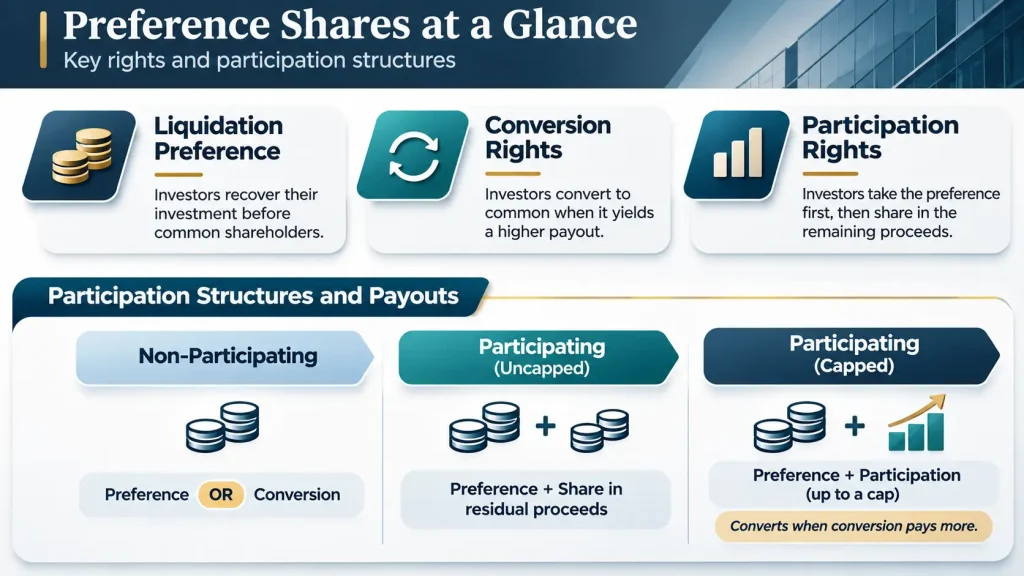
A preference share is a hybrid instrument, part creditor claim and part ownership stake. It ranks above common stock in a sale or liquidation but below debt. Investors take on the risk of an unproven company, and the preference share gives them priority at distribution.
The structure took shape in railroads and utilities, industries that needed large sums of capital with slow, uncertain returns. Common stock felt too volatile, while debt felt too rigid, so preference shares offered a middle path with dividends, seniority, and an option to convert.
Venture capital later refined this design into its default instrument for institutional rounds. The investor commits money today, and the company writes protections against outcomes nobody can yet predict.
The Core Rights Attached to a Preference Share
Most preference shares carry a familiar bundle of rights:
- Liquidation preference, usually 1x the invested capital, paid before common holders receive anything
- Dividend rights, either cumulative or non-cumulative
- Conversion rights into common stock when that pays more
- Anti-dilution protection against down rounds
- Board seats or protective voting provisions
None of these rights is decorative, since each one prices the risk of investing with incomplete information.
How Liquidation Preference Works in Practice
The liquidation preference is the foundational right of preferred stock. In a sale, merger, or wind-down, preferred holders recover their capital before common holders see a dollar.
Consider a company that raises $5M in Series A preference shares with a 1x preference. In a $10M exit, investors take $5M off the top before anyone else participates. This shields them from a disappointing outcome, but it also creates a tiered structure where founders can see little from a respectable acquisition. The priority is fair in principle, because the investor gave up liquidity while the founder kept operational control.
Conversion Rights Provide a Floor and a Sail
Standard non-participating preference shares include a conversion option. The holder can convert into common stock, usually one-for-one, whenever conversion yields more than the preference. In a large exit, investors give up the preference and share pro rata with everyone else. Preferred holders therefore never do worse than common holders, which gives the instrument a floor and a sail.
Participating Preference Shares and the Double Dip
Participating preference shares push the investor’s claim one step further. The holder collects its liquidation preference, then shares in the remaining proceeds as if it had converted, so it gets paid twice from one exit.
Now add participation rights to the earlier example. The Series A holds $5M in participating preference shares and owns 25% of the company. In a $10M sale, it collects $5M, then 25% of the remaining $5M, for a total of $6.25M. Founders, employees, and angels split the remaining $3.75M, despite owning 75% of the business.
Why Investors Ask for Participation Rights
Participation rights tend to appear under three conditions:
- Investor leverage, when a startup accepts tougher terms to land a sought-after firm
- Market volatility, when investors want extra downside insulation and upside convexity
- Portfolio timing, when funds seek structural returns to offset risk across vintages
The cost shows up later in team morale, when a high headline price produces a modest payout for employees. A clause written as risk mitigation can turn into a lasting cultural fracture.
Capped vs Uncapped Participating Preference Shares
A cap decides how far the double dip extends. Without one, the holder takes its preference plus a pro rata share at any exit size. A cap, often set at 2x the investment, halts participation once total proceeds reach that ceiling. Beyond that point, the holder converts to common whenever conversion pays more.
Investor Payouts at Three Exit Values
The table below assumes a $5M Series A investment at 25% ownership with a 1x preference.
| Exit value | Non-participating | Participating, uncapped | Participating, 2x cap |
| $10M | $5M (takes preference) | $6.25M | $6.25M (below cap) |
| $20M | $5M (indifferent) | $8.75M | $8.75M (below cap) |
| $60M | $15M (converts) | $18.75M | $15M (converts, as $10M cap is lower) |
At $20M, the participating investor collects $8.75M, leaving common holders with $11.25M. At $60M, the uncapped holder takes $18.75M, while the capped holder converts and takes $15M. That $3.75M difference flows back to founders and employees.
The Behavioral Cost of Uncapped Participation
Uncapped participation usually signals an investor negotiating from strength, facing a company that was early or short on options. Its effects outlast the round in four ways:
- Perverse exit incentives, as boards refuse good $20M to $50M offers
- Retention risk, as key people see their equity sit underwater
- Term sheet stacking, as each new investor demands parity with earlier rounds
- Governance distortion, as participating holders steer exits toward their priorities
A capped structure rewards early risk in modest outcomes without claiming unlimited upside as the company scales. Stacking shows up quickly in companies raising several rounds. A venture-backed digital marketing company raised $36.5M across Series A through C, and each new term sheet arrived benchmarked against earlier rounds.
Reading the Exit Waterfall for Preference Shares
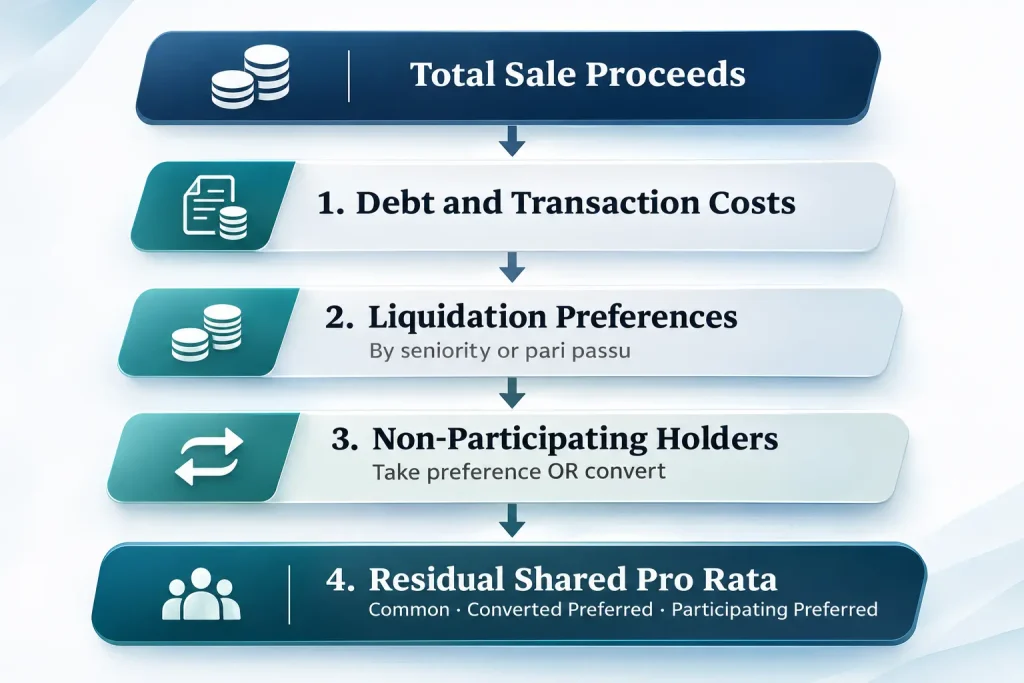
The exit waterfall models how sale proceeds flow through the capital stack. It translates legal priority into cash for each holder at closing.
Capital Structure for the Worked Example
| Holder | Investment | Terms | Ownership |
| Series A | $5M | 1x participating, uncapped | 25% |
| Series B | $10M | 1x non-participating | 30% |
| Common | None | Founders, employees, angels | 45% |
Payouts at a $40M and a $20M Exit
| Holder | $40M exit | $20M exit |
| Series A | $13.75M | $6.79M |
| Series B | $10.5M (converts) | $10M (takes preference) |
| Common | $15.75M | $3.21M |
At $40M, Series B converts, because 30% of the residual pays $10.5M against a $10M preference. Series A takes its $5M, then 25% of the remaining $35M. At $20M, Series B keeps its $10M preference, and Series A takes $5M plus a pro rata share of the last $5M. Common holders own 45% of the company yet receive roughly 16% of the proceeds.
More than $100M of cross-border M&A at a publicly listed gaming company shows how distribution shapes deal support. A transaction can look sound on valuation and still stall once stakeholders see their share.
What CFOs Should Model Before Every Round
A disciplined CFO treats the waterfall as a recurring governance tool, not a closing exercise:
- Model exit scenarios for every round, at values ranging from $10M to $1B
- Translate percentages into dollars for founders, employees, and angels at $50M, $100M, and $200M
- Bring the model to the board before anyone signs a term sheet
Reforming Preference Share Terms to Align the Capital Stack
Most early-stage companies inherit their capital structures, with each round copying the first term sheet. A founder who accepts participating terms at seed may hold 12% fully diluted after Series C, with her team receiving under 10% of proceeds in a modest exit.
Boards can break that pattern by reviewing the stack between rounds. A mission-driven education institution in Silicon Valley raised $37M across equity and venture debt. Its capital structure sat on the board and audit committee agenda alongside the operating plan.
Practical Tools for Rebalancing Preference Shares
Reform calls for careful adjustment, and several tools are available:
- Cap participation at a defined multiple, such as 2x total return
- Add sunset clauses that convert preferred to common after 5 to 7 years
- Set conditional conversion triggers above a defined exit value, such as $100M
- Grant option refreshers or RSUs when dilution erodes team incentives
- Tie any enhanced terms to objective milestones such as revenue, product releases, or time
Many respected funds avoid participating preferred entirely, knowing strong founders prefer partners who believe in shared upside.
What Founders Should Do Before Signing
Founders often leave preference terms to counsel, yet those terms decide who walks away with what. Before signing, founders should:
- Learn the mechanics of liquidation preference and participation
- Ask for waterfall models across a wide range of exit values
- Negotiate caps and sunset clauses wherever possible
- Challenge clauses that reward capital without corresponding risk
A principled default uses 1x non-participating preference shares, caps any participation, and converts to common at defined success thresholds. Such a structure cannot guarantee fairness, but it records the intention to be fair.
Three Key Takeaways
- Preference shares give investors priority and downside protection, while conversion rights ensure they never trail common holders. Clause details decide who benefits in a middling exit.
- Uncapped participation lets investors collect twice at every exit size, compressing common payouts. A 2x cap or conversion trigger keeps investor protection while restoring upside for the team.
- Waterfall models built before every round turn abstract terms into dollar outcomes for real people. Boards that review the stack can correct misalignment before an exit forces the question.
Disclaimer: This article is intended for informational purposes only and does not constitute legal, tax, or accounting advice. You should consult your own tax advisor or counsel for advice tailored to your specific situation.
Hindol Datta is a four-time CFO and senior finance executive with over 25 years of leadership experience across cybersecurity, SaaS, gaming, logistics, digital marketing, medical devices, consumer products, and nonprofit organizations. He has led more than $120M in fundraising and over $150M in M&A transactions while building the financial and operational systems that let complex businesses scale with confidence. He is the author of seven books in the Systems CFO Series and holds active CPA, CMA, and CIA credentials.
AI-assisted insights, supplemented by 25 years of finance leadership experience.