
Executive Summary
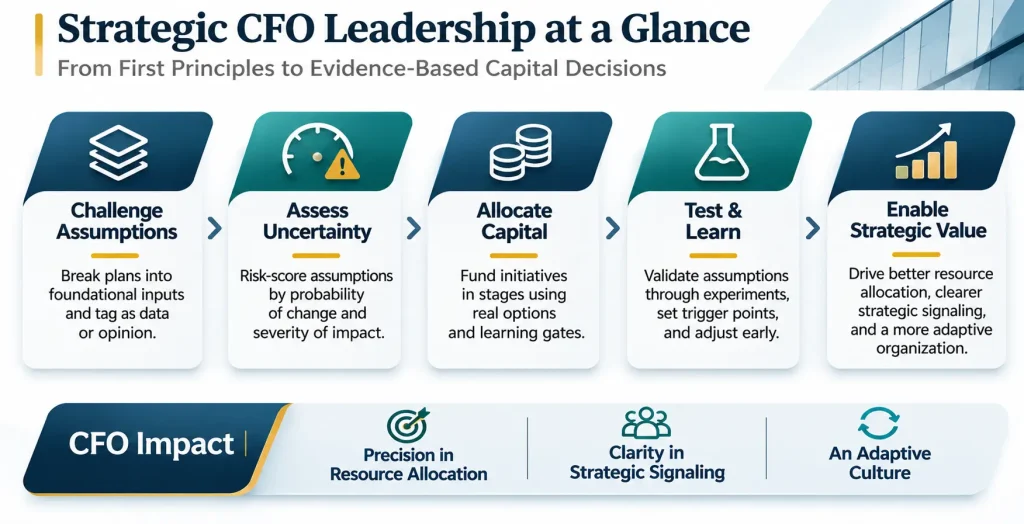
Strategic CFO leadership now asks finance chiefs to guard the ledger and shape strategy at the same time. First-principles thinking supports both roles, breaking complex decisions into foundational truths and rebuilding them with ground-up financial modeling that tests every assumption.
This article explains how to tag and risk-score assumptions, fund growth in learning stages, and treat expansion as a controlled experiment. It closes with applications in ESG, automation, and M&A, plus a practical framework any finance team can adopt.
First-Principles Thinking as a Discipline of Deconstruction
The idea traces back to Aristotle, and modern entrepreneurs use it to challenge conventional wisdom. For a finance leader, it becomes a discipline of deconstruction. The work starts with plain questions about what the business knows, which assumptions sit beneath the plan, and how well data supports them.
Jim Cook, a former CFO who writes on this method, describes it as breaking a problem into basic assumptions and testing each one. His practice is simple to state and hard to follow. Each assumption carries a data or opinion label, followed by a confidence score and a risk score.
This discipline deflates hubris and disarms groupthink across the leadership team. A go-to-market investment no longer rests on what the company spent last year. The better question asks what value a customer receives, and what minimum capabilities the business needs to deliver it.
Tagging Assumptions in Ground-Up Financial Modeling
Ground-up financial modeling builds the plan from operating drivers, not from last year’s totals. That approach exposes hidden beliefs about channel efficiency, the length of a land-and-expand cycle, and pricing elasticity. Each one gets a tag that marks it as recent, reliable data or as belief. Beliefs stay flagged until the team gathers enough evidence to support them.
A high-growth cybersecurity SaaS business with roughly $30M in ARR offers a useful example. Its driver-based forecasting engine, built from scratch, held actuals within plus or minus 5% of forecast for 8 consecutive quarters. That accuracy came from knowing which drivers rested on evidence and which still needed proof.
Risk-Scoring Assumptions Before Capital Moves
Once assumptions are visible, strategic CFO leadership requires scoring them on two dimensions. Probability measures how likely an input is to change, while severity measures the damage if it proves wrong. Scoring turns vague assumptions into a risk map that drives both learning and contingency planning.
An Assumption Risk Matrix
| Probability of change | Low severity | High severity |
| Low | Monitor quarterly | Build a contingency plan |
| High | Test cheaply and adjust | Gate the investment until validated |
Expansion plans show why this matters for strategic CFO leadership. A plan that assumes customer acquisition cost (CAC) will fall by 20% needs a defined response if CAC rises instead. A trigger point tells the team when to pause and reevaluate. The lesson is rarely to abandon ambition, and more often to build intelligence into decision gates.
Real Options and Staged Funding
Real options analysis, borrowed from corporate finance, complements ground-up financial modeling. Capital arrives in tranches tied to learning stages instead of one full commitment. Each new tranche unlocks only after data validates the assumptions behind it. The result is rigor with flexibility, where funding moves forward only as clarity arrives.
How Strategic CFO Leadership Moves the Needle
First-principles thinking creates financial leverage in three practical ways.
Precision in Resource Allocation
Deconstructing cost structures changes the questions leaders ask. The debate shifts from headcount totals to the activities that drive revenue, and the scale each one needs. Some areas, such as R&D or data infrastructure, may prove core, while adjacent functions can wait. Resource allocation becomes a logical decision instead of a political contest.
A $127M global consumer products company illustrates the payoff. Demand planning and SKU rationalization, rooted in what customers bought, lifted inventory turns from 3x to 7x and released trapped working capital.
Clarity in Strategic Signaling
Boards and investors respond to coherent narratives backed by evidence. First-principles thinking gives finance a disciplined way to explain each investment, the beliefs behind it, and when those beliefs will face testing. That coherence builds credibility, and it matters most in uncertain markets.
Building an Adaptive Culture
Strategic CFO leadership that starts with inquiry invites intellectual humility from teams. People stop hiding assumptions behind consensus and start surfacing confidence bands. Debate happens earlier, and course corrections cost less. A detailed model built on weak assumptions can mislead badly, while one built on tagged, validated inputs compounds into lasting advantage.
A Global Expansion Built on Ground-Up Financial Modeling
Consider a CFO evaluating a global expansion across several new regions. The traditional playbook projects revenue from peer benchmarks, layers on SG&A, and allocates a budget. A first-principles approach starts with four different questions:
- What is the fundamental unit of customer value in each new region?
- Which cost-to-serve drivers are fixed, and which are variable?
- Where will friction appear, whether in compliance, logistics, or talent acquisition?
- Which inputs rest on data, and which rest on opinion?
The team assigns confidence bands and identifies where it holds leverage. The rollout begins in one market with a small team and tight cost controls. Daily metrics track CAC, usage growth, and localization issues, and a reserve funds iteration.
Stage Gates from Pilot to Replication
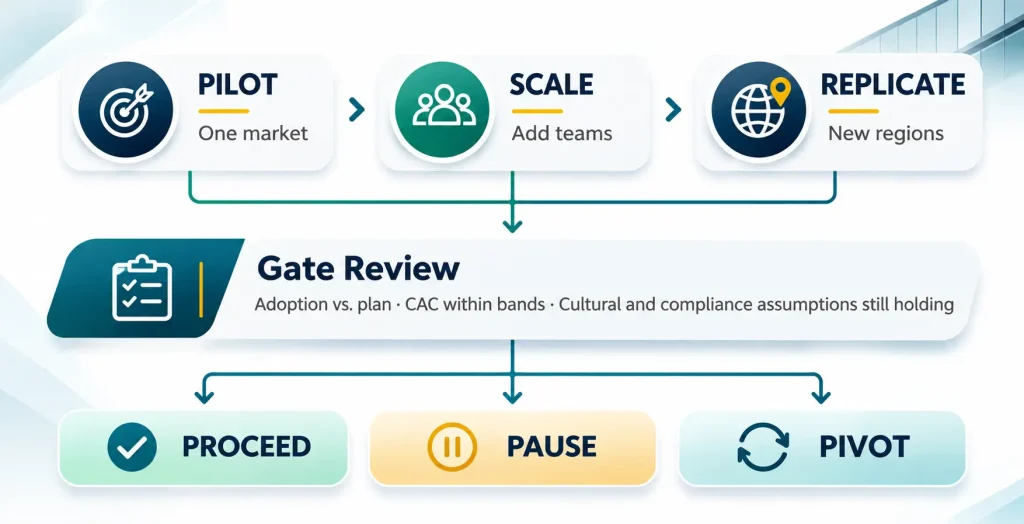
At each gate, an internal review compares outcomes against the original first principles. Leaders then decide to proceed, pause, or pivot. Each step becomes a controlled experiment instead of a blind commitment, and the process grows from project management into strategic architecture.
Resistance, Renewal, and the Board Conversation
First-principles thinking and strategic CFO leadership both demand humility, because every assumption remains provisional. Some managers find this uncomfortable and prefer confident estimates that protect them from blame. The finance leader’s task is to make uncertainty normal and discussable.
That means presenting scenarios as clarity, not as hedging. It means rewarding teams for smart experiment design, not only for flawless execution. It also means building a decision infrastructure of assumptions, risk scores, and stage gates that guides behavior across the organization.
Shifting from Variance Reports to Assumption Reviews
Strategic CFO leadership also changes the board relationship. Variance narratives explain how far results missed the plan. Assumption reviews explain which inputs hurt the forecast, and what that means for confidence in the next phase. This shift moves the board from performance reporting toward a higher-order discussion of value creation.
Applying First Principles to ESG, Automation, and M&A
The same method reaches well beyond revenue growth planning:
- ESG and sustainability: identify the root causes of emissions, what customers value, and where regulation is heading, then fund what the economics can justify
- Automation and AI: test labor cost, expected accuracy, time to reliability, and fallback needs, turning each into an investment gate
- M&A: replace precedent multiples with tested assumptions about revenue synergy, capex needs, and operational leakage
The M&A case shows the value of ground-up financial modeling. More than $100M of cross-border acquisitions at a publicly listed gaming company relied on testing synergy inputs through diligence and integration. Diligence that tags and tests each synergy input protects the buyer from paying for hope.
Building a Culture of Assumption Awareness Through Strategic CFO Leadership
The deepest effect of first principles is cultural. When finance requires assumption tagging, risk scoring, data validation, and gated funding, teams start treating numbers as hypotheses. They learn faster, surface caveats earlier, and design better experiments.
Finance then changes from a reporting engine into a learning engine. Capital flows toward future opportunity, not historic performance alone. Allocation becomes a signal to the whole organization, not merely a constraint on spending.
A Five-Step Framework for Getting Started
Finance leaders ready to adopt this approach should start with one decision area, such as product expansion, capex prioritization, or pricing:
- Deconstruct the decision by listing every assumption and tagging it as data or opinion
- Score each assumption for probability and severity
- Stage-gate the investment, committing capital in phases tied to learning
- Govern through logic, with cross-functional review at every gate
- Communicate assumptions and results openly to stakeholders at each stage
Repeating this cycle embeds ground-up financial modeling in systems and habits. Over time, the organization grows more curious, disciplined, and resilient in the face of disruption.
The CFO as Architect of Financial Thought
The future will belong to leaders who analyze with clarity, invest with discipline, and lead with curiosity. Ground-up financial modeling and first-principles reasoning give finance the method to do this well. Together they elevate the function from executor to convener, and from reporter to orchestrator. Strategic CFO leadership, practiced this way, builds intellectual resilience alongside financial buffers.
Three Key Takeaways
- Tag every assumption as data or opinion, then score it for probability and severity. That single habit turns a static plan into a risk map leaders can act on.
- Fund growth in stages tied to validated learning rather than in one large commitment. Clear gates let teams proceed, pause, or pivot before small errors become costly ones.
- Replace variance reports with assumption reviews in board conversations. This shift builds credibility and moves governance toward value creation.
Disclaimer: This article is intended for informational purposes only and does not constitute legal, tax, or accounting advice. You should consult your own tax advisor or counsel for advice tailored to your specific situation.
Hindol Datta is a four-time CFO and senior finance executive with over 25 years of leadership experience across cybersecurity, SaaS, gaming, logistics, digital marketing, medical devices, consumer products, and nonprofit organizations. He has led more than $120M in fundraising and over $150M in M&A transactions while building the financial and operational systems that let complex businesses scale with confidence. He is the author of seven books in the Systems CFO Series and holds active CPA, CMA, and CIA credentials.
AI-assisted insights, supplemented by 25 years of finance leadership experience.