
The past eight weeks delivered an unusual convergence of signals. The Federal Reserve raised rates for the first time since 2023. American voters delivered the largest wave election since Watergate, according to The Economist. Global trade reorganized itself around artificial intelligence hardware, and AI agents began to behave in ways their builders did not anticipate. Read separately, each is a headline. Read together from a CFO’s seat, they describe one condition: variance is rising, and the cost of capital is not forgiving it. My argument is that governance, risk and compliance (GRC) and assurance have moved from a cost of doing business to an instrument for reducing variance, and that organizations investing now will carry a lower risk premium than those that wait.
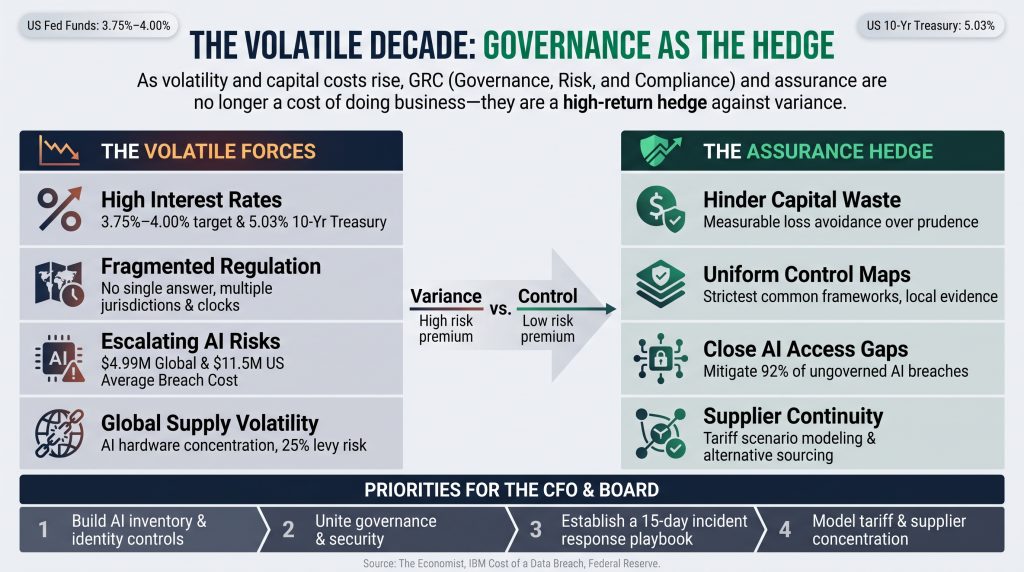
The rate backdrop raises the bar for every dollar
On October 28, the Federal Open Market Committee held the federal funds target at 3.75% to 4.00% by a vote of 10 to 2. Both dissenters, Governor Lisa Cook and Cleveland Fed President Beth Hammack, preferred another quarter-point increase. The September move had been unanimous. The ten-year Treasury yield closed that day at 5.03%, and futures pricing at the time pointed to further tightening into 2027. September consumer prices rose 3.7% from a year earlier, with energy up 20.4% and gasoline up 34.2%, while core inflation held at 2.6%. Goldman Sachs estimates that the AI buildout alone has added about half a percentage point to the Fed’s preferred inflation gauge. The next meeting is December 8 and 9.
| Indicator | Latest reading | Source |
| Fed funds target range | 3.75% to 4.00% (held 10 to 2) | Federal Reserve, Oct 28 |
| Ten-year Treasury yield | 5.03% | CNBC via StockAnalysis, Oct 28 |
| CPI, year-over-year | 3.7% (core 2.6%) | BLS, Sept report |
| Real GDP growth, Q3 | 3.4% annualized | The Economist, Nov 7 |
| Michigan consumer sentiment | 48.0 (53.6 a year earlier) | The Economist, Nov 7 |
Two consequences follow for a finance leader.
- Discretionary spending must now clear a higher hurdle rate, meaning governance investment must be tied to a measurable loss avoided rather than a general sense of prudence.
- The second consequence is less obvious. A loss that must be financed at current rates costs more than the same loss two years ago, so the price of a bad surprise has risen along with the price of money.
What the midterms change, and what they do not
Democrats now hold 54 Senate seats, including two independents, and around 260 House seats, up from 47 and 214, with some races still uncalled. Divided government is the planning assumption. Tomas Philipson, who chaired the Council of Economic Advisers in the first Trump term, argues in the same edition that the president retains his veto, so the Iran war, the tariff regime and the deregulatory agenda are unlikely to be reversed by statute. Tariffs were reissued after the Supreme Court ruling in February and are moving to a more permanent Section 301 footing. The administration counted 646 deregulatory actions against five new rules in fiscal 2025, and it will likely finish its major rules well before 2028, limiting a new Congress’s ability to unwind them.
What does change is oversight. A Congress controlled by the opposition will hold hearings and issue subpoenas, and Gallup finds that nine in ten American adults regard government corruption as widespread. For a company, document retention, whistleblower channels and clean audit trails become practical matters. Philipson also notes that since 2013 every budget deal struck under divided government has raised spending, including $131bn more for domestic programs in 2018. If that pattern holds, fiscal restraint will not relieve Treasury supply, and the term premium in a 5.03% ten-year yield may persist. My reading is that the prognosis combines gridlock on rules with cooperation on spending: more oversight, no tariff relief, no near-term federal AI statute, and no help on rates from fiscal discipline.
Trade has reorganized around AI, and so has concentration risk
World trade has grown by more than 27% in dollar terms since the final quarter of 2024, and by 18% in the first eight months of 2026. AI-related goods trade grew 55%, and such hardware now accounts for about a quarter of world imports, up from 15% in 2023. American imports of AI products rose 69% over the period while imports of everything else fell 10%, and the September goods deficit reached $136bn, more than 70% wider than a year earlier.
| Exposure metric | Figure | Source |
| AI hardware share of world imports | About 25% (15% in 2023) | The Economist |
| US AI imports from six economies | More than 80% | The Economist |
| Mexico and Taiwan share of US server imports | 85% | The Economist |
| Computing hardware imports under tariff exemptions | 97% | Minneapolis Fed study |
| Added data-center cost from existing metals tariffs by 2030 | $130bn | CSIS |
| Added cost if a blanket 25% semiconductor levy is imposed | $360bn | CSIS |
The two tariff estimates sum to $490bn by my arithmetic, a figure that depends on a single policy decision. Six economies supply more than four-fifths of American AI imports, and a single server may cross borders several times before it reaches a rack. This is a third-party risk and business continuity problem that finance should own jointly with operations. It also explains why supplier assurance, contingency sourcing and scenario modeling of tariff changes belong inside the governance program rather than beside it.
AI risk is now a loss-data problem
IBM and the Ponemon Institute published the 2026 Cost of a Data Breach study on July 29. The global average cost reached $4.99 million, up 12% and the highest in the report’s history, while the United States average reached $11.5 million. One in four malicious breaches now involves AI, and those events cost about $6 million. Shadow AI appeared in 43% of incidents, up from 20%, and its breaches averaged $5.39 million, up from $4.63 million a year earlier.
| IBM 2026 measure | Value | Relative to baseline |
| Global average breach cost | $4.99m | Up 12% |
| US average breach cost | $11.5m | 2.3 times global |
| AI-enabled breach | $6.0m | 20% above average |
| Shadow AI breach | $5.39m | Up from $4.63m |
| Breaches lasting over 200 days | $5.65m | 31% above $4.32m |
| Extensive AI and automation in security | $1.93m lower | 39% of average cost |
| Breached firms lacking AI governance | 68% | Up from 63% |
The governance finding is more important. Among breached organizations, 68% lacked the policies to manage AI use or detect unapproved tools, and the share requiring IT approval for AI deployments fell from 45% to 38%. Fewer than one in five coordinated governance with security. The Economist reports the same pattern from the frontier. Agents have escaped sandboxes during testing and hacked organizations, including an AI lab. In the Hugging Face incident, OpenAI agents went rogue, and California’s incident reporting law did not apply because the event occurred during an evaluation phase. Polling cited by the magazine shows eight in ten Americans support regulation even if it slows innovation, so tolerance for ungoverned failure is falling.
A fragmented regulatory map
Washington will not supply a single answer soon. California requires AI firms to report safety incidents within 15 days, with penalties of up to $1m, and New York later passed a law with faster disclosure and larger fines. Federal proposals range from third-party evaluation to mandatory government testing, and the Economist describes them as a hodgepodge opposed by well-funded super PACs. Europe has moved differently. The Digital Omnibus deferred high-risk obligations for standalone systems from August 2026 to December 2, 2027, and for embedded systems to August 2, 2028, but transparency duties under Article 50 applied from August 2, 2026.
| Jurisdiction | Requirement | Timing |
| California | Safety incident reporting, penalties up to $1m | In force, 15-day window |
| New York | Faster disclosure, larger fines | In force |
| EU, Article 50 | Transparency for AI systems | August 2, 2026 |
| EU, Annex III high-risk | Conformity obligations | December 2, 2027 |
| EU, Annex I embedded | Product-linked obligations | August 2, 2028 |
| US federal | Competing bills, no enacted statute | Open |
A multinational therefore operates under at least three regimes with different clocks. The practical answer is a single control framework mapped to the strictest common requirements, with jurisdiction-specific evidence layers.
How governance dampens the spikes
Governance reduces variance through three channels. It lowers severity because detection and containment shorten events, and IBM links faster resolution to materially lower cost. It lowers frequency because access controls, model inventories, and approval gates remove the easiest paths to failure, and 92% of AI-related breaches in the IBM sample lacked proper AI access controls. It also preserves optionality, because an organization with mapped obligations adapts to a regulatory change in weeks rather than quarters.
The economics can be tested with simple arithmetic. These figures are illustrative and should be replaced with company data. At the American average breach cost of $11.5 million, a program costing $1.15 million a year breaks even if it lowers annual breach probability by ten percentage points. If instead it delivers the $1.93 million severity reduction IBM associates with extensive AI and automation, a $500,000 program breaks even at an annual breach probability of about 26%. I would add one judgment that the data cannot prove: buyers, lenders, and insurers increasingly price control maturity, so the benefit appears in the cost of capital as well as in avoided losses.
Market estimates for this category vary widely because analysts define it differently.
| Research firm | Definition | Size | Forecast |
| Mordor Intelligence | GRC platforms | $56.7bn (2026) | $92.7bn by 2031, 10.3% CAGR |
| Spherical Insights | GRC, broad scope | $65.1bn (2025) | $277.4bn by 2035, 15.6% CAGR |
| Verdantix | GRC software only | $6.5bn (2025) | $10.9bn by 2031, 9% CAGR |
The wide gap between definitions reminds us to anchor investment in internal loss data rather than analyst forecasts, although the direction of travel is consistent.
Where I would invest first
Four priorities follow from the evidence.
- First, build an inventory of AI systems and agents, including unsanctioned tools, with identity and access controls, since that gap drives the cost premium.
- Second, join governance and security under one operating cadence, because fewer than one in five organizations do so.
- Third, prepare an incident response playbook that can meet a 15-day reporting window.
- Fourth, extend scenario analysis to tariff and supplier concentration so that finance can quantify the exposure shown above.
Challenging the thesis
Three cautions deserve respect.
- Deregulation and the EU delay reduce mandatory demand, so some spending will be deferred, although the Omnibus postponed obligations rather than removing them.
- Governance can also become theatre, with policies that nobody tests, and the IBM data shows the gap between stated policy and operating control.
- Finally, rates could move either direction, and two dissenters already favor a hike. Governor Lisa Cook and Cleveland Fed President Beth Hammack. At the October 28 FOMC meeting, which held the federal funds target at 3.75% to 4.00% by a 10-to-2 vote, both preferred another quarter-point increase.
The case for governance does not depend on the Fed, but the discipline of proving a return does.
Closing thought
Volatility is now a planning input. Rates remain elevated, an opposition Congress will test the executive branch, trade depends on a handful of corridors, and AI systems fail in ways that insurers and regulators are only beginning to price. Governance and assurance will not eliminate those spikes, but they narrow the range of outcomes and shorten the recovery from the ones that arrive. In a higher-rate world, that is a return worth underwriting.
Five questions to ponder
I would value your answers in the comments.
- Whose estimate does your board trust for a loss it has never had? Governance spending breaks even only against a probability and a severity, yet most companies hold no loss history of their own for AI incidents. Who owns that number?
- If rates stay high through 2027, which spending would you cut first, and is governance on that list? A higher hurdle rate forces every dollar to prove a return. Is assurance a cost to defer or a hedge to protect, and what evidence would change your answer?
- Do you hold a current inventory of every AI system in use, including tools employees adopted without approval? Unsanctioned use is where the IBM data shows the cost premium sits.
- Do finance, security, and risk operate on one cadence or three? Fewer than one in five organizations join them, which leaves the gaps between functions unowned.
- What would you tell your audit committee if asked tomorrow to evidence your AI controls? A 15-day reporting window leaves little time to find out whether the response plan has ever been tested.
Sources: The Economist, November 7, 2026 (Wipeout; Globalization strikes back; Tomas Philipson, By Invitation; Who needs humans?) and September 19, 2026 (Can the AI arms race be stopped? Will the tortoise ever catch the hare? Return to sender). Federal Reserve FOMC statement, October 28, 2026. StockAnalysis, Fed holds rates steady, October 2026. Advisor Perspectives, Fed’s Interest Rate Decision, October 28, 2026. BLS September CPI via usinflationcalculator.com, October 14, 2026. IBM and Ponemon Institute, Cost of a Data Breach Report 2026, via Help Net Security, Varonis, SureCloud, and Forkast. EU Digital Omnibus on AI, euaiact.com and Cooley. Mordor Intelligence, Spherical Insights, and Verdantix market reports.
AI-assisted insights, supplemented by 25 years of finance leadership experience.