
Executive Summary
An investor board seat is the most consequential governance term in a venture financing. Board seat venture capital terms determine whether capital arrives as disciplined oversight or as quiet influence over the company’s direction. Founders negotiate valuation with care, then concede the board with far less attention. Yet the board shapes every decision after the wire transfer.
This article examines how a board seat in venture capital works at each stage of company growth. It also shows how composition and information rights shift power, and how both sides can turn governance into partnership. Readers will gain a practical view of the questions investors ask and the structures that protect founder agency.
Why an Investor Board Seat Begins with Fiduciary Duty
The modern board of directors is a legal construct built on duties of care and loyalty, and every director, whether a founder or an investor, is bound to act for the corporation itself rather than for the faction that appointed them. In practice the boardroom is a negotiated arena that reflects the balance of ownership, vision, and risk.
An investor who secures a board seat does so under the banner of oversight, yet often carries a genuine impulse toward influence, and that tension is the design of the board rather than a flaw in it.
How Board Seat Venture Capital Terms Change by Stage
Founder-Controlled Boards at Inception
At inception the board mirrors the founder. Most early companies seat one to three directors, nearly all of them insiders, which preserves speed and autonomy. Angel and pre-seed investors typically forgo a seat in exchange for convertible instruments or advisory rights, and a board observer role is sometimes offered as a lighter alternative. As institutional capital arrives, the cap table widens and the demand for formal governance follows.
The Series A Investor Board Seat
The Series A term sheet usually introduces the first institutional seat, and the investor rationale has several layers.
- Stewardship of capital, since venture partners answer to limited partners and must monitor how funds are deployed.
- Strategic input, including pattern recognition and hiring insight.
- Exit planning, with early visibility into liquidity events and IPO timelines.
Founders should test whether the seat serves the company’s mission or the investor’s portfolio priorities. In a venture-backed digital marketing company that scaled from $9M to $180M in 24 months and raised $36.5M across three rounds, the investor directors who added the most value were those who treated each new round as a chance to sharpen the operating plan rather than to tighten their grip on it.
Board Composition and the Politics of Arithmetic
Board structure looks arithmetic on paper, with a Series A lead taking one seat, founders retaining one or two, and a fifth seat going to an independent director, yet a political calculus sits behind that simplicity.
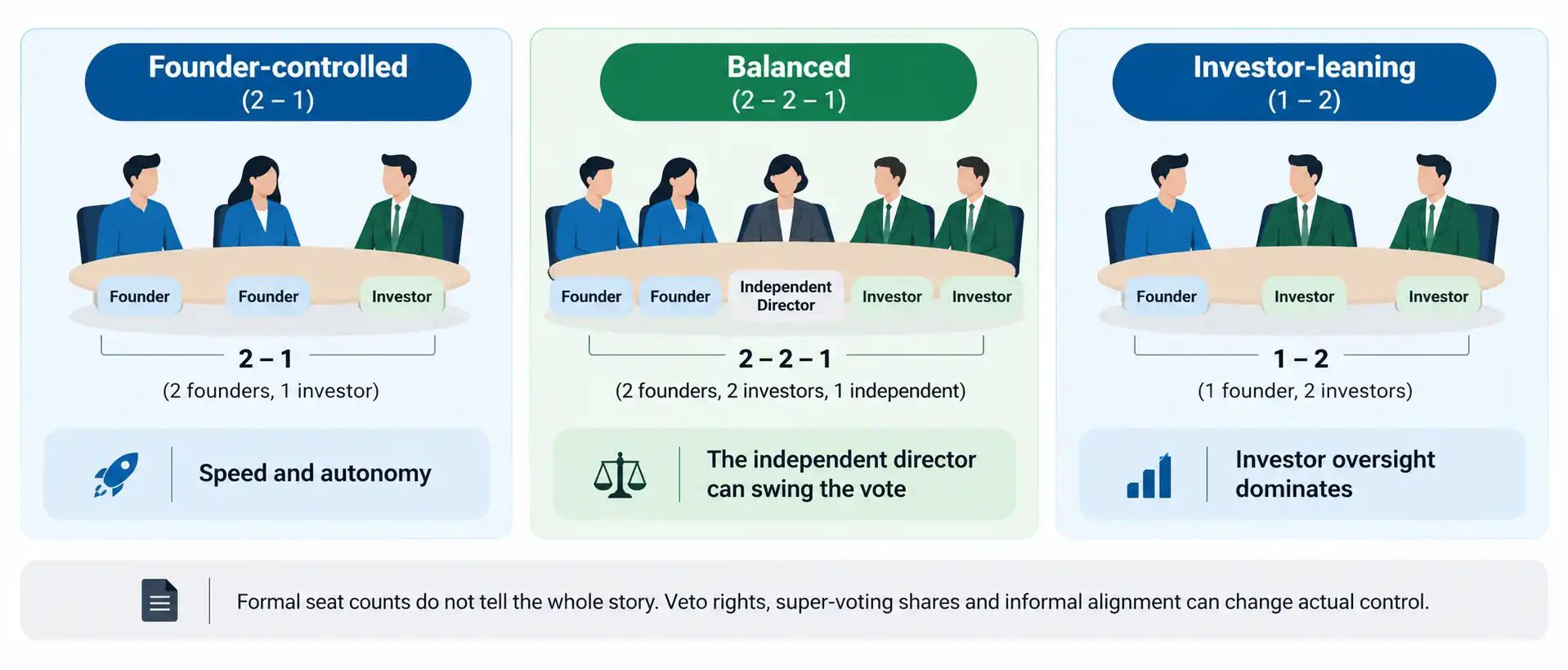
Several realities complicate the diagram.
- A 2-1 founder-investor board appears founder-controlled, yet independence is often nominal.
- A 2-2-1 board with a true independent can swing power on informal alignment alone.
- Super-voting shares or protective veto rights outside the board can override formal parity.
Gaining a seat is therefore less about position than about posture, since influence travels through agenda-setting and narrative framing as much as through the vote.
Information Rights and Asymmetry
Directors receive privileged access to quarterly metrics, hiring deliberations, strategic pivots, and cultural dynamics, and the advantage tilts toward investors who sit on many boards. Founders must judge whether that visibility becomes guidance or surveillance, which depends on whether the investor inquires to understand or to direct.
Alignment Versus Adversarialism in the Boardroom
The ideal board resembles a partnership, yet misaligned incentives can turn it adversarial quickly.
- Investors may favor liquidity events that suit fund cycles rather than company timing.
- Founders may resist oversight that tempers vision with prudence.
- Independents may drift toward investors when they are not neutral.
Three historical cases show the board to be a lever on trajectory, since a landmark consumer technology board in 1985 removed its own founder, a social media company endured frequent CEO changes between 2008 and 2015, and a social network in 2006 gained strategic clarity from an early investor director.
What an Investor Board Seat Really Asks of a Founder
The Questions That Shape the Company
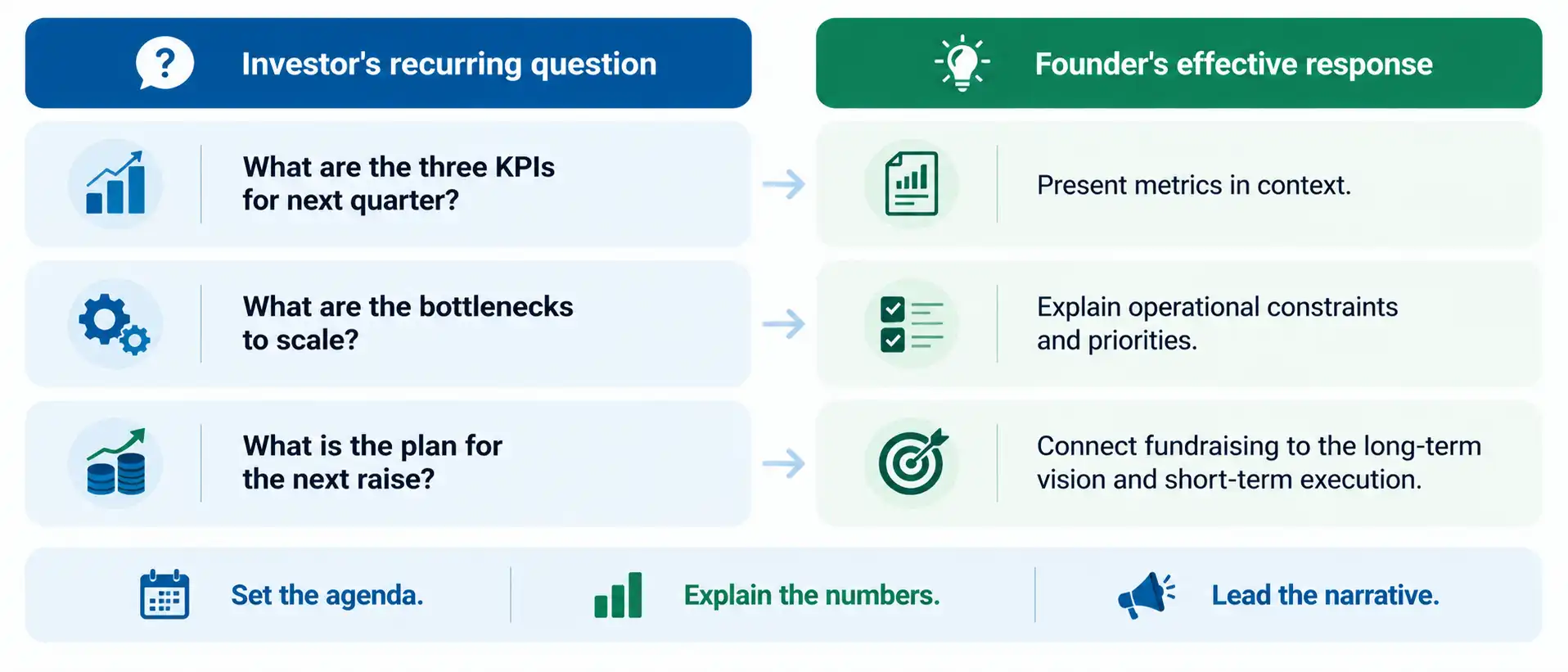
A seat carries voting power and operational visibility, yet the deeper influence lives in the questions investors ask repeatedly.
- What are the three KPIs for the next quarter?
- What are the bottlenecks to scale across the business?
- What is the plan for the next raise?
These questions are never neutral, so a founder who answers them without reflection may quietly re-optimize the company around the investor’s worldview.
In a marketplace SaaS company during a $20M Series B, the cohort and unit economics model withstood diligence because the narrative behind it was built before the investor questions arrived.
Transparency Without Subservience
Founders should engage deeply without surrendering authority over strategy.
- Set the agenda in advance to frame the conversation.
- Present metrics in context rather than in isolation.
- Pair the long-term vision with short-term execution.
A founder who masters the narrative keeps control of the board conversation.
The Independent Director as Referee or Ghost
In a 2-2-1 structure the independent is the swing vote, and the value of that seat depends on selection and temperament. A well-chosen independent brings functional expertise, emotional neutrality, and a long view, while a poorly chosen one becomes an extension of the investor or stays silent.
When Investor Oversight Becomes Overreach
Fiduciary power can drift into political practice, and overreach tends to take recognizable forms.
- Micromanagement of hiring decisions and day-to-day sales strategy.
- Exit timelines tied to fund needs instead of company readiness.
- Undermining the CEO in front of the team or the media.
The ethical investor asks whether the company is being guided toward durable value or a portfolio outcome, and the ethical founder asks whether feedback is being resisted out of ego or in defense of the mission.
A subtler danger is the silent erosion of autonomy, which occurs when independents are chosen for comfort rather than challenge and investor questions harden into operating mandates, leaving the founder reacting instead of steering.
Designing Board Governance as Culture Rather Than Courtroom
Founders should design board dynamics with the same intention they bring to product design, setting norms for communication cadence and using pre-reads to raise the quality of discussion. The board should be neither a courtroom nor a rubber stamp for investor directives.
A mission-driven education institution that raised $37M in equity and venture debt offered a useful lesson here. Steady monthly board reporting and open audit committee engagement built enough trust that later capital negotiations felt collaborative.
Crisis as the Real Test
Influence becomes most visible during cash crunches, product failures, and founder transitions, when decisions must be made quickly and trust matters more than the charter. In an early-stage email marketing technology company, a turnaround that cut monthly burn from $800K to $200K succeeded because directors had already been given candid numbers, so intervention arrived as support rather than as a takeover.
Long-Termism and the Investor Director
The strongest investor directors think in arcs of seven to 10 years, encouraging measured scaling, discouraging vanity metrics, and defending against premature exits, and founders should seek such allies deliberately.
Dilution, Control, and the Founder as Board Architect
Many founders read dilution as loss, yet a founder holding 30% who leads with clarity can wield more real power than one holding 51% without the trust of the board. To protect that standing, founders should act as board architects who balance alignment with diversity of view and insist on directors who add differentiated strategic value.
The Investor Board Seat as Covenant
The seat is neither throne nor shackle. For the investor it is a covenant that binds them to the long-term fate of the company, and for the founder it is a proving ground for leadership rather than a forfeiture of autonomy. Trust grows from restraint, curiosity, and candor on both sides of the table.
Three Key Takeaways
- An investor board seat should be negotiated with the same rigor as valuation, because composition, veto rights, and information access decide who truly steers the company.
- Founders keep authority by setting agendas, presenting metrics in context, and choosing an independent director for wisdom and bandwidth rather than convenience.
- Investors earn influence by asking before instructing, thinking in long arcs, and treating the seat as a covenant with the company instead of a lever for fund timelines.
Disclaimer: This article is intended for informational purposes only and does not constitute legal, tax, or accounting advice. You should consult your own tax advisor or counsel for advice tailored to your specific situation.
Hindol Datta is a four-time CFO and senior finance executive with over 25 years of leadership experience across cybersecurity, SaaS, gaming, logistics, digital marketing, medical devices, consumer products, and nonprofit organizations. He has led more than $120M in fundraising and over $150M in M&A transactions while building the financial and operational systems that let complex businesses scale with confidence. He is the author of seven books in the Systems CFO Series and holds active CPA, CMA, and CIA credentials.
AI-assisted insights, supplemented by 25 years of finance leadership experience.