
Executive Summary
The importance of free cash flow rests on a simple question: after sustaining the business and investing in its future, how much cash is left? Revenue, EBITDA, and earnings per share draw attention, yet free cash flow decides whether a company merely performs or endures.
This article explains why free cash flow is important, how to define it consistently, and which operating levers turn earnings into cash. It also covers capital allocation, governance, forecasting, and the culture that keeps cash discipline embedded, not episodic.
Why Is Free Cash Flow Important to Strategy?
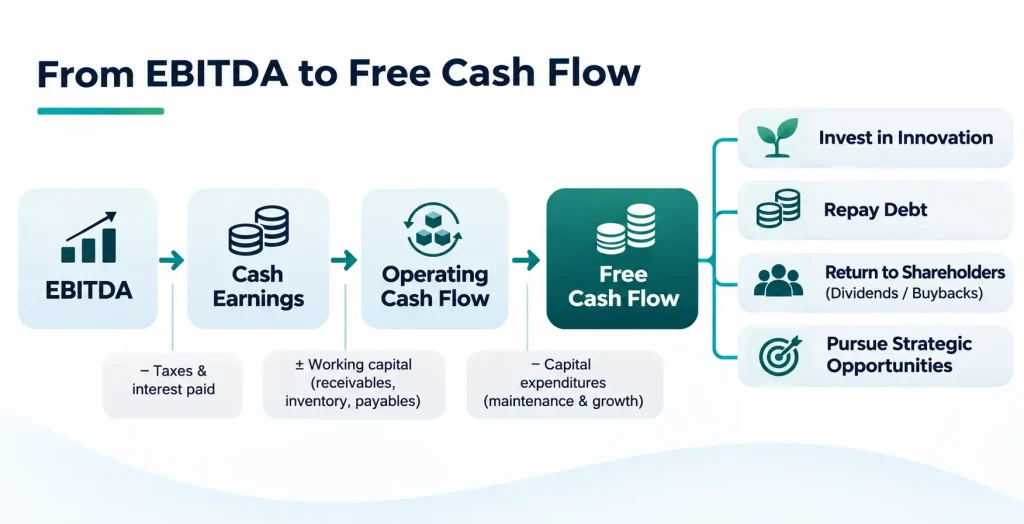
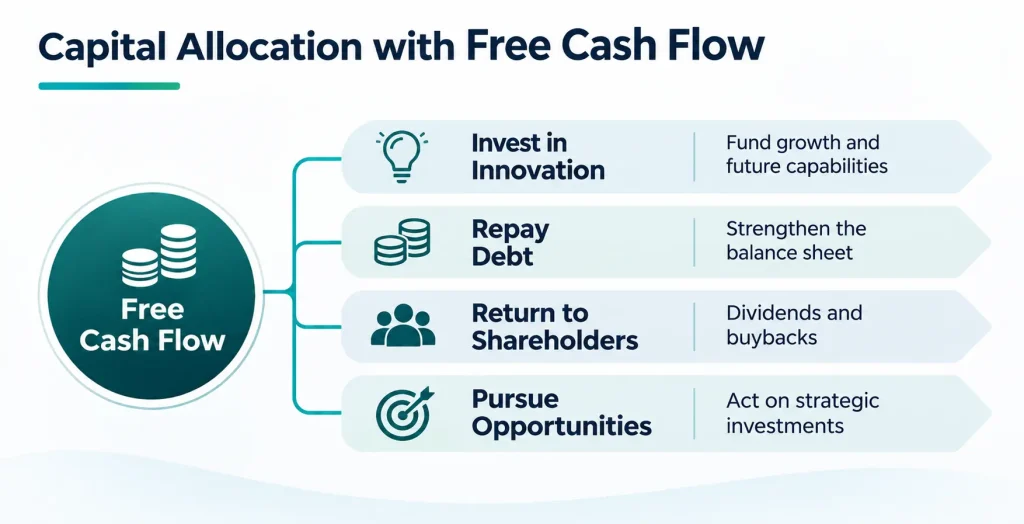
Free cash flow measures a company’s ability to convert reported earnings into spendable liquidity. Non-cash adjustments cannot inflate it, and it resists flattering narratives. The remainder funds innovation, debt repayment, dividends, buybacks, and opportunistic investment.
Companies that recognize the importance of free cash flow and place it at the center of strategy tend to age well. They resist hollow growth, manage working capital with intention, and challenge capital spending with discipline. Such firms endure across cycles because they are sound, not because they are flashy.
A company with high earnings but weak free cash flow has little room to maneuver. A business with modest growth but strong cash generation can shape its own future. That contrast explains why free cash flow is important in a way no headline metric can match.
FCF Accounting: Defining Free Cash Flow with Clarity
The basic FCF accounting formula is straightforward: operating cash flow minus capital expenditures. The real value lies in the mindset behind it, since the number shows what the business can do, not just how it looks.
Operating cash flow can swing with working capital, one-time items, or short-term performance. Capital expenditures can blend growth investment with maintenance spending that keeps the lights on. Leaders must read both lines with care before drawing conclusions.
Choosing a Consistent FCF Definition
Several versions of free cash flow exist, and each answers a slightly different question.
| FCF measure | How it is calculated | Best used for |
| Simple FCF | Operating cash flow minus capex | Internal tracking and board reporting |
| Unlevered FCF | Cash flow before interest payments | Enterprise valuation and M&A |
| Levered FCF | Cash flow after debt service | Equity value and dividend capacity |
| Adjusted FCF | Excludes one-time items or adds back stock compensation | Trend analysis, with full disclosure |
Good FCF accounting values consistency over technical precision, and that choice reinforces the importance of free cash flow as a trusted measure. A company should adopt one definition that reflects its economic reality, then apply it across every period. Boards, management, and investors can then track true performance and strategic capacity.
Context, Benchmarks, and Scenarios
Free cash flow always reflects a company’s stage, capital intensity, and business model. A fast-growing SaaS company may show thin free cash flow while compounding value through high-return reinvestment. A legacy industrial firm may generate strong cash with little growth or innovation.
Benchmarking free cash flow margins against peers and across cycles reveals discipline or drift. Comparing free cash flow to enterprise value produces the free cash flow yield, a metric investors use to separate substance from story. Scenario analysis adds a forward view, testing cash under a 10% revenue slowdown or a 200 basis point rate increase.
The Operational Drivers Behind Free Cash Flow
EBITDA starts in the income statement, but free cash flow starts in daily operations. It depends on how teams order inventory, collect invoices, approve projects, and commit capital. In average organizations, slow collections and slow inventory turns widen the gap between paper profit and real liquidity.
Working Capital Management
Receivables, inventory, and payables each matter, but optimizing one in isolation often harms another. Shorter days sales outstanding usually comes from clearer contracts, better onboarding, and stronger credit models. The goal is predictable inflows, which reduce the need for cash buffers.
Inventory demands precision, not blunt cuts that hurt service levels. A $127M global consumer products company with supply chains across China and Vietnam offers a clear case. Demand planning and SKU rationalization lifted inventory turns from 3x to 7x, releasing trapped working capital and transforming cash conversion.
Payables management works best through negotiated terms and well-timed disbursements. Stretching suppliers artificially damages relationships, while terms earned through scale and reliability strengthen the cash position.
Capex Discipline and Margin Quality
Capital spending is lumpy, long-dated, and difficult to reverse, which makes weak governance costly. Strategic CFOs test every request against its payback period, growth logic, and lower-capital alternatives. Projects that miss the hurdle rate face delay, redesign, or cancellation.
Margin quality matters just as much for free cash flow. EBITDA built on temporary cost cuts, aggressive revenue recognition, or high churn converts poorly into cash. Cash conversion ratios and EBITDA-to-cash rates provide early warnings when reported results drift from economic reality.
Contracts, Taxes, Technology, and Behavior
Several quieter levers also shape free cash flow:
- Contract design, such as upfront subscription billing, milestone payments, and consignment terms
- Tax planning around timing, credits, and loss carryforwards, done with full compliance
- Technology modernization that speeds invoicing and reconciliation
- Behavioral discipline, where managers judge every spend by its return and timing
Systems upgrades can pay back in liquidity as well as cost. A cybersecurity SaaS business that implemented NetSuite across 5 country entities cut its monthly close from 18 days to 10. Faster closes surface cash issues sooner and shorten the path from activity to collection.
The Importance of Free Cash Flow in Capital Allocation
Generating free cash flow is one achievement, and deploying it wisely is another. The importance of free cash flow shows best in what leaders choose to fund. Capital allocation remains the most enduring test of executive judgment, because each choice signals priorities to markets, boards, and employees.
| Allocation lever | When it fits | Key discipline |
| Reinvestment in the core | Returns exceed the cost of capital | Measure return per dollar invested |
| Dividends | Mature firms with stable cash | Base payouts on sustainable FCF |
| Share repurchases | Shares trade below intrinsic value | Judge by price paid, not dollars spent |
| Debt reduction | Rising rates or volatile cash flow | Preserve flexibility while protecting credit |
| Acquisitions | Clear strategic and integration fit | Track realized synergies after close |
| Resilience reserves | Uncertain markets | Protect the downside before volatility arrives |
Acquisitions deserve the most caution, since cash on hand can tempt companies into deals they cannot absorb. More than $100M of cross-border M&A at a publicly listed gaming company reinforced the value of return thresholds, scenario models, and post-close accountability. The best acquirers treat cash as a discipline mechanism, not a license to buy.
Investment in capability, such as data platforms, talent, and brand, also deserves the same rigor. Leaders should define what capability the spend builds and how they will measure its maturity. Clear communication of these choices builds trust, and that trust lowers the cost of capital.
Embedding the Importance of Free Cash Flow in Governance and Culture
Mastering free cash flow requires embedding it in how the company runs. Governance starts with real-time visibility into receivables, payables, inventory, and project disbursements. Early signals allow intervention before month-end, not explanation after it.
Discipline comes from governance structures that demand justification. Every major capital request should pass hurdle rates, scenario tests, and post-investment reviews. Boards should ask how much income turned into cash, and how leaders used that cash to reduce risk or raise returns.
Driver-Based Cash Flow Forecasting
Many companies forecast the income statement with rigor but simply extrapolate cash flow, overlooking the importance of free cash flow in planning. Effective cash forecasting is driver-based and scenario-oriented, tied to actual payment behavior and real project plans. Lead indicators such as order volume, backlog health, supplier lead times, and collections velocity reveal cash needs early.
The most valuable forecast prepares leadership for a range of outcomes, not one precise number. An early-stage email marketing SaaS company shows what that clarity enables. Rigorous cash visibility supported a turnaround that cut monthly burn from $800K to $200K.
Cash Culture and Leadership Development
Cash awareness must reach product managers, engineers, sales leaders, and supply chain teams, not only treasury and FP&A. Quarterly cash walks during management reviews show how EBITDA moves through the system and where it leaks. Recognition for shorter revenue-to-cash cycles turns efficiency into contribution.
Succession planning completes the picture for cash discipline. Future executives should understand the time value of capital and the asymmetry between spending cash and earning it back. Such leaders ask whether capital deployed here will pay back in both cash and control.
Three Key Takeaways
- The importance of free cash flow lies in its honesty, since it shows how much discretionary capital the business generates. Adopt one consistent FCF accounting definition and apply it in every period.
- Free cash flow is built in operations through receivables, inventory, payables, and capex discipline. Improving these levers widens strategic freedom more reliably than chasing reported earnings.
- Embed free cash flow in governance, forecasting, and leadership development so discipline becomes permanent. Companies with this mindset weather storms and often capitalize on them.
Disclaimer: This article is intended for informational purposes only and does not constitute legal, tax, or accounting advice. You should consult your own tax advisor or counsel for advice tailored to your specific situation.
Hindol Datta is a four-time CFO and senior finance executive with over 25 years of leadership experience across cybersecurity, SaaS, gaming, logistics, digital marketing, medical devices, consumer products, and nonprofit organizations. He has led more than $120M in fundraising and over $150M in M&A transactions while building the financial and operational systems that let complex businesses scale with confidence. He is the author of seven books in the Systems CFO Series and holds active CPA, CMA, and CIA credentials.
AI-assisted insights, supplemented by 25 years of finance leadership experience.