
Executive Summary
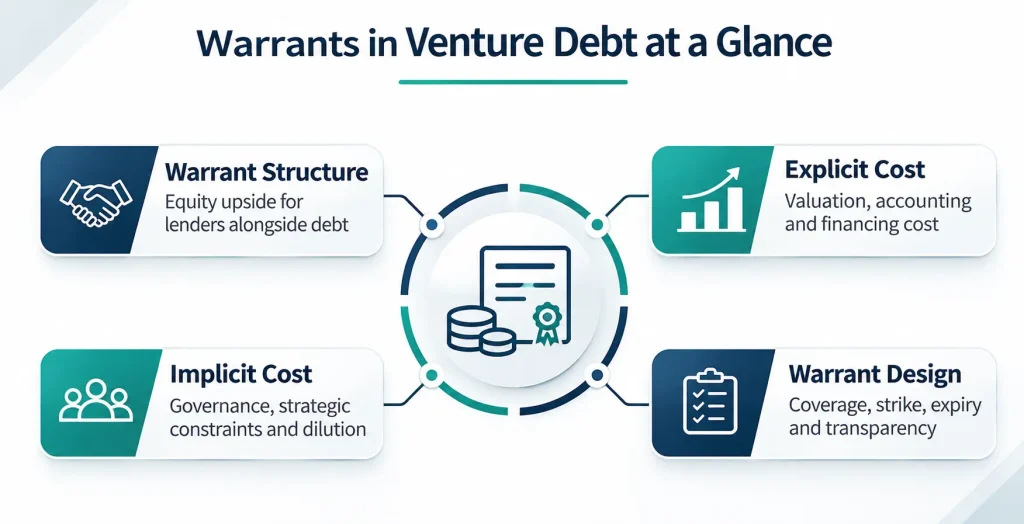
Warrants enter venture debt deals as modest sweeteners, yet the implicit cost of warrants often surfaces at exit. Every warrant carries an explicit cost that appears in valuation models and accounting entries. It also carries an implicit cost in governance, founder psychology and cap table clarity.
This article explains how warrants work and how they dilute ownership. It closes with design principles and an exit model showing when warrants serve a company or quietly tax it.
What a Warrant Is and Why Venture Lenders Ask for One
A warrant is a contractual right to buy equity at a fixed exercise price before an expiration date. Companies usually issue warrants alongside venture debt or structured financing. Unlike employee options, warrants sit outside the option pool and carry no vesting tied to employment.
Lenders ask for warrants because debt alone cannot price startup risk. Most early companies are pre-profit and depend on follow-on capital to stay solvent. The warrant gives the lender a share of the upside while it keeps its senior position in the capital stack.
Key Terms in a Warrant Contract
Five variables shape the cost of every warrant:
- Exercise price: the fixed price per share, usually set at the latest preferred round.
- Coverage: commonly 5% to 15% of the debt amount, converted into a share count.
- Expiration term: typically 5 to 10 years, sometimes accelerated on a change of control.
- Warrant type: the right to buy preferred shares or common shares.
- Cashless exercise: the holder receives in-the-money value as shares without paying cash.
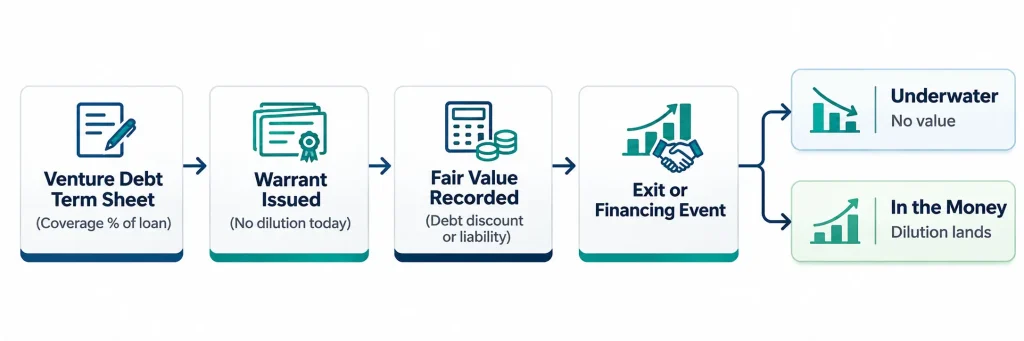
How a Warrant Moves From Term Sheet to Exit
The Mechanics of Warrant Dilution
Suppose 10% coverage on a $10M loan at $5 per share, which yields 200,000 warrant shares. Founders hold 5,000,000 shares and investors hold 4,000,000. After exercise, the warrant holder owns 200,000 of 9,200,000 shares, or 2.17%.
At a $184M acquisition, that stake is worth $4M, or $3M after the $1M exercise cost. Founders would have received $102.22M without the warrant and receive $100M with it. The warrant takes $2.22M from founders without ever touching the income statement.
Cashless exercise changes the share count but not the economics. The formula is shares received = N × (exit price − strike price) ÷ exit price. With 200,000 warrants, a $50 exit price and a $5 strike, the holder receives 180,000 shares at once.
Market Norms for Warrant Coverage
| Company Stage | Typical Warrant Coverage |
| Pre-Series A | 8% to 15% |
| Series A to B | 5% to 10% |
| Later-stage or recurring-revenue SaaS | 1% to 5% |
Coverage applies to the loan, not the company, so 5% coverage on a $20M loan equals $1M, or 250,000 shares at a $4 strike. Against 10,000,000 existing shares, that comes to 2.44% dilution.
The lender earns fixed interest, holds equity upside, and keeps security through seniority and covenants. Warrants carry no votes or board seats, so they feel lighter than convertible debt, yet they remain latent dilution.
The Explicit Cost of Warrants: Valuation and Accounting
The explicit cost of a warrant is its fair value at issuance. Black-Scholes remains the most common method, adapted for private companies through proxy volatility from comparables.
Valuing Warrants With Black-Scholes
The model values a warrant as a call option: C = S × N(d1) − X × e^(−rT) × N(d2). Inputs include share price (S), strike (X), term (T), risk-free rate (r) and volatility (σ). For a Series B company, take S = $10, X = $10, T = 7, r = 3.5% and σ = 50%. Each warrant is then worth about $5.53, so 100,000 warrants carry a fair value near $553K.
Accounting for Warrants Under GAAP
Under ASC 470-20, the company allocates loan proceeds between the debt and the warrant. For an equity-classified warrant, the entry debits a debt discount and credits additional paid-in capital. On a $10M loan with a $500K warrant, the books show $9.5M of debt. The $500K discount then amortizes as non-cash interest over the loan term.
ASC 815-40 decides whether the warrant qualifies for equity treatment. Cash settlement or variable terms usually force liability classification. The company remeasures liability-classified warrants at fair value each period, which brings earnings volatility. During buy-side diligence on an IT services target, quality-of-earnings work separated non-cash charges like these from operating results.
Warrant-Linked Debt Versus Straight Equity
Compare a $10M loan at 10% interest and 10% coverage with $10M of equity at $40M pre-money, assuming a $150M exit.
| Cost Element | Warrant-Linked Debt | Straight Equity |
| Interest over 4 years | About $4M | None |
| Warrant gain or investor stake | About $2M net | 20% of $150M = $30M |
| Principal | Repaid, not a cost | Not repaid |
| Total financing cost | About $6M | About $30M |
Warrant-linked debt wins when the company succeeds, since its cost rises more slowly than equity. Equity wins when the company stalls, because debt still demands repayment.
Tax, Timing and Audit Effects
The explicit cost also reaches beyond the loan itself:
- Large warrant grants can shift 409A valuations for common stock.
- Auditors may challenge warrant valuations when exit talks suggest mispricing.
- New investors may demand protective clauses when warrant dilution was left out of models.
- Exercise before exit may create withholding obligations in some jurisdictions.
The Implicit Cost of Warrants: Control, Alignment and Culture
The implicit cost of a warrant never reaches the ledger, living instead in boardroom hesitation and eroding trust.
Governance Drift and Strategic Conservatism
Lenders rarely take board seats, yet they often negotiate information rights, observer seats and default triggers. They also add covenants on new debt, large spending and M&A. Combined with a warrant, this gives the lender upside and influence without full equity risk.
The result is strategic conservatism, a pull toward protecting debt instead of building equity value. A company carrying heavy warrant-bearing debt may delay pivots, avoid bold acquisitions, hoard cash, or trim R&D.
Founder Psychology and Cultural Friction
A founder who thinks she gave up 20% may find nearer 23% once warrants and notes convert. Stacked across rounds, a 3% giveback can grow to 7% without anyone challenging it.
Opacity hurts culture, since warrants often go missing from investor decks and waterfall analyses. Employees then ask why a repaid lender earns $5M at exit. Acquisition diligence at a $30M ARR cybersecurity company showed that buyers surface every claim on equity, modeled or not.
Negotiation Handcuffs
Down rounds can trigger warrant repricing, and change-of-control rights can slow closings. Follow-on investors sometimes demand cancellation or repurchase first, so the company pays twice: once in dilution and again in cleanup.
Managing the Implicit Cost of Warrants Through Design
Warrants work best as bridges, such as a loan ahead of an imminent equity round. They also suit a company near a cash crunch when equity would be punitive. One mission-driven education and research institution raised $37M across equity and venture debt. Structuring that stack meant weighing every lender term against its dilution.
Five Principles for Fair Warrant Design
A well-structured warrant follows five practical design principles:
- Strike parity: set the exercise price at the most recent preferred round.
- Limited coverage: 1% to 3% for senior secured debt, and 5% to 10% for unsecured bridges.
- Defined expiry: 7 to 10 years at most, accelerating on a qualified financing or IPO.
- Repurchase rights: the company can buy back unexercised warrants at fair value or a fixed multiple.
- Transparency: model warrants in every cap table, exit scenario and investor discussion.
Coverage could also rise when the company hits milestones and fall if the lender skips follow-on funding. Revenue-based financing, capped convertible notes and structured equity offer cleaner alternatives in many situations.
Modeling the True Cost of Warrants Across Exit Values
The base case uses 10% coverage on $10M, a $5 strike and 10,000,000 existing shares. That produces 200,000 warrant shares, and founders hold half of the existing shares. Exit prices below include the cash paid at exercise.
Cap Table Sensitivity Table
| Exit Valuation | Warrant Value (Net) | Cashless Shares | Warrant Ownership | Founder Value Loss |
| $50M | $0 (at the money) | 0 | 0% | $0 |
| $100M | About $980K | About 99,000 | 0.98% | About $490K |
| $200M | About $2.94M | About 149,000 | 1.47% | About $1.47M |
Net warrant value is the total dilution cost, and founders bear their ownership share of it.
Cumulative Warrants Across Rounds
Now assume $10M of debt at Series A and $20M at Series B, each with 5% coverage. That adds 100,000 shares at $5 and 100,000 at $10. With 1,000,000 options, the fully diluted count reaches 11,200,000. The warrants then hold 1.79%, worth $3.57M gross at a $200M exit, or $2.07M after exercise. Interest on $30M at 10% could reach about $12M over 4 years if fully drawn.
Summary Equations
- Warrant shares = warrant value ÷ strike price.
- Ownership on full exercise = warrant shares ÷ (existing shares + warrant shares).
- Cashless shares = N × (exit price − strike price) ÷ exit price.
- Net warrant value = (exit price − strike price) × warrant shares.
- Founder dilution cost = founder ownership before exercise × net warrant value.
Three Key Takeaways
- Value every warrant at issuance with Black-Scholes and model it at several exit values. That makes the explicit cost visible before anyone signs.
- The implicit cost of warrants shows up in covenants, cautious strategy and eroding trust. Boards should weigh these effects alongside interest rates and coverage.
- Use warrants as narrow bridges with parity strikes, capped coverage and defined expiry. Repurchase rights and full cap table disclosure keep them honest.
Disclaimer: This article is intended for informational purposes only and does not constitute legal, tax, or accounting advice. You should consult your own tax advisor or counsel for advice tailored to your specific situation.
Hindol Datta is a four-time CFO and senior finance executive with over 25 years of leadership experience across cybersecurity, SaaS, gaming, logistics, digital marketing, medical devices, consumer products, and nonprofit organizations. He has led more than $120M in fundraising and over $150M in M&A transactions while building the financial and operational systems that let complex businesses scale with confidence. He is the author of seven books in the Systems CFO Series and holds active CPA, CMA, and CIA credentials.
AI-assisted insights, supplemented by 25 years of finance leadership experience.