
November 13, 2026
The first three parts of this series argued that governance hedges volatility, that legitimacy is the scarce input in American AI, and that assurance deserves industrial policy. Part 4 moves inside the company, to the audit committee table and the CISO’s desk, and asks a narrower question: when an AI system causes a loss, who is accountable, and does the evidence support the comfortable view that this is a technology problem for engineers to solve? I will argue that the public data point somewhere else. The losses concentrate where controls are absent, the disclosures are running ahead of the capability behind them, and accountability is converging on the management body in the major regimes reviewed here, whatever the size of the penalty.
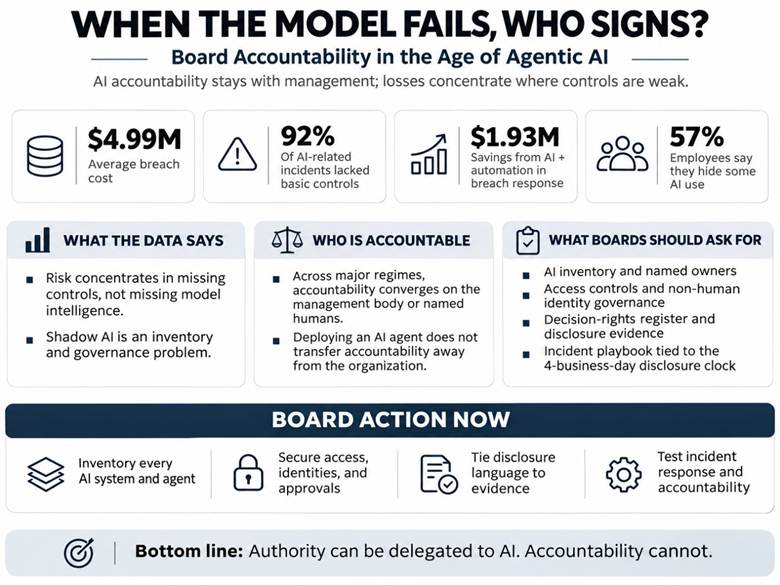
The comfortable view and the evidence against it
Three beliefs circulate in many executive suites. The first holds that AI risk is a model problem, which better engineering will resolve. The second holds that regulators are retreating, so oversight can wait. The third holds that trust is a soft variable, relevant to marketing and little else. Each is testable, and each fares poorly against the numbers below.
Start with losses. IBM’s 2026 Cost of a Data Breach Report, prepared with the Ponemon Institute, puts the global average breach at $4.99 million, a record and a 12 percent increase over the prior year (IBM report page). Help Net Security’s summary of the full report adds that roughly one in five organizations reported a security incident involving an AI model or application, up from about one in eight a year earlier, and that 92 percent of those organizations lacked role-based access, multifactor authentication, or similar controls on their AI systems. Close to seven in ten breached organizations lacked AI governance policies, and fewer than one in five coordinated that governance with their security teams.
| Measure | 2026 finding | Source |
| Global average breach cost | $4.99 million, up 12 percent | IBM Cost of a Data Breach 2026 |
| Organizations with an incident involving an AI model or application | About 1 in 5, versus about 1 in 8 a year earlier | IBM, via Help Net Security |
| Of those, lacking AI access controls | 92 percent | IBM, via Help Net Security |
| Breached organizations lacking AI governance policies | 68 percent, versus 63 percent the prior year | IBM, via Baker Donelson |
| Security incidents involving shadow AI | 43 percent, versus 20 percent the prior year | IBM, via Baker Donelson |
| Average cost of a shadow AI incident | $5.39 million | IBM, via Baker Donelson and Sentra |
| Mean time to identify and contain a breach | 247 days, reversing five years of decline | IBM, via Help Net Security |
| Savings where AI and automation are used in defense | $1.93 million | IBM report page |
Two inferences follow. First, the shadow AI figure is $0.40 million, or about 8 percent, above the global average of $4.99 million, and the share of incidents it touches more than doubled in one year. Unapproved tools are an inventory failure, which is a control the finance function understands well. Second, the same technology that causes the loss also reduces it. Organizations that used AI and automation across prevention and response saved $1.93 million per breach, according to IBM’s data. The variable that separates a costly outcome from a contained one is governance of access and visibility, not the presence of AI. That finding directly challenges the first belief.
Time adds a third inference. IBM reports that breaches lasting beyond 200 days cost about a third more, and that the mean time to identify and contain reached 247 days. Applying that uplift to the $4.99 million average gives roughly $6.65 million for a long-running breach, so detection speed alone is worth about $1.7 million per event. That is illustrative arithmetic on IBM’s averages, not a forecast for any one company, but it frames visibility spending in terms a capital allocation committee already uses.
A caution on reading the 92 percent: it describes organizations that already suffered an AI-related incident, so it shows how common weak controls were among the unlucky, not how common they are across all companies. IBM’s separate figure that only about two in five organizations apply access controls to AI models and data is the better indicator of prevalence.
Disclosure has outrun capability
If losses point to a control gap, the governance data show that the gap sits behind a wall of confident disclosure. The Conference Board found that the share of S&P 500 companies disclosing AI as a risk rose from 12 percent in 2023 to 83 percent in 2025, while disclosed AI expertise among their directors rose only from 1.5 percent to 2.7 percent. EY’s Center for Board Matters found that the share of Fortune 100 companies citing AI in board oversight rose from 16 percent to 48 percent in a year. Yet a Harvard Law School Forum review of the S&P 100 found that only 28 percent disclosed both board-level oversight and an AI policy.
| Indicator | Figure | Source |
| S&P 500 companies disclosing AI as a risk, 2023 to 2025 | 12 percent to 83 percent | The Conference Board |
| S&P 500 directors with disclosed AI expertise, 2021 to 2025 | 1.5 percent to 2.7 percent | The Conference Board |
| Fortune 100 citing AI in board oversight, 2024 to 2025 | 16 percent to 48 percent | EY Center for Board Matters |
| S&P 100 disclosing both board oversight and an AI policy | 28 percent | Harvard Law School Forum on Corporate Governance |
| Organizations assessing AI security before deployment | 64 percent, versus 37 percent a year earlier | World Economic Forum, Global Cybersecurity Outlook 2026 |
The improvement is real: the WEF survey of 804 leaders across 92 countries, prepared with Accenture, found that 64 percent now assess the security of AI tools before deployment, up from 37 percent. But 87 percent of the same respondents named AI-related vulnerabilities the fastest-growing cyber risk of 2025. Awareness is rising slightly more slowly than exposure.
This matters for a specific reason. In October 2024 the SEC settled charges against Unisys, Avaya, Check Point and Mimecast, with civil penalties of $4 million, $1 million, $995,000 and $990,000. The theory was not that these companies failed to disclose but that their disclosures negligently minimized what they already knew, and in the Unisys case the SEC also cited deficient disclosure controls. An audit committee that signs off on AI risk language without evidence of the underlying controls reproduces that fact pattern. The word the profession uses for it, “AI washing,” describes a disclosure that does not match reality. The numbers above suggest the exposure is broad.
Accountability is converging, even where penalties diverge
Now to the second belief, that regulators are retreating. In the United States the picture is mixed. Item 1.05 of Form 8-K, effective since December 18, 2023, requires disclosure of a material cybersecurity incident within four business days of determining materiality, and Regulation S-K Item 106 requires annual disclosure of governance and management’s role. Bloomberg Law reports that lawyers expect less aggressive enforcement from the current SEC while still advising vigilance on accurate and timely disclosure. Delaware common law adds a separate channel: law-firm commentary from Morrison Foerster and Fenwick applies the Caremark oversight doctrine, and the Boeing and TransUnion decisions, to AI. One independent legal reference notes that no Delaware court had yet applied Caremark to an AI fact pattern as of September 2026, so this is a forecast of exposure, not a settled holding.
Outside the United States the direction is clearer. Europe’s NIS2 directive makes management bodies approve and oversee cybersecurity risk measures under Article 20, with fines of up to 10 million euros or 2 percent of worldwide turnover for essential entities, and DORA places ultimate responsibility for ICT risk on the management body of financial entities. The EU AI Act adds fines of up to 35 million euros or 7 percent of turnover for prohibited practices. In Asia, South Korea’s AI Basic Act took effect on January 22, 2026, with a one-year grace period before administrative fines, which Nemko puts at up to 30 million won. Japan’s AI Promotion Act, in force since June 2025, imposes no penalties. Singapore’s January 2026 framework for agentic AI is voluntary guidance, but it makes the clearest statement of principle: deploying an agent does not transfer accountability away from the organization, and humans must remain meaningfully accountable.
Singapore’s framework deserves a closer reading because it addresses the problem Das Narayandas described in the Harvard Business Review and in Part 2. It asks organizations to bound risk upfront, make humans meaningfully accountable with defined approval checkpoints, apply technical controls across the agent lifecycle, and train end users. It also names automation bias, the tendency to over-trust a system that has performed reliably, as a risk that regular audits of the oversight itself should test. In other words, it treats authority and accountability as a design problem, which is the correct framing for an audit committee.
| Jurisdiction | Instrument | Who is accountable | Penalty |
| United States | SEC Form 8-K Item 1.05 and S-K Item 106; Delaware oversight doctrine | Registrant; directors through oversight duties | 2024 settlements from $990,000 to $4 million |
| European Union | NIS2 Article 20; DORA; AI Act Article 99 | Management body | NIS2 up to EUR 10 million or 2 percent; AI Act up to EUR 35 million or 7 percent |
| South Korea | AI Basic Act, from January 22, 2026 | Providers and deployers | Fines after a one-year grace period, up to KRW 30 million |
| Japan | AI Promotion Act, June 2025 | Promotion framework | None |
| Singapore | Model AI Governance Framework for Agentic AI, January 22, 2026 | Humans accountable for agents | Voluntary |
The inference I draw is that penalties diverge but the locus of accountability does not. Each of the regimes reviewed here, binding or voluntary, ends at the management body or at named humans. A multinational should therefore build to the strictest standard it faces, because a single control evidence base can serve all of them, and because the cost of maintaining separate postures exceeds the cost of one good one.
What the public wants, and what employees do
The third belief, that trust is soft, collides with the best global dataset on the subject. The University of Melbourne and KPMG surveyed more than 48,000 people in 47 countries and found that only 46 percent are willing to trust AI systems, while 70 percent believe regulation is needed and only 43 percent believe existing law is adequate. Inside organizations, 57 percent of employees say they hide their use of AI, 66 percent rely on AI output without checking it, and only 40 percent say their workplace has a policy on generative AI. Emerging economies show higher trust, with China at 68 percent, which is why a company selling globally meets different expectations by market.
That combination should concern a CFO, because it describes the mechanism behind IBM’s shadow AI number. Employees are using tools nobody approved, concealing it, and trusting output they haven’t verified, in organizations with no policy. PwC’s 2026 Global Digital Trust Insights, based on 3,887 executives in 72 countries, found that only 6 percent had implemented all of the data risk measures it surveyed. Policy without implementation is the pattern in every dataset.
What audit committees and CISOs should evidence
The data point to six artifacts that a committee can request and test.
- An inventory of AI systems and agents, including those discovered rather than approved, with a named owner for each.
- Access controls on models and the data they reach, including identities for non-human agents, since IBM reports that fewer than half of organizations secure the non-human identities their AI workflows depend on.
- A decision-rights register of the kind described in Part 2, showing where authority has actually been delegated.
- A disclosure control that ties each AI risk statement in the 10-K to an internal evidence source.
- An incident playbook that maps AI-related events to the four-business-day materiality clock.
- And board minutes that show questions asked and actions directed, because the oversight cases turn on what directors did when warnings surfaced.
For the CISO, the practical shift is from defending a perimeter to governing identities. IBM names identity and access management among the most effective cost reducers in its study, and its AI findings say the same thing from the other direction: the breaches that proved costly were those where nobody had decided what an AI system was permitted to reach. A CISO who arrives at the audit committee with an inventory, an access map, and a tested incident clock is offering the board something it can rely on, and something that supports the director’s own record.
The reporting line matters as well. The WEF survey shows CEOs ranking cyber-enabled fraud first while CISOs rank ransomware first, reminding us that the two audiences read risk differently. The audit committee is the natural forum for reconciling them: EY’s work shows that the audit committee is the most common home for board-level AI oversight among Fortune 100 companies, at 21 percent, and about three-quarters of S&P 500 companies assign cybersecurity oversight to it. That concentration argues for explicit charter language and for pre-read materials that include control evidence, not only management narrative.
Challenging the thesis
Four limits deserve candor. The IBM sample consists of breached organizations, so its percentages describe the unlucky group. Survey figures are self-reported, and vendors who sell governance tools publish several of the secondary summaries I relied on, so I have anchored the central numbers to IBM, the SEC, and the World Economic Forum where possible. Expertise figures differ by methodology: EY reports that 5 percent of S&P 500 directors had AI experience cited in 2026 proxies, while the Conference Board reports 2.7 percent as of 2025, which are different years and definitions. And the enforcement environment in the United States is lighter than it was, so my argument rests on the probability of private litigation, investor expectations, and foreign regimes, not on a certain SEC action. The honest summary is that exposure is rising faster than enforcement.
Closing thought
The three beliefs fail on the same evidence. AI risk concentrates in missing controls rather than missing intelligence, oversight is being formalized even where penalties are modest, and trust is measurable and low. The question in this article’s title has a plain answer under every regime I reviewed: a named human at or near the top of the organization signs, and the quality of that signature depends on the evidence behind it. Part 5 turns to what that evidence is worth in the markets.
Five questions to ponder
I would value your answers in the comments.
- If an AI agent in your company took a harmful action tonight, who signs, and is that written down? Authority can be delegated to a system, but accountability cannot.
- Which committee owns AI oversight, and does it have the expertise to do so? Only a small share of directors bring AI experience, while disclosure of AI risk has become near universal.
- Could your disclosure process meet a four-business-day clock for an AI-related material incident? Most plans were written for a conventional cyber event.
- How much AI use in your company is hidden from management? Surveys find that most employees conceal at least some of their AI use, so policy alone will not reveal it.
- Which regimes apply to you, and do you run one control framework mapped to the strictest? The alternative is a separate program for each jurisdiction, each with its own evidence demands.
Sources: IBM and Ponemon Institute, Cost of a Data Breach Report 2026 (ibm.com/reports/data-breach), with detail from Help Net Security, July 30, 2026, Baker Donelson, Ten Takeaways, and Sentra, August 13, 2026. SEC, press release 2024-174, October 22, 2024. Bloomberg Law, Companies Weigh AI Cyber Risks in Disclosures to Atkins’ SEC. The Conference Board, AI governance report, April 22, 2026. EY Center for Board Matters, Fortune 100 AI oversight analysis, 2025, and Seven Questions Boards Should Ask After the 2026 Proxy Season, August 2026, via Harvard Law School Forum on Corporate Governance, which also published US AI Oversight Through Three Lenses, March 11, 2026. World Economic Forum with Accenture, Global Cybersecurity Outlook 2026, January 12, 2026. PwC, 2026 Global Digital Trust Insights. University of Melbourne and KPMG, Trust, Attitudes and Use of Artificial Intelligence: A Global Study 2025. Morrison Foerster, Red Flags Everywhere, March 4, 2026. Fenwick, AI in the Boardroom, May 27, 2026. CASRAI, Board Oversight of Frontier AI, verified September 20, 2026. RM Magazine, How Should Boards Govern AI, February 12, 2026. Ropes & Gray, EU cyber laws; Legiscope, NIS2 and DORA penalties. EU AI Act, Article 99. Cooley, South Korea AI Basic Act, January 27, 2026; Nemko, AI Regulation in South Korea. ppc.land, Asia’s AI laws. Singapore IMDA, Model AI Governance Framework for Agentic AI, January 22, 2026, via Baker McKenzie and Bird & Bird.
AI-assisted insights, supplemented by 25 years of finance leadership experience.