
November 15, 2026
Four essays into this series, a skeptical director would be entitled to ask a simple question. If governance and assurance are so valuable, where does the value show up on the income statement? It is a fair challenge, and an honest answer is more interesting than the one most vendors and consultants offer. The public evidence supports a strong case for trust as an asset, but not the case usually made. This final part summarizes the argument, tests it against the data, and sets out how a board can measure what it is buying.
What the first four parts established
Part 1 argued that governance functions as a hedge in a volatile decade, with a federal funds rate of 3.75% to 4.00%, a ten-year yield near 5.03%, and a fragmented regulatory map. Part 2 argued that legitimacy is the scarce input in the American AI buildout, since capital is plentiful (venture funding of $515.8 billion through the third quarter, 82.7% of it in AI) while public consent is not (Gallup found more than 70% opposed to a local data center in the Ohio case reported by TIME). Part 3 argued that assurance can become an industrial advantage if standards, conditional market access and workforce investment move as quickly as the technology. Part 4 moved to the boardroom and showed that accountability for AI failure is already allocated by law and doctrine, while oversight practice trails disclosure: AI risk disclosure rose from 12% to 83% of large companies between 2023 and 2025, yet only 2.7% of directors bring AI expertise.
The common thread is that trust behaves like infrastructure. It is expensive to build, invisible when it works, and ruinous to lack. The remaining task is to price it.
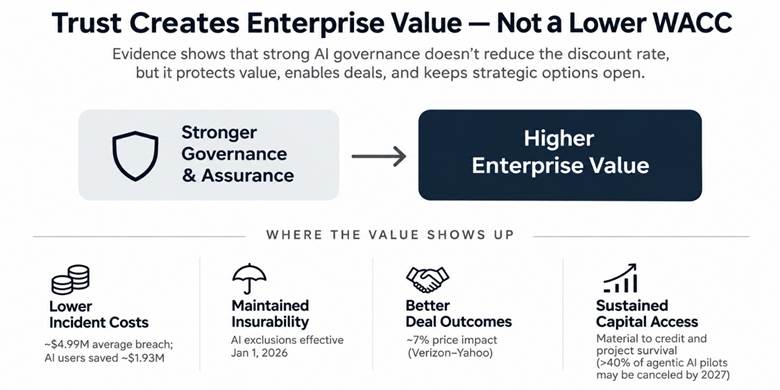
The uncomfortable finding: trust is not a discount rate
The most common claim in this field is that strong governance lowers the cost of capital. The most cited academic support is Cheng, Ioannou and Serafeim (Strategic Management Journal, 2014), which found that firms with better corporate social responsibility performance faced significantly lower capital constraints across a panel of 2,439 listed firms. A later replication tells a more careful story. It reproduced the original result in cross-sectional models but found no significant effect of within-firm improvement over time, concluding that unobserved traits such as management quality may drive both strong governance and easier financing.
Credit agencies point the same way. Moody’s 2025 survey of nearly 2,000 rated organizations recorded only 25 cyber-related rating actions against 16 issuers, and noted that victims so far have had sufficient resources to cope. Moody’s and S&P both describe governance as increasingly material to credit, yet neither publishes a basis-point discount for it.
My inference is that a board should not promise investors a lower WACC. The data do not support that promise, and a CFO who makes it will be asked to prove it. The value of trust is real, but it sits in the tail of the distribution, in the losses avoided, the transactions preserved, and the options kept open.
Where the value actually shows up
The table below sorts the evidence by the channel through which trust becomes cash, and separates what is tangible from what is intangible.
| Channel | Type | Public evidence | How a CFO measures it | Source |
| Incident cost | Tangible | Average breach cost $4.99 million; 247 days to identify and contain; AI and automation users saved $1.93 million; shadow AI present in 43% of incidents at $5.39 million | Expected loss with and without controls | IBM Cost of a Data Breach 2026 |
| Insurability | Tangible | Verisk/ISO generative AI exclusion forms (CG 40 47, CG 40 48, CG 35 08) available from January 1, 2026; AIG and Berkley among carriers that filed AI exclusions | Retained risk and premium at renewal | Verisk; Insurance Insider |
| Deal price | Tangible | Verizon cut its Yahoo price from $4.83 billion to $4.48 billion, about 7%, after breach disclosures | Diligence findings converted to price or escrow | GeekWire; MediaPost |
| Capital access | Intangible | Moody’s calls cybersecurity a prerequisite for capital access; S&P treats operational authority of AI governance as the key credit factor | Rating commentary, covenant terms, lender questionnaires | Moody’s; S&P via Cybersecurity Dive |
| Project survival | Intangible | Gartner expects over 40% of agentic AI projects to be canceled by the end of 2027 for cost, unclear value, or inadequate risk controls | Share of pilots reaching production | Gartner |
| Client trust | Intangible | Deloitte Australia refunded part of a AU$440,000 fee after AI-generated errors in a government report | Win rate and renewal in regulated accounts | Reporting on the DEWR contract |
None of these rows is a discount rate. All of them are cash.
Contrarian thought one: sell trust as an option on survival
If trust works in the tail, it should be valued like insurance, as the price of avoiding a distribution outcome. The Yahoo transaction is the cleanest public illustration. A 7% price concession on a $4.83 billion deal is $350 million. As purely illustrative arithmetic, the same 7% applied to a $500 million acquisition equals $35 million. That is a transfer from seller to buyer caused by what diligence could not evidence, and it dwarfs any plausible annual assurance budget for a company of that size. The Yahoo discount is an upper-bound anchor from one consumer-data case in 2017, not a rule, but it shows where the money moves when a counterparty cannot prove its controls.
The insurance market now reinforces this logic. Verisk’s exclusion forms let carriers remove generative AI exposure from general liability policies, and trade reporting indicates that the surge in filings began in summer 2025. Specialist Lloyd’s coverholders are writing affirmative AI cover for what the standard market is stepping away from. The consequence for a CFO is direct. Where a policy excludes AI, the company retains the risk on its own balance sheet, and the evidence of governance is what determines whether a specialist insurer will take it back.
Contrarian thought two: governance that cannot say no is a cost, not an asset
Disclosure has outrun substance. AI risk disclosure reached 83% of large filers, while only 28% of the S&P 100 disclose both board oversight and an AI policy. S&P’s May 2026 analysis supplies the test that matters for credit: whether an issuer’s AI governance has operational authority or is merely advisory. S&P also observes that governance failures are consistently more financially damaging than purely technical ones.
The practical reading is that a committee, a policy and a framework do not earn value unless someone can stop a deployment, revoke an agent’s access or hold a release. McKinsey’s maturity data from Part 2 pointed the same way, with companies that had an accountable function scoring 2.6 against 1.8 for those without one. A governance program with no authority is a cost line that investors, lenders and insurers will each eventually discount to zero.
Contrarian thought three: assurance is a throughput asset
The standard objection is that governance slows innovation. The best public evidence suggests that the opposite failure is more common. McKinsey’s 2026 survey found that 80% of respondents report personal productivity gains from AI, yet only 37% attribute any EBIT impact to it, unchanged from the prior year, and only about 6% qualify as high performers. Gartner expects more than 40% of agentic AI projects to be canceled by the end of 2027, citing escalating cost, unclear business value and inadequate risk controls in the same breath.
The inference is that inadequate controls are one of three named causes of project failure, not a tax on success. Retrofitting controls after a pilot reveals a problem is slower and costlier than building them in, and projects that cannot show their controls are the ones that lose funding. The word of caution is that these are surveys and forecasts. They show association, not proof, and Part 2 made the same point about McKinsey and BCG maturity data. Still, a board that treats assurance as the cost of getting AI into production, rather than the cost of slowing it, will allocate differently.
Contrarian thought four: the largest losses are reputational, and they are cheap to cause
Air Canada lost a small claims tribunal case in 2024 over a chatbot that gave incorrect bereavement fare advice. The award was C$812, but the ruling that a company is responsible for everything on its website, including its chatbot, has been cited ever since. Deloitte Australia refunded part of a AU$440,000 fee after a report contained fabricated citations and a made-up quotation from a federal court judgment. Neither cost was high. Both became permanent reference points in how clients and courts regard AI-assisted work.
This is the intangible side of the ledger, and it follows a pattern. The direct cost of a failure is small, the precedent is expensive, and the person bearing it is usually the one who signed. Edelman’s 2026 survey of nearly 34,000 people in 28 countries reports that business is now viewed as more ethical and competent than other institutions, which means the reputational standard applied to companies is rising. The same research recorded a three-point drop in global trust in technology companies. Trust is a reserve that companies currently hold, and it is drawn down by exactly these small, visible failures.
What large SMBs and enterprises should do differently?
The two groups face the same evidence from opposite directions. Enterprises are buyers and lenders of trust, and they push requirements downstream. Moody’s found that 14% of rated organizations have never reviewed their software suppliers’ cybersecurity practices and that only 65% do so annually, while a growing number require vendors to carry cyber insurance. My inference is that this review cycle will extend to AI. A large SMB that can hand an enterprise customer a clear evidence package (an inventory of AI systems, named accountable owners, access controls, test records, and an incident log) shortens procurement and avoids being the weakest supplier. For that company, trust is a sales asset before it is a risk asset.
For the enterprise, the priority is operational authority. Five questions give a board a working test:
- Who can halt an AI deployment, and has that power ever been used?
- Can management produce a current inventory of AI systems, including shadow AI, which IBM found in 43% of incidents?
- How does the insurance program treat AI after the 2026 renewal, and what risk has migrated to the balance sheet?
- Would the company’s controls survive a buyer’s diligence without a price adjustment?
- What share of AI pilots reach production, and what do the canceled ones have in common?
Together these convert an abstract trust agenda into numbers a finance committee can audit.
Challenging the thesis
Several limits deserve candor. First, most of the evidence here is associational, drawn from surveys with self-reported outcomes, and the causal literature on governance and financing is contested, as the replication shows. Second, the Verisk forms are optional endorsements, so the extent of actual exclusion varies by carrier, and several of the insurance details come from trade reporting rather than regulatory filings. Third, the Yahoo case is nine years old and involved consumer data, so its 7% should be treated as an anchor and not a benchmark. Fourth, markets often do not pay for prevention until a loss makes it visible, which means a company may spend ahead of any measurable reward and be disadvantaged against a less careful competitor in the interim. Fifth, governance can be done badly, and a heavy process that slows every release is a real cost. The opposing view, that assurance is overhead to be minimized, is rational for a company with little AI exposure, no regulated customers and no plan to be acquired.
Closing thought
The series began with the claim that governance is a hedge and ends with a narrower, better claim. Trust does not pay by lowering the discount rate. It pays by keeping the company insurable, financeable, acquirable and deployable on the day something goes wrong, and by making its AI projects the ones that survive scrutiny. A board that can demonstrate that, with evidence a stranger can verify, holds an asset its competitors cannot easily copy. The brake, as Part 3 put it, is the moat.
Five questions to ponder
I would value your answers in the comments.
- Could your controls survive a buyer’s diligence without a price adjustment? The Yahoo precedent shows where the money moves when a counterparty cannot prove its controls.
- How did your AI insurance change at the 2026 renewal, and what risk now sits on your own balance sheet? Exclusions turn a silent risk into a retained one.
- Who has the authority to halt an AI deployment, and has that power ever been used? Credit analysts distinguish governance with operating authority from governance that is merely advisory.
- What share of your AI pilots reach production, and what do the canceled ones have in common? Cost, unclear value, and weak controls appear together in the failure data.
- If the data show no cost of capital discount, how will you justify assurance spending to your board? The honest case rests on insurability, deal readiness and project survival, and each can be measured.
Sources: Cheng, Ioannou and Serafeim, “Corporate Social Responsibility and Access to Finance,” Strategic Management Journal (2014), https://lbsresearch.london.edu/id/eprint/8 | Replication commentary, https://altiorem.org/research/does-corporate-social-responsibility-increase-access-to-finance-a-commentary-on-cheng-ioannou-and-serafeim-2014/ | Moody’s 2025 Issuer Cyber Survey coverage, https://www.insurancejournal.com/news/international/2025/10/10/843354.htm and https://www.claimsjournal.com/news/national/2025/10/14/333467.htm | Moody’s Cyber Risk Global 2026 Outlook coverage, https://www.basispointinsight.com/Story/cyber-threats-set-to-intensify-in-2026-as-ai-arms-race-accelerates–moody-s_634ece907c74.html | S&P Global AI and credit analysis (May 26, 2026), https://cybersecuritydive.com/news/ai-cyberattacks-credit-ratings-sp-analysis/821599 | Verisk ISO generative AI exclusions, https://www.independentagent.com/vu_resource/verisk-to-roll-out-new-general-liability-exclusions-for-generative-ai-exposures/ and https://www.moneygeek.com/insurance/business/general-liability/generative-ai-exclusion/ | Insurance Insider, https://www.insuranceinsider.com/sample-content/is-the-market-headed-towards-a-second-silent-cyber-problem-with-ai | RAND exclusion filings via Insurance Business, https://www.insurancebusinessmag.com/us/news/cyber/thinktank-warns-brokers-against-assuming-ai-is-covered-590236.aspx | Verizon and Yahoo price reduction, https://www.geekwire.com/2017/verizon-pays-350m-less-yahoo-following-data-breach-disclosures/ and https://www.mediapost.com/publications/article/295691/verizon-cuts-350m-from-yahoo-acquisition-price.html | Gartner, https://www.gartner.com/en/newsroom/press-releases/2025-06-25-gartner-predicts-over-40-percent-of-agentic-ai-projects-will-be-canceled-by-end-of-2027 | McKinsey, The State of AI in 2026, https://www.mckinsey.com/featured-insights/mckinsey-global-surveys/the-state-of-ai | Deloitte Australia refund, https://www.theregister.com/2025/10/06/deloitte_ai_report_australia/ and https://yourstory.com/ai-story/deloitte-repay-australia-ai-report-errors | Air Canada tribunal ruling, https://ia.acs.org.au/article/2024/businesses-liable-for-ai-chatbot-mistakes.html | Edelman 2026 Trust Barometer, https://www.edelman.com/news-awards/2026-edelman-trust-barometer-society-slides-into-insularity and https://semafor.com/article/02/11/2026/trust-in-tech-companies-dropped-globally-in-2026-report | IBM Cost of a Data Breach 2026, Conference Board, EY, Harvard Law School Forum, Stanford AI Index, TIME and Gallup, as cited in Parts 1 to 4 of this series.
AI-assisted insights, supplemented by 25 years of finance leadership experience.