Executive Summary
Customer lifecycle marketing turns retention from a hope into a habit by matching every message and touchpoint to where a customer stands in the journey. Acquisition wins headlines, yet businesses mature and compound through the customers they keep. Small gains in retention ripple through lifetime value, valuation, and the amount a company can afford to spend on growth.
This article explains why retention carries such strategic weight, how churn and segmentation work, and how lifecycle marketing operates across onboarding, engagement, renewal, and reactivation. It closes with the data, automation, metrics, and organizational alignment that make the discipline stick.
Why Customer Retention Carries Strategic Weight
Acquisition has long overshadowed retention, much like a miner who celebrates each nugget while ignoring the leaky pan beneath it. Retention measures a company’s ability to keep customers over time, yet it also reflects satisfaction, habit, and trust. In subscription and platform businesses, it reveals whether a company has kept its promise.
The Compounding Math of Retention
Suppose a company acquires 100 customers and loses 5% of them each month. After 12 months, about 54 remain, while a company losing 2% per month keeps about 78. Across thousands of accounts and multi-year LTV models, that gap becomes enormous. Research from Bain & Company found that a 5% increase in retention can lift profits by 25% to 95%, depending on the industry.
The leverage comes from structure, since acquisition front-loads marketing spend, commissions, and onboarding time, while retained customers spread those costs across years. They expand usage, buy adjacent products, refer others, and offer richer feedback.
Retention as a Mirror for Product-Market Fit and Valuation
Weak retention usually signals a product that customers do not need often enough or value deeply enough. Investors therefore watch net revenue retention (NRR) and gross revenue retention (GRR) closely. NRR above 120% signals expansion, and GRR above 90% reflects a healthy base. Without strong retention, growth becomes a treadmill instead of a flywheel.
Retention also reaches the boardroom, shaping pricing, roadmap priorities, and capital structure. Retention determines LTV, and LTV sets how much CAC a company can afford. A venture-backed digital marketing company that scaled from $9M to $180M in 24 months relied on that link between lifetime value, acquisition cost, and contribution margin.
Brand and ethics follow the same thread, because customers remember consistent delivery and responsive support, and churn often signals broken promises or neglect. Designing for retention means respecting customers’ time, money, and intelligence.
Understanding Churn and Retention Segments
Retention starts at the first touchpoint, not after the sale, because expectations set in marketing must be met in the product. A retention-oriented company treats its funnel as a loop, where acquisition, activation, engagement, retention, and advocacy feed each other.
Stages and Types of Churn
Early retention, within the first 90 days, depends on onboarding and initial value. Mid-term retention depends on habit formation, and long-term retention depends on whether the product evolves with customer needs.
Voluntary churn covers conscious cancellations, while involuntary churn comes from failed payments or missed renewals. Payment retries and dunning flows reduce involuntary churn. Proactive engagement and roadmap alignment address voluntary churn.
Four Lenses for Retention Segmentation
Segmenting retention reveals both churn risk and product resonance:
- Customer cohort: Compare retention across acquisition months to spot quality differences between channels.
- Usage tier: Test whether power users retain better than casual users, and why.
- Persona: Identify which roles inside a customer organization stay most committed.
- Geography: Look for regional differences in retention drivers.
A marketplace SaaS platform raising a $20M Series B showed the value of this lens. Its cohort and unit economics models held up under investor diligence because they exposed behavior by segment instead of blended averages.
Customer Lifecycle Marketing Across the Journey
If retention is the compass, customer lifecycle marketing is the map. It orchestrates messaging, engagement, and product experience around where customers are, not where a company wishes them to be. Unlike transactional marketing, it operates on the axis of time.
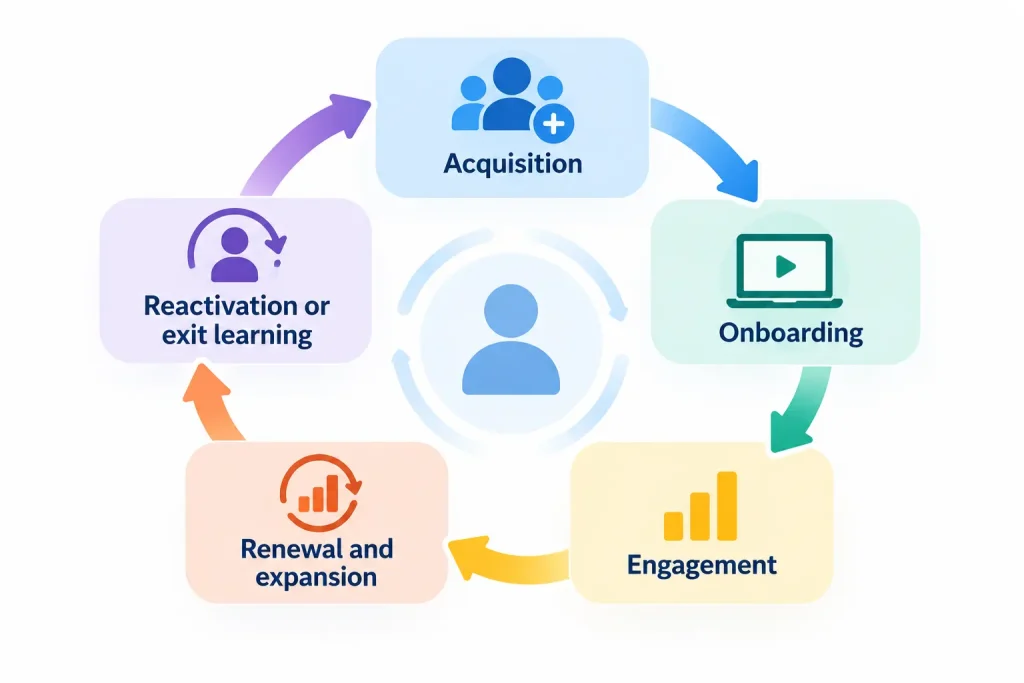
Each stage needs its own messaging, metrics, and mindset. A customer still learning the product should not be upsold, and a power user should not receive beginner tips. The table below summarizes how lifecycle marketing shifts across the journey.
| Lifecycle Stage | Primary Goal | Key Tactics |
| Onboarding | Fast value realization | One success path, progressive disclosure, behavioral triggers, human help for B2B accounts |
| Engagement | Turn usage into habit | Activity monitoring, personalized tips and webinars, new use cases, outcome reminders |
| Renewal and expansion | Reaffirm and grow commitment | Early renewal talks, usage reports, tailored upsells, social proof |
| Reactivation | Recover dormant or lost customers | Exit surveys, easy paths back, relevant new features, sparing use of incentives |
Onboarding: The Moment That Matters Most
Onboarding is the most critical retention phase, since customers form first impressions and meet their first friction here. The goal is value realization, measured as time to first value (TTFV). High drop-off usually signals complexity or misaligned expectations, and fixing onboarding can lift retention more than any later effort.
Engagement, Renewal, and Reactivation
During engagement, email, in-app messages, and SMS alerts work only when timing and relevance are right. Reinforcing outcomes, such as “You saved 8 hours this week,” beats promoting features. Poor renewal performance often stems from silence between onboarding and renewal, so dialogue should begin well before expiration. Upsells and adjacent modules must feel additive to the customer, not extractive.
Not all churn is final, since some users go dormant and others leave for solvable reasons. Reactivation should feel like an invitation to a better experience, never like a sales call.
Data, Segmentation, and the Human Touch
Customer lifecycle marketing lives and dies by segmentation. Useful segments are behavioral, demographic, lifecycle-based (new, active, at-risk, churned), and sentiment-based, drawing on NPS, CSAT, and support history. A high-NPS customer might receive a referral request, while a low-engagement user might receive a success story.
Automation is essential, yet humanity still matters, and the art lies in knowing where each belongs.
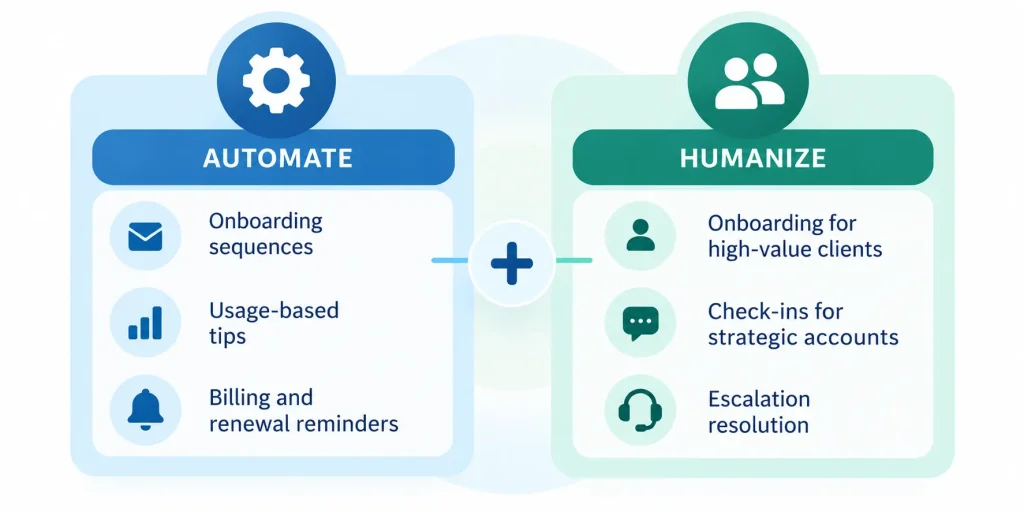
A well-timed call can reverse a churn decision, and a thoughtful email can prompt a referral. Within customer lifecycle marketing, technology should scale empathy instead of replacing it.
Metrics That Matter for Lifecycle Marketing
Optimizing retention through customer lifecycle marketing requires a focused set of measures:
- Churn rate: Overall customer loss per period.
- Net revenue retention: Revenue kept and expanded from existing customers.
- Customer health score: A composite of activity, sentiment, and support data.
- Time to first value: How quickly customers experience benefit.
- Feature adoption rate: How much of the product’s utility customers actually use.
Reliable measurement also sharpens forecasting across the business. At a cybersecurity SaaS company with $30M in recurring revenue, a driver-based forecasting engine held actuals within five percent of forecast for 8 consecutive quarters. Retention data that predictable gives leaders confidence to plan.
Feedback Loops and Continuous Improvement
Customer lifecycle marketing evolves with the product, the customer, and the market. A feedback-driven company revises onboarding flows monthly and A/B tests email sequences constantly. It updates help content based on support tickets and revisits segmentation models each quarter.
Making Retention Everyone’s Job
Retention is not the sole burden of marketing. Product teams must design for stickiness, support teams must resolve issues with empathy and speed, and sales teams must set realistic expectations. Leadership must champion lifetime value over short-term gain. When retention becomes a shared metric, silos fall and the whole company rows toward allegiance instead of acquisition alone.
Customer lifecycle marketing respects the customer’s journey and aligns the organization to serve it with precision and empathy. In a market saturated with alternatives, that enduring connection becomes the most valuable asset of all. The companies worth staying with are those that never stop showing up.
Three Key Takeaways
- Small retention gains compound into large profit gains, since retained customers spread acquisition costs across years and raise the CAC a business can afford.
- Customer lifecycle marketing works when messaging fits each stage, with the heaviest investment in onboarding and time to first value.
- Segmented data, selective human outreach, and shared retention goals across product, sales, and support turn retention into an organizational reflex.
Disclaimer: This article is intended for informational purposes only and does not constitute legal, tax, or accounting advice. You should consult your own tax advisor or counsel for advice tailored to your specific situation.
Hindol Datta is a four-time CFO and senior finance executive with over 25 years of leadership experience across cybersecurity, SaaS, gaming, logistics, digital marketing, medical devices, consumer products, and nonprofit organizations. He has led more than $120M in fundraising and over $150M in M&A transactions while building the financial and operational systems that let complex businesses scale with confidence. He is the author of seven books in the Systems CFO Series and holds active CPA, CMA, and CIA credentials.
AI-assisted insights, supplemented by 25 years of finance leadership experience.