
Executive Summary
Cap table management begins in a spreadsheet at most startups, and for a short while that choice holds up well. Equity grants, SAFE conversions, departures, and closed rounds soon turn a tidy file into a source of legal and financial risk.
This article compares Excel with leading cap table software such as Carta and Pulley across cost, modeling depth, and compliance. It also sets out clear triggers for leaving the spreadsheet and a practical rollout plan for finance leaders.
Why Cap Table Management Is a Governance Decision, Not a Software Choice
Every early-stage company keeps its first cap table where it keeps everything else, which is usually Excel. The file costs nothing, the finance team knows it, and it bends to any structure a founder can imagine. That flexibility hides an exposure that grows with every equity event the company records. Each new option grant, departing employee, or converting SAFE adds another chance for a broken formula or an outdated version.
A cap table is an operating system for ownership rather than a static record. It must hold up to legal review, regulatory compliance, equity administration, and investor scrutiny at the same time. By Series A, institutional investors expect a capitalization table that is auditable, current, and tied to legal and financial records.
Platforms such as Carta, Pulley, and Shareworks from Morgan Stanley at Work promise automation, transparency, and real-time scenario modeling. Each one carries different features, costs, and ideal use cases. The sections below weigh a DIY spreadsheet against a dedicated equity management platform, with stage, complexity, and strategy as the deciding factors.
Excel for Cap Table Management: Where It Works and Where It Breaks
At the pre-seed or friends-and-family stage, a spreadsheet cap table is usually all a company needs. The trouble starts when the business keeps using it long after the equity structure has outgrown it.
Advantages of a Spreadsheet Cap Table
Excel earns its place as the default for early founders, and its strengths are easy to list:
- Total flexibility in modeling any ownership structure
- No software costs or subscription fees
- A familiar interface for most finance teams
- Room to customize for bespoke or unusual situations
Limitations That Surface as Equity Grows
The same openness that makes Excel useful also leaves it without guardrails. As stakeholders multiply, these gaps start to carry real cost:
- No automated audit trail for changes
- Manual tracking of vesting schedules
- Difficulty modeling SAFEs, convertible notes, and complex liquidation preferences
- High risk of human error in linked formulas
- No board approval workflows or signature collection
- Weak version control across founders, counsel, and investors
A Series B marketplace SaaS raise offers a useful lesson here. Its cohort and unit economics models held up through diligence on a $20M round because every figure traced back to one source. Ownership data deserves the same standard, since investors test the cap table as closely as the revenue model.
When to Use Excel and When to Move Off It
Excel remains a reasonable choice when a company has fewer than 5 stakeholders, no option pool, no convertible securities, and only angel or pre-funding capital. The case for switching becomes strong once any of the following events occurs:
- The first option grant is issued
- The first SAFE or convertible note is accepted
- A Series A process is about to begin
- Hiring moves from a handful of people to a steady pace
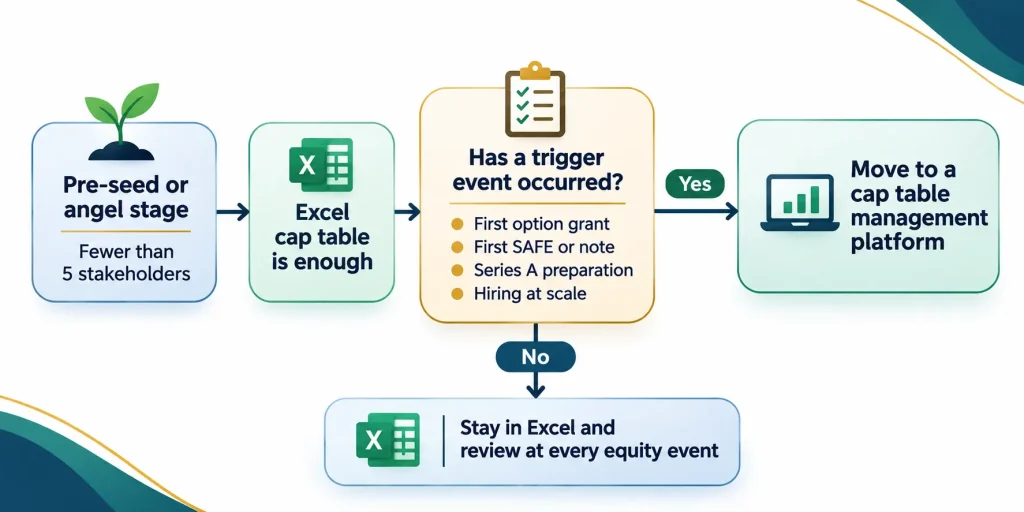
The best practice for a CFO is to keep Excel as a modeling sandbox only. Once the company commits to formal governance, a purpose-built platform should hold the official record for accuracy and compliance.
Carta vs. Pulley: Comparing Leading Cap Table Management Platforms
The two platforms that come up most often in founder and board conversations take different paths to the same goal. Carta built depth for the full journey to IPO, while Pulley built speed and simplicity for early-stage teams.
Carta: Depth for Companies Heading Toward IPO
Founded as eShares, Carta later absorbed Capshare and now leads the equity management market from seed through IPO, with strengths that include:
- Deep integration with legal partners and law firms
- Built-in 409A valuation services
- Automated option tracking and board approvals
- Investor access portals
- Advanced scenario modeling for exits, fundraising, and dilution
- ESOP and compliance dashboards
The trade-offs deserve equal attention, starting with a cost structure that climbs as the company grows and weighs hardest on post-Series B teams. Reporting is less customizable for niche cases, and legal onboarding may require alignment with outside counsel. Carta fits best for companies with 15 or more stakeholders, firms preparing for frequent fundraising, and CFOs who want tight 409A valuation alignment.
An S-1 and IPO-readiness process at a Euronext Paris-listed gaming company shows why that depth matters later on. Underwriters and Big Four auditors expect every share class and grant to reconcile across entities and reporting standards.
Pulley: Speed and Clarity for Seed and Series A
Pulley entered the market later, with a focus on transparency, startup-friendliness, and fast onboarding. Users often cite its clean interface and responsive support team, and its strengths include:
- Lower pricing tiers for early-stage startups
- Excellent modeling for SAFEs and convertible notes
- Easy onboarding from an existing Excel file
- Scenario modeling that handles complex cap tables
- Strong support and rapid product iteration
Pulley offers 409A services, though they sit less deeply in the product than Carta’s, and adoption among later-stage companies still trails the market leader. The platform suits seed and Series A startups, founders who want intuitive cap table management, and companies that rely on SAFEs and notes for early funding.
Carta vs. Pulley vs. Excel Feature Comparison
| Feature | Carta | Pulley | Excel |
| 409A Valuation Integration | Built-in | Available | Manual or outsourced |
| Scenario Modeling | Advanced | Strong | Manual |
| SAFE Modeling | Moderate | Excellent | Manual |
| Onboarding Time | Weeks | Days | Immediate |
| Cost | Higher | Lower at early stage | Free |
| Legal Workflow | Strong | Moderate | None |
| Audit Trail | Yes | Yes | No |
| Version Control | Centralized | Centralized | Risk-prone |
Neither platform is the right answer for every company. A seed-stage team with a stack of SAFEs may find Pulley the faster path, while a company planning several rounds and an eventual exit will value Carta’s breadth.
Operationalizing Cap Table Management for Governance and Scale
Adopting a cap table management platform such as Carta or Pulley does far more than digitize a spreadsheet. The move formalizes how the company handles equity across legal, administrative, and strategic dimensions.
A venture-backed digital marketing company that raised $36.5M across Series A through C, while closing three acquisitions, illustrates the pressure. Each round and each deal adds holders, grants, and conversion terms that the record must absorb without error. The effects of a platform show up in three distinct areas.
Governance Impact
- Digital board consents
- Standardized grant documentation
- A real-time audit trail
- Legal version control
- Readiness for investor and acquirer due diligence
Finance and HR Impact
- Integrated vesting schedules
- Scenario modeling for raises and exits
- Tax reporting, including 83(b) elections and ISO versus NSO tracking
- Employee dashboards that make equity transparent
Strategic Modeling for Dilution and Exits
- Exit waterfalls
- Option pool refresh planning
- Pro forma ownership for future rounds
- Dilution impact analysis
At a cybersecurity and identity access management company, board-grade reporting and a sound controls environment carried the business through acquisition diligence. A clean equity record belongs in that same category of diligence-ready infrastructure.
CFO Best Practices for Platform Rollout
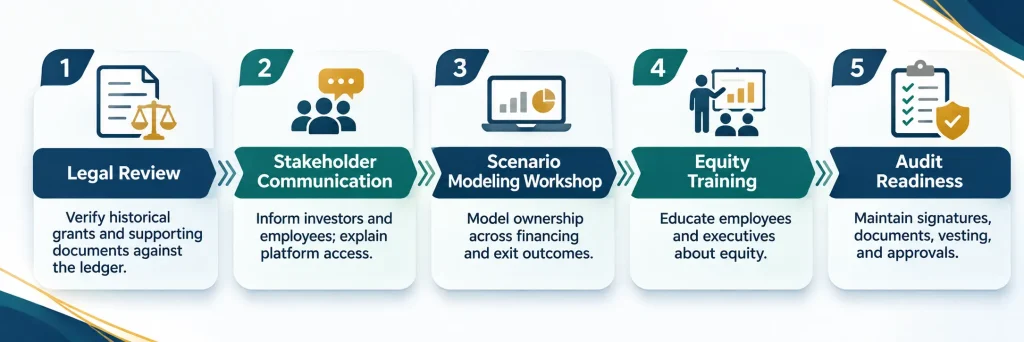
- Legal review: Scan and upload every historical grant and supporting document, then confirm each one matches the ledger.
- Stakeholder communication: Tell investors and employees the platform is live and explain how to access it.
- Scenario modeling workshop: Use the platform to build ownership models across several exit and financing outcomes.
- Equity training: Pair the rollout with training on how equity works for employees and executives alike.
- Audit readiness: Treat the cap table as a core compliance system, keeping signatures, documents, vesting, and approvals current.
Why the Right Cap Table Platform Signals Institutional Readiness
Choosing a cap table tool is a governance decision more than a software preference. It shapes how a company allocates, administers, and explains ownership to everyone with a stake in it. Starting in Excel makes sense, but staying there invites avoidable risk.
Cap table management platforms like Pulley and Carta reduce legal exposure, sharpen decisions, and let a company grow without cap table chaos. For a CFO, the right platform delivers risk reduction, investor confidence, and internal alignment, and above all it signals institutional readiness. The spreadsheet gets a company started, but the system is what gets it funded.
Three Key Takeaways
- Excel works for cap table management only while a company has a handful of holders and no options or convertibles, and the first grant or SAFE is the signal to move.
- Carta suits companies planning frequent raises and an eventual exit, while Pulley serves seed and Series A teams that lean on SAFEs and want fast onboarding.
- A platform rollout succeeds when legal review, stakeholder communication, scenario modeling, training, and audit readiness move together as one governance program.
Disclaimer: This article is intended for informational purposes only and does not constitute legal, tax, or accounting advice. You should consult your own tax advisor or counsel for advice tailored to your specific situation.
Hindol Datta is a four-time CFO and senior finance executive with over 25 years of leadership experience across cybersecurity, SaaS, gaming, logistics, digital marketing, medical devices, consumer products, and nonprofit organizations. He has led more than $120M in fundraising and over $150M in M&A transactions while building the financial and operational systems that let complex businesses scale with confidence. He is the author of seven books in the Systems CFO Series and holds active CPA, CMA, and CIA credentials.
AI-assisted insights, supplemented by 25 years of finance leadership experience.