
Executive Summary
A follow-on investment is a second vote cast with better information, and it reveals more about discipline than the first check ever does. For investors and founders alike, the decision to reinvest or abstain shapes ownership, governance, and the story the market reads next.
This article lays out a decision tree for follow-on funding, examines the distortions of pro rata rights, and explores the founder’s trade-offs between capital and control. It closes with non-binary tools such as secondaries, structured rounds, and continuation vehicles.
Why Follow-On Investment Decisions Test Discipline
The follow-on arrives without the drama of the first check or the fanfare of the exit. It emerges between early promise and tested performance. Follow-on capital does not reward the past; it bets on the shape of the future.
Investors now hold more data and context, yet also more bias. Founders face a layered moment too, because a follow-on protects against outside dilution while anchoring the company to existing power structures. Proximity often overrides the discipline of price, so teams take familiar money the market might not offer.
Four Distortions That Corrupt Follow-On Funding
- The pro rata illusion, which assumes that the right to follow on creates an obligation to do so
- Ownership anchoring, which preserves a stake after belief has eroded
- Signaling theater, where investors write symbolic checks to keep up appearances
- The scarcity fallacy, which fears that passing means missing the next winner
Left unexamined, these distortions turn a clear update of beliefs into an act of tribal loyalty. Designed well, follow-on strategy becomes a form of narrative risk management that shapes how future investors and buyers read the company.
The Follow-On Investment Decision Tree
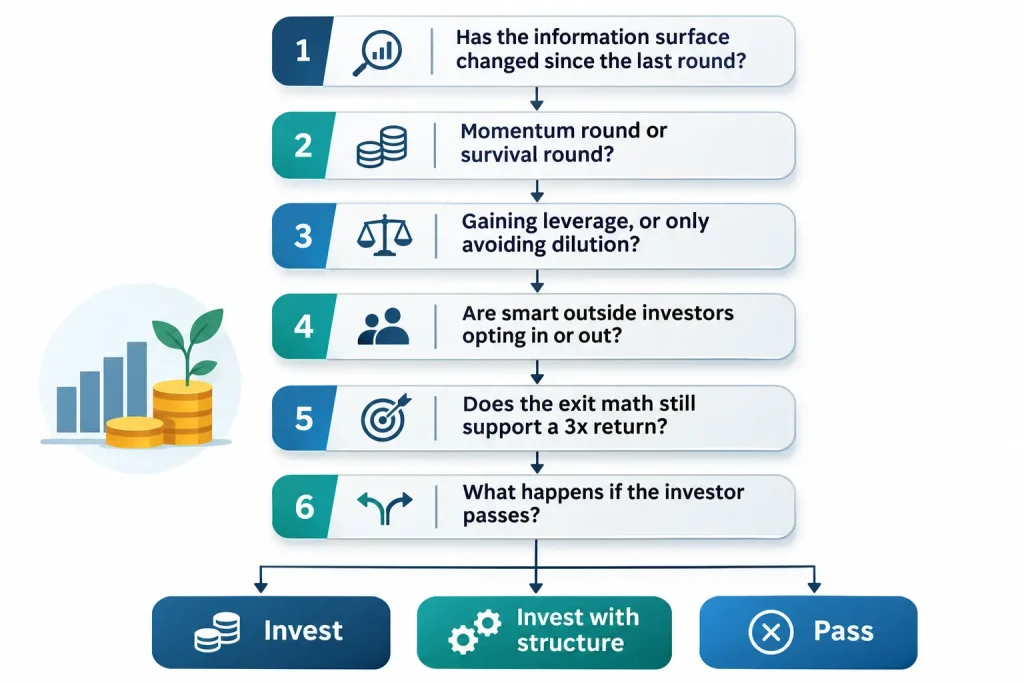
An early bet expresses belief in potential, while the follow-on bet is colder and tests whether the variables have changed. The most dangerous outcome in venture is slow-motion mediocrity disguised as “still early.” Misallocated follow-on capital prolongs indecision when the system needs a reset.
Information Surface and Round Motive
By Series B or C, investors should see revenue curves, churn patterns, retention cohorts, and hiring efficiency. A company can double revenue and still degrade in quality, so signal integrity matters more than magnitude. A useful test is the “thesis maintenance cost,” meaning how much new justification a reinvestment now requires.
Cohort and unit economics models anchored diligence for a $20M Series B at a marketplace SaaS company. That level of evidence is what a changed information surface looks like.
Round motive matters as much as size, since momentum rounds come from strength, draw oversubscription, and price new optionality. Survival rounds tend to be founder-initiated and layered with convertibles, SAFEs, or venture debt. Any survival check needs clear delta math: if investors put in $5M, what must change for the company to become acquirable or raise at a markup?
Leverage, Outside Signals, and Exit Math
Ownership preservation drives too many follow-ons, yet in a $200M early-stage fund, owning 10% of a company that sells for $300M is a strong result. Heavy follow-on spending raises the cost basis and can shrink that same outcome to a rounding error.
Outside signals help too, since an insider-filled round that no outsider would price may look strong on paper while masking desperation.
Exit math closes the loop: if a follow-on implies a $1.2B exit in a market where no buyer has paid above $700M, the realistic buyer universe argues for passing.
The Counterfactual
Every follow-on investment memo should ask what happens without participation. Passing can sacrifice ownership, yet it can also preserve reserves for better terms or for portfolio companies with a steeper slope. Opportunity cost is as real here as in any capital budgeting decision.
Pro Rata Rights and Their Distortions
Pro rata rights give early investors the right, not the obligation, to maintain their stake. In theory this rewards conviction and simplifies syndication. In practice, the right to maintain ownership is a tool, not a strategy.
Three Central Distortions of Pro Rata Behavior
| Distortion | What Happens | Better Practice |
| The Illusion of Conviction | Insiders re-up small, pre-negotiated checks with little fresh underwriting | Underwrite every follow-on as a new bet at a new price |
| The Reality of Fund Math | A follow-on at a $300M post-money valuation becomes a new bet, not a 2x on the seed | Model reserve ratios, capital concentration, and dollar-weighted exposure |
| The Signaling Trap | An insider who passes for unrelated reasons spooks new investors | Explain abstentions early and in plain terms |
Consider a lead investor who skips a strong, oversubscribed Series C because the sponsoring partner left the firm. New investors ask what the insider knows, and the round can nearly collapse over organizational drift. Investors often follow on to avoid questions rather than to make money, which is political risk management, not strategy.
When Pro Rata Rights Become Strategic Handcuffs
Pro rata turns into a liability in three common situations:
- An insider blocks a new lead by over-exercising
- Pro rata preservation shrinks the allocation for new, value-added capital
- A rights war among insiders drags the round into negotiation purgatory
A Series B lead offering $30M may walk away if insiders demand 80% of the round. CFOs can counter this with term sheet language that qualifies pro rata rights:
- Insiders exercise rights within 10 days of lead term acceptance
- Maximum follow-on capped at historical ownership
- No follow-on if strategic capital exceeds 30% of the round
These clauses favor clarity, removing ambiguity and speeding up allocation.
Founder Dilemmas in Follow-On Funding
A follow-on brings more money and more influence. Founders must welcome capital while keeping agency, and accept support without outsourcing strategy.
Five Trade-Offs Founders Face
- Comfort capital versus catalytic capital: Insider rounds close fast, yet the silence of outside investors can say more than any insider term sheet.
- Ownership versus control: Control depends on governance and narrative power, and protective provisions accumulate with each round.
- Information asymmetry: Founders know the true burn slope and pipeline, and capital raised under pretense becomes a governance liability.
- The false scarcity of dilution: A founder who refuses to drop from 21% to 17% may later fall to 12% in a down round.
- Cultural signals: Teams read every round, so founders should explain what the capital enables, such as doubling sales coverage or pulling profitability forward.
Raising $36.5M across Series A through C at a venture-backed digital marketing company shows how each round reshapes the board and the cap table. Dilution that increases the slope of the business is worth accepting. The real loss is dilution that buys nothing.
Beyond Binary Follow-On Investment Decisions
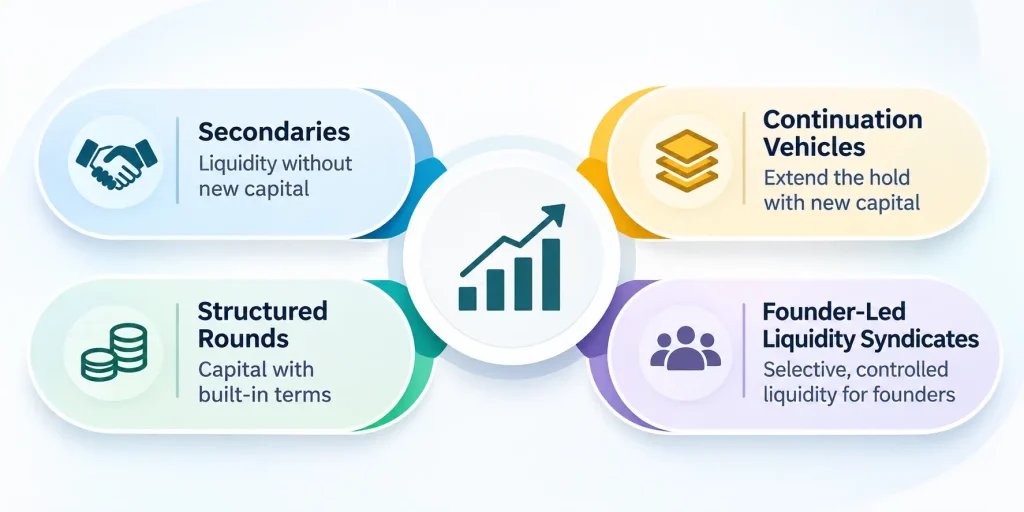
By Series C or D, the choice stops being invest or abstain. A new class of instruments lets investors recycle conviction without blind commitment.
Secondaries, Structured Rounds, and Continuation Vehicles
| Instrument | Purpose | Governance Guardrails |
| Secondaries | Partial liquidity that de-risks founders and lets early investors recycle capital | Agree who participates, at what price, what share of holdings, and whether the pool is opt-in |
| Structured Rounds | Capital with embedded discipline when margins are thin or markets uncertain | Model the full waterfall, the downside, and a shared definition of success |
| Continuation Vehicles | Liquidity for LPs while the GP keeps a stake and rolls the asset forward | Ensure regulatory compliance and full LP transparency |
| Founder-Led Liquidity Syndicates | Partial secondaries for early employees that reduce pressure for a premature exit | Cap participation, set pricing, and limit eligibility by tenure |
Structured rounds can take several practical forms in a follow-on:
- Tranched equity, such as $20M now and $10M upon reaching 30% YoY growth
- Participating preferred with a cap, such as 1x plus 20% upside capped at 3x
- Convertible debt with equity resets tied to the timing of the next raise
Founder-led liquidity syndicates work best with firm guardrails:
- Participation capped at 20% of vested options
- Pricing set at the last preferred round or a third-party appraisal
- Eligibility limited to employees with more than 3 years of tenure
- Board approval waived for pools under $5M
Raising $37M in equity and venture debt for a mission-driven education and research institution showed how blended structures can match capital to uncertain funding conditions. Sometimes the best follow-on involves no new capital at all. One early-stage digital marketing SaaS company cut monthly burn from $800K to $200K, extending runway through internal discipline instead of another round.
The Stewardship of Follow-On Capital
The first check buys exposure, while the follow-on defines an investor’s philosophy. A sound follow-on investment strategy rests on five convictions:
- Decisions must reflect updated beliefs, not outdated loyalties
- Capital acts as a signal and should compress noise, not amplify it
- Ownership differs from control, which depends on governance, alignment, and timing
- Liquidity can signal continued trust instead of weakness
- Follow-ons form part of the exit strategy, since every reinvested dollar tightens or blurs the path to outcome
Sometimes the answer is yes with full force, sometimes yes with structure, and sometimes no, where the courage lies in restraint. The best financial leaders update, design, and align, but they never bet blind.
Three Key Takeaways
- Treat every follow-on investment as a new bet at a new price, tested against the information surface, the round motive, exit math, and the counterfactual.
- Qualify pro rata rights with time limits, ownership caps, and strategic capital thresholds so they support new leads instead of blocking them.
- Use secondaries, structured rounds, and continuation vehicles when a binary yes or no would stall momentum or misprice uncertainty.
Disclaimer: This article is intended for informational purposes only and does not constitute legal, tax, or accounting advice. You should consult your own tax advisor or counsel for advice tailored to your specific situation.
Hindol Datta is a four-time CFO and senior finance executive with over 25 years of leadership experience across cybersecurity, SaaS, gaming, logistics, digital marketing, medical devices, consumer products, and nonprofit organizations. He has led more than $120M in fundraising and over $150M in M&A transactions while building the financial and operational systems that let complex businesses scale with confidence. He is the author of seven books in the Systems CFO Series and holds active CPA, CMA, and CIA credentials.
AI-assisted insights, supplemented by 25 years of finance leadership experience.