
Executive Summary
Anti-dilution provisions often arrive dressed as simple fairness, shielding early investors when a later round prices below theirs. In practice, the clause decides who absorbs a down round, and its form can move several points of ownership away from founders.
This article explains full ratchet and weighted average anti-dilution protection and works through the math behind each. It also sets out the safeguards worth negotiating before signing.
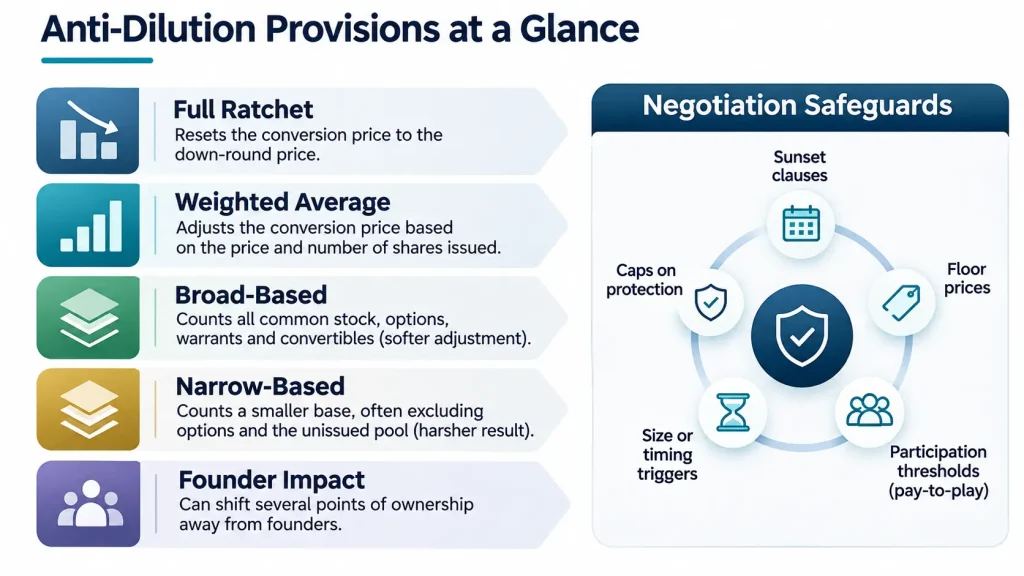
Why Anti-Dilution Provisions Are Governance Disguised as Formula
At first reading, the clause looks like plain arithmetic. If capital markets ran on arithmetic alone, nobody would need counsel or judgment at the term sheet stage. The formula hides a decision about how investors and builders share risk.
Early capital deserves protection, but immunity from the downside is a different proposition. A founder who understands the mechanism can accept the clause without surrendering control.
Startups seldom follow a straight line, since markets pivot and product-market fit can arrive late. Should the earliest capital bear none of that downside? Two principal forms of protection dominate the market:
- Full ratchet, which reprices earlier preferred stock all the way down to the new round’s price.
- Weighted average, which adjusts the price in proportion to the size and depth of the down round.
Full Ratchet Anti-Dilution and Its Implications
A full ratchet provision resets the conversion price of earlier preferred stock to the down round price, however few new shares are issued. Cash invested stays the same, yet the investor receives more common shares on conversion.
The logic is simple and the implication severe. The founder carries the volatility while the investor rides the outcome, so capital becomes a hedge instead of a participant.
A Worked Full Ratchet Example
Consider a company with the following capitalization after its seed round:
- The seed investor holds 1,000,000 preferred shares bought at $2.00 per share.
- Founders and employees hold 4,000,000 shares of common stock.
- The seed round implies a post-money valuation of $10M.
- The Series A then issues 2,000,000 shares at $1.00 per share, a down round.
Under full ratchet, the seed conversion price falls from $2.00 to $1.00, so the conversion ratio becomes 2.00 / 1.00 = 2.0. The seed investor now converts into 2,000,000 common shares instead of 1,000,000, and every extra share comes out of the common holders’ percentage.
Weighted Average Anti-Dilution: The Algebra of Proportional Fairness
A weighted average provision recalculates the conversion price using both the lower price and the number of new shares. It recognizes that a small bridge at a modest discount should not carry the penalty of a large recapitalization. Investors still receive protection without obliterating the founders.
The Weighted Average Formula
The standard formula is New Conversion Price = Old Price × (A + B) ÷ (A + C), where:
- A is the number of shares outstanding before the new issue.
- B is the number of shares the new money would have bought at the old price.
- C is the number of shares actually issued in the new round.
Take an old price of $2.00, a new price of $1.00, 5,000,000 shares outstanding and 1,000,000 new shares, so B equals 500,000. The new conversion price is $2.00 × 5,500,000 ÷ 6,000,000, which works out to $1.83 per share. Early investors get a cushion, while common holders avoid the full burden of a round they did not price.
Broad-Based Versus Narrow-Based Weighted Average
The definition of A drives the outcome in each variant:
- Broad-based weighted average counts all common stock plus options, warrants and other convertible securities, so the larger base softens the adjustment.
- Narrow-based weighted average counts a smaller base, often excluding options and the unissued pool, which produces a harsher result for founders.
Modeling Founder Dilution Under Each Anti-Dilution Provision
Ownership after any adjustment follows one relationship: New Ownership = (So × P) ÷ St. So is the original shares held, P is the post-adjustment conversion ratio, and St is total shares after the financing. The formula lets a founder quantify the ownership at stake before the negotiation, not after the board vote.
Simulation of Founder Equity After a Series A Down Round
In the earlier company, a $2M Series A prices at $1.00 per share. A broad-based weighted average adjusts the seed conversion price to roughly $1.71.
Founder Ownership Comparison Table
| Scenario | Seed Shares on Conversion | Total Shares | Founder Ownership |
| No anti-dilution protection | 1,000,000 | 7,000,000 | 57.14% |
| Broad-based weighted average | 1,166,667 | 7,166,667 | 55.81% |
| Full ratchet | 2,000,000 | 8,000,000 | 50.00% |
A seven-point swing in founder ownership from a single clause is not a rounding error. One venture-backed digital marketing company scaled from $9M to $180M in revenue while raising $36.5M across Series A through C. Finance modeled each term sheet against the full cap table, since early terms carry into later rounds.
Negotiating Anti-Dilution Provisions in the Term Sheet
Push for the Right Form
Negotiate for weighted average over full ratchet, and insist on the broad-based version. In an oversubscribed round, press to remove the clause altogether. Scarcity creates leverage, and founders should use it.
Limit the Scope with Practical Safeguards
Several safeguards moderate the clause without removing it:
- Sunset clauses, which end protection after a fixed period or agreed milestones.
- Floor prices, which set a minimum level for any adjusted conversion price.
- Pay-to-play thresholds, which require investors to join the down round to keep protection.
- Caps on protection, which limit the maximum adjustment to a fixed percentage.
- Size or timing triggers, which exempt small bridges or financings inside a set window.
Frame the Narrative as Partnership
Investors are partners, and shared downside creates shared urgency. Founders can argue that protection is reasonable while immunity is not.
Understanding the Full Term Sheet Stack
Anti-dilution protection rarely acts alone, so founders should always model it alongside the other terms in a financing.
How Anti-Dilution Compounds with Other Terms
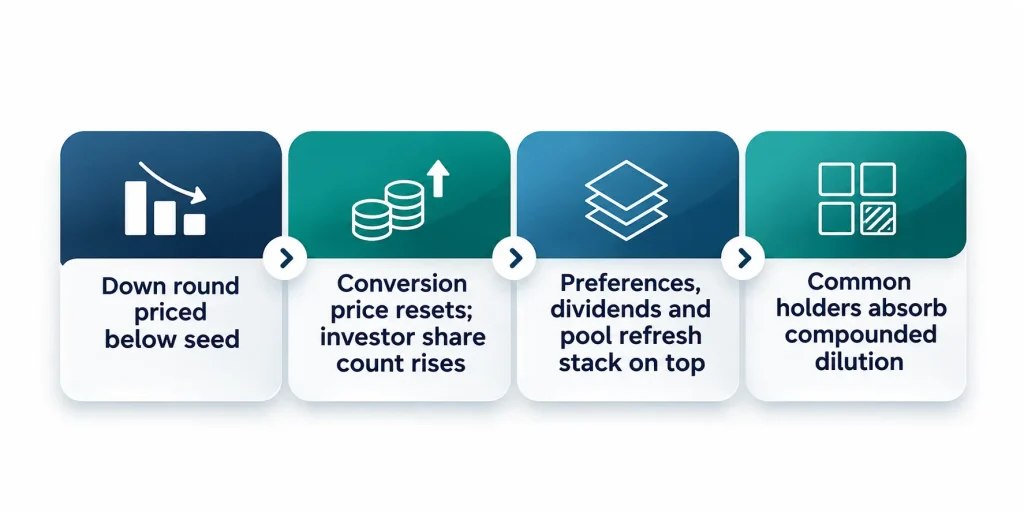
A down round first triggers the anti-dilution clause, which resets the conversion price and raises the investor’s share count. A liquidation preference then pays investors first in a modest exit, leaving less for common stock. Cumulative dividends make matters worse, since unpaid dividends add to that preference every year. In a stronger exit, the investor converts and takes a larger slice through the adjusted share count.
New investors often require a larger option pool sized before their money arrives. That refresh usually sits outside the anti-dilution formula, so existing holders absorb it without adjustment. Common holders lose ground whether the exit is modest or strong.
A $37M raise across equity and venture debt for a mission-driven education and research institution shows why. Each instrument in that capital stack changed how the others behaved under stress.
The Strategic and Human Cost of Anti-Dilution Protection
To an institutional investor, the loss of founder equity can look like a rounding error. To the founder, it can feel like betrayal, the product of contractual asymmetry rather than poor execution.
How the Clause Changes Incentives
Anti-dilution rights also reshape the game theory of venture financing. Investors insulated from a down round may be more willing to force one. Founders, in turn, may feel cornered and avoid a bridge or a lower valuation even when either makes strategic sense.
Who Bears the True Dilution
The real dilution does not land on a spreadsheet. It lands on the team that built the product, the customers who waited and the founder who deferred salary. A company must preserve the will to build, not just ownership.
Companies do recover from near-collapse when founders keep enough belief and equity to try again. One early-stage email marketing technology company cut monthly burn from $800K to $200K in a turnaround that depended on a motivated team. A cap table mangled by protectionist terms can leave no crew to sail once the storm passes.
Designing Anti-Dilution Provisions for Alignment
Treat anti-dilution provisions as decisions, not defaults, and design them for the moment of testing, not the day of signing.
At a cybersecurity and identity access management company, clean capital records carried the business through acquisition diligence. A buyer at that stage examines every term in the stack.
So when counsel next describes the anti-dilution clause as standard, ask whether it is just, not whether it is common. Then run the numbers, because cap tables do not lie and neither does the math. Used wisely and sparingly, the clause becomes a tool for alignment instead of a trap.
Three Key Takeaways
- Anti-dilution provisions decide who absorbs a down round, so founders should treat them as a governance decision and model them before signing.
- A broad-based weighted average protects investors in proportion to the down round, while a full ratchet can strip several points of founder ownership.
- Sunset clauses, floor prices and pay-to-play requirements keep protection reasonable, provided the full term sheet stack is modeled alongside them.
Disclaimer: This article is intended for informational purposes only and does not constitute legal, tax, or accounting advice. You should consult your own tax advisor or counsel for advice tailored to your specific situation.
Hindol Datta is a four-time CFO and senior finance executive with over 25 years of leadership experience across cybersecurity, SaaS, gaming, logistics, digital marketing, medical devices, consumer products, and nonprofit organizations. He has led more than $120M in fundraising and over $150M in M&A transactions while building the financial and operational systems that let complex businesses scale with confidence. He is the author of seven books in the Systems CFO Series and holds active CPA, CMA, and CIA credentials.
AI-assisted insights, supplemented by 25 years of finance leadership experience.