
Executive Summary
A venture capital thesis is the compass an investor relies on when data is thin and outcomes are skewed. Far more than a slide of target sectors, it encodes beliefs about markets, customer behavior, and the direction of technology.
This article examines the three pillars of a strong investment thesis: market, model, and momentum. It then explores how filters, calibration, counter-thesis work, and founder-market fit keep conviction disciplined instead of dogmatic.
Why a Venture Capital Thesis Is a Worldview, not a Slide
The investment thesis is often mistaken for a PowerPoint construct, a market map with logos arranged by category. In practice, a venture capital thesis is a declaration of worldview shaped by reason, experience, and humility. Beneath it sit assumptions about human behavior, economic motion, and the vectors along which technology travels.
A well-formed thesis supplies a rational framework and a philosophical ballast at the same time. Without both, decisions under uncertainty drift toward whatever narrative sounds most persuasive that week.
The Three Pillars of a Venture Capital Thesis
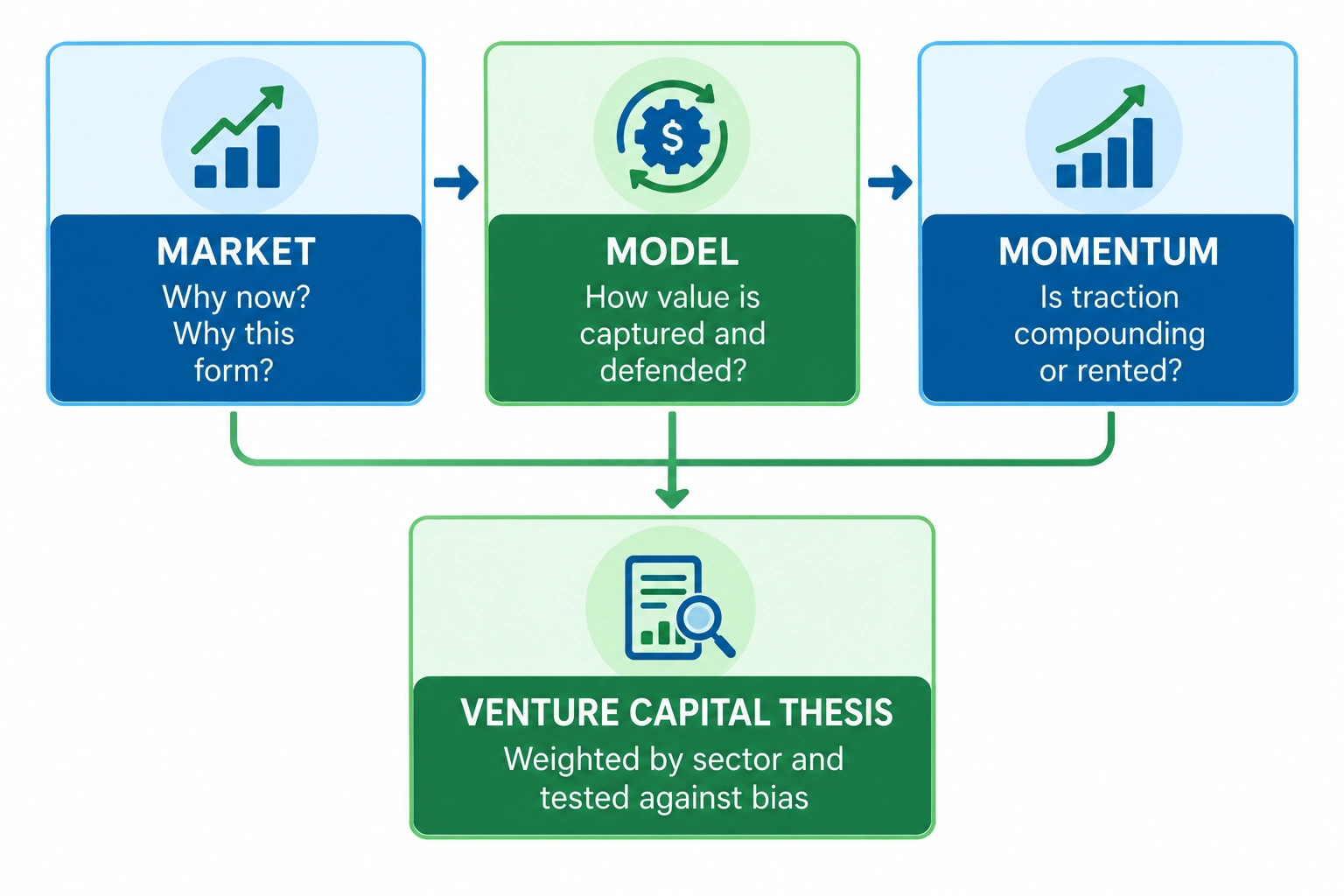
Market, model, and momentum form the cognitive scaffolding of any durable investment thesis. Each pillar asks a different question, and the diagram below shows how the three converge.
Market: Reading the Ecology Behind the TAM
The first duty of a venture investor is to resist the seduction of the total addressable market slide. Markets are not quantitative expanses waiting to be captured; they behave more like living ecologies. Understanding one means grasping its pain points, structural resistances, historical inertia, and latent inflection points. The better question asks why the market exists in its current form and what has just become possible.
Complexity theory offers a useful lens, because markets act as adaptive systems instead of static maps. Regulatory shifts, non-obvious adjacencies, or cultural adoption curves can redefine the slope of opportunity almost overnight. A venture capital thesis grounded in market insight must therefore remain dynamic, updating its priors as conditions move.
Model: Testing the Business Model as a Behavioral Hypothesis
The model is the economic structure through which a company captures and defends value. A sound investment thesis looks past top-line growth to the engine underneath: pricing architecture, distribution leverage, operating efficiency, and repeatable conversion. The goal is not just scale, but slope; not just revenue, but robustness.
Every business model is a behavioral hypothesis, not a spreadsheet artifact. Will customers pay repeatedly and advocate for the product? Will acquisition costs fall through compounding effects, or rise as easy channels saturate? Static CAC-to-LTV ratios rarely answer these questions on their own, while cohort behavior and upsell velocity often do.
During a $20M Series B raise at a marketplace SaaS company, cohort and unit economics models anchored investor diligence. Diligence focused far more on how each cohort behaved than on the headline growth rate. A strong thesis tests the model for integrity over perfection, separating momentary traction from structural advantage.
Momentum: Separating Real Traction from Surface Acceleration
In venture, velocity matters as verification and not as vanity. Real momentum is compounding alignment: product readiness, market pull, team execution, and capital efficiency moving together. Of the three pillars, momentum is also the most volatile. False momentum from marketing spend, PR optics, or inorganic user spikes can distort perception badly. Reading momentum correctly requires temporal calibration and a circle of competence applied to venture foresight:
- Are users returning without being paid or prompted to return?
- Is the sales cycle shortening as customer references accumulate?
- Are partnerships self-propagating, or does each one require heavy lifting?
- Is revenue becoming more predictable as the company grows?
A venture-backed performance marketing company that scaled from $9M to $180M in 24 months shows the difference in practice. Its growth held because CAC, LTV, and contribution margin discipline grew alongside the revenue line.
Weighting Market, Model, and Momentum by Sector
The three pillars do not carry equal weight in every investment thesis. In deep tech, the model may lag the market for years while the science matures. In consumer applications, momentum may race ahead of a business model that has not yet proven itself. Skilled investors weight each pillar according to the sector, as the framework below summarizes.
Sector Weighting Framework
| Sector | Leading Pillar | Lagging Pillar | What to Watch |
| Deep tech | Market | Model | Technical milestones and timing of commercial inflection |
| Consumer applications | Momentum | Model | Organic retention versus paid acquisition |
| B2B SaaS | Model | Momentum | Net revenue retention and sales cycle trends |
Investor Psychology and the Living Investment Thesis
No investment thesis exists outside the psychology of the person holding it. An investor burned by a logistics startup may pass on the next category-defining freight platform. One who made 10x in fintech may over-index on the sector long after macro tides have turned.
A thesis must therefore be examined as well as adaptive, revised when markets shift and when personal priors prove brittle. Treated this way, a great investment thesis becomes a practiced form of epistemic humility. The result is the structured pursuit of belief, disciplined by data and elevated by insight.
Refining the Venture Capital Thesis Through Filters and Calibration
Belief, to be durable, must pass through fire before it earns capital. A thesis has to withstand analytical scrutiny, cognitive bias, peer consensus, and the pull of a good narrative.
Strategic Filters as Force Multipliers
Filters are deliberate constraints on opportunity selection, and they multiply force instead of limiting it. Focusing on particular verticals, business models, or founder profiles deepens pattern recognition and speeds up decisions. Those filters must reflect comparative advantage, or they become blinders masquerading as focus. A well-calibrated filter lets the investor ask better questions faster:
- Does this model scale with non-linear cost structures?
- Is this market defensible against platform incumbents?
- Will this team evolve as complexity compounds?
Bayesian Calibration and the Narrative Trap
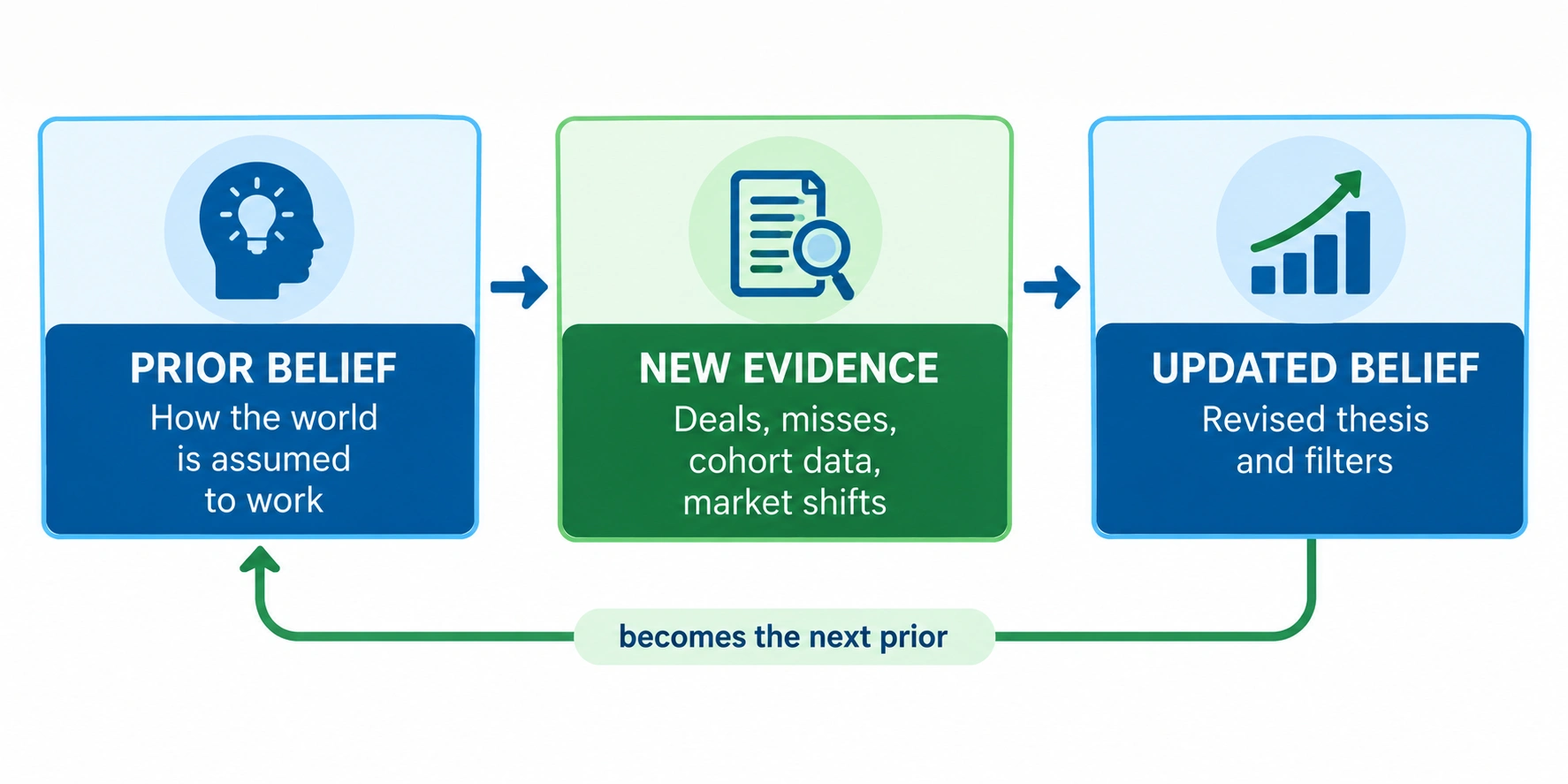
Calibration is the constant updating of expectations in response to feedback loops, because a thesis that never evolves is superstition rather than conviction. Every deal made, missed, or misjudged becomes an input, though not every input deserves equal weight. Investors must guard against narrative traps, the retrospective fictions told to rationalize outcomes. Was a 20x return the product of genius or of timing? Did a missed unicorn reflect flawed analysis or a misaligned risk appetite? Bayesian logic offers a useful frame for this discipline, and the loop below shows how it works.
Counter-Thesis Exploration and Rational Contrarianism
Every strong venture capital thesis should contain the seeds of its own rebuttal. An investor bullish on vertical SaaS must also ask when horizontal platforms could dominate. A preference for solo founders demands an understanding of when co-founder resilience prevails. This internal adversarial process makes the thesis more tested without making it less bold.
Venture thrives on outlier outcomes and rewards belief that arrives before consensus. That belief cannot be blind, which is why the discipline might be called rational contrarianism. The goal is seeing what others miss, not by being oppositional, but by being earlier.
Pattern Recognition, Ethics, and Founder-Market Fit
Pattern recognition is a habit built through repeated exposure to edge cases, failures, pivots, and reinventions. A well-read thesis draws from anthropology, economics, behavioral psychology, and systems design.
Ethics belongs inside the thesis as well, not in a separate policy document. A strategy that seeks scale without sustainability risks becoming a strategy of extraction. Wise investors interrogate how value is shared with customers, employees, and communities, not only how it is created. Momentum achieved through exploitation is not durable; it is entropy in disguise. The thesis must also confront founder-market fit, which comes down to a few questions:
- Do the founders hold an earned insight into the problem space?
- Do they show mission-driven stubbornness balanced by evidence-driven flexibility?
- Can they turn ideas into execution as the company grows more complex?
Testing the Venture Capital Thesis in Community
An investment thesis mirrors the investor’s optimism, fears, and epistemic blind spots. Written in isolation, it risks becoming a closed loop that only confirms itself. A $37M raise across equity and venture debt for a mission-driven education and research institution shows the value of outside pressure. Its investor narrative had to survive the board, the audit committee, and skeptical investors at once, and each challenge exposed weak assumptions.
The thesis is a direction and not a destination, a north star for navigating chaos. It demands rigor without rigidity, belief without blindness, and ambition anchored in ethical clarity. In the spirit of Publius, observing the world means little without understanding the forces that shape it. Build the thesis with care, update it with wisdom, and let it serve the future it dares to finance.
Three Key Takeaways
- A venture capital thesis rests on market, model, and momentum, and the weight of each pillar should shift with the sector. One fixed lens applied to every deal leads to mispriced risk.
- Real momentum shows up in retention, shortening sales cycles, and revenue predictability, while false momentum is usually purchased. Separating the two requires cohort data over headline growth.
- An investment thesis stays useful only when it updates like a Bayesian prior and faces a deliberate counter-thesis. The strongest theses are the ones most willing to change when evidence demands it.
Disclaimer: This article is intended for informational purposes only and does not constitute legal, tax, or accounting advice. You should consult your own tax advisor or counsel for advice tailored to your specific situation.
Hindol Datta is a four-time CFO and senior finance executive with over 25 years of leadership experience across cybersecurity, SaaS, gaming, logistics, digital marketing, medical devices, consumer products, and nonprofit organizations. He has led more than $120M in fundraising and over $150M in M&A transactions while building the financial and operational systems that let complex businesses scale with confidence. He is the author of seven books in the Systems CFO Series and holds active CPA, CMA, and CIA credentials.
AI-assisted insights, supplemented by 25 years of finance leadership experience.