
Executive Summary
Liquidation preferences sit quietly inside preferred stock agreements, yet they decide who gets paid first at exit. In venture capital, a modest 1x liquidation preference offers fair protection. Participation rights, multiples and stacked rounds, however, can redirect most of a moderate exit away from founders and employees.
This article traces how the clause evolved and breaks down its main structures. It models payouts across three exit values using one cap table. It then sets out reforms that protect capital without hollowing out founder incentives. The aim is to help founders, investors and boards judge term sheets by outcomes, not headlines.
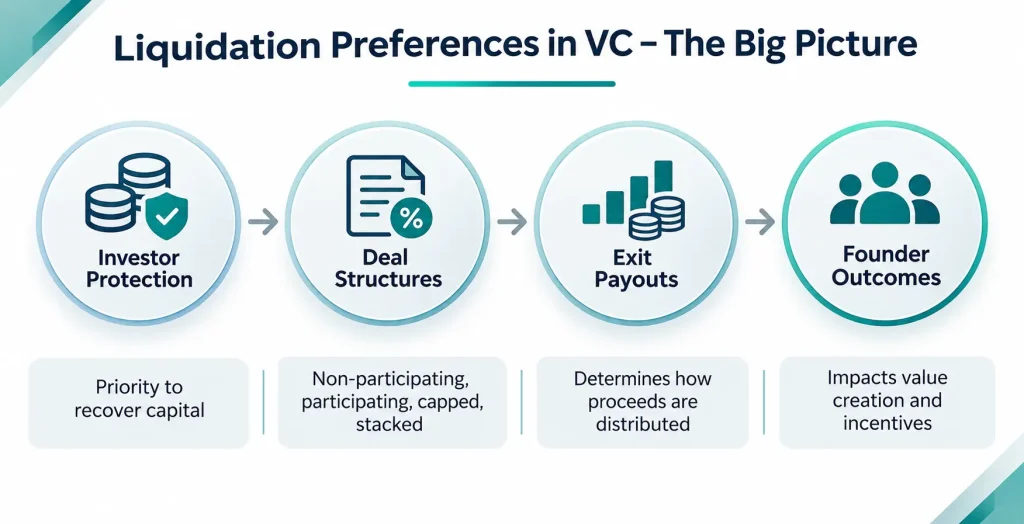
Where Liquidation Preferences Came From
The logic of preference began in private equity and corporate finance, where capital was scarce. In leveraged buyouts and distressed restructurings, preference meant literal priority in bankruptcy court.
Venture capital borrowed the idea as it grew into an institutional asset class. Startups rarely faced immediate insolvency, but most would fail. Founders also knew far more about the business than their investors did. A liquidation preference bridged that gap with a plain bargain: if the company stalls, investors recover capital first.
How the Clause Hardened Over Time
The terms grew more demanding with each market cycle, settling on cap tables like sediment:
- Early venture: 1x non-participating preferred was the norm, with conversion to common in strong outcomes.
- 1990s: participating preferred spread, adding a pro-rata share on top of the preference.
- Early 2000s: stacked preferences emerged, with each new round claiming its own priority.
- Dot-com crash: survival capital arrived with 2x and 3x multiples and uncapped participation.
- 2010s: valuations soared, yet the terms stayed and drifted toward upside extraction.
These liquidation preferences aimed to calibrate risk, not to punish founders. Over time, though, an adaptive tool hardened into default practice. A founder who builds a $100M company beneath $70M of stacked preferences can fairly ask a hard question. Does the work create equity, or does it simply service capital?
Common Liquidation Preference Structures in Venture Capital
Each liquidation preference structure carries its own geometry of risk and reward. Four forms dominate most venture capital term sheets today:
- 1x non-participating: the investor takes its capital back or its as-converted share, whichever is greater.
- 1x participating: the investor takes its capital back, then a pro-rata share of everything left.
- Capped participation: participation stops at a ceiling, often 2x, after which the investor converts.
- Stacked preferences: each round holds its own preference, and later rounds usually sit senior.
What Participation Does to a Moderate Exit
Consider an investor who puts in $5M for 20% of a company that sells for $20M. Under participating terms, the investor takes $5M first and then 20% of the remaining $15M. That totals $8M, or 40% of proceeds on a 20% stake. Under non-participating terms, the same investor would take $5M, since that beats its $4M as-converted share.
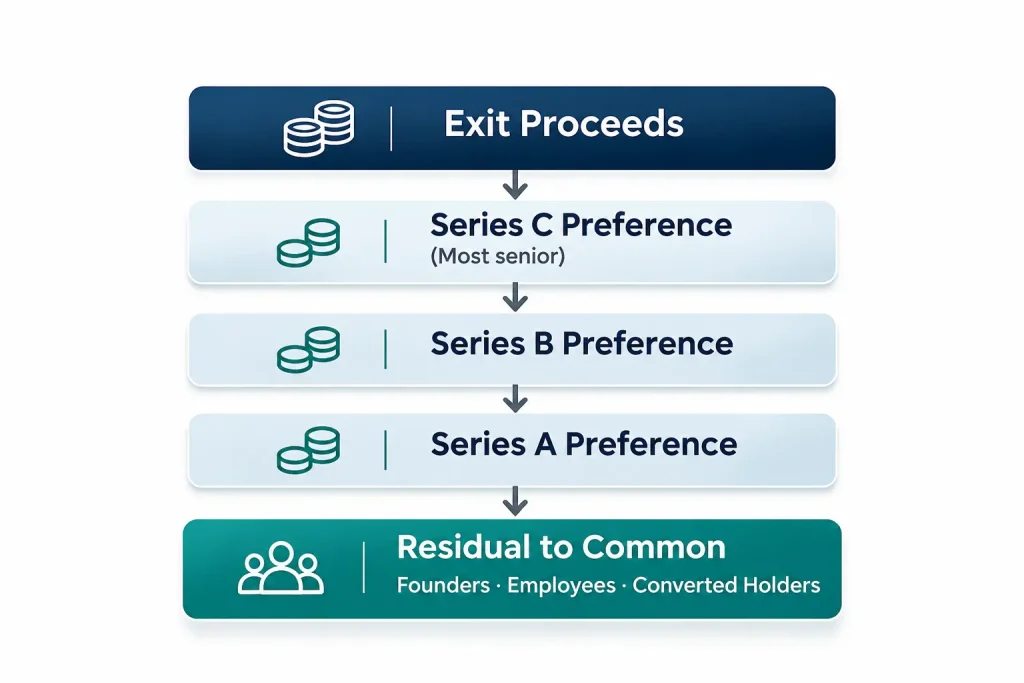
Stacking compounds the effect with every new round. Picture $5M of Series A, $7M of Series B and $8M of Series C, all at 1x. A $40M exit clears the $20M of combined preference with room to spare. A $20M exit pays Series C and B in full and leaves Series A the remainder. Common holders, including founders, receive nothing at all.
How a Stacked Preference Waterfall Flows
Why Terms Matter More Than Valuation for Founders
Founders often negotiate from urgency and chase the headline number, while the terms do the real work. Two similar-looking offers can produce sharply different results at the same $100M exit.
Comparing Two Term Sheets at a $100M Exit
| Term | Term Sheet A | Term Sheet B |
| Investment | $10M | $12M |
| Pre-money valuation | $50M | $60M |
| Preference | 1x non-participating | 1x participating, no cap |
| Investor ownership | 16.67% | 16.67% |
| Investor payout | $16.67M (converts) | $12M + $14.67M = $26.67M |
| Founders and common | $83.33M | $73.33M |
An extra $2M of capital and a $10M higher valuation cost common holders $10M. One venture-backed digital marketing company raised $36.5M across Series A through C while scaling from $9M to $180M in revenue. Its protective habit was modeling every round’s waterfall before signing.
The Down Round Dilemma
Now take a company in its fourth year with product-market fit but uneven growth. Its last round priced the business at $100M with a 1x participating preference. A new investor offers $20M at a $75M pre-money valuation with a 2x non-participating preference. Under those terms, the first $40M of any exit belongs to the new money.
Accepting buys runway but creates a heavy overhang on every future exit. Rejecting the round, however, risks insolvency within six months. The choice feels less like strategy and more like hostage negotiation. Many founders accept terms that preserve survival but drain the economic meaning from their work.
Practical Moves at the Negotiating Table
Founders often hold more leverage than they use, and a few disciplines help apply it:
- Demand waterfall models at $25M, $50M, $100M and $250M exits before signing.
- Negotiate as stewards, explaining that distorting terms lower the odds of any exit.
- Use oversubscribed rounds to remove participation, even at a $5M lower valuation.
- Choose investors who grow the pie instead of securing first claim on it.
- Remember that investors write many checks, while a founder writes one career.
Strong financial data makes each of these moves more credible. During a $20M Series B for a marketplace SaaS platform, cohort and unit economics models anchored investor diligence. Evidence of that quality gives a company real standing to push back on terms.
Modeling the Liquidation Waterfall Across Exit Values
The model below applies one simple cap table to three exits. Series A invested $5M for 20% of the company. Series B invested $15M for 25%, leaving founders the remaining 55%. Each non-participating investor takes its preference or its as-converted share, whichever pays more. Converting holders share whatever remains after senior preferences are settled.
Comparative Payout Table
| Exit Value | Structure | Series A | Series B | Founders |
| $40M | 1x non-participating | $6.67M | $15M | $18.33M |
| $40M | 1x participating | $9M | $20M | $11M |
| $40M | 2x non-participating | $10M | $30M | $0 |
| $80M | 1x non-participating | $16M | $20M | $44M |
| $80M | 1x participating | $17M | $30M | $33M |
| $80M | 2x non-participating | $13.33M | $30M | $36.67M |
| $160M | 1x non-participating | $32M | $40M | $88M |
| $160M | 1x participating | $33M | $50M | $77M |
| $160M | 2x non-participating | $32M | $40M | $88M |
What the Numbers Reveal
The table exposes patterns that a term sheet alone conceals:
- Participation costs founders $7.33M at a $40M exit and still $11M at $160M.
- The 2x multiple leaves founders with nothing at $40M, double the $20M raised.
- An investor converts once ownership times exit value exceeds its multiple times investment.
- Preferences distort the value of every dollar above the floor, so dilution becomes nonlinear.
The crossover rule shows the stakes for Series B. At 1x, conversion begins once 25% of the exit exceeds $15M, above a $60M sale. At 2x, that conversion threshold doubles to a $120M sale. Across that wide band of realistic offers, Series B and the founders want different outcomes.
Reforming Liquidation Preferences for Fairness Under Pressure
Sound reform starts from one axiom: no preference structure should undermine the chance of a rational exit. Founders who expect nothing below a fantastical threshold will delay or decline reasonable bids. At that point, the waterfall becomes a dam that stalls value instead of storing it.
Signed terms cannot be erased, but they can be renegotiated. Five design ideas make that renegotiation more productive:
- Sunset clauses: participating preferences revert to non-participating if no exit occurs within five years.
- Conversion incentives: preferred stock converts automatically when an exit exceeds 3x the original post-money.
- Founder performance triggers: 50% revenue CAGR over three years, or early break-even, downgrades preferences.
- Capping the stack: total preference stays below 1.5x current valuation unless common holders unanimously agree.
- Board balance: founder-appointed or independent directors match each preferred seat on the board.
Governance deserves special attention, because liquidation preferences get weaponized in acquisition votes more often than at signing. One mission-driven education and research institution raised $37M across equity and venture debt. Managing its board and audit committee relationships showed how capital structure decisions keep getting tested long after closing.
Liquidation Preferences and the Spirit of Partnership
Liquidation preferences are neither virtuous nor villainous on their own. Used with restraint, a preference works as trust insurance. Used without limits, it becomes an equity time bomb that reshapes incentives for years.
Founders should learn the math and treat every clause as part of their economic identity. Valuation is temporary, while terms tend to last. Investors earn their best returns from relationships that create upside, not from clauses that extract protection. Boards should recognize that misaligned incentives are rarely accidents but the result of upstream design.
Three Key Takeaways
- Judge any term sheet by modeling its liquidation waterfall at several exit values. A higher valuation with participation can leave founders worse off than a lower, cleaner offer.
- Participation and multiples bite hardest in moderate exits, which are the most common outcomes. The crossover points where investors convert deserve as much scrutiny as the valuation.
- Sunset clauses, conversion triggers, stack caps and balanced boards keep downside protection while preserving the founder incentives that create value.
Disclaimer: This article is intended for informational purposes only and does not constitute legal, tax, or accounting advice. You should consult your own tax advisor or counsel for advice tailored to your specific situation.
Hindol Datta is a four-time CFO and senior finance executive with over 25 years of leadership experience across cybersecurity, SaaS, gaming, logistics, digital marketing, medical devices, consumer products, and nonprofit organizations. He has led more than $120M in fundraising and over $150M in M&A transactions while building the financial and operational systems that let complex businesses scale with confidence. He is the author of seven books in the Systems CFO Series and holds active CPA, CMA, and CIA credentials.
AI-assisted insights, supplemented by 25 years of finance leadership experience.