Executive Summary
Founders who ask how to reduce customer churn are often asking whether their product keeps its promise. New logos are easy to count and easy to celebrate, while departing customers slip away with little noise. Each quiet exit, however, is a verdict on the gap between the value a company promised and the value it delivered.
This article treats churn as a systemic signal, not a nuisance metric. It defines the measures that matter and sets out seven drivers of customer churn. It then explains how to engineer customer retention as a cross-functional growth strategy. The goal is a business that customers refuse to leave and a growth story that investors trust.
Understanding Customer Churn Before Trying to Fix It
Growth-stage companies feel a constant pull toward acquisition, because a full pipeline looks like progress on every board slide. Any company hoping to reduce customer churn must first accept that a leaking customer base cannot be outsold for long.
The Churn Metrics That Matter
Churn is the percentage of customers or revenue lost over a defined period. The calculation can follow customer counts or dollars, and each view answers a different question:
- Logo churn measures the share of customers who cancel in a period.
- Revenue churn measures the share of recurring revenue lost, which weights large accounts properly.
- Gross churn captures pure loss from cancellations and downgrades, with no offsets.
- Net churn nets those losses against upsell and expansion from the same customers.
- Net Revenue Retention (NRR) tracks how a cohort’s revenue shrinks or grows over time.
Definitions alone do not produce judgment, so every churn rate needs context. Early-stage startups with evolving products may see high churn as customers experiment and move on. Mature SaaS companies with high switching costs should worry about even low single-digit churn. Trajectory matters more than any benchmark, so the useful questions are simple ones. Is churn slowing as product-market fit sharpens, and is each new cohort retaining better than the last?
Every Churned Customer Tells a Story
Behind each cancellation sits a narrative worth recovering. The product may have missed its promised value, or onboarding may have been rushed and support indifferent. Pricing may have drifted out of line with usage, or market forces beyond the company’s control may have intervened. Until a team investigates these stories and surfaces the patterns, churn stays opaque and therefore irreversible.
Cohort and unit economics models are the most reliable way to recover these stories at scale. They show which customer groups stay and which fade over time. They also show where efforts to reduce customer churn should focus before the next funding round.
Seven Drivers to Address When Learning How to Reduce Customer Churn
Any serious plan to reduce customer churn starts with the forces that create it. The seven drivers below rarely act alone, and most churned accounts show traces of two or three at once.
Seven Churn Drivers and Their Retention Levers
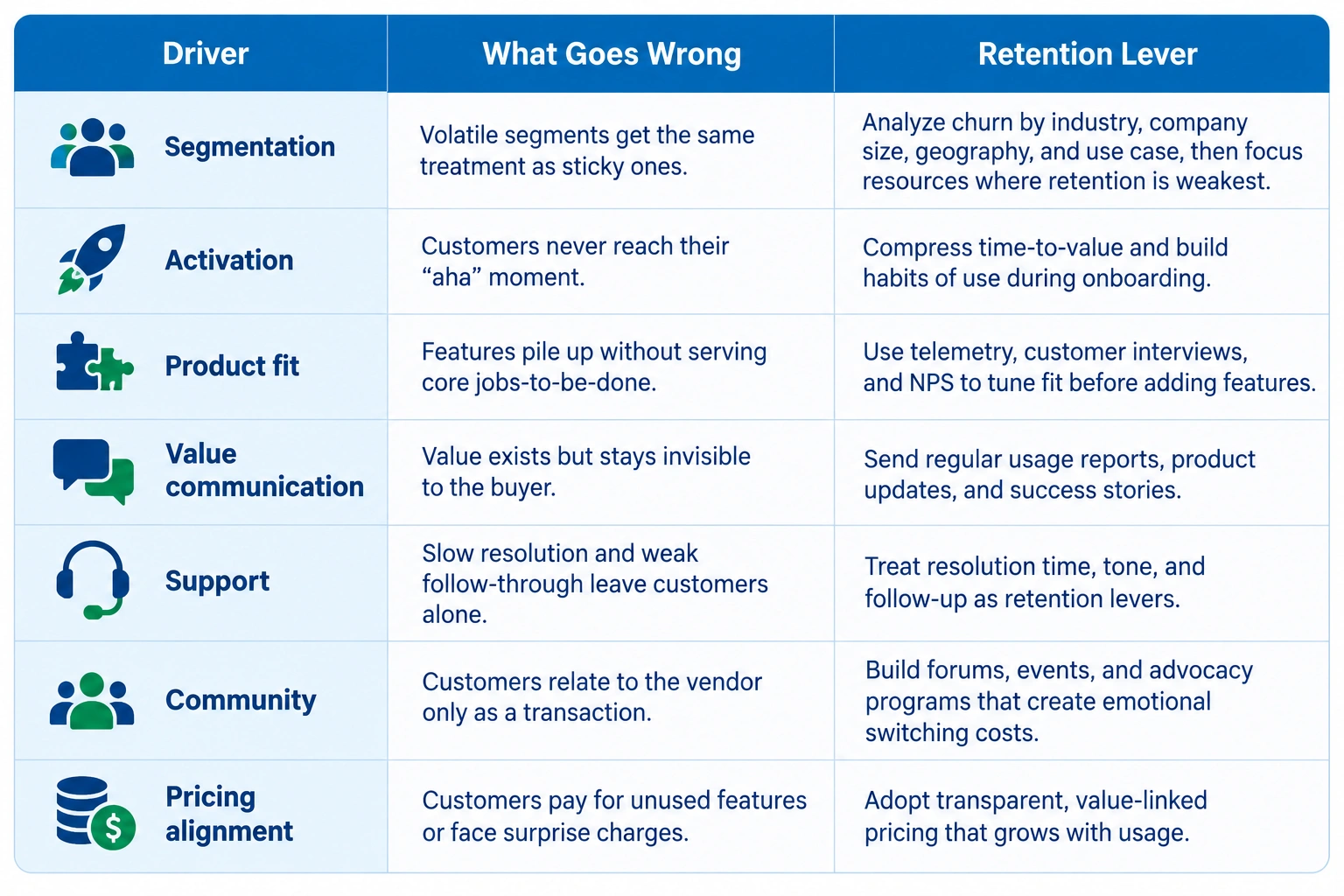
Most churn is decided in the first weeks of a relationship, so activation deserves early attention. Onboarding is both a product experience and a relational one. Value communication matters for a related reason, since customers often leave when value stays invisible. Retention depends partly on reminding customers what they gained.
Pricing deserves a final word, since misaligned pricing breeds silent resentment. Customers who pay for unused features rarely complain loudly before they cancel. They simply stop renewing, and the account disappears from the forecast with little warning.
Taken together, these drivers show that churn is the sum of systemic misalignments. To reduce customer churn, a company must investigate those misalignments with rigor, empathy, and relentless iteration.
Engineering Customer Retention as a Growth Strategy
If churn reflects dissonance between expectation and experience, retention is the result of deliberate design. Moving from diagnosis to prescription means building retention into the company as a proactive engine of growth.
Make Retention Cross-Functional
Customer success cannot carry retention alone, because every function shapes the customer experience. Product drives retention through utility and engineering through reliability. Marketing contributes through narrative continuity, and finance contributes through clean, transparent billing. Retention works like an orchestra, and the company must act as its conductor.
Start With Cohort Data
Cohort analysis reveals the shape of retention over time and turns vague concern into forensic diagnosis. Strong churn diagnostics usually answer three practical questions:
- Which acquisition channels produce the stickiest customers?
- Do certain pricing plans correlate with lower churn?
- Which features predict long customer lifetimes?
Retention data is also forecasting data, which gives finance a direct stake in the analysis. A driver-based forecast can only stay close to actuals when the team knows which customers will renew and why. Without that knowledge, every revenue projection rests on assumptions the business cannot defend.
Build a Retention Roadmap
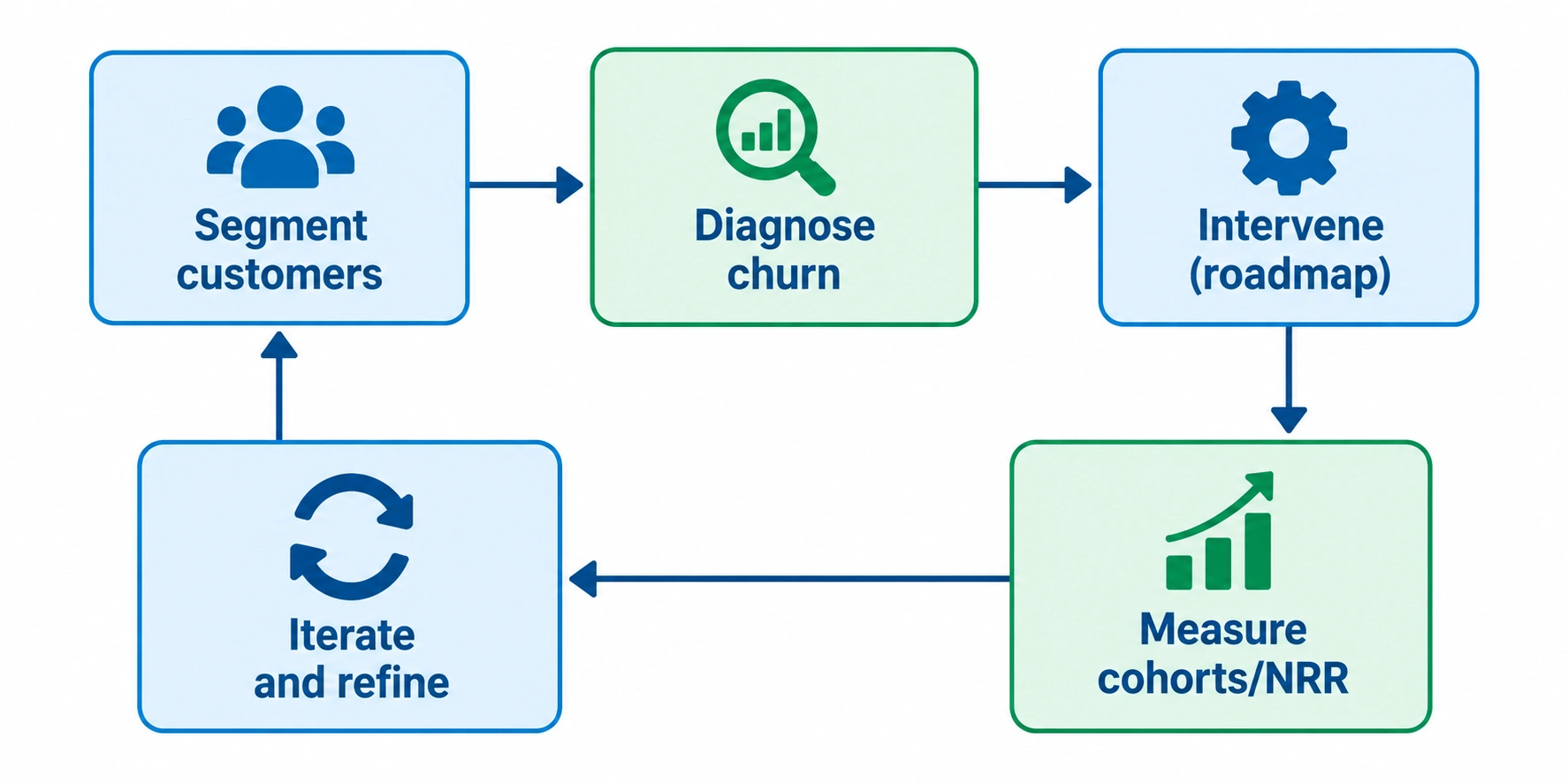
A retention roadmap sequences interventions instead of listing tasks. Quick wins such as better onboarding or sharper in-app messaging can run alongside longer initiatives. Reworking core workflows or launching a customer community belongs in that longer horizon, and the cycle below shows how each step feeds the next.
Invest in Proactive Customer Success
Proactive customer success relies on predictive health scoring, periodic check-ins, goal tracking, and early escalation. A customer success manager should know an account is drifting long before a cancellation notice arrives. When teams work this way, customer success becomes revenue-positive instead of a cost center.
Experiment, Listen, and Give Customers a Voice
Retention is a moving target, so the work never ends with a single fix. Three habits keep the effort to reduce customer churn moving forward:
- Run hypothesis-driven experiments, such as A/B tests on onboarding sequences, new engagement cadences, or loyalty programs, and measure each outcome.
- Act on the feedback already in hand, from NPS surveys to feature requests and support tickets, instead of archiving it.
- Invite customers into product evolution through advisory boards, reference programs, and beta cohorts, since collaborators rarely leave.
Align Metrics and Incentives with Retention
Teams must track gross churn and also understand what drives it. Retention should become a shared KPI that shows up in bonuses, OKRs, and dashboards across the company. What gets measured gets managed, and what gets rewarded gets repeated.
Why Reducing Customer Churn Strengthens the Investor Narrative
Investors may admire topline growth, but durable growth is what persuades them. A founder who shows rising NRR, stabilizing cohorts, and falling voluntary churn signals operational depth.
The economics explain why retention is the new acquisition. Keeping a customer costs less than winning one, and each saved account preserves future revenue. Each prevented cancellation also spreads customer acquisition cost over a longer lifetime. Companies that pair rapid growth with CAC, LTV, and contribution margin discipline tend to sustain that growth far longer. Acquisition alone rarely carries a business through its later stages.
Loyal customers also become advocates who widen the network that brings in new ones. Founders should treat retention as a muscle to strengthen. Boards, in turn, should ask about logos kept as often as logos won, because continuity compounds and retention wins the long game.
Three Key Takeaways
- Learning how to reduce customer churn starts with treating each cancellation as evidence of misalignment. Segment churn and track cohort trajectory before reaching for fixes.
- Customer retention is a cross-functional discipline that product, engineering, marketing, finance, and customer success share. Make it a common KPI tied to incentives, and back it with a sequenced retention roadmap.
- Companies that reduce customer churn extend the payback on every dollar of CAC, because retention costs less and compounds. Strong net revenue retention also gives investors the clearest proof of durable, capital-efficient growth.
Disclaimer: This article is intended for informational purposes only and does not constitute legal, tax, or accounting advice. You should consult your own tax advisor or counsel for advice tailored to your specific situation.
Hindol Datta is a four-time CFO and senior finance executive with over 25 years of leadership experience across cybersecurity, SaaS, gaming, logistics, digital marketing, medical devices, consumer products, and nonprofit organizations. He has led more than $120M in fundraising and over $150M in M&A transactions while building the financial and operational systems that let complex businesses scale with confidence. He is the author of seven books in the Systems CFO Series and holds active CPA, CMA, and CIA credentials.
AI-assisted insights, supplemented by 25 years of finance leadership experience.