
Executive Summary
Technical due diligence tests whether a company understands its own systems before investors probe them. Startups that run this review internally, well ahead of a raise, control the narrative and reduce the uncertainty discount investors apply to unknowns.
This article covers why internal diligence matters, which artifacts make a system explain itself, and how incentives shape candor. It closes with the concrete leverage that preparation creates in valuation, terms, and post-investment trust.
Why Technical Due Diligence Must Start Internally
The moment a venture capitalist signals intent, the time for preparation has already passed. Every architectural shortcut and undocumented dependency will soon surface under scrutiny. Capital tends to flow to the coherent, not merely the competent. A strong stack and a pedigreed team still raise doubts when knowledge sits in silos or answers sound evasive.
Too often, internal answers are statements of faith instead of findings of fact. Claims like “the system scales well under load” fracture quickly under third-party review. Founders should adopt a Bayesian stance toward their own assumptions, asking what evidence would force a revision. Internal technical due diligence turns the team into its own skeptical investor.
How Investors Read a Technical Stack
A typical VC technical due diligence process looks linear: code review, architecture evaluation, scalability assessment, and security audit. In practice, it works as an exercise in inference. Seasoned reviewers triangulate between architecture diagrams, Jira boards, Git histories, and incident logs. They look for coherence across every part of the system.
Perceived risk often exceeds actual risk, because founders optimize for performance instead of intelligibility. A slightly suboptimal but well-instrumented system earns more confidence than an elegant black box. The same principle shows up in buy-side work on an IT services acquisition, where quality-of-earnings analysis exposed gaps between reported earnings and economic reality. In technical due diligence, investors discount whatever they cannot trace.
Running a Red-Team Diligence Exercise
Companies should simulate full technical due diligence at least 12 months before a formal raise. The internal team should include the CTO, the head of infrastructure, a product architect, and a trusted external auditor. That group pretends to know nothing and asks to see everything. The exercise should produce a technical risk map with clear answers to three questions:
- Which monoliths impede agility?
- Which data models rest on untested assumptions?
- Which modules depend on a single engineer who alone understands them?
Consider a Series B company building vertical AI for legal contracts. Its red-team review found that model retraining produced slightly different outcomes depending on feature ingestion order. No user had noticed, yet a probing investor would have read it as negligence. The team re-architected the pipeline and disclosed the flaw in the diligence deck, and investors leaned in.
An earlier-stage platform company faced a similar choice over a custom container orchestration layer. Leadership chose to replatform at considerable cost before its first institutional raise. That decision turned a defensive pitch into a declarative one, showing a team able to correct itself.
The Architecture of Inquiry Behind Technical Due Diligence
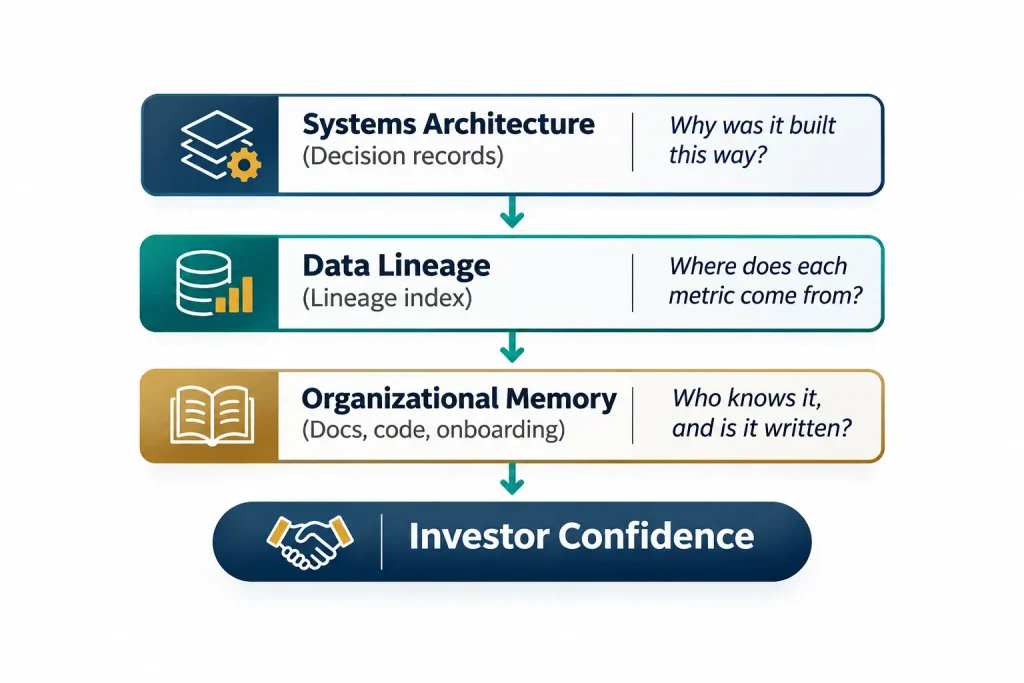
Operations teams judge systems by throughput, uptime, and latency. Due diligence judges them by causality: what explains these metrics, what constrains them, and what breaks under new load. Companies therefore need a stack of explanations spanning three layers.
Architectural Decision Records
Most codebases grow through accretion, with features layered on MVP-era hacks that only their authors can read. Architectural decision records reverse that entropy in less than a page each. Every significant choice, from database engines to authentication protocols, should answer three questions. What were the options, what were the trade-offs, and why did the team choose this path? Missing records should be written, and outdated ones annotated.
Building a Data Lineage Index
Data lineage traces a data point from origin to action, and most technical due diligence efforts stumble here. The fix is a conceptual map, updated quarterly, that traces how each core business metric gets built.
Sample Data Lineage Index
| Metric | Source Tables | Transformation Scripts | Dependencies | Owning Team | Last Audit |
| LTV | Billing, usage | Cohort model | CRM sync | Finance | Q2 |
| CAC | Marketing spend, CRM | Attribution logic | Ad platform APIs | RevOps | Q2 |
| Churn rate | Subscriptions | Retention script | Billing events | Data | Q1 |
This index uncovers silent metric drift, reveals single points of knowledge, and proves the team earns its metrics instead of guessing them. A marketplace SaaS company raising a $20M Series B relied on cohort and unit economics models built with this discipline. Those models withstood investor scrutiny because every number traced to a source.
Preserving Organizational Memory
Engineers leave, roadmaps shift, and context disappears unless someone writes it down, so three practices matter:
- Living documentation, with a single source of explanation for each system and a rotating quarterly steward
- Annotated code that explains intent, so a single comment can prevent a week of forensic analysis
- Structured onboarding, where a new engineer can deploy, trace a request, and roll back within two weeks
That onboarding test matters in technical due diligence because a VC associate combing through documentation is also onboarding. What that associate learns, or fails to learn, shapes valuation. In competitive rounds with tight timelines, clear technical documentation tilts the playing field. The CFO becomes the architect of legibility, building maps of reliability alongside dashboards of revenue.
Incentives, Silos, and the Politics of Technical Disclosure
The greatest risk in any diligence process is human complexity, not code complexity. Most system failures in diligence begin as communication failures. Engineers earn praise for shipping velocity, and product leaders for roadmap delivery. Even CTOs may rationalize shortcuts as temporary debt, so omission becomes a rational act.
One devtools startup described its microservices as “fully decoupled” in every pitch deck and board update. Internal diligence found hidden inter-service dependencies, retry loops without circuit breakers, and shared stateful caches. Engineers had known for months, yet earlier attempts to raise issues had met instructions to “optimize for speed,” so silence became learned behavior.
Creating Safety for Candor
Credible technical due diligence requires a zone of safety where engineers earn credit for revealing architectural debt. A closed-door “Truth Sprint” before each raise asks senior engineers for doubts instead of roadmaps:
- Which parts of the system worry the team most?
- Which edge cases survive on luck?
- Which assumptions have never been tested at scale?
- Which metrics look clean only because a denominator changed?
In one session, a backend engineer admitted that a pipeline feeding both dashboards and billing ran on a copied cron script. It had worked for 18 months without question. Surfaced internally, it became a solvable risk instead of a sign of amateurism.
Aligning Incentives Around Disclosure
A quarterly Technical Risk Disclosure Bonus rewards engineers who surface weaknesses, undocumented dependencies, or future bottlenecks. CTO and product OKRs should include documentation completeness, postmortem integrity, and debt remediation. Finance leaders should attend quarterly architecture reviews, and senior engineers should review operating plans. A cybersecurity SaaS company that paired ASC 606 controls with board-grade reporting carried that shared language through acquisition diligence. By contrast, a pristine documentation site built two weeks before a raise, with sanitized Git histories, turns technical due diligence into theatre and fools no one.
How Technical Due Diligence Shapes Valuation and Terms
Investors begin with uncertainty about technology, team, and trajectory, and risk is the most negotiable variable on a term sheet. Clean decision records, lineage indices, and audit histories from technical due diligence let investors update from structured signal. In one Series B negotiation, a partner remarked that the team had saved the fund a month of work. An IPO-readiness process at a publicly listed gaming company, run with underwriters and Big Four auditors, rewarded the same preparation.
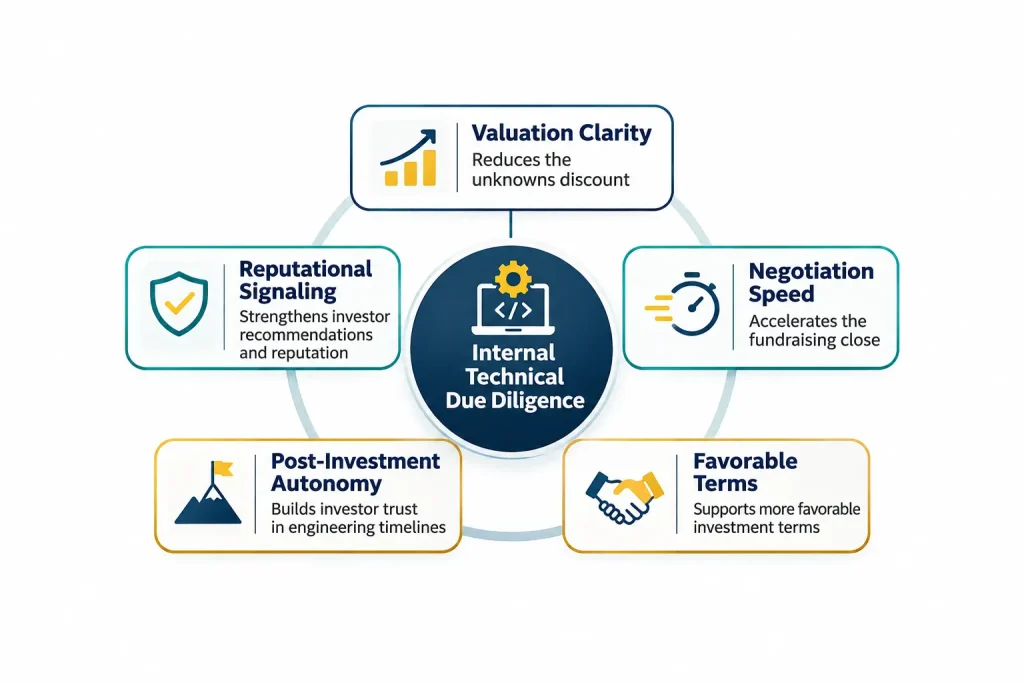
Five Forms of Leverage from Internal Diligence
| Leverage | How It Works |
| Valuation clarity | Surfaced and remediated risk shrinks the unknowns discount, potentially lifting multiples by 10% to 15% |
| Negotiation speed | Ready artifacts arrive in days, accelerating close in competitive rounds |
| Favorable terms | Fewer unknowns can secure a light-touch board seat, reduced liquidation preference, or secondary optionality |
| Post-investment autonomy | Confident investors trust engineering timelines and treat slips as normal variance |
| Reputational signaling | Investors remember well-run processes and recommend those companies to peers |
Nobody can fake this advantage, because investors detect over-polished answers quickly. Authentic clarity discloses technical debt with context and frames decisions as reasoned bets under constraint. Companies that build self-explaining systems also gain optionality for new markets, acquisitions, and pivots.
The cost of skipping this work shows up after close. A company that raised on charisma and a strong demo soon revealed misaligned metrics and flaky infrastructure. Investors tightened oversight, and the team lost room to maneuver. The most expensive capital is the capital that arrives amid confusion.
Three Key Takeaways
- Technical due diligence works best as an internal discipline started 12 months before a raise, so investors confirm an understanding the team already holds.
- Decision records, a data lineage index, and living documentation turn a complex stack into a system that explains itself under pressure.
- Candor depends on incentives, and companies that reward disclosure earn valuation clarity, faster closes, better terms, and lasting investor trust.
Disclaimer: This article is intended for informational purposes only and does not constitute legal, tax, or accounting advice. You should consult your own tax advisor or counsel for advice tailored to your specific situation.
Hindol Datta is a four-time CFO and senior finance executive with over 25 years of leadership experience across cybersecurity, SaaS, gaming, logistics, digital marketing, medical devices, consumer products, and nonprofit organizations. He has led more than $120M in fundraising and over $150M in M&A transactions while building the financial and operational systems that let complex businesses scale with confidence. He is the author of seven books in the Systems CFO Series and holds active CPA, CMA, and CIA credentials.
AI-assisted insights, supplemented by 25 years of finance leadership experience.