
Executive Summary
Reference customers often carry more weight in venture capital diligence than any pitch deck, model, or demo. One candid call can accelerate a round, raise a valuation, or quietly end a deal.
This article explains why reference calls shift investor belief and what makes a reference powerful. It also shows how startups can build systems that produce credible advocates, and how those advocates change valuation, allocation, and life after close.
Why Reference Customers Carry So Much Weight with Investors
Venture capital speaks the language of ARR, CAC, retention curves, and payback periods. Beneath that fluency, every investment remains an act of belief made with limited data. The most potent input is often the voice that confirms the model, and that voice usually belongs to a reference customer.
Too many startups treat reference customers as afterthoughts, leaving their strongest evidence to unscripted intermediaries. A reference call tests whether the company can sell, support, and evolve. It also reveals whether pitch deck promises match the experience on the ground, which makes it a form of meta-diligence.
The Paradox of External Testimony
No reference customer is a neutral observer of the company. Some negotiated favorable terms, and others feel loyal to a sales rep instead of the platform. Investors still treat their testimony as gospel because it comes from outside the company. A CFO may spend three weeks on a cohort analysis, yet one remark like “we could not live without it” can outweigh it.
Reference value also varies by market, buyer title, geography, and strategic adjacency. A Tier 1 data infrastructure logo, for instance, outweighs a regional retail deployment. Leadership teams carry three responsibilities in this dynamic:
- Curate references that are credible, articulate, and representative, not just happy
- Understand what investors will ask, infer, and translate into their models
- Build an operating engine where referenceability becomes a design principle
Ethics matter here as much as tactics, because a coached customer sounds coached. Valuations built on real signals endure, while those built on theatrical references collapse.
The Reference Call as a Bayesian Update
Every investor starts with priors about the market, team, and stage. A reference call feels external, independent, and embedded in real use, so it moves those priors sharply. One strong call can shift an investor from tentative interest to conviction.
Consider a firm evaluating contract analysis software for mid-sized law firms, doubtful that lawyers will adopt new tools. A managing partner then reports using it on every intake, replacing two paralegal roles, and recommending it to three peers. That single comment updates adoption, velocity, virality, and economic impact at once.
A strong call works like a micro case study, revealing procurement paths, onboarding friction, and switching costs. Negative evidence from reference customers weighs even more heavily in the investor’s mind. When a customer says “it is early” or mentions slow support, deals often stall without any real flaw.
These calls also reinterpret the numbers a startup presents. A clean cohort chart loses weight if a customer hints at churn. Light usage gains credibility when the customer describes expanding use cases. Investors also listen for cues, such as whether the customer knows the founders by name.
The Anatomy of High-Leverage Reference Customers
Only a few customers can influence valuation with a single sentence. Startups must cultivate these voices across quarters and support tickets, long before an investor asks for names. Four attributes define high-leverage reference customers, and each one compounds the others.
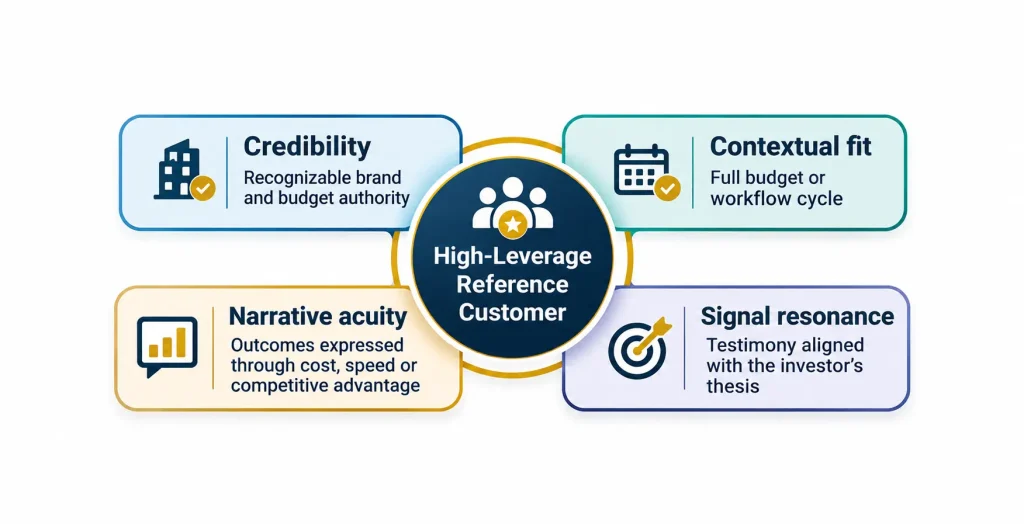
The Reference Maturity Model
| Attribute | What Investors Look For | Signal That Lands |
| Credibility | Recognizable brand, ideal customer profile, VP-level budget authority, fluent speaker | A Fortune 500 CISO confirming expansion plans |
| Contextual fit | At least one full budget or workflow cycle, experience of both value and limits, renewal or upsell | A customer who renewed, expanded, and integrated deeply |
| Narrative acuity | Outcomes framed as cost, speed, or competitive advantage | “We automated 80% of manual reconciliation” |
| Signal resonance | Testimony that confirms the investor’s thesis for why the company wins | Cross-department growth for a usage-based expansion thesis |
Narrative acuity is the dimension founders most often underestimate. One enterprise AI client described the system as “like adding a quant to every team without hiring one.” That line appeared in four pitch decks, and the investor later credited it above the demo.
Signal resonance can also cut against a deal when testimony conflicts with the thesis. A reference who mentions a nine-month implementation undermines a rapid-deployment story, even when satisfied. Preparation therefore means context, not a script, and a short pre-call briefing can cover three points:
- The themes the investor will likely explore, such as implementation, ROI, and support
- The parts of the relationship that proved most valuable or differentiated
- The investor’s stage focus and portfolio context
Designing Startups for Referenceability
At scale, reference customers must become a repeatable outcome of how the company operates. Referenceability signals executional integrity and a culture that treats customer value as the currency of growth. Four connected systems produce it, as the flow below shows.
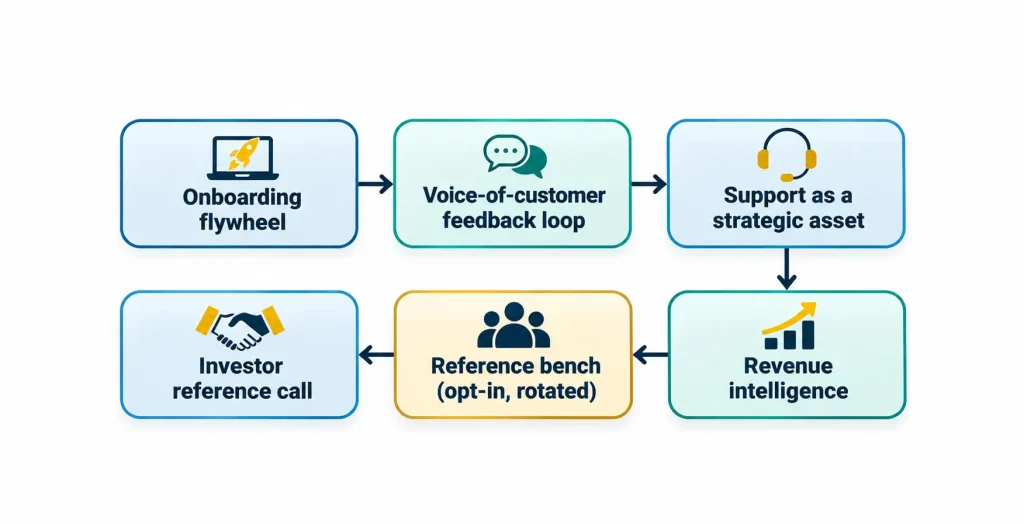
The Onboarding Flywheel
Every day between signature and first value erodes advocacy potential. Sales must set accurate expectations, product must work out of the box, and customer success must deliver early insight. Milestone-based onboarding aligns everyone on outcomes instead of activities. Early outcomes then create the emotional equity that seeds referenceability.
The Voice-of-Customer Feedback Loop
Advocates grow out of ongoing dialogue with the company, not silence. Effective programs combine quarterly customer councils, post-implementation retrospectives, and fast-path flags for significant praise or concern. Every signal deserves acknowledgment, even when it does not change the roadmap. Customers who see their input reflected develop a stake in the company’s success.
Support as a Strategic Asset
Investors ask customers what happened when things broke, because every system eventually fails. Strong teams staff support for insight resolution and track NPS and Customer Effort Score trends. Unresolved ticket surges flag reference risk, while repeated praise flags spotlight candidates. Engagement-level analytics at a professional services firm with five business units exposed hidden margin leaks. Support data exposes advocacy leaks in the same way.
Revenue Intelligence and the Reference Bench
CRM and customer success platforms should tag referenceable health scores, expansion milestones, and advocacy behaviors. The company can then maintain an opt-in reference bench segmented by industry, use case, deal size, and region. Teams should rotate these customers to prevent burnout and track which references influenced outcomes.
Many CFOs know CAC to the penny yet have no visibility into the cost of advocacy. A venture-backed digital marketing company that raised $36.5M across three rounds built rigorous CAC, LTV, and contribution margin discipline. Programs for reference customers deserve the same rigor as any KPI.
How Reference Customers Move Valuation and Deal Terms
Venture pricing reflects belief density within a compressed timeline, and reference customers accelerate that belief. In one cybersecurity deal, a Fortune 50 CISO’s reference cut expected diligence from three weeks to four days. The CISO called it the first product that required pushing the team to deploy faster. In competitive rounds, one investor leaning in pressures others to match tempo.
Reference Power and the Valuation Premium
Strong references reduce perceived risk around churn and expansion, and lower risk feeds directly into price. In another round, a Fortune 100 CISO’s unprompted mention of expansion plans moved valuation by 15%.
How a Reference Call Shifts the Investor’s Model
| Scenario | Discount Rate | Effect on Value |
| Without reference confidence | 25%, reflecting retention uncertainty | Baseline present value |
| With a strong, verified reference call | 18% | Present value of projected revenue rises, often by 10% to 20% |
Nothing about the company changes in this scenario except the investor’s belief. Reference management therefore belongs to capital formation, not sales. A cybersecurity SaaS company that held actuals within plus or minus 5% of forecast for 8 quarters earned credibility through numbers. Reference calls add the external voice that numbers alone cannot supply.
Allocation and Post-Close Dynamics
When interest exceeds supply, a broad, brand-aligned reference base becomes a scarcity signal. Partners can show traction with customers who resemble past winners, and allocation follows. After close, strong references earn operational runway for the team. Cagey references trigger frequent check-ins, granular reporting, and closer scrutiny of churn and NPS.
CFOs should maintain a reference allocation map, updated quarterly and tied to capital planning. Four factors decide where each customer sits on that map:
- Strategic relevance to investors
- Narrative fluency
- Timing within the renewal or expansion cycle
- Willingness and readiness to advocate
Teams should also record whether each call moved the term sheet, shortened diligence, or raised the price band. Over time, this capital CRM shows which reference customers move markets and under what conditions.
Three Key Takeaways
- Reference customers act as high-weight evidence in investor decisions, so one credible call can move diligence speed, risk premiums, and valuation more than additional metrics.
- The strongest references combine credibility, contextual maturity, narrative acuity, and thesis alignment, and they deserve context before calls, never scripts.
- Startups that design onboarding, feedback, support, and revenue intelligence around referenceability turn advocacy into a measurable capital asset.
Disclaimer: This article is intended for informational purposes only and does not constitute legal, tax, or accounting advice. You should consult your own tax advisor or counsel for advice tailored to your specific situation.
Hindol Datta is a four-time CFO and senior finance executive with over 25 years of leadership experience across cybersecurity, SaaS, gaming, logistics, digital marketing, medical devices, consumer products, and nonprofit organizations. He has led more than $120M in fundraising and over $150M in M&A transactions while building the financial and operational systems that let complex businesses scale with confidence. He is the author of seven books in the Systems CFO Series and holds active CPA, CMA, and CIA credentials.
AI-assisted insights, supplemented by 25 years of finance leadership experience.