
Executive Summary
A startup revenue model tells investors far more than how a company makes money. It signals scalability, defensibility, capital efficiency and whether returns can arrive within a fund’s life. Venture capital places conviction under constraints, so the models it backs must promise exponential upside while answering hard questions about risk and time.
This article examines which revenue models for startups earn venture conviction, how founders should design and communicate them, and what makes revenue durable enough to sustain investor belief. It closes with the metrics, operating disciplines and governance that turn early traction into institutional revenue maturity.
Why the Startup Revenue Model Shapes the Venture Narrative
In venture capital, revenue works less like a metric and more like a story about the future. Every startup revenue model rests on three connected dynamics, and investors read them as a chain that ends in conviction or doubt.
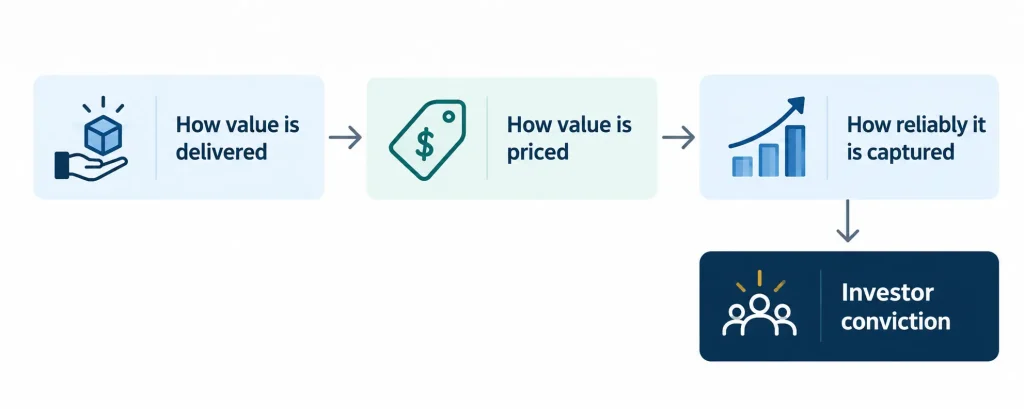
Investors do not favor certain models out of prejudice; portfolio math drives the preference. A fund needs companies that can return 10x or more within its life, and that requirement shapes how revenue must behave from the earliest stage.
Subscription, Marketplace and Usage-Based Models
The subscription model, especially in B2B SaaS, remains the canonical favorite because it is predictable, renewable and expandable. Annual contracts dampen churn volatility, and net revenue retention (NRR) above 120% signals product stickiness alongside account growth. Subscription revenue also lends itself to cohort analysis, benchmarking and capital forecasting, which are the tools investors use to underwrite conviction.
Marketplaces earn similar respect when take rates stay consistent, buyers and sellers keep returning and liquidity runs deep. The best marketplace becomes infrastructure, not a simple venue for transactions. At that point gross merchandise value turns predictable, the take rate becomes defensible and revenue begins to resemble SaaS in its stability. During one marketplace SaaS company’s $20M Series B, cohort and unit economics models spanning US and Polish operations anchored investor diligence and held up under scrutiny.
Usage-based and consumption pricing now shapes much of infrastructure software, developer tools and API-driven businesses. These models can look volatile early, yet they scale gracefully when usage tracks customer value. Investors like the margin profile because costs often stay flat while usage climbs.
Other Revenue Models for Startups and Their Caveats
Other revenue models for startups have their place, but each must clear a specific bar before investors take it seriously:
- Licensing: defensible when tied to proprietary intellectual property.
- Transactional: must demonstrate purchase frequency, not one-time spikes.
- Freemium-to-premium: must show strong conversion and durable retention.
- Advertising: must reach scale and offer depth across audience segments.
The model must also match the market it serves. Forcing a SaaS model onto a transactional use case distorts both pricing and retention. Investors look for coherence, meaning a revenue model that feels inevitable given the customer, the product and the market dynamic.
Designing a Startup Revenue Model That Investors Trust
A well-structured startup revenue model is a strategic decision embedded in product, pricing and positioning, not a byproduct of a spreadsheet. It shapes user behavior, sets capital needs and colors investor perception. Ten principles separate models that earn conviction from those that stall in diligence.
Ten Principles for Communicating Revenue with Strategic Clarity
| Principle | What Investors Look For |
| Align with user value | Pricing that scales with customer outcomes, such as API calls or storage |
| Keep it simple | Revenue logic that fits on one slide and speeds go-to-market |
| Test pricing early | Tiers validated with early adopters on perceived value, not volume alone |
| Scale at low marginal cost | Automation, templates and product-led growth instead of custom servicing |
| Narrate the metrics | Strong LTV/CAC, short CAC payback, healthy gross margin and low churn |
| Build defensibility | Network effects, proprietary data, switching costs or regulatory barriers |
| Show adaptability | An instrumented, learning-driven team that pivots on signal |
| Plan for timing | Subscription or milestone payments that cover cash gaps in long sales cycles |
| Align with capital strategy | Metrics that support the next funding round on schedule |
| Connect to vision | Pricing tied to purpose and growth tied to grounded economics |
Underpricing deserves a closer look because it quietly damages so many young companies. Founders often price low out of fear or in pursuit of adoption, yet cheap plans attract the wrong segments and erode unit economics later. Smart founders test tiers with early adopters and iterate on perceived value, not volume alone.
Metrics carry the rest of the argument, and a venture-backed digital marketing company that scaled revenue from $9M to $180M in 24 months shows why. Its growth held because the finance function built CAC, lifetime value and contribution margin discipline into operations early, which helped support $36.5M raised across three venture rounds.
Timing and capital strategy belong in the same conversation. A founder targeting a Series A in 18 months needs a revenue model that produces strong retention, predictable revenue and early expansion within that window. Investors back missions that monetize meaningfully, so the pitch should connect monetization to momentum instead of presenting pricing as an isolated mechanic.
The Anatomy of a Resilient Startup Revenue Model
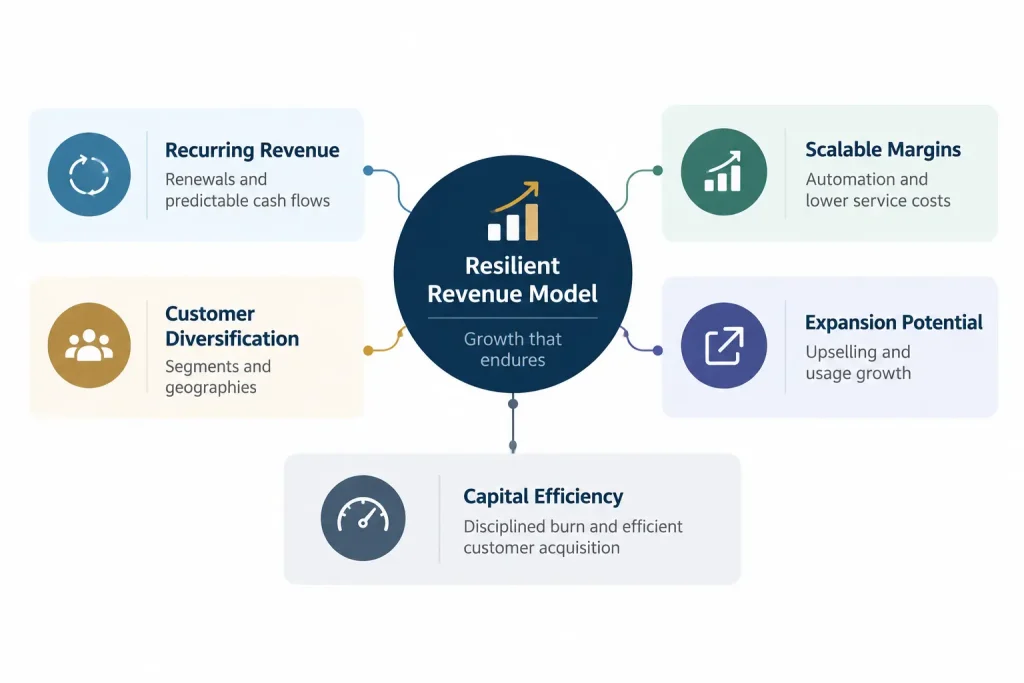
Velocity and scale win the first meeting, but resilience earns long-term conviction. A durable startup revenue model must grow and persist at the same time. Eleven traits give revenue that endurance:
- Recurrence: monthly subscriptions, annual contracts or resetting usage charges make future cash flows modelable.
- Margin scalability: gross margins improve over time through automation, platform leverage or falling service costs.
- Customer diversification: revenue spreads across segments and geographies, so losing a top client is survivable.
- Expansion potential: tiered plans, usage growth and cross-sell paths raise ARPU without new acquisition cost.
- Channel stability: organic levers such as SEO, community, virality and integrations compound beyond paid acquisition.
- Contractual durability: annual or multi-year agreements with strong renewal terms extend runway visibility.
- Retention and net expansion: NRR above 120%, read through cohort views, validates product-market fit.
- Pricing power: customers accept higher prices as value rises, which allows tier mobility through inflation and competition.
- Data advantage: proprietary data fuels personalization, customer insight and barriers to entry.
- Workflow integration: products embedded in daily processes turn usage into habit and habit into renewal.
- Capital efficiency: efficient burn, short CAC payback and high LTV/CAC steady the business in volatile markets.
Margins and Capital Efficiency in Practice
Margin scalability separates fast growth from valuable growth. At one cybersecurity and identity SaaS company with roughly $30M in ARR, pricing discipline, workforce mix and delivery cost management lifted gross margin by 12%. That headroom funded reinvestment and protected the burn multiple during rapid expansion.
Capital efficiency follows the same logic at an early-stage email marketing technology company, which cut monthly burn from $800K to $200K through an operational turnaround. The reset gave the business room to stabilize and operate within its means, which investors read as a sign of disciplined leadership.
Institutionalizing Revenue Maturity as the Startup Scales
As a company matures, the emphasis shifts from early growth to repeatability. Founders must architect the organization, metrics and go-to-market motion to sustain the revenue model they built, instead of hoping early momentum carries forward on its own.
Revenue Metrics That Go Beyond Vanity
Investors want visibility into revenue durability, not just topline growth. A mature company tracks the following measures continuously, not once a quarter:
- Gross Revenue Retention (GRR)
- Net Revenue Retention (NRR)
- CAC Payback Period
- ARPU progression by cohort
- Customer Health Scores
Forecast Accuracy as a Source of Credibility
Forecast accuracy builds investor trust faster than almost any other signal. Projections should rest on segment behavior, pipeline coverage, conversion rates, churn risk and seasonality, not hope. The same cybersecurity SaaS business held actuals within plus or minus 5% of forecast for 8 consecutive quarters once a driver-based forecasting engine replaced guesswork.
Operating Disciplines of a Mature Revenue Organization
| Discipline | What Maturity Looks Like |
| Product and GTM integration | User feedback flows directly into roadmap and packaging decisions |
| Pricing as a discipline | Annual reviews, packaging tests and A/B experiments run as routine |
| Channel partnerships | Alliances and ecosystem plays extend reach beyond internal sales |
| International scalability | Inbound demand and trial usage abroad inform local monetization |
| Scalable support and success | Product-led onboarding, documentation and education protect margins |
| Financial instrumentation | Real-time dashboards, revenue attribution and multi-scenario models |
| Strategic reserve policies | Hiring and expansion paced to trailing, proven revenue cycles |
| Governance | Revenue committees, board monetization reviews and cross-team revenue OKRs |
Resilient revenue does not happen by accident; design cultivates it, execution disciplines it, and alignment across product, sales, finance and the investor narrative extends it. The models that attract venture capital are those that grow, but the models that sustain investor belief are those that endure.
Three Key Takeaways
- Investors judge a startup revenue model by its fit with the market and its ability to return a fund on schedule, so recurring, expandable revenue tied to customer value earns the strongest conviction.
- Simple pricing, early price testing and a clear narrative around LTV/CAC, CAC payback and NRR turn any revenue model for startups from a spreadsheet assumption into an investable story.
- Resilience matters as much as velocity, and diversified customers, improving margins, accurate forecasts and disciplined governance are what sustain investor belief beyond the first round.
Disclaimer: This article is intended for informational purposes only and does not constitute legal, tax, or accounting advice. You should consult your own tax advisor or counsel for advice tailored to your specific situation.
Hindol Datta is a four-time CFO and senior finance executive with over 25 years of leadership experience across cybersecurity, SaaS, gaming, logistics, digital marketing, medical devices, consumer products, and nonprofit organizations. He has led more than $120M in fundraising and over $150M in M&A transactions while building the financial and operational systems that let complex businesses scale with confidence. He is the author of seven books in the Systems CFO Series and holds active CPA, CMA, and CIA credentials.
AI-assisted insights, supplemented by 25 years of finance leadership experience.