
Executive Summary
The relationship between a venture capitalist and a founder is among the most consequential in the business world. Rooted in capital and shaped by trust, it determines not only the trajectory of individual companies but the character of entire sectors. For investors with significant operating experience, the temptation to overreach is real and understandable. But the most effective venture partners know that influence and interference are not the same thing. They bring perspective, networks, and discipline to the table without crowding out the founder’s agency. Building trust between investors and founders requires restraint as much as it requires engagement. This article examines how that balance is struck, what it looks like in practice, and why the investors who master it consistently produce better outcomes for everyone involved.
The Foundation of a High-Stakes Partnership
Venture capital and founder relationships begin with a transaction but must evolve into something far more durable. Capital is the opening act. What follows determines whether the investment becomes a legacy or a lesson.
In the early days, optimism tends to carry both parties. The investor is excited about the opportunity. The founder is energized by the backing. But as the company matures and real pressure accumulates, the nature of the relationship is tested. Product cycles slip. Hiring plans stall. Revenue assumptions prove too aggressive. It is precisely in these moments that the investor’s role becomes either a genuine asset or a costly distraction.
The most effective venture partners enter the relationship with a clear philosophy: they are there to accelerate, not to operate. They bring the leverage of experience, network, and pattern recognition. They do not bring a second layer of management.
Where Investors Add the Most Measurable Value
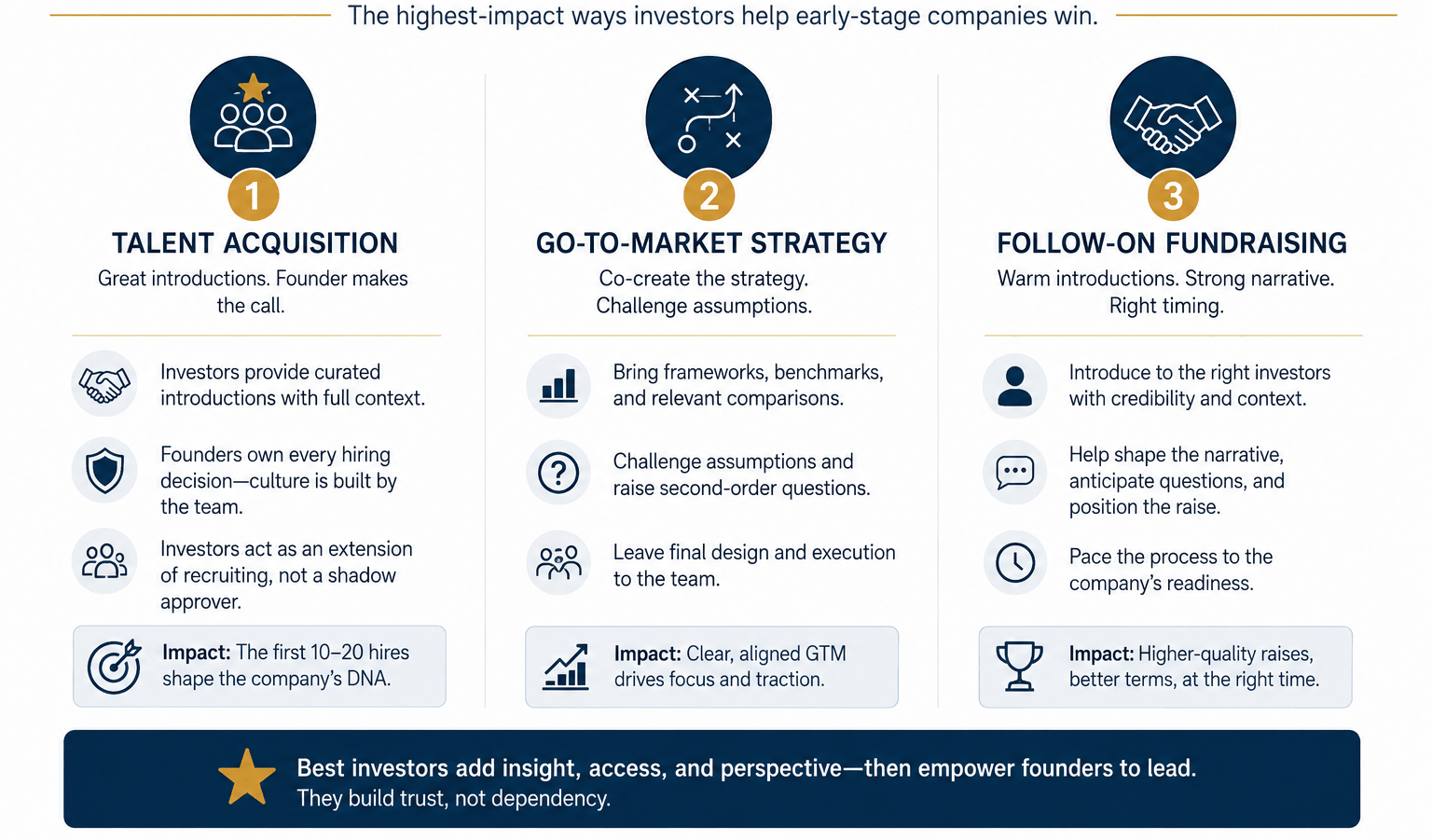
Talent Acquisition
Hiring is where early-stage companies win or lose, and it is also where an experienced investor can deliver outsized value. A venture partner with deep networks and institutional credibility can make introductions that no founder pitch alone would secure.
The distinction that matters, however, is between providing candidates and making decisions. The best investors offer curated introductions with full context, then step back. They understand that the final hiring call belongs to the founder, because culture is set by the people who show up every day and build it together. An investor who positions candidates as directives, even subtly, is crossing a line that erodes trust over time.
Drawing on years of finance leadership across cybersecurity, SaaS, and gaming, I have seen firsthand how the first ten to twenty hires shape a company’s operating DNA. Investors who respect this bring referrals with richness and restraint. They become an extension of the recruiting function, not a shadow approver.
Go-to-Market Strategy
Founders typically possess deep product conviction but may lack seasoned perspective on pricing architecture, channel design, or buyer segmentation. This is where a thoughtful investor can be genuinely additive.
The operative word is additive. Go-to-market discussions that arrive as opinions from multiple directions without a coherent point of view create noise, not clarity. Investors who have seen a particular GTM model succeed in one sector sometimes push that model into a different context without accounting for differences in product maturity or customer behavior. The result is confusion at precisely the moment when the team needs alignment.
The better approach is to co-create the strategy. Bring frameworks, benchmarks, and relevant comparisons to the conversation. Challenge assumptions. Raise the second-order questions that the team may be moving too quickly to ask. Then leave the final design and execution in the hands of the people who will live with it.
Follow-On Fundraising
If there is one domain where investors can add the most clearly measurable value, it is follow-on funding introductions. A warm introduction from a credible seed investor to a Series A or growth-stage partner carries a weight that no cold outreach replicates.
But the quality of that introduction matters as much as the connection itself. The most effective investors do not simply send a name and a brief note. They help the founder shape the narrative, anticipate the questions, and position the raise within the broader capital market context. They pace the process to the company’s operational readiness rather than their own desire to generate signal.
Having led capital raises exceeding one hundred and twenty million dollars across sectors ranging from education to cybersecurity to logistics, I have observed that the raises which go smoothly are almost always the ones where the investor and the founder have aligned on story before they aligned on valuation. Timing, preparation, and narrative coherence are the invisible infrastructure of a successful fundraise.
The Boundary Between Support and Interference
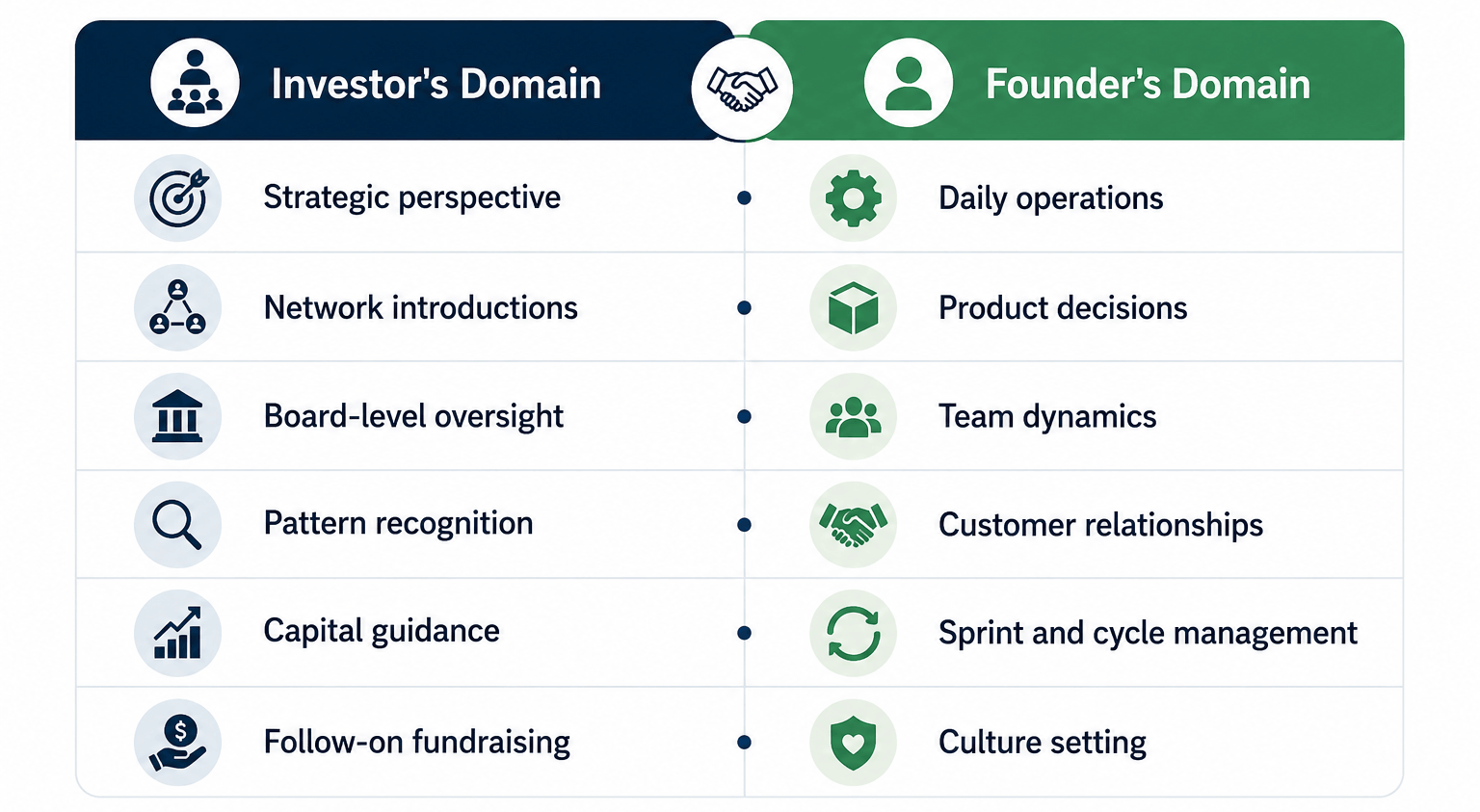
The table above is simple, but it captures a tension that quietly damages many investor-founder relationships: the drift from the left column into the right one.
Daily operations belong to the founder. Product cycles, customer feedback loops, internal team conflicts, and sprint management are not arenas for investor involvement. These are precisely the domains where founders must lead, and sometimes fail, in order to grow. An investor who hovers over these functions does not accelerate the company. They slow it down.
Board meetings are a particular inflection point. The most effective board members use their seat to ask second-order questions, to steer conversation away from surface metrics toward unit economics and capital efficiency, and to support without parenting. They challenge assumptions without undermining confidence. They are fully present without being overbearing.
Building Trust Between Investors and Founders Over Time
Building trust between investors and founders is not an event. It is a sustained practice of calibrated engagement.
The most powerful tool available to an investor is the well-timed question. What are you not seeing right now? Where are you second-guessing yourself? What would the decision look like if capital were not a constraint? These questions invite reflection without prescribing answers. They create space for the founder to lead while benefiting from the investor’s perspective.
Silence, too, carries weight. A check-in call with no agenda. A note of encouragement after a difficult quarter. A referral to an executive coach at the right moment. These are not minor gestures. They signal to a founder that they are supported without being managed, that the investor is present without being intrusive.
Over the course of working alongside leadership teams in sectors including digital marketing, medical devices, and mission-driven nonprofit organizations, I have seen how psychological safety shapes performance. Founders who feel trusted make bolder decisions. Founders who feel monitored become cautious and reactive. The investor who understands this does not just generate better returns. They attract better founders.
What is the most common mistake venture capital investors make in founder relationships?
The most common mistake is conflating involvement with value. Investors who feel that high engagement justifies high oversight tend to insert themselves into operational decisions that belong to the founder. This creates friction, slows execution, and signals a lack of trust. The investors who generate the strongest long-term outcomes are those who invest their energy in the high-leverage intersections: talent strategy, fundraising preparation, and strategic framing. They resist the temptation to add commentary to every decision, and they build relationships where the founder genuinely wants their perspective, rather than feeling obligated to manage around it.
Conclusion
Venture capital at its best is a force multiplier. It sharpens the vision of a founder who already has one. Also, opens doors that would otherwise remain closed. It provides the capital and the perspective that transform a promising idea into a scalable institution. But none of that happens when the investor mistakes ownership for authority, or participation for control. The venture partners who earn genuine trust are those who understand that their role is to navigate, not to drive. They know when their experience is additive and when their silence is more valuable than their opinion. They honor the asymmetry of roles while operating with a symmetry of intent. In doing so, they build relationships that outlast any single investment and create reputations that attract the next generation of exceptional founders.
Disclaimer: This blog is intended for informational purposes only and does not constitute legal, tax, or accounting advice. You should consult your own tax advisor or counsel for advice tailored to your specific situation.
Hindol Datta is a seasoned finance executive with over 25 years of leadership experience across SaaS, cybersecurity, logistics, and digital marketing industries. He has served as CFO and VP of Finance in both public and private companies, leading $120M+ in fundraising and $150M+ in M&A transactions while driving predictive analytics and ERP transformations. Known for blending strategic foresight with operational discipline, he builds high-performing global finance organizations that enable scalable growth and data-driven decision-making.
AI-assisted insights, supplemented by 25 years of finance leadership experience.