Executive Summary
VC due diligence is often mistaken for an interrogation, yet its real purpose is understanding. The pitch deck opens the story, but venture capital due diligence tests whether the numbers, the team and the market can carry it. This article examines the technical, financial and cultural layers of diligence, along with the questions investors rarely ask aloud.
Founders will find a practical way to separate deal-killers from deal-shapers and to lead their own process. Investors will find a case for ethical, well-paced inquiry. Both sides will see why the conduct of diligence predicts the partnership that follows.
Why VC Due Diligence Is About Understanding, Not Judgment
Capital in venture is abundant, but conviction is scarce, and diligence is where investors earn conviction. Some founders fear the process as an inquisition. Many investors treat it as a game of traps. Both views miss the point, because diligence is a search for truth across fragments of ambition, history and promise.
No investor finds certainty, since early-stage companies never offer it. The goal of VC due diligence is clarity about risk, team dynamics and the fit between narrative and numbers. Good diligence treats a company as a living system, not a file. It asks how the numbers came to be, who shaped them and who challenged them along the way.
From Pitch Deck to Pattern Recognition
The deck introduces the story with polished slides, but serious investors go straight to the scaffolding underneath. Typical early questions in VC due diligence include the following:
- Do customer acquisition costs align with the claimed channel strategy?
- Does the churn rate match the reported NPS scores?
- Do gross margins reflect product-market fit or a pricing distortion?
These questions are architectural, and none of them is meant as an attack. Strong founders welcome them, because answering them sharpens their own strategy. In a Series B round, cohort and unit economics models often carry more weight than any slide. Those models hold up under pressure only when the finance team builds them to answer these questions from the start.
How the Venture Capital Due Diligence Process Flows
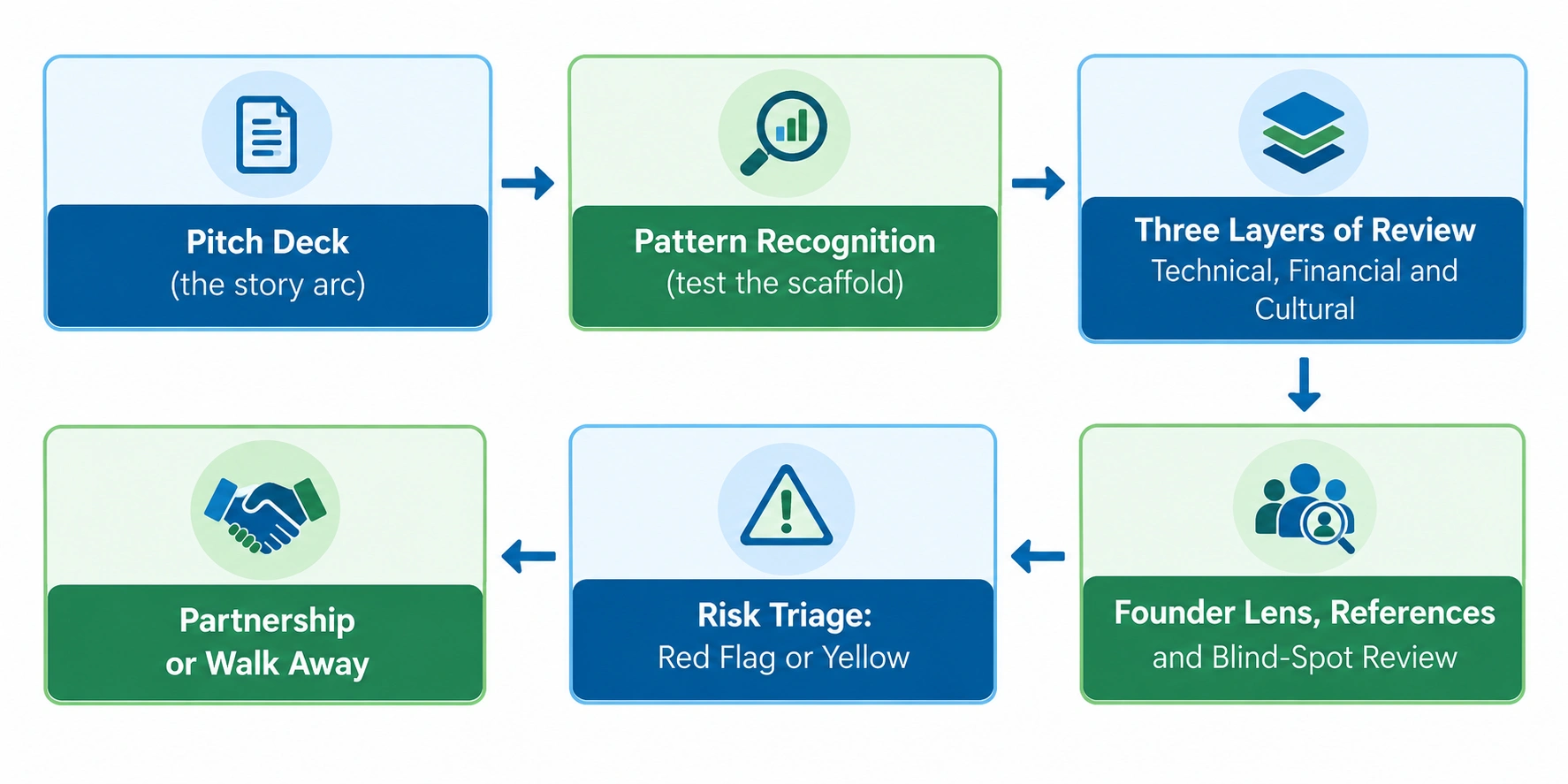
The Three Layers of Venture Capital Due Diligence
Each of the three layers below tests a different kind of risk, and none can stand in for the others.
| Layer | Focus | Core Questions |
| Technical | Product, tech stack and roadmap | Is the technology proprietary or assembled? Can it scale securely? Are dependencies documented or tribal? |
| Financial | Everything beyond the P&L | Are there anomalies in burn rate patterns? How aggressive is revenue recognition? Does the runway include realistic hiring and GTM costs? |
| Cultural | Team behavior and decision-making | What do former employees say? How does the team handle failure? Is there psychological safety in decisions? |
Financial Due Diligence Beyond the P&L
Revenue recognition is where aggressive policies tend to hide. Investors test whether the company applies ASC 606 consistently and whether board reporting ties back to the underlying ledger. A track record of actuals landing close to forecast over several quarters gives investors evidence instead of promises.
Why Cultural Diligence Decides Resilience
Culture rarely appears in a data room, yet it determines how a company behaves when a crisis arrives. Clean financials can still mask a team that hides bad news or punishes dissent.
Reading the Founder in VC Due Diligence
A startup reflects its founder’s psychology, so diligent investors read both the data and the founder’s relationship to it. The most useful founder signals include the following:
- whether the founder volunteers risk before anyone asks
- whether the founder owns past pivots with humility
- whether confidence rests on intellectual honesty or on performance
Pattern recognition matters here more than any isolated fact. The best investors look for alignment between stated strategy and lived behavior. Incongruence often reveals more than an honest error ever could.
Using Time as a Diagnostic Tool
Diligence depends on time, which one phone call cannot compress and endless review cannot improve. Strong investors spend time asymmetrically, putting the most effort where uncertainty runs highest. If the GTM strategy is clear but the hiring plan is opaque, attention shifts to org charts, compensation bands and reference calls.
Speed Versus Depth in Competitive Rounds
Competitive rounds compress timelines, and the pressure to move fast rises. Speed, however, erodes discernment in ways that surface later. Good investors triage by finding the biggest risks fast and digging deep there. Founders should watch for investors who rush diligence, since they may rush governance too. Endless diligence carries its own warning, because it can signal indecision or theater. A well-paced process, managed by the founder as much as the investor, signals readiness.
Red Flags Versus Yellow Lights in VC Due Diligence
Few deals reach the closing table without some blemish. The real skill lies in separating red flags, which kill deals, from yellow lights, which shape them.
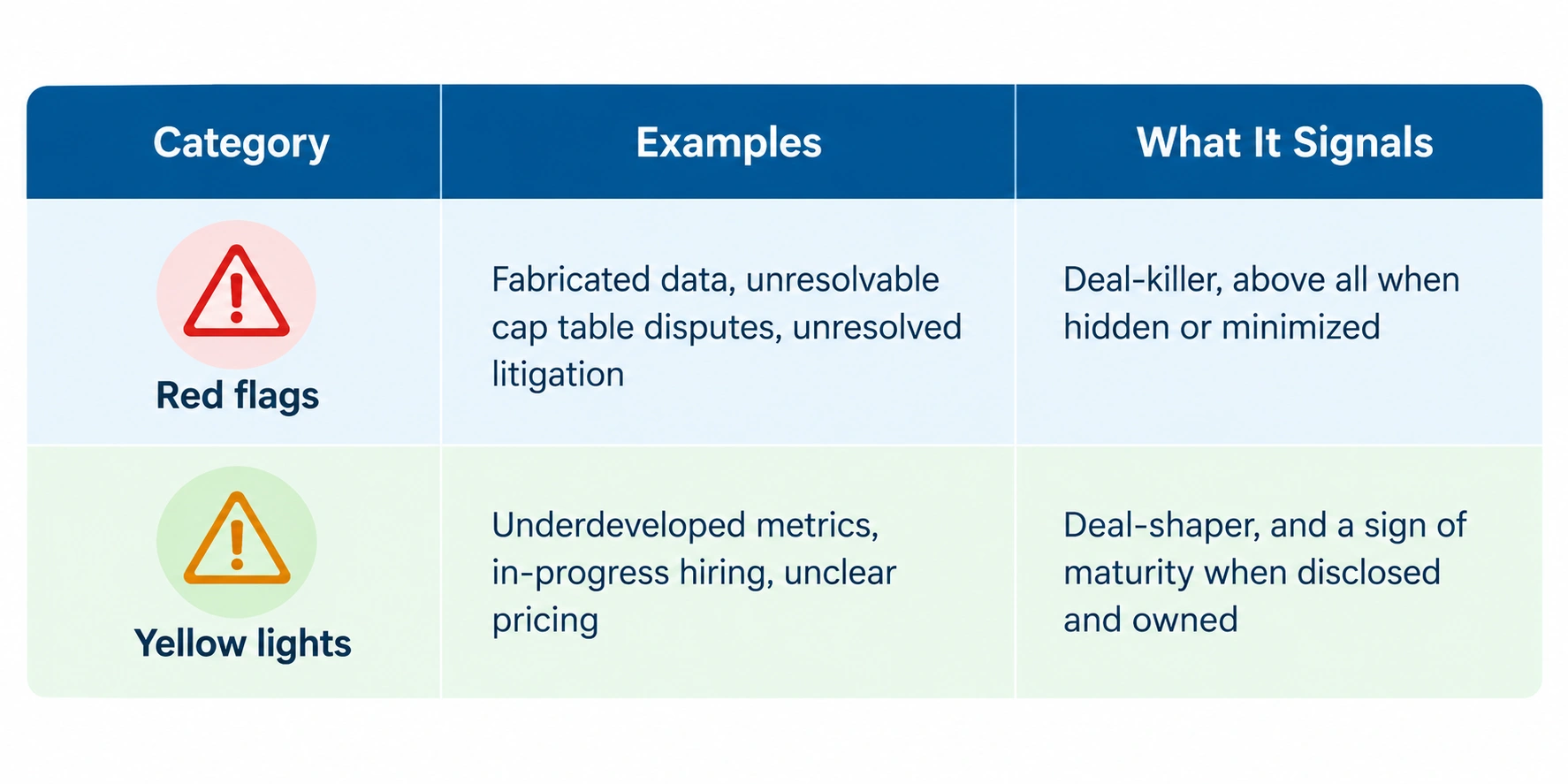
A yellow light that the founder discloses and owns can signal maturity. A red flag that the founder hides or minimizes points to rot underneath.
Strategic Blind Spots in Startup Due Diligence
Diligence drifts toward what is easy to measure, such as CAC, LTV and revenue growth. Several critical factors resist neat spreadsheet analysis of any kind:
- Timing and narrative: is the company ahead of the market, in sync or late?
- Market complexity: are regulatory shifts looming, and is the TAM overstated?
- Competitor psychology: how will incumbents respond if the startup gains traction?
This calls for second-order thinking from the investor. The question is not only whether the product is good, but what happens when it wins and which allies or enemies emerge.
The Ghost Metrics Investors Rarely Record
Some data points circulate in diligence rooms but rarely reach a memo:
- founder exit history
- executive churn rate
- time-to-decision in past board meetings
These are behavioral patterns more than metrics, and they reveal the operating climate. A founder who cycles through five heads of sales in two years has a pattern. A team with no documented hiring process has a culture, whether anyone admits it or not.
The Ethics of Venture Capital Due Diligence
The power imbalance in venture is real and frequently underestimated. Founders work with thin resources, while investors arrive with analysts, legal teams and options. That asymmetry places the moral weight of diligence on the investor. Ethical investors should commit to a few basic practices:
- disclose their timeline, process and evaluation criteria
- respect confidentiality beyond the terms of any NDA
- avoid fishing for proprietary IP without clear investment intent
- keep questions relevant and avoid invasive probing
Transparency must run in both directions for diligence to work. Investors should be open about what they know, what they value and what they will not tolerate.
Reference Checks as Signals from the Periphery
References reveal truths that documents rarely capture, but investors must choose them with intent:
- current customers validate product fit
- former employees reveal culture
- ecosystem peers provide reputational context
Confirmation bias is the main hazard in this part of VC due diligence. Investors should seek disconfirming voices, such as the customer who churned or the employee who left abruptly. Used well, references deepen understanding instead of manufacturing doubt.
How Founders Can Lead Their Own Due Diligence
The founder is a co-author of understanding, not an object of scrutiny. Smart founders take an active role in three ways:
- curate the data room so it tells a coherent story
- frame unknowns with honesty
- ask what diligence surfaced in past rejections
This approach reads as leadership to investors, not as defensiveness. A founder who owns the investor narrative keeps diligence focused on substance instead of surprises. Founders can treat the process as map-making, not a pass/fail exam, and test whether this co-traveler understands the terrain.
VC Due Diligence as a Preview of the Partnership
How an investor conducts diligence signals how they will behave after close. Investors who bully in diligence tend to micromanage later. Founders who hide during diligence tend to isolate themselves later. The founder is also running diligence on the investor, and every email, call and avoided question is data.
The best outcomes come from mutual trust built through rigorous inquiry, not from perfect data. When both sides feel seen and not judged, psychological safety follows and execution improves. Investors who ignore how a team treats its people may fund acceleration without sustainability. Founders who oversell may win the round but lose the trust. Done well, venture capital due diligence is the vigilance before the vow, where rigor tempers belief and judgment guides risk.
Three Key Takeaways
- Treat VC due diligence as a search for clarity, not certainty. Spend the most time where uncertainty is highest, and read founder behavior alongside the numbers.
- Separate red flags from yellow lights with deliberate care. A weakness the founder discloses and owns can build trust, while a hidden one destroys it.
- Remember that venture capital due diligence previews the partnership itself. Ethical, well-paced inquiry on both sides sets up a boardroom built on collaboration rather than conflict.
Disclaimer: This article is intended for informational purposes only and does not constitute legal, tax, or accounting advice. You should consult your own tax advisor or counsel for advice tailored to your specific situation.
Hindol Datta is a four-time CFO and senior finance executive with over 25 years of leadership experience across cybersecurity, SaaS, gaming, logistics, digital marketing, medical devices, consumer products, and nonprofit organizations. He has led more than $120M in fundraising and over $150M in M&A transactions while building the financial and operational systems that let complex businesses scale with confidence. He is the author of seven books in the Systems CFO Series and holds active CPA, CMA, and CIA credentials.
AI-assisted insights, supplemented by 25 years of finance leadership experience.