
Executive Summary
A term sheet is both a gatekeeper and a mirror in early-stage finance. It turns gaps in experience, incentive and time horizon between founders and investors into a short list of clauses. For the founder, it is where ambition meets dilution, and for the venture capitalist, it is the structure that protects risk and reward.
This guide offers a term sheet explained through two lenses. The first covers the visible clauses, from liquidation preferences to information rights. The second covers what the document leaves unsaid, including exit horizon, investor behavior and follow-on intent. Both lenses point toward a negotiation built on alignment, not control.
Why the Term Sheet Encodes Incentive Divergence
At the heart of every term sheet sits a structural tension. The investor seeks to safeguard capital, while the founder seeks to preserve control. These incentives are not adversarial, yet they are not identical either.
Venture capitalists invest with a portfolio mindset and can absorb losses as long as the winners return the fund. Founders, by contrast, are tied to a single company, a single timeline and a single outcome. The term sheet codifies this asymmetry, and its clauses balance, hedge or tilt the equation toward one side. For that reason, a term sheet should be read as a coherent strategy, much as a chessboard is a field of coordinated moves, not a set of squares.
Liquidation Preferences: The Shield of Capital
The liquidation preference is the most basic investor protection in any term sheet. A 1x non-participating preference is now considered standard. It ensures that, in a sale or liquidation, the investor recovers the original capital before common shareholders receive anything.
That concept is acceptable to most founders, but the danger lies in the cascade. Distortion begins when preferences stack across multiple rounds, each with its own seniority, rights and participation. An exit may clear $100M and still return little to the founding team.
How a Stacked Liquidation Waterfall Works
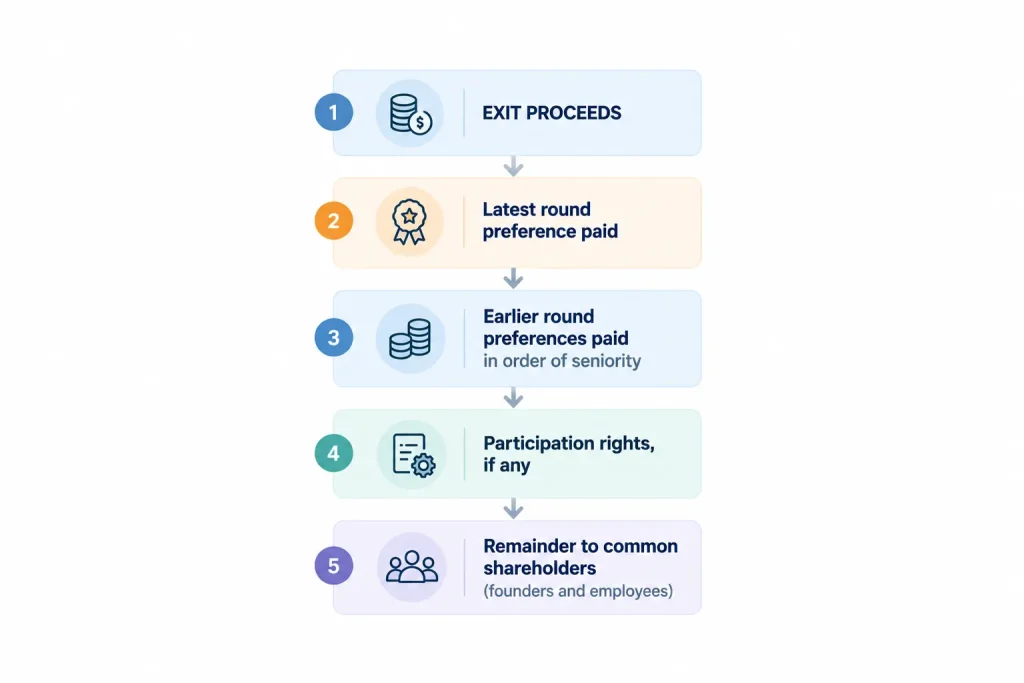
Capital deserves seniority, yet founders should still ask whether each preference supports long-term value creation or simply protects the downside. Every stacked preference adds an invisible hand to boardroom decisions, most of all when an exit is on the table.
Board Control and Protective Provisions
If liquidation preferences guard the downside, board control and protective provisions govern the operating future. A typical early-stage board might seat two founders, two investors and one independent director. That structure looks balanced until protective provisions come into play.
Protective provisions give preferred shareholders a veto over key decisions. These often cover issuing new shares, raising debt, approving budgets and even hiring or firing the CEO, which makes them latent levers of control.
Investors argue that these rights prevent reckless dilution or strategic drift. Founders must judge whether the controls stop at prudence or reach into preemption. The answer often lies in board culture more than in the drafting. Board work at a publicly listed gaming and digital entertainment company shows how the same governance rights can work as a backstop with one investor group and as a brake with another.
Anti-Dilution Provisions: Confidence and Fragility
Anti-dilution clauses adjust the conversion price of preferred shares if the company later raises a down round. The method chosen decides how much of that loss shifts from investors to founders and common holders.
Anti-Dilution Methods Compared
| Method | How It Adjusts | Who It Favors |
| Weighted average | Adjusts proportionally, based on the size and price of the new issuance | More founder-friendly |
| Full ratchet | Resets as if shares were bought at the new, lower price | Most protective to investors |
Anti-dilution protection is a rational hedge in a volatile market, yet its presence also signals that the investor expects fragility. Founders should weigh the conditions that would trigger it, not just the clause itself. A company built on sound fundamentals seldom triggers a ratchet, so a term sheet that assumes otherwise deserves scrutiny.
Vesting Schedules and Founder Recommitment
Founder vesting is often treated as hygiene, with a standard four-year schedule and a one-year cliff. Re-vesting clauses in mid-stage rounds, however, often signal investor concern about founder focus, engagement or succession.
Recommitment can be justified in a recapitalization or leadership transition. Even so, founders should resist schedules that erase past contributions, because equity already earned should not be re-legislated without cause. Negotiating here protects continuity, not a founder’s escape from accountability.
Drag-Along and Tag-Along Rights: Exit Game Theory
A drag-along clause lets a majority of investors and the board force minority shareholders, often founders or employees, to sell. Tag-along rights work in the opposite direction, letting minority holders join a sale made by major holders.
These clauses can protect or preempt, since a drag-along enables decisive exit execution while a tag-along ensures fairness. Poorly aligned terms, however, can leave founders watching their company sold for strategic gain without a proportional return.
As a remedy, founders should negotiate that any drag-along applies only above a minimum return threshold, such as a 3x return to common. Acquisition diligence on a cybersecurity and identity access management business shows why that matters, since exit terms decide who captures value once a buyer arrives.
Information Rights and Investor Visibility
Most term sheets grant investors access to financials, board materials and KPIs. That is reasonable, but transparency should not become micromanagement. Monthly reporting is prudent, while weekly interrogation becomes intrusive. The founder’s job is to frame the data and narrate the business, not merely expose it.
Reading the Silences in a Term Sheet
Some omissions carry more weight than provisions, because visible clauses describe the deal while silences reveal the likely tenor of the relationship. Those gaps are seldom accidental, and they show whether an investor builds with founders or bargains against them.
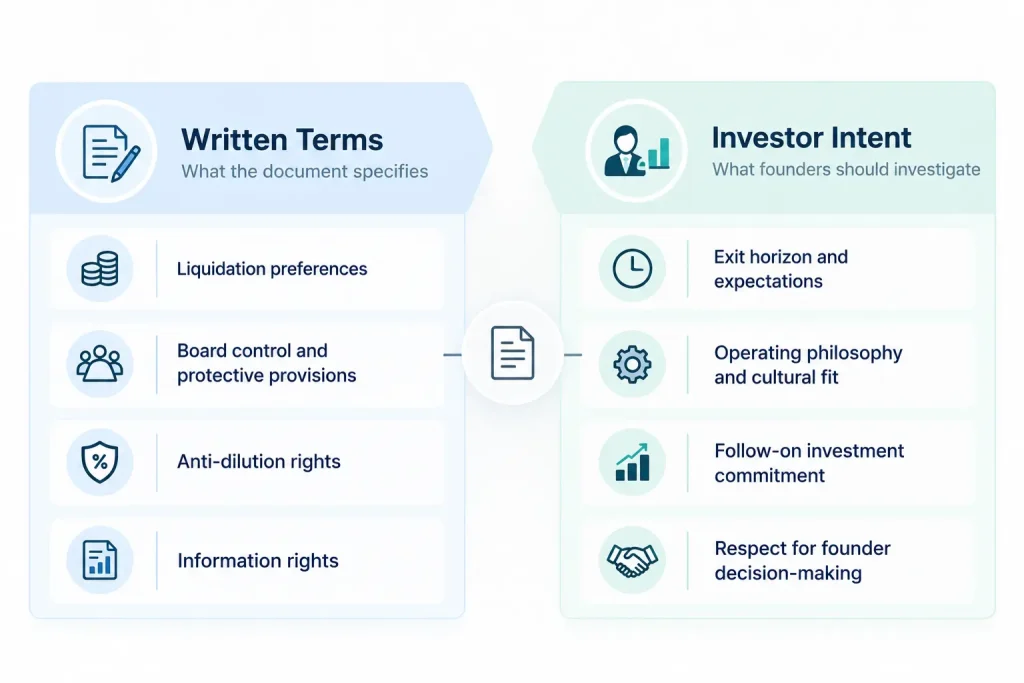
Time Horizon and Exit Expectations
A term sheet rarely states the investor’s holding period or exit strategy. Founders should ask whether the investor wants a 3x in three years or a 10x in ten. They should also learn whether the investor favors an IPO, a secondary or an early sale. Missing exit language creates ambiguity that tends to surface around year five, when options divide stakeholders.
Cultural Fit and Operating Philosophy
No term sheet discloses how investors behave after a missed quarter. Founders need to know whether investors will lean in or pull back, and whether they will cut team or cut equity. Reference checks are the best defense against this silence. Founders should seek out messy exits, near-failures and hard pivots, not just the logos on a fund’s website.
The ESOP Illusion
Term sheets often require an option pool expansion, usually 10% to 15%. Where that pool is calculated decides who carries the dilution.
| Pool Calculation | Who Bears the Dilution |
| Post-money | Founders bear the dilution |
| Pre-money | Founders and investors share the burden |
The term sheet will not spell out this asymmetry, so founders must run the math themselves. A pool sized against the post-money figure can cost founders several points of ownership at close.
Follow-On Strategy and Pro-Rata Rights
Pro-rata rights let investors maintain ownership in future rounds, and they are standard. The real question is whether investors will exercise them and reserve capital to do so. A venture-backed digital marketing company that raised $36.5M across three rounds shows why this matters, since each round depended on insiders who chose to follow. Founders should ask portfolio founders directly whether their seed lead backed the Series A, or faded in a flat round.
The Founder’s Right to Say No
Every term sheet defines what founders must do, yet few define what founders may refuse. The right to decline a hire, a pivot or an unsolicited acquisition is central to building with conviction. Whether an investor respects that right shows up in dinners, calls and the pause after a hard boardroom challenge, not in the document.
Negotiating a Term Sheet Through Principle, Not Fear
Founders often approach a term sheet as grateful, hurried supplicants. Stronger founders negotiate against future regret instead of present relief. Three questions guide that approach:
- Which clause will need clarifying five years from now?
- Which word should be struck before signing?
- Which partner will still look like the right choice in a hard year?
A mission-driven education and research institution that raised $37M across equity and venture debt shows how board relationships formed during a raise shape the partnership long after signing. Every startup is an institution in the making, and institutions are forged in principle rather than panic.
Conclusion: The Term Sheet as an Invisible Handshake
A term sheet is a handshake written in prose. Some of its words bind legally, others carry cultural weight, and the rest set the tone of power and posture. Decoding it fully means understanding both the deal and the dealmakers. Reading both clauses and silences brings clarity, which gives founders the agency to build a contract worthy of the company they intend to create.
Three Key Takeaways
- A term sheet should be read as one coordinated strategy, because liquidation preferences, protective provisions and anti-dilution terms interact in ways no single clause reveals.
- What a term sheet leaves unsaid about exit horizon, investor behavior and follow-on intent deserves the same diligence as the written terms, and reference checks are the best tool for it.
- Founders should negotiate against future regret, testing each clause, the ESOP math and every drag-along threshold against the company they hope to run in five years.
Disclaimer: This article is intended for informational purposes only and does not constitute legal, tax, or accounting advice. You should consult your own tax advisor or counsel for advice tailored to your specific situation.
Hindol Datta is a four-time CFO and senior finance executive with over 25 years of leadership experience across cybersecurity, SaaS, gaming, logistics, digital marketing, medical devices, consumer products, and nonprofit organizations. He has led more than $120M in fundraising and over $150M in M&A transactions while building the financial and operational systems that let complex businesses scale with confidence. He is the author of seven books in the Systems CFO Series and holds active CPA, CMA, and CIA credentials.
AI-assisted insights, supplemented by 25 years of finance leadership experience.