
Executive Summary
Series A funding marks the point where a startup stops proving an idea and starts proving a business. Across these startup funding rounds, capital acts as fuel, signal, constraint, and strategy at the same time. Founders who treat each raise as a design choice, rather than a finish line, tend to build companies that last.
This article maps the capital strategy for each stage, from the seed round through Series C. It covers investor expectations, capital allocation, key risks, and success metrics. It then turns to dilution, board construction, valuation, and reporting rigor.
What Is a Seed Round, and Why It Shapes Series A Funding
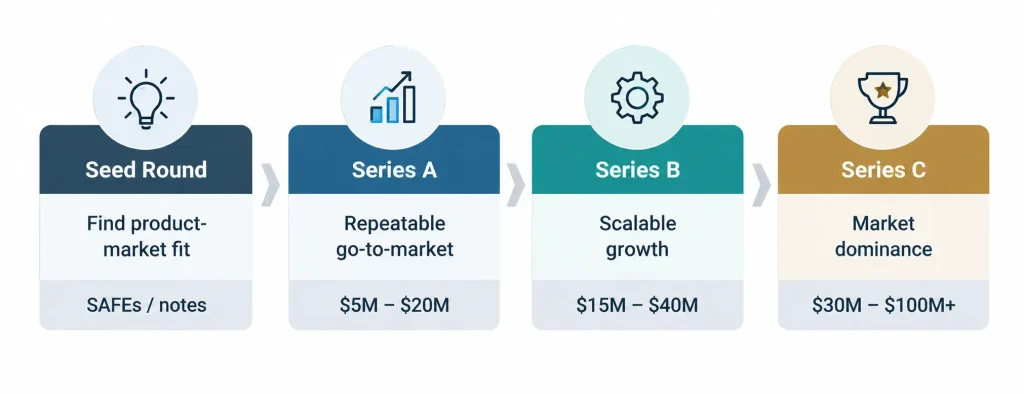
A seed round is the first meaningful outside capital a startup raises, usually to find product-market fit. Many seed rounds use SAFEs or convertible notes rather than priced equity. That structure defers valuation until a later, priced round.
The seed stage matters because Series A investors study its outcomes before committing capital. Clean books, a defensible cap table, and honest cohort data make Series A funding conversations move faster. One venture-backed manufacturing company had no finance function until its first finance hire built the accounts, GAAP framework, and controls. That groundwork let it speak credibly with investors later.
Series A Funding: From Product-Market Fit to Repeatable Go-to-Market
Series A is often the first priced equity round, and it asks one hard question: can early traction become a system? Rounds generally range from $5M to $20M, and investors expect proof of three things:
- Predictable customer acquisition channels
- A repeatable sales motion beyond founder-led sales
- Revenue retention and early upsell signals
Where Series A Capital Should Go
Most of the Series A budget should fund the first commercial engine:
- The first commercial team across sales, marketing, and customer success
- Core systems such as CRM, analytics, and customer support tooling
- Cohort testing, ICP refinement, and go-to-market experimentation
Two risks dominate the deployment of Series A funding. The first is overhiring ahead of revenue, which inflates burn before the sales motion is proven. The second is failing to segment customer acquisition cost by channel, which hides where growth comes from. A venture-backed digital marketing company that later scaled from $9M to $180M in 24 months built CAC, LTV, and contribution margin discipline early. That discipline let leadership see which channels deserved more money and which deserved less.
Series B Funding: From Repeatable GTM to Scalable Growth
Series B validates the go-to-market motion and shifts the company from experimentation to execution. Round sizes tend to range from $15M to $40M. Capital at this stage moves toward building scale across three fronts:
- Expanding the sales organization and adding sales enablement infrastructure
- Building a formal marketing engine across demand generation, content, and paid acquisition
- Extending the product roadmap in response to customer insight
Key Considerations and Risks at Series B
Founders should target CAC payback periods under 18 months. Customer success and renewals deserve dedicated investment, since they drive net revenue retention. International expansion makes sense only when the domestic go-to-market motion is solid. The common failure is a GTM team that grows faster than its onboarding and playbooks. A related risk is marketing spend that outpaces pipeline maturity.
Investors now scrutinize unit economics in depth. A marketplace SaaS company raising a $20M Series B anchored its diligence in cohort and unit economics models spanning US and Polish operations.
Series C Funding: From Scaling to Market Dominance
Series C turns the venture into a growth-stage company. Raises often range from $30M to over $100M. The investor lens shifts toward market capture, stable unit economics, and margin trajectory. The capital strategy expands into three areas of investment:
- Adjacent verticals or new geographies
- Strategic acquisitions that consolidate market position
- Finance, legal, and governance maturity that prepares the company for liquidity
Key Moves and Watchpoints at Series C
Key moves include pushing into enterprise accounts with multi-year, large ACV contracts. Forecasting and attribution infrastructure becomes necessary, and strategic partnerships open new channels. Growth can mask inefficiency at this stage, with CAC ballooning beneath strong top-line numbers. Talent dilution and cultural entropy during hyper-scaling pose a quieter threat to execution.
A Euronext Paris-listed gaming company shows the governance demands here: it executed more than $100M in cross-border M&A and ran an S-1 readiness process with underwriters and Big Four auditors. Both depended on one unified definition of revenue across every subsidiary.
Startup Funding Rounds at a Glance
The table below summarizes the success measures investors apply across startup funding rounds.
| Stage | Typical Raise | Core Goal | Key Success Metrics |
| Seed | Varies; often SAFEs or notes | Product-market fit | Early customers and usage evidence |
| Series A | $5M-$20M | Repeatable go-to-market | Burn multiple under 2x, LTV:CAC above 3x, $1M-$3M ARR with double-digit monthly growth |
| Series B | $15M-$40M | Scalable growth | NRR above 100%, Magic Number above 0.75, $5M-$10M ARR growing 100% year over year |
| Series C | $30M-$100M+ | Market dominance | Rule of 40 above 40%, CAC payback under 12 months, clear path to cash flow positivity, IPO, or M&A |
Capital Discipline from Series A Funding Through Series C
Capital unlocks scale, but it also amplifies weakness. Companies that endure differ less in how much they raise than in how they deploy it.
Dilution Is the Price of Asymmetry
Each round from A to C dilutes founders by roughly 15% to 25%. Founders accept this as the cost of capital now in exchange for value later. Excessive early dilution, however, can weaken founder control just as long-term value begins to form. A sound target keeps cumulative dilution under 50% by Series C. Super-voting rights and governance controls deserve careful judgment, not reflexive retention. Down rounds or raises above 30% dilution often signal mismanagement or desperation to the market.
Staging Capital Versus Overcapitalizing
Larger rounds signal strength, yet overcapitalization breeds bloat. Companies that raise more than they need often:
- Overhire without clear productivity benchmarks
- Launch initiatives beyond their core competency
- Lose the operational frugality that built early momentum
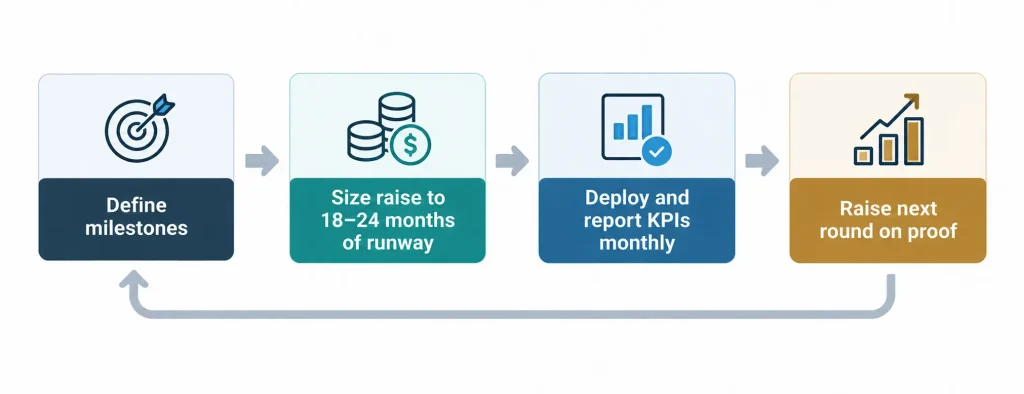
The better discipline ties raise size to 18 to 24 months of runway with clear milestones. Reserve budgets should cover market shifts or talent upgrades. An early-stage email marketing SaaS company learned the cost of loose spending, cutting monthly burn from $800K to $200K in an operational turnaround.
Board Construction and Investor Composition
Between Series A and C, the board shifts from an advisory group into a governance body. Smart founders bring in independent directors by Series B. They also seek investor diversity across sector, geography, and temperament. Voting rights and protective provisions deserve attention early, before they harden into constraints. Warning signs include an investor stack made up of early-stage generalists and a board without operating depth.
Valuation Discipline and Round Timing
High valuations are attractive, but they carry hidden costs:
- Pressure for unsustainable growth
- Expectations misaligned with market reality
- Downside risk in the next round if metrics lag
Valuation should anchor to trailing revenue and margin trends. Round timing should follow milestone achievement, not investor appetite.
Organizational Debt and Talent Capitalization
Each round must justify the organizational scale it funds. Successful growth-stage companies share clear OKRs at every level and compensation tied to long-term value. Their cultures absorb scale rather than resist it. Equity should attract stage-appropriate leaders such as VPs and general managers. Liquidity programs, including structured secondaries, work best when tied to retention.
Metrics Discipline: Data Before Dollars
Investors from Series A to C expect financial and operational rigor, including:
- GAAP-compliant revenue tracking
- CAC by channel, region, and segment
- Cohort retention and contribution margin by product line
- Monthly investor updates with KPI dashboards
- Quarterly board decks that marry narrative and numbers
A cybersecurity and identity SaaS company with roughly $30M in ARR shows what this rigor buys. Its driver-based forecasting engine held actuals within 5% of forecast for 8 consecutive quarters. That credibility carried it through acquisition diligence.
Scenario Planning and Exit Optionality
Strong founders model base, bear, and bull runway scenarios. They also map exit paths, whether strategic M&A, an IPO, or remaining private. Capital can then fund IP or tuck-in acquisitions and build capability in compliance, investor relations, and communications.
Conclusion: Capital Strategy Is Company Strategy
Capital is never a neutral input across startup funding rounds. From Series A to C, it shapes the tempo, tone, and trajectory of the company. Founders who treat capital as both sword and shield create optionality for every later decision. Those who treat it as a trophy or insurance policy build fragility that money only hides. Scaling well matters more than scaling fast, and capital must follow strategy rather than replace it. Each allocation decision compounds in silence and writes the future of the company.
Three Key Takeaways
- Treat Series A funding as proof of a repeatable system, not a reward for early traction. Spend it on the commercial engine and on the data that shows which channels work.
- Size every raise to 18 to 24 months of runway tied to clear milestones. Overcapitalization breeds bloat as surely as undercapitalization breeds desperation.
- Build governance, reporting, and dilution discipline before investors demand them. Companies that reach Series C with clean metrics and balanced boards keep control of their own exit options.
Disclaimer: This article is intended for informational purposes only and does not constitute legal, tax, or accounting advice. You should consult your own tax advisor or counsel for advice tailored to your specific situation.
Hindol Datta is a four-time CFO and senior finance executive with over 25 years of leadership experience across cybersecurity, SaaS, gaming, logistics, digital marketing, medical devices, consumer products, and nonprofit organizations. He has led more than $120M in fundraising and over $150M in M&A transactions while building the financial and operational systems that let complex businesses scale with confidence. He is the author of seven books in the Systems CFO Series and holds active CPA, CMA, and CIA credentials.
AI-assisted insights, supplemented by 25 years of finance leadership experience.