
Executive Summary
Return on innovation is one of the hardest numbers a CFO must defend, since the payoff rarely lands inside a single budget cycle. Innovation, seen properly, is the fullest expression of financial discipline, not an exception to it. Capital planning, used well, becomes the design tool that decides which futures a company can reach.
The discussion covers real options, budgets as belief systems, throughput constraints, and the ethics of long-horizon bets. It also sets out a staged funding framework, a way to separate exploration from exploitation, and practical tests for the bottlenecks that erode return on innovation.
Why Return on Innovation Resists Traditional Metrics
Innovation begins at the edge of the business, often weak, poorly formed, and expensive in its early life. Its upside, however, can be so large and nonlinear that ordinary return metrics misread it entirely. Conventional models assume stable markets and bell-curve risk, two conditions that innovation rarely honors.
Many finance leaders once saw innovation as the province of founders and engineers, while finance guarded burn rate and unit economics. A CFO who treats capital as design, not fuel, decides which ideas receive a fair test. Measuring return on innovation starts with accepting that the result is a shape, not a single ratio.
Innovation as a Portfolio of Real Options
The economics of innovation sit closer to real options theory than to cost-benefit analysis. A funded initiative works like a call option on a future capability, one that may open a new profit pool or defend an existing one. Its value includes the flexibility it keeps open, not just the expected payoff.
The trap is that innovation upside is exponential while budget logic stays linear. Annual envelopes and quarterly milestone reviews assume a known path that new ideas do not have. Asking a sapling to justify itself in the language of lumber guarantees that the sapling never grows.
Competitive Signaling and Credible Commitment
Game theory adds another layer, since the value of an initiative depends on what competitors are exploring. Rivals can read a cut in innovation funding as retreat, while sustained investment creates optionality and deterrence at once. Signaling still needs internal rigor, because many organizations celebrate a glory project at kickoff and abandon it once friction appears. A sound capital plan anticipates those valleys and shields early experiments from the organizational antibodies that resist change.
Staged Investment and the Discipline of Pruning
Not every seed deserves to grow, and the real options metaphor collapses if every project becomes sacred. Intelligent capital planning funds discovery, tests coherence, and ends weak projects without remorse. That is stewardship, since the scarcest resource in any company is strategic attention.
One venture-backed digital marketing company scaled revenue from $9M to $180M in 24 months. Growth held because finance measured every new bet against acquisition cost, lifetime value, and contribution margin. Initiatives that missed their learning thresholds lost funding, which freed capital for experiments that were working. Disciplined pruning protected the return on innovation across the whole portfolio.
A Stage-Gate Framework for Innovation Funding
No model can forecast cash flows for a product that does not exist yet. Finance can still map the decision tree, name the variables that will surface, and time capital to informational inflection points.
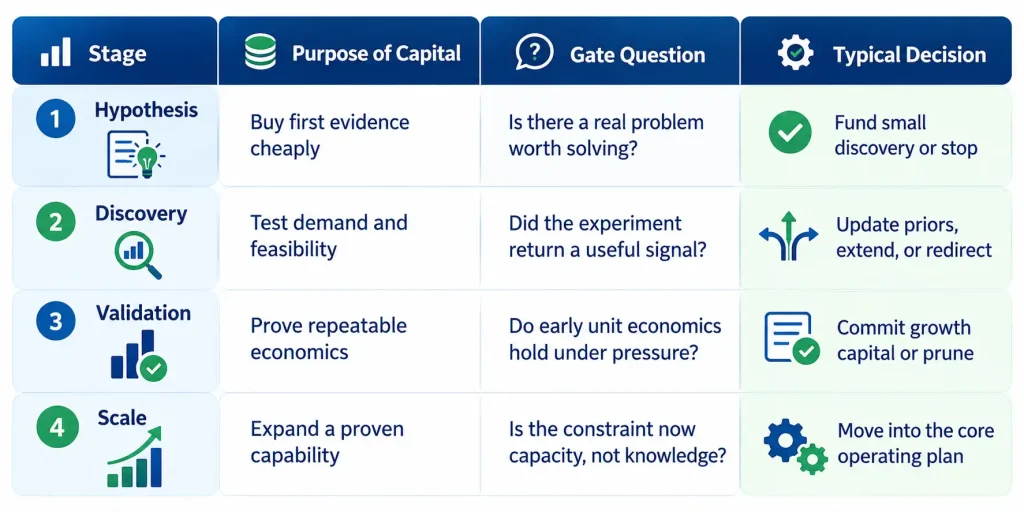
This approach is Bayesian in spirit, since teams begin with priors, spend capital to observe, and revise strategy as evidence arrives. Each gate asks what the next dollar will teach, not what the last dollar bought. Frameworks only go so far, though, because executives must also accept reporting negative ROI for several years while conviction does its work.
Capital Planning as a Belief System
A strategy deck speaks the language of aspiration, but the budget reveals what a company believes. Whatever receives funding becomes real over time, and whatever the plan omits fades from view. The CFO’s deepest influence lies in designing that structure of belief, not in approving line items.
Time is the first fault line, because annual planning clashes with innovation that moves in fits and starts. A project needing $2M this year and $20M next year may show only faint signals today. Judged on current KPIs alone, that project starves before it can learn anything useful.
Separating Exploration From Exploitation in the Capital Plan
Exploitation covers knowable returns, where finance optimizes for scale, margin, and yield. Exploration lives in fog and asks whether latent demand exists or an adjacent market might tip. Return on innovation suffers when exploitation metrics punish variance in the one place where variance is the point.
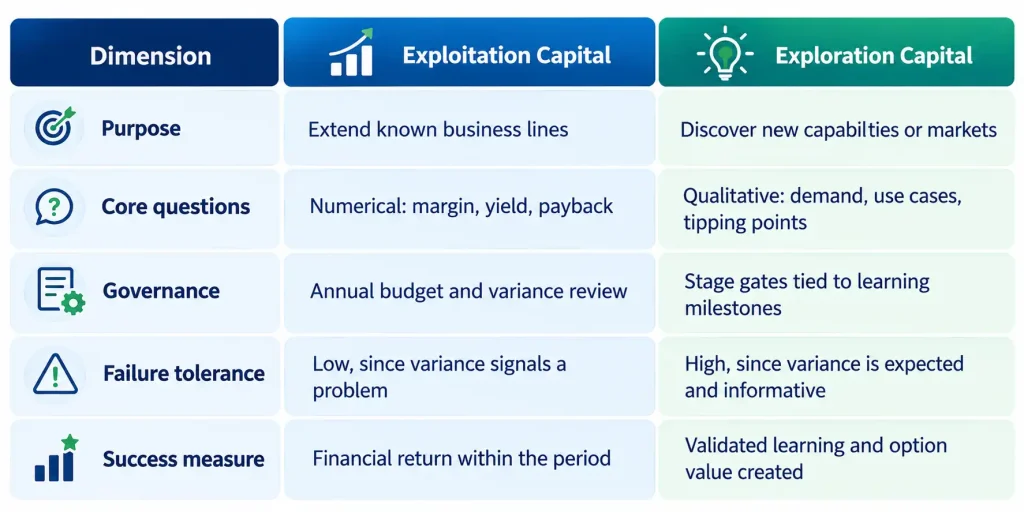
Measuring the Cognitive Return on Innovation
Every budget compresses belief, much as a signal compresses information. A plan overfitted to past performance learns little, while one that funds some unproven experiments gains the capacity to evolve. The return on innovation is cognitive as well as financial, so finance should track questions such as these:
- Did the project reshape the company’s view of its addressable market?
- Did it expose a bottleneck in the go-to-market model?
- Did it change hiring plans or capability priorities?
- Which assumption does leadership now hold that it did not hold before?
Recording these answers matters because memory is short and capital is political. A documented failure points toward the next attempt, while an undocumented success turns into mythology. Funding choices also decide whose ideas earn belief, so the CFO must balance seniority with originality and consensus with dissent.
Improving Return on Innovation Through Throughput and Constraints
Funding alone does not make innovation thrive, because ideas grow inside systems of talent, belief, and accountability. Every organization has a ceiling on how much novelty it can absorb, and capital cannot outrun it.
Finding the Bottleneck That Caps Innovation ROI
The Theory of Constraints holds that the narrowest bottleneck sets the throughput of the whole system. To raise return on innovation, the CFO must look for constraints in places like these:
- Engineering, where architectural debt slows every new experiment
- Legal, where risk aversion delays customer pilots
- Talent acquisition, where uncommon thinkers never make it through hiring
- Finance itself, where slow close cycles and weak data delay go or stop decisions
At a cybersecurity and identity access management company with $30M in ARR, the binding constraint sat inside finance. Cutting the monthly close from 18 days to 10 and building a driver-based forecast held actuals within five percent of plan for 8 consecutive quarters. That predictability gave leadership room to fund new bets with confidence.
Feedback Loops, Incentives, and the Case for Slack
Many firms run experiments without tracking lessons, confusing shipping with impact. Each funded initiative should return a short narrative on what the team tried, what failed, and which assumptions now look valid. If every initiative dies in pilot, the incentives may be at fault, not the ideas.
The capital plan draws the behavioral perimeter, so the company gets the behavior it finances. Slack completes the system, since a fully allocated organization can only optimize and never explore. Teams building a product from a blank page, as in an early HR technology venture, rely on that margin to notice what users need before any roadmap names it.
The Ethics of Long-Horizon Return on Innovation
Capital review meetings often pair pristine numbers with fragile ideas from young presenters. Every allocation is a vote of confidence in people, and that vote grants legitimacy and gathers a team. Because capital is finite, funding one direction means declining another, and every firm eventually inherits the biases of its allocators.
Temporal dislocation is the hardest ethical problem, because major innovations often pay off after the approving leader has moved on. At a mission-driven education and research institution, a $37M raise across equity and venture debt meant committing to outcomes that would outlast any one leadership team. The final ethic of innovation capital is generosity: backing a bet because it is worthy, ending what no longer deserves time, and funding the experiment that might prove the company wrong.
Three Key Takeaways
- Treat each innovation initiative as a real option and fund it in stages tied to learning milestones, so return on innovation reflects the knowledge each dollar buys.
- Split the capital plan into exploration and exploitation, each with its own governance, metrics, and failure tolerance, because one standard applied to both damages both.
- Raise return on innovation by removing the bottleneck that limits throughput, building feedback loops into every funded project, and protecting enough slack for teams to see what the roadmap missed.
Disclaimer: This article is intended for informational purposes only and does not constitute legal, tax, or accounting advice. You should consult your own tax advisor or counsel for advice tailored to your specific situation.
Hindol Datta is a four-time CFO and senior finance executive with over 25 years of leadership experience across cybersecurity, SaaS, gaming, logistics, digital marketing, medical devices, consumer products, and nonprofit organizations. He has led more than $120M in fundraising and over $150M in M&A transactions while building the financial and operational systems that let complex businesses scale with confidence. He is the author of seven books in the Systems CFO Series and holds active CPA, CMA, and CIA credentials.
AI-assisted insights, supplemented by 25 years of finance leadership experience.