
Executive Summary
A quarterly forecast is more than a number handed to the market each earnings season. Built well, it shows investors how a company thinks, learns and adjusts, and sophisticated capital values that coherence more than precision.
This article examines the quarterly forecast across four dimensions: what investors want from guidance, how to design quarterly projections with integrity, how to deliver them on earnings calls and how to build the culture behind believable guidance. The aim is to move the forecast from a compliance artifact to a strategic doctrine.
Why Every Quarterly Forecast Reflects Conviction, Not Clairvoyance
Investors armed with models, platforms and analysts still hunger for clarity of belief. Nobody on the buy side expects omniscience, but they do expect conviction that is traceable, intelligible and credible in how it corrects itself.
In too many boardrooms, the forecast becomes a shadow play, sandbagged to avoid embarrassment or inflated to court optimism. At worst, guidance turns into ritual, a hedge against sentiment instead of a window into strategy.
A credible quarterly forecast tells the market what the company believes, why it believes it and how it will adjust as it learns. That shift turns guidance into a record of reasoning and honest governance, exposing assumptions, uncertainty and the levers management intends to pull.
What Investors Want from Quarterly Guidance
On each earnings call, an analyst asks for guidance, the CFO offers a range and the market reacts. Beneath that transaction, the forecast exposes how management processes change, responds to signals and forms belief in a probabilistic world.
Epistemology offers a useful principle here, since belief earns justification only when it can survive revision. A company guiding to 8% growth earns credibility by explaining its reasoning, not by being right. It must show which assumptions support the figure, what could invalidate them and how management will respond. Seen this way, the forecast becomes a structured hypothesis, and the investor judges hypothesis quality instead of keeping score.
Why Structured Imprecision Builds More Trust Than False Precision
Research by Kahneman and Tversky shows that people overweight precise numbers, even arbitrary ones. Guidance of “$760M to $790M” can sound more confident than “the high $700Ms,” yet it may be little more than numerical theater. False precision invites distrust, while structured imprecision with transparent framing builds trust over time.
The Four Questions Behind Every Guidance Request
A request for next quarter’s guidance looks simple on the surface. In practice, four deeper questions sit beneath it:
- Is the company’s strategic inference process coherent and consistent?
- What is the aperture of uncertainty around the core assumptions?
- How quickly will management update its belief when the signal changes?
- Does this team process reality more reliably than its competitors?
Capital answers that last question through allocation and valuation multiples. A firm that shows its reasoning stays legible even when wrong, while one offering only precision becomes illegible even when right.
Designing Quarterly Projections with Narrative Integrity
A typical quarterly forecast arrives as a number paired with a tone, such as $790M in revenue with cautious optimism. That may satisfy the appetite for clarity, but it lacks substance without narrative integrity. Two habits erode it: anchoring to last quarter’s trendline and guiding to a multiple because peers did so.
Treating Assumptions as Testable Hypotheses
Sound quarterly projections begin with causal premises, not placeholders. If bookings grow at a given rate, churn holds steady and pricing realization improves, revenue should land at a specific level. Each assumption connects to a lever of control or a zone of uncertainty.
In Bayesian terms, the CFO holds a prior belief built on history, then observes new data such as FX tailwinds. The updated quarterly forecast becomes the posterior, and investors want to know what changed and by how much. A driver-based forecasting engine paired with a capacity model makes this updating routine, and variance against forecast narrows as the model matures.
Building a Guidance Range That Matches Underlying Uncertainty
In range construction, statistical form must follow communicative function. The width of the range should match the underlying volatility of the business, and management should explain what governs it.
Guidance Range Design and Investor Perception
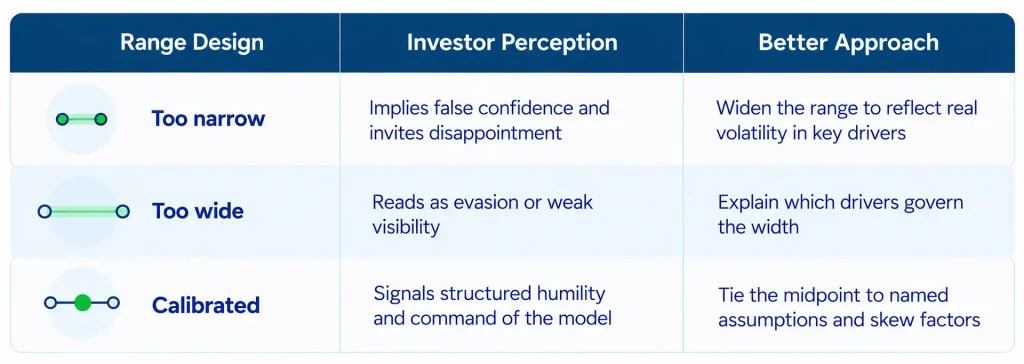
The forecast must also connect to the strategic arc, such as a quarter of absorption before margin lift. Tethered to strategy, the number becomes a waypoint that earns investor patience.
Revision, in turn, should demonstrate learning instead of admitting failure. One practical policy changes guidance only when deviation in three primary drivers exceeds defined thresholds from the base case. Sharing that policy publicly turns a fragile forecast into a robust one.
Communicating the Quarterly Forecast on Earnings Calls
On the earnings call, tone betrays truth and narrative coherence outweighs arithmetic. Investors arrive to judge whether management still understands the business, not just to collect updates.
Sequencing Assumptions Before the Number
Many firms rush guidance after the performance recap, treating the most important forward-looking artifact as a footnote. A stronger sequence lets the number arrive as the natural conclusion of a reasoning chain.
Recommended Guidance Sequence for Earnings Calls
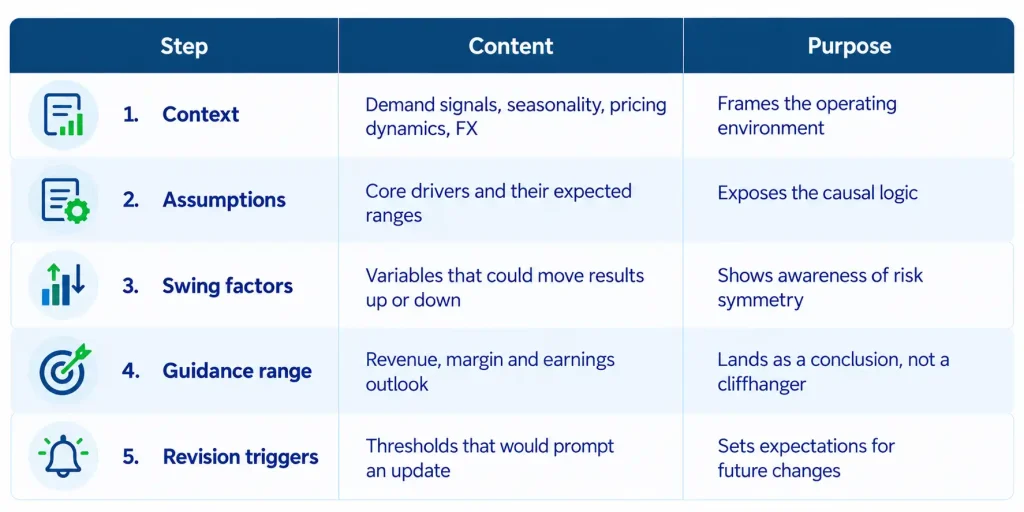
On a live call, the CFO must occupy a narrow corridor between overconfidence and hedging. Explaining that a 34% gross margin outlook depends on implementation mix is preemptive reasoning, not spin.
For multi-entity companies, a single definition of revenue across every subsidiary lays the groundwork for this clarity. When every reported figure traces back to one consistent logic, reporting cycles shorten and guidance becomes easier to defend.
Visual Tools That Frame Uncertainty Without Inviting Panic
Post-call materials can elevate belief, and two visual tools do most of the work:
- A forecast bridge chart shows movement from the prior quarter to the new forecast, with overlays for volume, pricing and FX.
- A confidence cone, borrowed from central banks, displays the volatility range across coming quarters.
Correcting a Missed Forecast
Downward revisions require rebuilding trust, not a perfunctory apology, and a credible correction message covers three layers:
- What was wrong, stated plainly and without euphemism
- Why it was wrong, traced to a specific assumption
- What will now change in the thinking process
A revision explaining that new sales hires ramped slower than modeled, and that pacing assumptions now include a 30% longer cycle, shows structural learning. Transparency of that kind earns reputational compound interest.
Building an Internal Quarterly Forecast Culture
External believability rests on internal honesty about what the numbers mean. Many companies suffer from forecast fatigue, where teams hear “tighten the number” while knowing the inputs are poorly understood. In those cultures, the forecast reflects internal politics more than external reality.
Distributed Inputs with Central Interpretation
Strong quarterly projections draw on intelligence from sales, supply chain, marketing and product, then pass through a central analytical lens. FP&A orchestrates contributors, adjudicates logic and distills one belief the company owns collectively. Monthly reviews then become causal seminars that ask which assumption failed and what that reveals about the system.
Scenario Fluency and Forecast Retrospectives
Scenario fluency goes beyond best, base and worst cases to show which variables dominate outcomes and interact non-linearly. In inventory-heavy businesses, demand planning and SKU rationalization succeed only when the forecast isolates the variables that drive inventory turns and cash conversion.
After each quarter closes, a retrospective should assess model quality, anchored by three questions:
- Which assumptions held, and which ones failed under pressure?
- Where did the model underweight volatility in key drivers?
- What patterns have emerged in model deviation over time?
Elasticity Policies and the Forecasting Ethic
Forecast elasticity policies set a dynamic risk framework, so when deviations cross a defined threshold, the firm debates whether to update public guidance or expect reversion. These rules prevent both knee-jerk revisions and inertia, which matters most during downturns.
The CFO must also protect the forecasting ethic: the company will not pretend to know more than it does, but it will be transparent about what it believes. Once forecasting becomes theater, it stops being leadership in any meaningful sense.
Three Key Takeaways
- A quarterly forecast earns credibility through visible reasoning, not precision alone. Investors reward guidance that names its assumptions, explains its range and shows how management will update its view.
- Quarterly projections work best when designed and delivered as causal narratives. Sequence assumptions before the number, use bridge charts and confidence cones, and formalize revision thresholds as policy.
- External believability depends on a disciplined internal forecasting culture. Distributed inputs, scenario fluency, blameless retrospectives and elasticity policies build a quarterly forecast the whole organization can stand behind.
Disclaimer: This article is intended for informational purposes only and does not constitute legal, tax, or accounting advice. You should consult your own tax advisor or counsel for advice tailored to your specific situation.
Hindol Datta is a four-time CFO and senior finance executive with over 25 years of leadership experience across cybersecurity, SaaS, gaming, logistics, digital marketing, medical devices, consumer products, and nonprofit organizations. He has led more than $120M in fundraising and over $150M in M&A transactions while building the financial and operational systems that let complex businesses scale with confidence. He is the author of seven books in the Systems CFO Series and holds active CPA, CMA, and CIA credentials.
AI-assisted insights, supplemented by 25 years of finance leadership experience.