
Executive Summary
The pre-seed vs seed distinction can look like a question of vocabulary, yet it now marks two separate stages of company formation. Each stage carries its own capital expectations, investor behavior and standard of founder readiness. Founders who blur the two often raise the wrong amount, from the wrong investors, on terms that complicate every round that follows.
This article maps both stages across round size, instruments, traction, valuation and diligence. It then turns to strategy, covering how to shape the narrative, protect the cap table, plan milestones between rounds and choose investors who will still matter at Series A.
Pre-Seed vs Seed: How the Earliest Stage of Venture Capital Took Shape
A seed round once meant the first outside capital a startup ever accepted. That money funded initial product development and early go-to-market planning. Over the last decade, a surge of available capital and changing founder needs carved out an earlier lane, now known as pre-seed. The two rounds are no longer simply early and earlier, because they answer different questions for different investors at different moments in a company’s life.
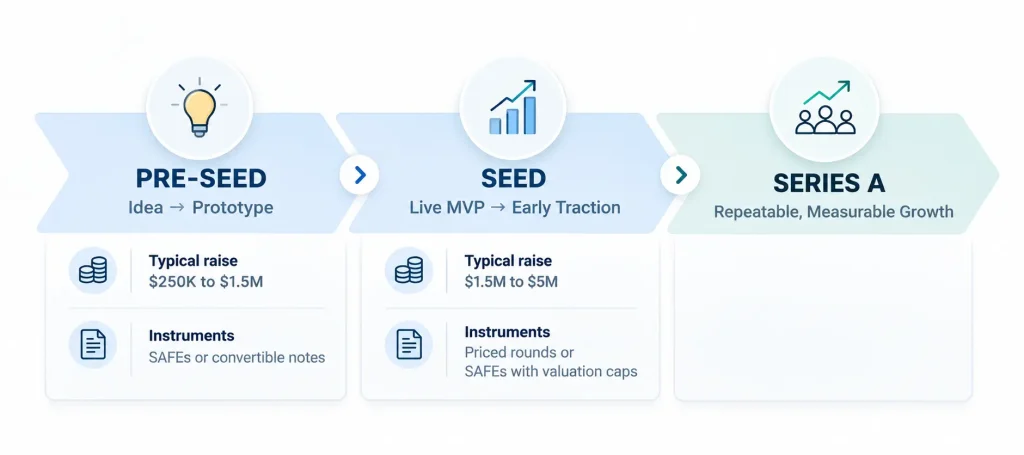
Pre-Seed Funding at a Glance
- Stage: idea to prototype
- Typical raise: $250K to $1.5M
- Instruments: SAFEs or convertible notes
- Investor type: angel investors, pre-seed VC funds and accelerators
- Use of funds: founding team salaries, early product build and market research
The Seed Stage at a Glance
- Stage: MVP in market with early traction
- Typical raise: $1.5M to $5M
- Instruments: priced rounds or SAFEs with valuation caps
- Investor type: seed VC funds, micro-VCs and institutional investors
- Use of funds: hiring, early customer acquisition and infrastructure
Team and Product Maturity at Each Stage
At pre-seed, the company is often a single founder or a small founding group. The product is either unbuilt or an MVP still in development. Hypotheses are tested through user interviews, not usage data, so conviction rests on conversations instead of dashboards.
By the seed stage, investors expect a defined founding team with both technical and go-to-market capability. The MVP should be live and acquiring early users. Traction should be measurable, even when modest, and retention or engagement figures carry more weight than headline growth.
Founder-led product builds show how wide this gap can be. An HR technology venture taken from concept through launch had to move through market research, product design, technology selection and go-to-market planning before any usage data existed. Each of those steps consumed pre-seed capital without producing seed-grade evidence, which is normal and should be budgeted for.
Traction Metrics That Separate Pre-Seed from Seed
Investors read traction differently at each stage, and founders benefit from knowing which signals matter when. The comparison below summarizes the shift from qualitative promise to quantified behavior.
Pre-Seed vs Seed Traction Expectations
| Metric | Pre-Seed | Seed |
| Product | In development or early MVP | MVP launched and iterating |
| Users | Friends, family and beta testers | Early customer base |
| Revenue | Rare or negligible | Early ARR or usage-based revenue |
| Retention and engagement | Anecdotal or qualitative | Quantified behavioral metrics |
The table shows that seed investors want evidence of behavior, not statements of intent. A pre-seed founder can point to interview notes and a waitlist. A seed founder needs cohort data that shows users returning without being chased.
Valuation and Dilution Benchmarks for Pre-Seed and Seed
Valuation ranges move with market cycles, sector and geography, so the commonly cited benchmarks below work as reference points, not promises.
- Pre-seed valuation: $3M to $10M, with a median near $7M
- Seed valuation: $8M to $20M, with a median between $12M and $15M
- Pre-seed dilution: 10% to 15%
- Seed dilution: 15% to 25%
Dilution compounds across rounds, and a founder who gives away 15% at pre-seed and 25% at seed has parted with more than a third of the company before Series A. That arithmetic should shape every early negotiation over price and terms.
What Investors Expect in Pre-Seed vs Seed Diligence
Diligence at Pre-Seed
Pre-seed investors back the founder’s insight, narrative and the uniqueness of the vision. Decisions often come within two or three meetings. Diligence stays light, with no audited financials and only basic projections.
Diligence at the Seed Stage
Seed diligence goes deeper, covering cohort metrics, CAC experiments and references on the team and advisors. Term sheets become more formal, and governance structures start to appear. A venture-backed digital marketing company that later scaled from $9M to $180M in revenue relied on CAC, lifetime value and contribution margin discipline built early. That same discipline is what seed investors probe, often before founders feel ready to show it.
Crafting the Pre-Seed vs Seed Fundraising Narrative
Capital follows the story a founder can credibly tell, not simply the stage on the calendar. The narrative must therefore change as the company moves between rounds.
At pre-seed, the story must explain why the solution feels inevitable. Investors want to know what unique angle the founder brings and why this founder should test this hypothesis. Storytelling should rest on insight, with ambition playing a supporting role.
At seed, the story moves from what could work to what is beginning to work. Data should carry the thesis, including early retention, customer testimonials and cohort behavior. The strongest seed narratives tie the long-term vision to the first signs of traction.
A pre-Series A AI governance and assurance platform offers a useful example. Its operating model, multi-year scenario analysis and investor narrative had to be built from nothing. The scenarios gave the story structure, and the story gave the scenarios a purpose investors could follow.
Building the Cap Table with Foresight
At pre-seed, founders often give away equity casually in exchange for speed or validation. By seed, that dilution becomes consequential, and professional investors will examine every line.
Practical guidelines for a clean cap table include:
- Keep pre-seed dilution under 15% where possible
- Avoid overloading the cap table with many small SAFE holders
- Reserve roughly 15% for an employee stock option pool by the seed round
- Formalize vesting schedules for every founder and early employee
- Clean up informal equity promises and handshake agreements before diligence begins
Milestone Planning Between Pre-Seed and Seed Rounds
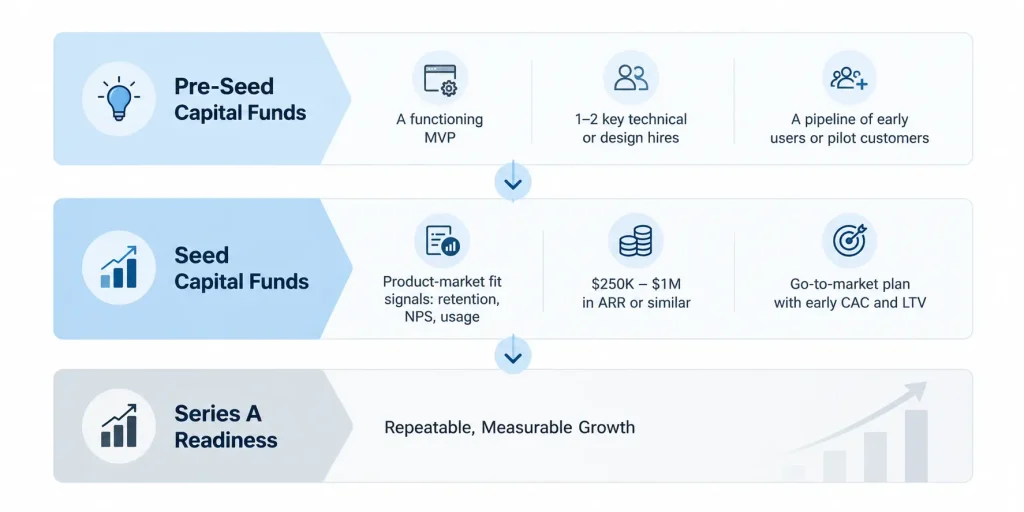
Each round should fund a specific set of milestones that unlock the next one. Raising without that map leads to capital that runs out before the evidence arrives.
Milestone Flow Diagram
Valuation Negotiation and Investor Fit
Choosing Investors at Pre-Seed
Chasing the highest valuation at pre-seed rarely pays off. Long-term alignment matters more, so founders should favor investors who can help raise the next round.
Choosing Partners at the Seed Stage
Founders hold more pricing leverage at seed, but anchoring the round on valuation alone is a mistake. The better partners keep working after close, offering customer introductions and talent referrals.
Balancing Speed and Signal
Pre-seed rounds can close quickly, yet speed can create problems later when:
- The round was too small to reach meaningful traction
- The terms were poorly structured
- The investors are neither supportive nor visible
Seed rounds, by contrast, should be signal-generating events for the market. Strong lead investors bring clear brand value and a history of supporting companies through Series A. They also syndicate thoughtfully instead of filling the round with passive names.
Operational Discipline Once the Seed Stage Begins
By seed, the startup becomes a business, and it must operate like one. That shift requires a few operating basics to be in place:
- Financial tracking, even if it starts simple
- A customer CRM with engagement tracking
- A data room holding projections, a hiring plan and the product roadmap
The cost of skipping these basics shows up fast. An early-stage email marketing technology company once had to cut monthly burn from $800K to $200K through an operational turnaround. Controls and reporting built earlier would have surfaced that burn long before it became a crisis. Similarly, a venture-backed manufacturing company gained its first real financial visibility only after a chart of accounts, internal controls and forecasting model were built from a blank page.
Raising Right, Not Just Raising Fast
The difference between pre-seed and seed is not only one of dollars and valuation. It reflects a shift in founder mindset, investor expectations and business maturity. Founders who raise with intent, build cap tables with foresight and treat capital as a tool for acceleration rather than validation position themselves for durability, not just the next round.
Three Key Takeaways
- Pre-seed vs seed is a difference in evidence, not just round size, because pre-seed funds a credible hypothesis while seed funds early proof that the hypothesis is working.
- Cap table decisions made casually at pre-seed become expensive at seed, so founders should cap early dilution, limit small SAFE holders and formalize vesting before diligence begins.
- Every round should buy specific milestones, and the right investors are those who help reach the next round, not those who offer the highest headline valuation.
Disclaimer: This article is intended for informational purposes only and does not constitute legal, tax, or accounting advice. You should consult your own tax advisor or counsel for advice tailored to your specific situation.
Hindol Datta is a four-time CFO and senior finance executive with over 25 years of leadership experience across cybersecurity, SaaS, gaming, logistics, digital marketing, medical devices, consumer products, and nonprofit organizations. He has led more than $120M in fundraising and over $150M in M&A transactions while building the financial and operational systems that let complex businesses scale with confidence. He is the author of seven books in the Systems CFO Series and holds active CPA, CMA, and CIA credentials.
AI-assisted insights, supplemented by 25 years of finance leadership experience.