
Executive Summary
Pre-money and post-money valuation are two of the most quoted terms in venture finance, yet many founders use them without grasping what they decide. The gap between the two numbers is the new capital, and it sets dilution, ownership, and board dynamics.
The arithmetic reveals where hidden dilution lives in option pools and SAFEs. It also guides when to push for a higher number, accept a modest one, or tie a round to milestones.
What Is Pre-Money and Post-Money Valuation?
Pre-money valuation is the value a company carries immediately before a new round of investment. It reflects how investors judge performance, team, traction, and prospects. Post-money valuation is the value immediately after the round closes, and it includes the new capital.
The Core Valuation Formula
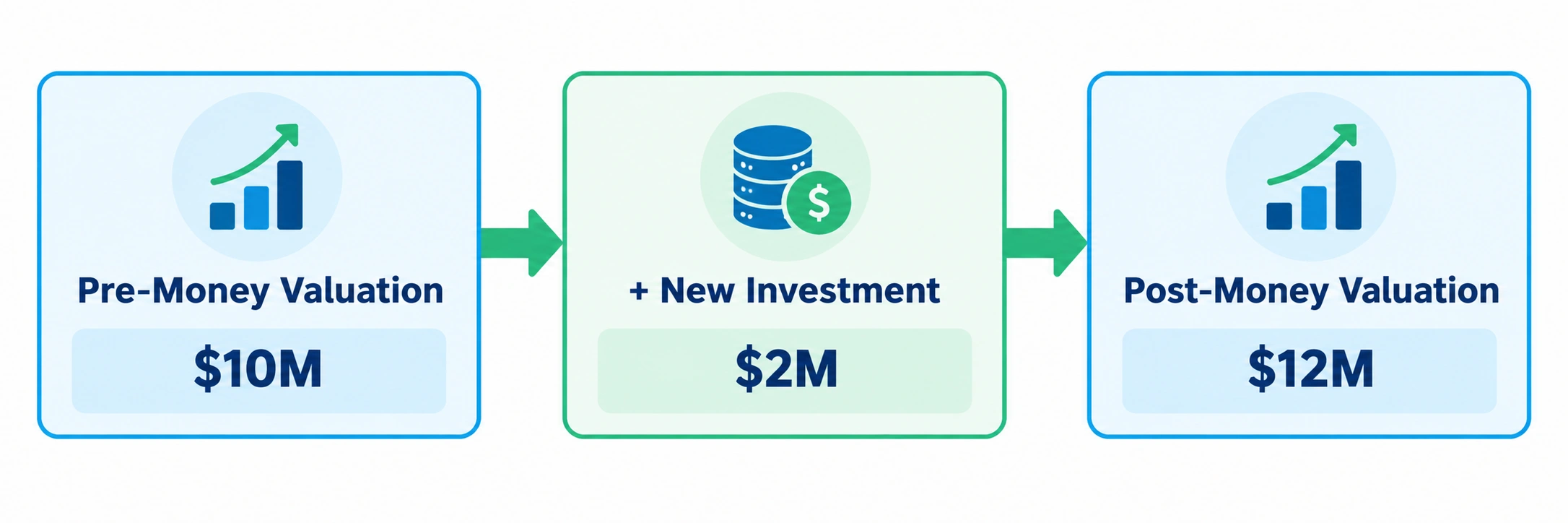
A company valued at $10M pre-money that raises $2M has a post-money valuation of $12M. The new investor owns $2M divided by $12M, or roughly 16.7% of the company. The pre-money figure, divided by fully diluted shares, also sets the price per share.
Why Pre-Money vs Post-Money Valuation Matters
A valuation is more than a number on a term sheet. It works as a mechanism of control, ownership, and signaling, and it shapes three outcomes:
- Equity dilution: the share of the company new investors will own after closing
- Founder ownership: the portion of the cap table that stays with early stakeholders
- Investor signal: how the broader market reads the company’s momentum and pricing
The Mechanics of Dilution
Dilution is the price of outside capital, and it compounds across rounds. Suppose a founder owns 100% of a company and raises $1M on a $4M pre-money valuation. The post-money valuation becomes $5M, the investor holds 20%, and the founder now owns 80%.
| Stage | Company Value | Founder Stake | Investor Stake |
| Before the round | $4M | 100% | 0% |
| After the round | $5M | 80% | 20% |
What matters most is how today’s price shapes tomorrow’s options. One venture-backed digital marketing company raised $36.5M across Series A through C while revenue grew from $9M to $180M. Its finance function modeled each round for its effect on the next, not only its headline price.
Negotiation Anchors
Founders tend to anchor valuation talks on the pre-money figure. Investors often steer toward post-money framing, especially when they want the option pool expanded. Each framing protects a different party at the table:
- Pre-money anchoring protects founder ownership.
- Post-money anchoring gives investors clarity on their effective stake.
The framing also changes how the employee stock option pool (ESOP) lands. A 15% pool measured post-money can dilute founders more than a 15% pool measured pre-money, depending on the calculation sequence.
ESOP: The Hidden Dilution in Pre-Money and Post-Money Valuation
Option pools are where founders most often lose ownership unnoticed. Investors frequently ask for a pool sized against the post-money cap table but created inside the pre-money valuation. This arrangement, known as the option pool shuffle, places the full cost of the pool on existing shareholders.
How the Option Pool Shuffle Works
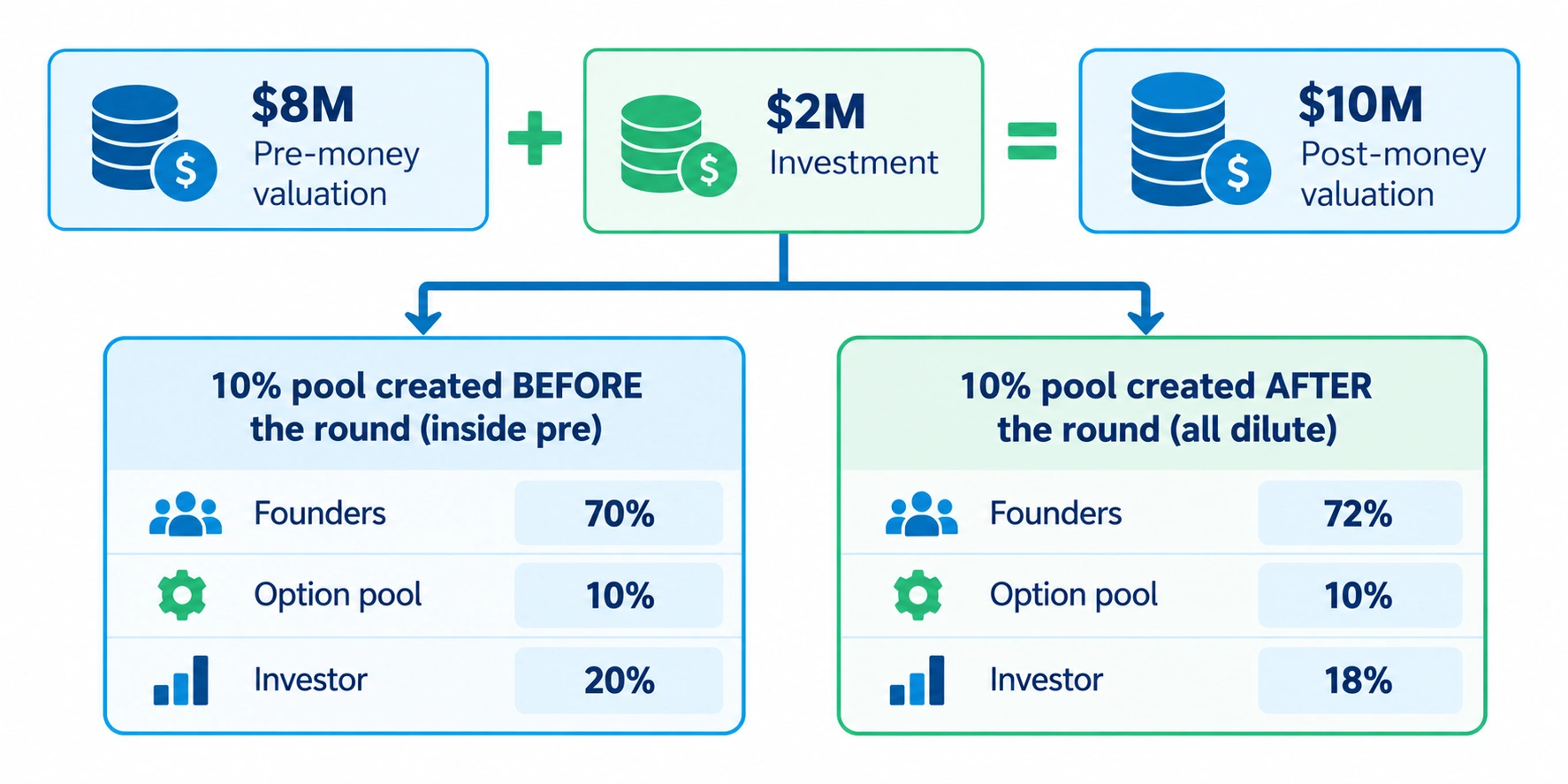
In this example, the shuffle costs founders two extra points of ownership. Put another way, a 10% post-money pool equals 12.5% of the pre-money share base. Founders absorb that dilution alone, and their effective pre-money valuation drops from $8M to $7M. Knowing where the pool sits can decide between control and compromise.
Signaling, Market Psychology, and Governance
A higher valuation can signal traction, validation, and competitive tension. Inflated valuations, however, tend to backfire in predictable ways:
- They raise the bar for the next round.
- They create pressure on growth and revenue metrics.
- They increase the risk of a down round if momentum slows.
Founders have to balance optics with fundamentals, because the valuation story must survive contact with real numbers.
Governance Follows Price
Valuation also shapes governance, since higher prices attract institutional investors who expect board seats, oversight, and protective provisions. A company raising at $40M with $100K in monthly recurring revenue may win the headline and lose the boardroom. One mission-driven education and research institution raised $37M in equity and venture debt. Its finance leadership staffed the audit committee and built monthly board reporting that matched investor expectations.
Pre-Money vs Post-Money in SAFEs and Convertible Notes
SAFEs and convertible notes often defer the valuation conversation until a priced round, and two terms decide how they convert:
- Valuation cap: the maximum valuation at which the instrument converts into equity
- Discount: a reduced conversion price that rewards early investors for taking risk
A pre-money SAFE converts before the new money enters, so SAFE holders dilute alongside founders. A post-money SAFE fixes the holder’s ownership percentage across the entire raise, which shifts more dilution onto founders as additional SAFEs stack up. Founders should confirm which structure they are signing and model cap table outcomes under both.
Valuation as Narrative, Not Fact
A valuation is not intrinsic truth but a hypothesis about future value, built jointly by founders and investors. It rests on data, yet belief drives it, and five forces shape that belief:
- Market comparables
- Revenue multiples
- Team credibility
- Product momentum
- Investor fear of missing out
Seen this way, a $20M valuation is a negotiated assumption about future outcomes, not a declaration of worth.
When to Prioritize Valuation and When to Let It Go
Situations That Favor a Higher Valuation
Founders have good reason to push for a higher number in three situations:
- Metrics and momentum are strong.
- Multiple term sheets are on the table.
- A major inflection point is near, such as a product launch or Series A.
In these conditions, a higher valuation defends the cap table, funds strategic hiring, and attracts stronger investors.
Situations Where Valuation Should Come Second
Valuation becomes secondary in a different set of conditions:
- The company needs capital quickly to survive.
- The investor brings high strategic value.
- Market sentiment is bearish.
Here, survival, speed, and alignment outweigh dilution concerns. Many enduring companies began with modest valuations and strong syndicates. An early-stage email marketing technology company offers a useful case, having cut monthly burn from $800K to $200K in a turnaround where runway mattered more than price.
The Trap of Overvaluation and the Virtue of Restraint
What Overvaluation Costs
An inflated valuation tends to create three problems for a growing company:
- It limits future investor appetite.
- It can trigger down rounds with punitive terms.
- It misaligns expectations between the board and the operating team.
Overvalued companies often chase metrics to justify their price instead of serving customers. Many end up raising capital to protect a narrative instead of building fundamentals.
Why a Conservative Valuation Often Wins
A fair or slightly conservative valuation leaves room to grow into the price. It tends to attract high-performing investors, create space for a future markup, and set up stronger follow-on rounds. Airbnb and Atlassian both raised early rounds at modest valuations. Those choices left room for momentum and repeat participation by the same investors.
Scenario Planning for Pre-Money and Post-Money Valuation
Valuation is one step in a longer journey, and scenario models make that journey visible. Founders should model three things before any raise:
- Capital needs across three to five future rounds
- Expected dilution under different valuation paths
- Founder ownership at exit under each scenario
A higher valuation today can cost leverage later, while a balanced valuation preserves options. A marketplace SaaS company raising a $20M Series B shows the value of this work. Its cohort and unit economics models anchored investor diligence and held up under scrutiny.
Strategic Leverage Points and Milestone Alignment
Founders can strengthen their valuation position through four levers:
- Hitting clear KPIs before the raise begins
- Creating competitive term sheet dynamics
- Including tier-one investors whose presence acts as a signal
- Expanding the addressable market with a credible go-to-market plan
Valuation is less about arguing a number than demonstrating a trajectory, because momentum sets price.
Tying Each Round to Milestones
Each valuation should map to concrete progress in three areas:
- A clear product and go-to-market milestone
- A defined team buildout plan
- A tangible change in market footprint
This alignment keeps the valuation story defensible at Series A, Series B, and beyond.
Conclusion: Valuation as a Strategic Instrument
Valuation is neither enemy nor savior; it is a tool. Calibrated well, it advances the mission, aligns stakeholders, and preserves optionality. The line between pre-money and post-money valuation may look like simple arithmetic, but it decides who holds control as a company grows. In the end, the valuation a company earns matters more than the one it starts with.
Three Key Takeaways
- Post-money valuation equals pre-money valuation plus new investment, and that formula determines how much of the company new investors own. Model every round for its effect on the next one.
- Option pools and SAFE structures are where hidden dilution lives. Before signing, confirm whether the pool sits inside the pre-money valuation and whether a SAFE is pre-money or post-money.
- A fair, milestone-backed valuation usually beats an inflated one. It attracts stronger investors and leaves room to grow into the price.
Disclaimer: This article is intended for informational purposes only and does not constitute legal, tax, or accounting advice. You should consult your own tax advisor or counsel for advice tailored to your specific situation.
Hindol Datta is a four-time CFO and senior finance executive with over 25 years of leadership experience across cybersecurity, SaaS, gaming, logistics, digital marketing, medical devices, consumer products, and nonprofit organizations. He has led more than $120M in fundraising and over $150M in M&A transactions while building the financial and operational systems that let complex businesses scale with confidence. He is the author of seven books in the Systems CFO Series and holds active CPA, CMA, and CIA credentials.
AI-assisted insights, supplemented by 25 years of finance leadership experience.