
Executive Summary
A deal that closes cleanly can still fail quietly. The capital wires, the term sheet settles, and the organization exhales, but what follows in the first hundred days is where the real transaction occurs. Post-merger integration is not a project management exercise. It is a leadership test. Founders and CEOs who treat this period as a stabilization exercise, rather than a strategic reset, tend to lose ground slowly and then suddenly: through attrition, misalignment, and cultural drift. This article draws on thirty years of operational CFO experience across venture-backed and private equity-backed firms to examine what the first hundred days demand of founders, why systems thinking is the essential discipline, and how to build the operational architecture that allows a newly funded or acquired business to grow without fracturing.
What the First 100 Days Are Really For
There is a common instinct, in the immediate aftermath of a deal, to move fast. New capital feels like permission. Investors arrive with expectations. The organization watches and waits for signals. But the founders who navigate this period most successfully are not the ones who move fastest. They are the ones who understand what this window is actually for.
The first hundred days are not for revolution. They are for reinitialization. The task is to reinforce what works, reaffirm who leads, and restate the purpose that predates the transaction. Every organizational system, whether a startup of twenty or a firm of two thousand, carries embedded assumptions about how decisions get made, what behavior gets rewarded, and what the company ultimately stands for. A deal closing does not erase those assumptions. It tests them.
The founder’s role in this period is to hold the pen. Investors bring leverage and a portfolio-level perspective. The founder brings specificity: the edge cases, the cultural fault lines, the nonlinear relationships between one hire and team velocity, between one support failure and customer churn. That specificity is not a soft quality. It is the most valuable input the organization has access to in a moment of transition.
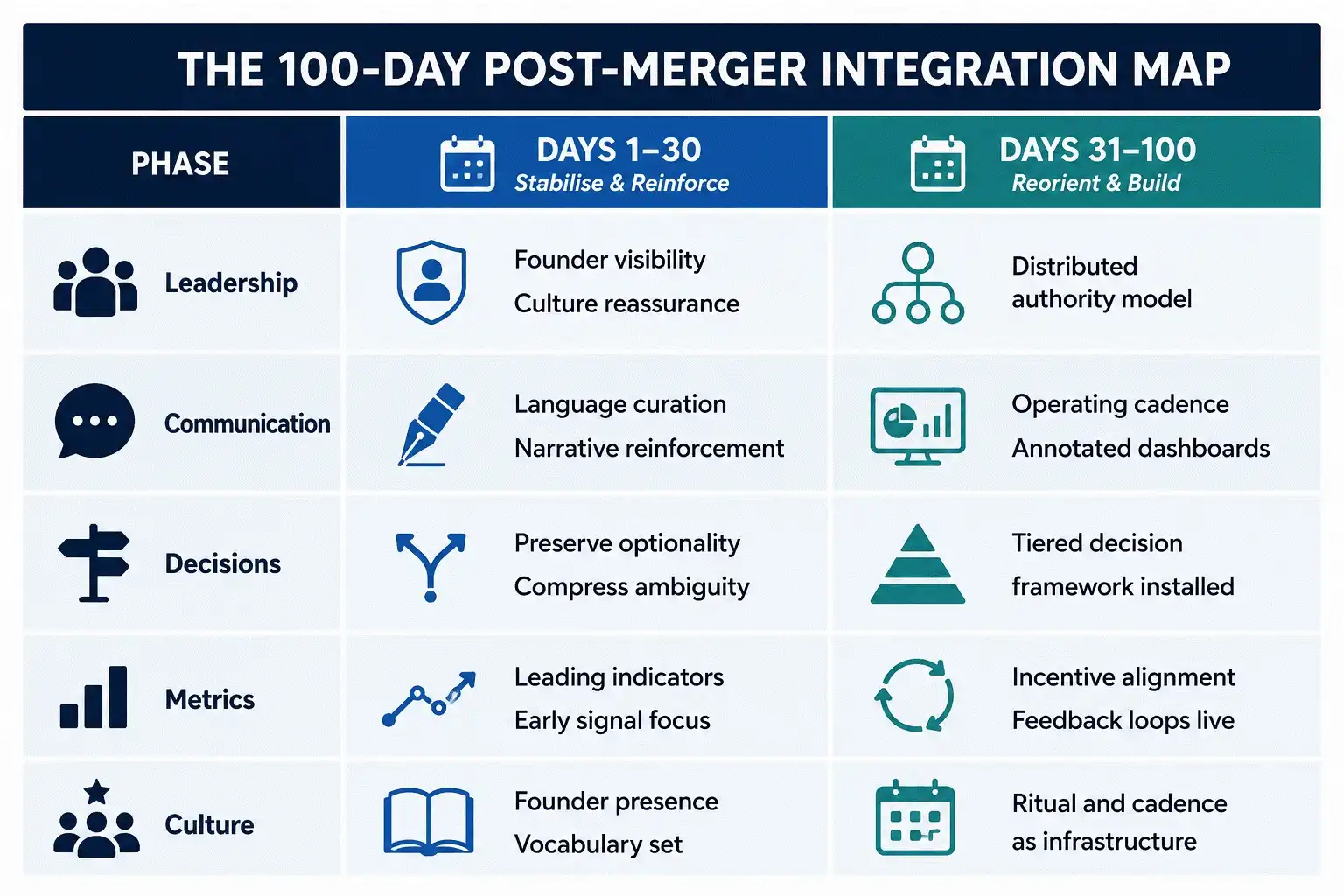
Phase One: Stabilise Before You Reorient
The Cost of Premature Disruption
Systemic shocks, even when rationally justified, carry long tail effects. Attrition among the people who hold institutional knowledge. Misalignment between teams that were previously coordinated. Operational entropy that accumulates faster than new structures can contain it. The founder who arrives with a restructuring mandate on day three is not demonstrating decisiveness. That founder is spending trust that has not yet been earned in the new configuration.
The first thirty days demand a different posture. Walk the floor. Join the onboarding calls. Lead the management syncs. Culture notices presence. It also notices its absence. A founder who reasserts their voice early makes it easier for the broader organization to trust the transition, because transition without a visible leader defaults to anxiety.
Language is one of the most underestimated levers available in this phase. The vocabulary used in all-hands meetings, board decks, and internal memos begins to shape the organization’s self-perception almost immediately. A management team that speaks exclusively about burn, margin, and pipeline signals fear or financial pressure. One that speaks about purpose, product, and people signals possibility. The founder must curate this vocabulary with deliberate intent, because in an organization navigating transition, language is a control variable.
The distinction between capital efficiency and cost cutting is one I have applied in practice. In a post-acquisition leadership meeting, when a new ownership group moved immediately toward budget elimination, I reframed the conversation around value per dollar rather than what could be removed. That linguistic shift altered the operating model for the following quarter. The founder backed it. The team aligned. The culture held.
Phase Two: From Reassurance to Architecture
Building the Decision System
By the time the first month closes, the founder’s role must evolve. The work of reassurance gives way to the harder task of building the systems through which the organisation will make decisions, distribute authority, and sustain momentum at scale.
Most founder-led businesses begin with an ad hoc decision structure. Intuition, speed, and closeness to the problem serve well when the team is small and uncertainty is high. After funding or acquisition, the complexity of decisions increases, and so does the cost of error. A tiered decision model addresses this directly:
- Reversible, low-impact decisions are delegated fully to team leads without escalation.
- High-impact but reversible decisions move through cross-functional vetting before resolution.
- Irreversible decisions, particularly those affecting capital allocation or cultural direction, remain with the founder or chief executive.
The benefit of this model extends beyond speed. It eliminates the organizational tax of ambiguity: the exhausting, invisible cost of a team uncertain about which forum addresses which type of issue. In post-merger integration, ambiguity is not merely inefficient. It is contagious.
Incentive Design and Operating Cadence
Two further pillars of this phase deserve deliberate attention: how the organization rewards performance, and how it structures its operating rhythm.
Compensation structures frequently lag behind strategy in the wake of a deal. I have seen companies misfire by over-indexing on top-line goals while margin pressures accumulate silently. The founder must rewire incentives to drive the business the organization is becoming, not the one it was. This means:
- Aligning sales compensation to quality of revenue rather than volume alone.
- Tying product milestones to time-to-value rather than feature release cadence.
- Structuring bonuses that reinforce cross-functional outcomes rather than siloed performance.
Incentives, like any control system, produce behavior. If the founder does not shape them intentionally in this window, the organization’s behavior will be shaped by the defaults embedded in whatever spreadsheet preceded the deal.
Operating cadence deserves equal attention. Weekly stand-ups, monthly all-hands meetings, and quarterly strategy offsites are not administrative obligations. They are rituals, and rituals shape behavior. A well-designed cadence reduces decision latency, increases shared context, and maintains cultural rhythm across a period when all three are under pressure. Having guided finance functions through integration across sectors including cybersecurity, SaaS, gaming, and logistics, I have observed consistently that organizations where the founder leads these forums retain cultural coherence. Those where the founder retreats into one-on-ones and investor meetings tend to fragment.
Information Flow and the Value of Early Signals
One of the clearest lessons from overseeing more than one hundred and fifty million dollars in M&A transactions across multiple industries is that the quality of a post-merger integration depends heavily on the quality of information flowing upward and across the organization during the first hundred days.
Operational dashboards serve two functions in this period. The first is tracking. The second, and frequently the more valuable, is teaching. What gets measured consistently communicates what the organization prioritises. But what gets interpreted publicly teaches the team how to think. An annotated dashboard, one that pairs a metric with an explanation of why it moved, creates real-time case studies that shape cognitive models across every level of management.
Upward feedback systems are equally important. Monthly skip-level conversations, anonymous pulse surveys, and structured retrospectives allow founders to harvest edge data: the early signals that precede systemic failure. A pattern flagged by a customer support representative, or a delivery friction noted by an engineer, is not an anecdote. It is an early signal with high marginal value in an environment where information is still incomplete. The founder who builds the structures to capture these signals gains a form of organizational intelligence that no dashboard can replicate.
Preserving Narrative Integrity Through the Transition
A post-deal organization risks becoming a vessel for investor expectations rather than the continuation of a founding intent. If the only story being told internally is the exit narrative, the organization’s sense of purpose begins to atrophy. Founders who have led their companies through significant inflection points understand that the original question that gave rise to the company’s formation, however it has evolved, remains the most powerful source of organizational cohesion available.
One practice I have implemented in more than one organization is a single-page narrative document that traces the company’s purpose from its earliest prototype to its current market position, connects that purpose to measurable customer impact, and explains how the metrics being tracked reflect mission execution. Read aloud at quarterly planning sessions, it functions as an anchor during periods when strategy is evolving and the organization most needs to remember what it is building toward.
Conclusion
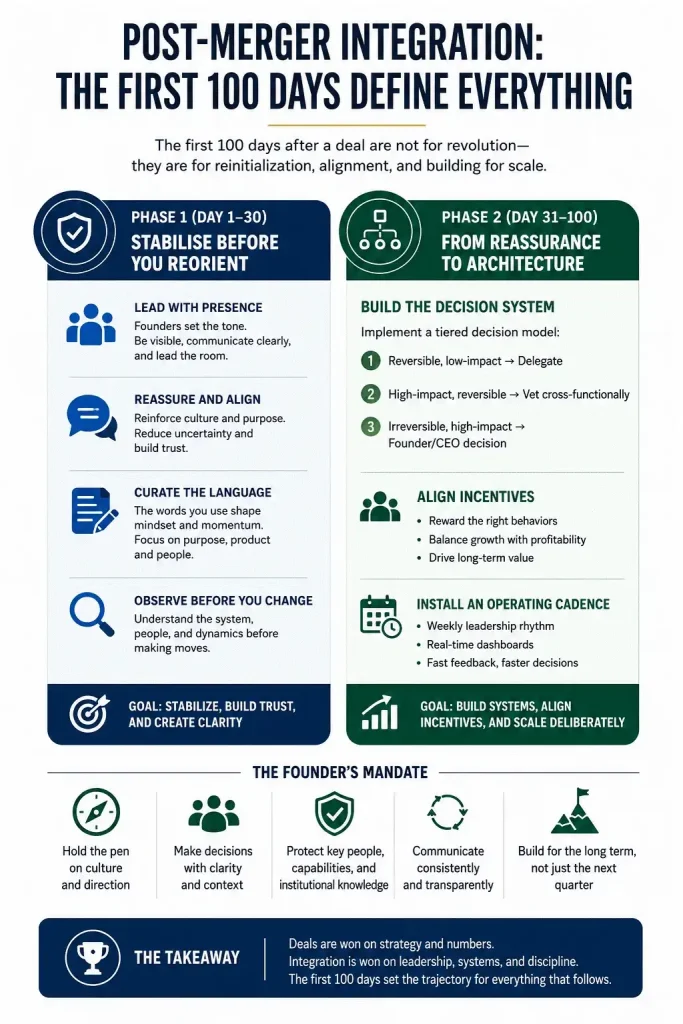
Post-merger integration does not succeed or fail at the closing table. It succeeds or fails in the hundred days that follow, in the decisions made under pressure, the culture either held or allowed to drift, and the systems either installed deliberately or left to chance. The founder who approaches this period as a systems architect rather than a caretaker of the past, who holds the narrative while distributing authority, who curates language as carefully as capital, and who builds feedback loops before they are urgently needed, creates an organisation capable of growing without fracturing. The hundred-day plan is not a project. It is a prototype of the company the founder intends to build.
Disclaimer: This blog is intended for informational purposes only and does not constitute legal, tax, or accounting advice. You should consult your own tax advisor or counsel for advice tailored to your specific situation.
Hindol Datta is a seasoned finance executive with over 25 years of leadership experience across SaaS, cybersecurity, logistics, and digital marketing industries. He has served as CFO and VP of Finance in both public and private companies, leading $120M+ in fundraising and $150M+ in M&A transactions while driving predictive analytics and ERP transformations. Known for blending strategic foresight with operational discipline, he builds high-performing global finance organizations that enable scalable growth and data-driven decision-making.
AI-assisted insights, supplemented by 25 years of finance leadership experience.