
Executive Summary
Portfolio diversification strategies in private equity are usually judged by how many sectors, stages, and geographies a fund can fit onto a single slide, yet the real test arrives when stress forces those holdings to move together. This article examines where the classical approach to risk spreading holds up, where it misleads, and how deliberate concentration and adaptive design can work alongside it.
CFOs, CIOs, and fund leaders will find a practical framework for measuring true independence across holdings, sizing conviction bets, and building a portfolio that learns from error.
Why Classical Diversification Falls Short in Private Equity
Portfolio diversification has been treated as prudence incarnate for decades, and in public markets it reduces to arithmetic, but private equity ties founders, regulators, and competitors into feedback loops that no correlation matrix fully captures.
Sector, Stage, and Structure as First Defenses
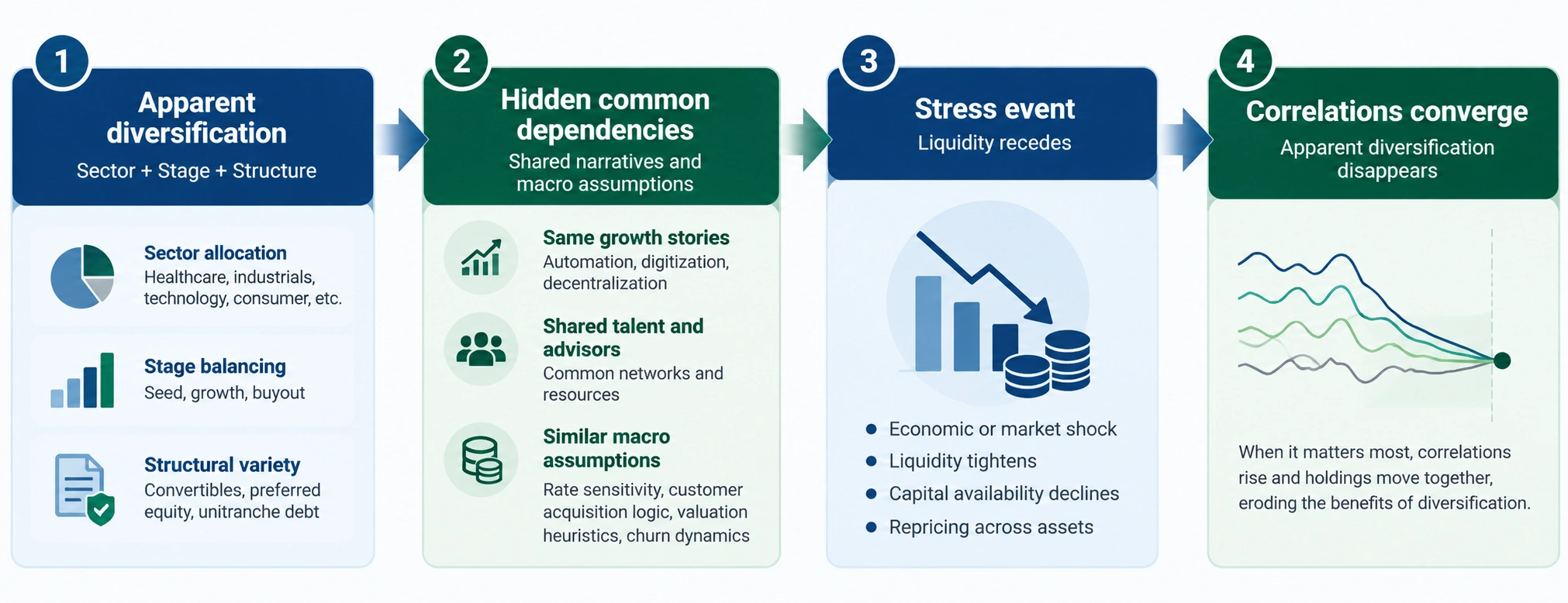
The classical approach to portfolio diversification strategies rests on three levers that most fund presentations recite.
- Sector allocation spreads exposure across healthcare, industrials, technology, and consumer verticals so that one downturn does not dominate results.
- Stage balancing combines seed, growth, and buyout investments to ladder exposure across company maturity and capital need.
- Structural variety uses convertibles, preferred equity, and unitranche debt to tailor downside protection and tax treatment.
Each lever offers a first layer of defense, yet each is an incomplete proxy for risk. Sectors are semantic containers rather than independent risk clusters, and the boundaries keep dissolving as retail merges with logistics platforms, healthcare with data infrastructure, and industrials with AI.
Stage diversification carries its own weakness, because a compression in exit multiples or a credit freeze impairs early and late-stage companies together while underwriting skills differ so sharply that few teams are competent across both. Mixing venture and buyout also forces 10-year and five-year resolution profiles into one fund, which strains pacing and valuation reporting.
Structural protections such as liquidation preferences become blunt instruments when liquidity disappears and enforcement slows.
The Hidden Concentration in Shared Narratives
Diversification strategies built on labels fail most often through concentration the allocator cannot see. When every sector thesis rests on the same growth story, whether automation, digitization, or decentralization, surface variety conceals a single bet. Portfolio companies drawing on the same talent pool and advisors can also share a reputational shock through narrative contagion.
Channel diversification inside a $127M global consumer products company illustrates the pattern. Sales ran through DTC, Amazon, and wholesale, which looked like three independent revenue streams, yet all drew on one supply chain spanning China and Vietnam. Real independence required looking beneath the channel labels, and the same discipline applies to any private equity portfolio.
Portfolio Diversification Strategies Under Correlated Stress
Why Correlation Converges When It Matters Most
Portfolio diversification strategies that assume a fixed correlation number miss that correlation is a property of a system under stress. Assets appear decorrelated during excess liquidity, but when liquidity recedes the linkages that were always present assert themselves together.
Consider SaaS companies serving healthcare, logistics, education, and financial services, where the verticals differ yet the businesses share rate sensitivity, customer acquisition logic, valuation heuristics, and churn dynamics, so a macro shift hits them together.
Complexity theory explains the mechanism, as a fund’s success in one area draws LP appetite for similar bets, which raises capital availability, lifts prices, lowers future returns, and inflates expectations. As investors lean on the same data sources and benchmarking tools, the real diversity of belief shrinks even while the portfolio looks varied, a condition best described as narrative entropy collapse. When rates rise, repricing becomes synchronized because the priors failed, not the models.
Rolling out a single definition of revenue across subsidiaries in a publicly listed gaming company operating in five countries revealed how often geographic variety depends on inconsistent measurement, since entities that appeared independent were describing performance through different lenses.
Temporal and Epistemic Diversification
Two approaches bring portfolio diversification strategies closer to true independence than label-based spread does.
Temporal arbitrage staggers how and when exposures react to a shock. A late-stage industrial buyout reliant on pricing power may weaken in the early stages of inflation, whereas a seed-stage robotics company may feel nothing for two years.
Epistemic diversification anchors investments in areas where the firm holds different informational edges, such as regulated markets in one team and open-source communities in another. The asymmetry sits in the decision logic behind each position rather than in the asset itself. A strong central dogma on an investment committee defeats this effort, because every deal then passes through the same cognitive lens, a condition best called mental-model concentration.
When Concentration Becomes the Rational Choice
Conviction, Information Edge, and Bayesian Updating
Diversification limits downside, but spreading capital too thinly also dilutes insight. In an illiquid asset class the psychological cost of being wrong alone often outweighs the statistical reward of being right alone, which suppresses concentration even when concentration is rational.
Three conditions make a concentrated bet defensible within sound portfolio diversification strategies.
- Informational asymmetry, where proprietary data, operating knowledge, or founder access gives the firm a genuinely non-consensus view.
- Winner-take-most dynamics, where platform plays and category-defining brands reward exclusive position over thin exposure.
- Bayesian updating, where a strong prior reinforced by high-signal diligence demands that capital follow belief.
Hedging against a thesis the evidence has confirmed is self-doubt disguised as discipline. Scaling revenue from $9M to $180M in 24 months at a venture-backed digital marketing company rested on rigorous CAC, LTV, and contribution margin analysis, which is the type of evidence that justifies sizing a position deeply rather than thinly. The Kelly Criterion offers a guide, since bet size should rise with edge and fall with uncertainty.
Guardrails Against Miscalibrated Bets
Belief can be strong and wrong, so concentrated positions must clear a higher epistemic bar. Practical guardrails keep concentrated positions honest and include the following.
- Adversarial testing and scenario modeling applied before any capital is committed.
- Lead-partner models or small high-conviction carveouts that institutionalize asymmetric insight.
- LP alignment around variance, since concentration extends duration.
- Process quality judged independently of outcome, because a good bet that fails remains a good bet.
Moral hazard deserves attention as well, since ego can masquerade as edge when a large position would define a career.
Building an Adaptive Portfolio That Learns From Shocks
Effective portfolio diversification strategies aim for resilient asymmetry rather than static spread. A resilient portfolio is a living map of hypotheses, each tied to priors, tested by data, and updated by events, and four design principles support it.
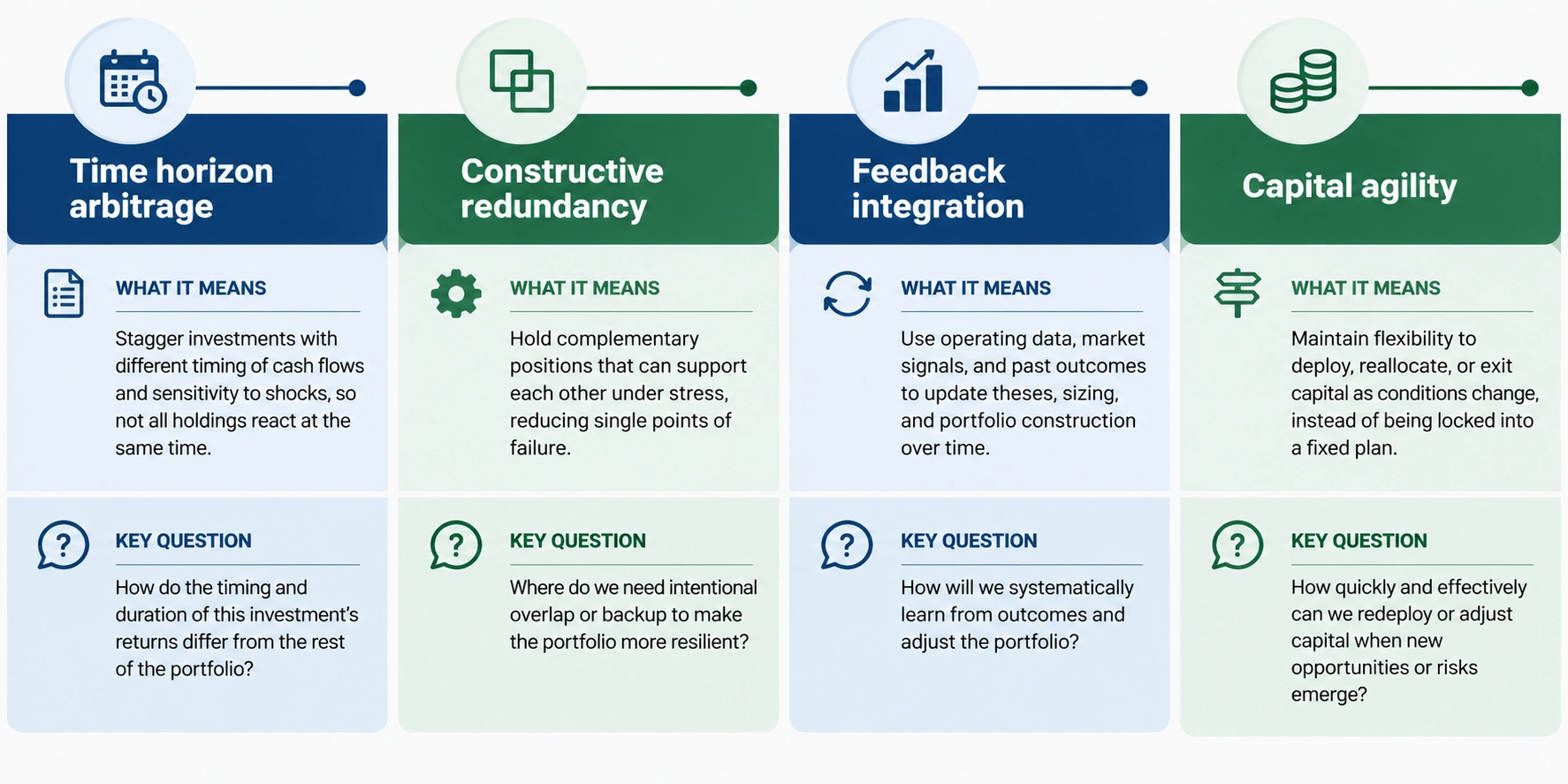
Constructive redundancy strengthens portfolio diversification strategies the way biological resilience does, with multiple pathways carrying the signal. It should be tracked by mechanism of value creation rather than by sector. If too many holdings depend on multiple expansion, a shift in capital cost hits the whole book. Mapping what must be true for each asset to realize value shows whether dependencies cluster.
Feedback integration separates firms that learn from firms that repeat. A high-growth cybersecurity SaaS company with roughly $30M in ARR held actuals within plus or minus five percent of forecast for 8 consecutive quarters once a driver-based forecasting engine and capacity model were built from scratch, which shows how a disciplined loop turns every variance into learning. The same loop applied through delta analysis on each investment makes a portfolio smarter with every vintage.
Capital agility completes the design, because committing every dollar early forfeits the freedom to learn, whereas spacing deployment with checkpoints tied to new information makes each later dollar better informed.
Applying Portfolio Diversification Strategies as a Decision Framework
Diversification, like leverage or liquidity, is a tool to be judged by contextual utility rather than theoretical elegance. What matters is not how different a portfolio looks on a spreadsheet but how differently its components behave under strain. Portfolio diversification strategies earn their place by helping a firm absorb shocks and reallocate conviction when conditions shift.
Three Key Takeaways
- Measure portfolio diversification by conditional response rather than by labels, since sector, stage, and geography spread means little when holdings share narratives, macro assumptions, and decision logic.
- Concentrate deliberately where informational edge and updated belief are strongest, and protect those positions with adversarial testing, governance design, and LP alignment.
- Design diversification strategies as a learning system by staggering time horizons, building constructive redundancy, integrating feedback, and preserving capital agility.
Disclaimer: This article is intended for informational purposes only and does not constitute legal, tax, or accounting advice. You should consult your own tax advisor or counsel for advice tailored to your specific situation.
Hindol Datta is a four-time CFO and senior finance executive with over 25 years of leadership experience across cybersecurity, SaaS, gaming, logistics, digital marketing, medical devices, consumer products, and nonprofit organizations. He has led more than $120M in fundraising and over $150M in M&A transactions while building the financial and operational systems that let complex businesses scale with confidence. He is the author of seven books in the Systems CFO Series and holds active CPA, CMA, and CIA credentials.
AI-assisted insights, supplemented by 25 years of finance leadership experience.