
Executive Summary
Machine learning in finance is changing what financial truth looks like on a CFO’s desk. Spreadsheet models assumed a linear, closed system that finance teams could explain line by line. Trained models instead find patterns across entangled inputs, revealing signals that variance reports were never built to see.
This article covers data entropy, Bayesian forecasting, adaptive system design and the ethics of explainability. Machine learning does not remove the burden of judgment from finance leaders. Instead, it raises the stakes of that judgment and demands new fluency in reading what the model sees.
Why Machine Learning in Finance Marks the End of Linear Analysis
Every profession reaches a moment when its most reliable instruments become insufficient, and financial analysis has reached that moment. For decades, finance teams treated the firm as a closed system that enough data could explain.
The firm was never a closed system, and machine learning in finance exposes this through models that learn from examples. Finance teams feed the past into a system and ask it to suggest the shape of the future. Often the model sees what years of manual analysis have missed.
That capability carries a new cost, since a CFO may now rely on a model whose internal logic resists a full audit. The real question is whether finance leaders can use it while keeping their obligation to interpret.
Entropy, Complexity, and the Hidden Signals in Financial Data
Older models rooted in regression treated the financial world as something charted and orderly. Real operating systems, however, behave in layered, jagged and entangled ways. A marketing campaign in April changes cash collection in July. Logistics delays defer revenue, then trigger churn and reputational damage further downstream.
Variance now arises from feedback loops that amplify some signals while cancelling others. Information theory adds a second problem, because the issue is no longer data scarcity but entropy. Sub-ledger extracts, clickstreams and telemetry arrive in volume, yet only a fraction carries predictive value.
Where Traditional Variance Analysis Falls Short
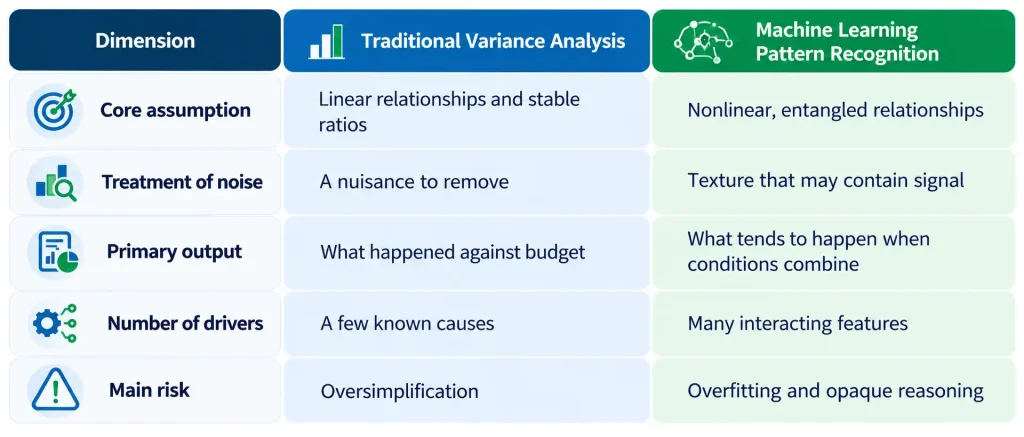
Machine learning in finance earns its place here. Its models do not assume linearity and find structure wherever it survives. Customer churn, for instance, rarely follows a single driver and more often reflects the co-occurrence of ten. The variance report, once the central document of the finance function, trades dimensionality for clarity. It reports what happened, while a well-guided model begins to describe what happens when.
Variance Reporting Compared with Machine Learning Pattern Recognition
The CFO as Curator of Signal
Computational power is not wisdom, since a model can predict without understanding, overfit to the past or see ghosts in shadows. CFOs should therefore treat every model as a hypothesis that deserves stress testing, not as an oracle. Understanding bias-variance trade-offs and loss metrics now belongs to the job.
Forecast accuracy comes from disciplined drivers and consistent review, not from automation alone. The same lesson applies to machine learning in finance: models detect anomalies, but finance leaders determine their meaning. The CFO still has to walk into the boardroom and translate statistical weightings into financial conviction.
Bayesian Updating and Machine Learning in Finance Forecasting
Much of what once passed for financial certainty was habit. Finance teams update slowly and trust the last quarter too much, even as stable cost structures turn volatile.
Bayesian reasoning offers both a statistical technique and a cognitive ethic. Every belief is conditional, and every forecast carries uncertainty that should shift as fresh evidence arrives. Machine learning models behave as Bayesian systems in this sense, reweighting variables continuously as new data flows in. The machine may update, yet it never faces the board or the employee affected by a revised decision.
Turning Probabilistic Belief into Action
Decision theory converts revised belief into behavior, and practical steps for an adaptive forecasting posture include:
- Dynamic reforecasting triggered by signs of model decay, not only by missed targets
- Scenario planning that allows outcomes which break linear logic
- Expected value frameworks that monitor low-probability, high-impact events
- Team language built around updated belief states instead of right or wrong forecasts
- Ethical review of what revised numbers imply for people, reputation and mission
Demand planning that revises assumptions continuously can lift inventory turns and release trapped working capital. In that setting, a forecast changes because the team learned, not because the plan failed. That framing separates a good analyst from a wise CFO. The analyst forecasts, while the CFO updates and teaches the firm to do the same.
Designing Adaptive Systems for Machine Learning in Finance
A firm is an adaptive organism, but it is also a system with inputs, constraints and feedback. As supply chains and demand grew less predictable, forecasting began to change outcomes, and measurement began to alter incentives. Embedding machine learning in finance therefore requires new architecture, not faster spreadsheets.
Four Design Principles for Adaptive Finance Systems
| Principle | What It Requires | Risk If Ignored |
| Close the feedback loop | Link prediction to action, and action back to the model | Insight that never changes behavior |
| Build around bottlenecks | Train models on where capacity truly sits: cash, lead times, engineering velocity | Optimization that chases shadows |
| Separate observation from intervention | Keep response decisions with humans who can override the model | A model no one can question |
| Learn continuously, with an anchor | Retrain on new data without losing strategic direction | Static decay or erratic swings |
The third principle deserves the most attention in practice. A model may predict a bookings decline, but reallocating marketing remains a human call. Publishing a forecast range can anchor behavior and collapse that range. A model that no one can overrule stops being a servant and becomes an idol.
The Machine Learning Finance Loop
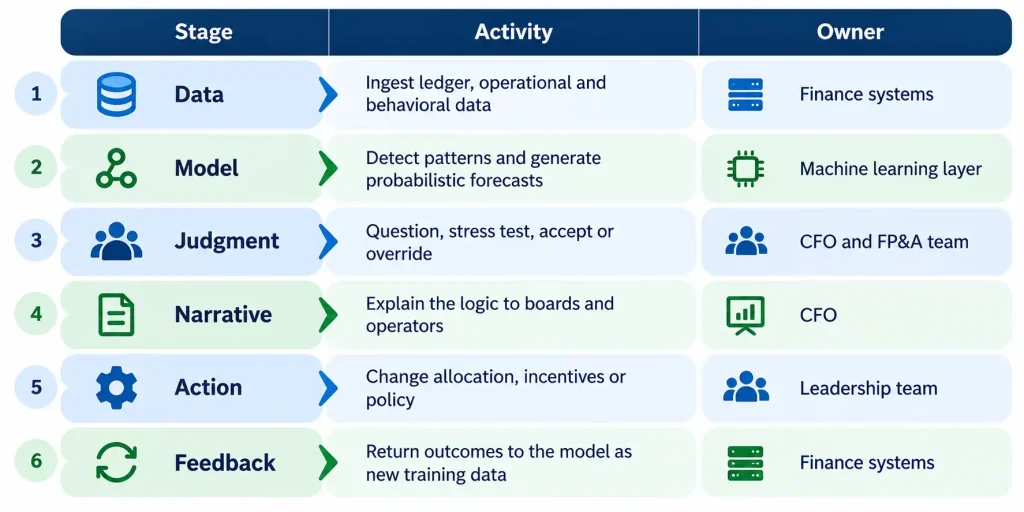
An AI-first finance workflow can compress the time from question to decision across modeling, reporting and diligence. Those gains only hold when human judgment reviews every output before it reaches investors or the board. Transparency in process, more than transparency in code, keeps decisions accountable and stops models from disguising preference as probability.
Explainability and the Ethics of Machine Learning in Finance
Traditional spreadsheet models offered something deep models cannot: clear authorship. Finance leaders built them and could walk a board through each assumption, while deep models spread their logic across many layers. An insight may be valid, even brilliant, yet unable to testify on its own behalf.
The burden of explainability therefore falls on the CFO. Boardrooms are rhetorical arenas, so the CFO must defend every insight in plain language without losing rigor. Multi-entity businesses learn this when they agree on one definition of revenue across subsidiaries. Machine learning in finance needs the same shared vocabulary before leaders can trust its insight.
The Observer Effect in Financial Modeling
A public forecast changes how teams behave, and a churn predictor prompts account managers to re-engage customers. In both cases, the model alters the future it tries to predict. Predictions become performative, so the CFO must decide when to reveal them, act quietly or override them.
The machine may be smart, but it is not wise. Wisdom here means seeing trade-offs that never appear in the data. Efficiency may conflict with equity, and this quarter’s optimization may cost next quarter’s trust. Sometimes the model knows something yet leadership is not ready to act, and that restraint reflects maturity.
From Custodian of Capital to Steward of Machine-Augmented Belief
Across these four dimensions, machine learning in finance reshapes where the CFO stands. Machine learning detects signal amid entropy, Bayesian reasoning keeps belief honest and adaptive design converts insight into behavior. Explainability, meanwhile, preserves the social contract between models and the leaders accountable for them.
The role of the CFO does not shrink in this transition; it deepens. The modern finance leader becomes the bridge between signal and story. If financial analysis was once about control and precision, machine learning in finance makes it about coherence and insight. Leaders must build that bridge with care and with conscience.
Three Key Takeaways
- Treat every model used for machine learning in finance as a hypothesis, not an oracle. Keep the authority to question and override its outputs with finance leadership.
- Build forecasting around Bayesian updating, where reforecasts respond to new evidence. Teach teams that a changed forecast signals learning, not failure.
- Design finance systems that close the loop from data to judgment to action, respect real bottlenecks and keep every decision explainable to the board.
Disclaimer: This article is intended for informational purposes only and does not constitute legal, tax, or accounting advice. You should consult your own tax advisor or counsel for advice tailored to your specific situation.
Hindol Datta is a four-time CFO and senior finance executive with over 25 years of leadership experience across cybersecurity, SaaS, gaming, logistics, digital marketing, medical devices, consumer products, and nonprofit organizations. He has led more than $120M in fundraising and over $150M in M&A transactions while building the financial and operational systems that let complex businesses scale with confidence. He is the author of seven books in the Systems CFO Series and holds active CPA, CMA, and CIA credentials.
AI-assisted insights, supplemented by 25 years of finance leadership experience.